Values & Principles

I’m going through a mentorship program at my work, and one thing my mentor and I are doing is going through True North by Bill George.  The book is about authentic leadership, and it’s great.  Even better is the accompanying workbook, which has led me through a series of challenging questions.

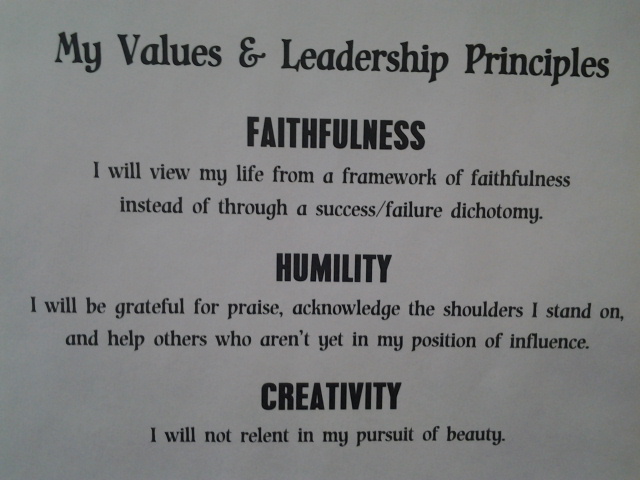
Lately, I had to define my values and, from them, write out my leadership principles.

Looking at the list, I realized it was so important to me that I typed them up and posted them in my office.  Here’s a pic.  Would love your thoughts and to hear your own!

values

More Thoughts on Profanity [& how ERP therapy changed my writing]

profanityAs you may have read before, I have a strange and evolving relationship with profanity.  Having grown up in a home that outlawed even pseudo-swearing (we couldn’t say gosh or shut up, among other things) paired with growing up with a mental illness elicited in me a dreadful fear of curse words– more than was ever healthy, even for a child.  For many years, my intrusive thoughts centered around illicit words, which developed in me a deep sense of guilt.

In my ERP therapy, I had to learn to think those words, even say them.  In doing so, I was stealing back power from my OCD, putting it more and more under my heel.  It was during ERP and in the year that followed that I realized a couple things:

1) Words are just words.  That said, “just words” still pack as much power as a nuke.

2) You can harm with words that are not profanity– worse than with profanity, in some cases.  A hard-hitting insult or an insincere comment can sting far worse than the word shit.

3) Shit does not equal poop.  Ass does not equal butt.  Damn does not equal darn.  They just really, really don’t.  They are completely different words.  As a writer, it’s my job to choose the best word in every line I write.  Just the same way that valor and courage both mean bravery, but those two words are not the same word.  I have to select each word with extreme care.

4) The fearsome qualities one assigns to the dreaded f-bomb are terribly reduced when you’re forced to listen to it for 80 minutes a day (again, ERP).

5) In ERP, I learned to separate myself from my OCD.  I learned to assign my intrusive thoughts to my disorder, instead of to myself.  To say, “OCD wants me to think X.”  This view, I see, has carried over into my view of my characters.  Even though I am the author, if my character John or Paul or Suzie wants to say a curse word, I don’t feel guilty.  Characters have their own histories, their own choice of words.  (Maybe you think this is strange … passing off my responsibility to characters that I’ve created.  If you do, then you’re probably not a writer.  As a writer, I have far less control over my characters than you might ever imagine.)

6) I write realistic contemporaries.  A teenager who has grown up lawlessly is going to swear.  You know that’s true.

7) In my personal life, I refuse to let OCD enslave me again.  One way it did so was by a huge and unwarranted fear of profanity.  I damn well won’t let it take control of me in that way again.

8) Personally– again, this is just for me– profanity is a small way for me to ward off the legalism that used to bind me.

9) “Let nothing unwholesome come out your mouth”: I guess I have to admit that I don’t really find curse words terribly unwholesome anymore.  I’m finding a lot of it to be based on social constructs that I don’t value enough to hold to.  I find it far more unwholesome for me to open my mouth and speak lies or to tear my fellows down.

10) This quote from Maggie Stiefvater:

Occasionally a reader will tell me that I don’t need to use swearing. They will follow this up with this well-worn phrase “you have a good enough vocabulary that you don’t need to use THOSE words.” Yes, I do. I do indeed. Since I don’t need to use them, that means I’m choosing to use them. If you trust me to be using non-swear words in a skillful way, please assume that I’m wielding my fucks and damns with the same contemplation.

As should all of you other writers out there. They’re just words. Handle them with care.

So, those are my thoughts.  I’m not terribly interested in getting into a debate, but do feel free to share your thoughts in the comments!

See more of my thoughts on profanity here:
Profanity in Literature
Profanity

Image credit: found this all over the internet, couldn’t find original.

I Confess

confessI don’t want to admit this to you.  I really don’t.

But I’ve made such efforts to be honest with my blogging community, and the wonderful, encouraging reception I’ve always gotten from you, my beloved readers, has continually encouraged me to continue with that honesty and integrity.

So today I’m going to tell you something that might make you made at me.  Here it is:

Sometimes I get really frustrated with people with OCD. 

Five years of freedom and already I am so quick to frustration.  Shame on me, right?  Then again, the last five years of my life (post-ERP) have been so absolutely incredible that they make me even more frustrated with those who avoid treatment.

The truth of the matter is this: exposure and response prevention is the best and most appropriate treatment for OCD.  Quite simply, if you’re looking for a “solution” to your OCD, then I have it for you: ERP.  I hear from a lot of people who seem to want a different answer, and yet my bottom line remains the same: ERP, ERP, ERP.

I know it’s scary.  (Trust me, I know it’s scary!)  But it’s the right answer, and I’m not going to send you on a wild goose chase when I know the right answer.  That would be like me telling you to go get chemotherapy for your gunshot wound or that you need insulin for your broken arm.  It’s obvious that those aren’t the correct treatment for the issue, and I won’t do that to you.

Research shows that ERP is the best treatment for OCD.  My life shows that a person with obsessive-compulsive disorder can redeem the years he or she lost to being enslaved by OCD.  No matter how many times you ask me, I’m going to give the same answer.

There.  Got it off my chest.  Don’t worry, folks; I’m still here for ya!  I aim to be a voice advocating for our quiet and oppressed community.  But just how I refuse to aid someone in compulsions, I will also refuse to send you down the wrong corridor for help.  I’m doing this with the best interest of our community in mind, I promise.

My heart and energies and motivations rest in leading those in slavery toward freedom.  Know that.

Life after OCD Treatment

Someone on Quora asked:

How does your personality compare from before and after the treatment ? Do you feel you are not curious anymore ?  Do you feel you are now asking less questions than before ? Is there any reduction or improvement in cognitive performance ? What were the negative symptoms ?
You can read my answer here.
For more information about ERP, the #1 treatment for OCD, go to jackieleasommers.com/OCD.

Writing or Having Written?

There’s a famous Dorothy Parker quote: “I hate writing; I love having written.”

Someone recently reminded me of this quote, and I argued back immediately, “No, I love writing itself!”

Here is where I will now contradict myself:

I love writing.  What can be more enjoyable than experiencing magic while it is happening?  To let the keystrokes happen almost of their own accord.  To encounter storylines that I could have never dreamed of on my own.  Or to press hard into a challenge and discover a solution.  This is the brilliance of writing, of being in the minute, of loving each moment as the words fly from you.

I love having written.  Lately, writing has been producing so much anxiety in me.  It’s different than my OCD anxiety though.  It’s more of a fear of the future and a fear of failure.  Part of it is that I’m writing on a deadline again for the first time since college.  Part of it is working on a first draft of a character-driven novel where I’m not certain the characters are strong enough to drive it.  Part of it is that it’s simply what writing is like.

I do know that I need to get my anxiety under control again.  I have a couple ideas:

* Post my First Draft Manifesto in places where I will see it often.
* Start using Valor, a blend of essential oils that’s been called both “a chiropractor in a bottle” and “courage in a bottle”
* Meet with writing mentor for some valuable wisdom on the writing life and how to win the head game [edit: did this and will post about it tomorrow!]
* Give myself grace
* Chat with my psychiatrist about this recent flare of anxiety

Any other suggestions?  My writing life as of late has been like a roller coaster of self-doubt, and I need to get this under control.  In other words, I need to not only love having written … I need to love writing itself.

My friend Anna posted about this on her blog today as well!  Check it out here!

anxiety_by_tamberella-d5seq3w

Theme Hopping

Recently someone emailed me and asked if my OCD was more about worrying about hell than it was about worrying if God was real, and I had to say honestly that after twenty-five years of OCD, there aren’t a lot of themes I haven’t experienced.  Is God real, is Jesus real, is heaven real, is Christianity legitimate, was Jesus really God’s son or was he the devil in disguise, have I committed the unpardonable sin?  OCD can cycle through a lot of themes in a quarter of a century.

That’s the thing with OCD: it often doesn’t remain in one place.  When I was still in high school– and even into my college years– I kept thinking, “If I could just sort out X, then I would be happy.”  So I’d wrestle with X, read books about it, seek reassurance, talk things over with my youth pastor and parents, research things online … and if I was ever able to “solve” it, then … my OCD moved onto Y.

Hitman: Contracts by TheKingArthur at deviantArt

Hitman: Contracts by TheKingArthur at deviantArt

I was in perpetual motion for so many years– but I never got anywhere.  It was all spinning my wheels.

Exposure and response prevention ignores the emergencies that OCD is sparking in every corner and goes after the OCD itself.  Instead of relying on compulsions, which temporarily help to “solve” individual issues, ERP is like a hitman with a mission to assassinate the OCD.

You can see why one is far more preferable than the other.


The Long Journey … to the Starting Line

"Cross That Line" by xLadyDaisyx on deviantArt

“Cross That Line” by xLadyDaisyx on deviantArt

It is SO HARD for OCD sufferers to be correctly diagnosed and then find the right treatment and a good cognitive-behavioral therapist.  In fact, it takes an average of 14-17 years for someone to access effective treatment.

That stat stings my heart.  I feel it deeply because of my own personal struggle.

I developed a sudden onset of OCD at the age of 7.  I wasn’t diagnosed with OCD until I was 22.  I started ERP (exposure and response prevention) therapy at 27.  That’s twenty years, folks– fifteen just till diagnosis alone.

Growing up, I just assumed that I “thought too much”– was an “overthinker” and especially sensitive to issues of morality. I didn’t understand that other people were also undergoing the same doubts as I was but were able to move past them with ease.  I, on the other hand, would get trapped.  The exit door to my brain was stuck shut, so all my thoughts just milled and churned and generated intense anxiety.  I didn’t know that others even had the same thoughts as I did, nor did I realize how it would be possible to let such thoughts come and go.

In childhood, I cried all the time.  In fact, I cried every single night for three years in a row.  I never told my parents about this.  I was so scared that they wouldn’t be able to “fix” me that I preferred to just rest in my own sadness, still clinging to the hope that *someday* I could be fixed.  As long as no one told me it was impossible, it still felt possible, and even thought I was terrifically sad, I kept that hope as my lifeline.

High school was a beast.  I got straight A’s (OCD drove me to perfectionism) and graduated at the top of my class.  I was a class clown, and I had some amazing friends.  But I battled intense spiritual doubts and lived in great fear.  My tenth grade year was one of the hardest of my whole life.  Only those closest to me knew it.

My doubts intensified in college.  They escalated to a whole new level.  Thankfully, I had a solid support system in my new friends (people who remain my support system to this day!).  And though they couldn’t understand what I was going through, they loved me.

After undergrad, things fell apart.  In a nutshell, I lost my grip on reality– my doubts had grown so large and out of control that I no longer knew if I could trust my friends or my own human experience.  Finally, for the first time in my lifesomeone used the words mental illness with me.  It felt shocking.

I was encouraged to meet with a therapist (unfortunately, a talk therapist– not effective for OCD), who also got me in to meet with a psychiatrist, and I was finally diagnosed with obsessive-compulsive disorder.  A diagnosis fifteen years in the making.

I spent about a year with that first talk therapist, and it was more damaging than anything else.  I finally “escaped” and never again set foot in that clinic.  Meanwhile, I was an SSRI lab rat, trying out a slew of various medications to treat my OCD.  I eventually went back to talk therapy– this time to a much better therapist, who was a true blessing, although she still didn’t truly understand OCD, and so my therapy included a lot of reassurances.  In other words, this kind, amazing woman who loved me was just reinforcing my compulsions.  Not good.  I also took a break from trying out medications after one stole all my energy and made me rapidly gain weight.  I was overweight for the first time in my life– all due to a medication– and have struggled with my weight ever since.

Five years after that initial diagnosis, my psychiatrist was out of ideas.  Literally.  She asked me what I thought we should do next.  I, of course, had no clue.  She referred me to an OCD specialist.

This incredible man– Dr. Suck Won Kim– changed my life.  He got me onto the right medication (almost immediately) and essentially required that I begin ERP, even giving me the name and contact information for the therapist who would ultimately allow me to bottle up my OCD and put a stopper in it.  Dr. Chris Donahue, to whom I’m forever indebted.

Twelve weeks was all it took.  In one sense.  In another, it took twenty years.

My life was a mix of depression, anxiety, compulsions, “bad” thoughts, and wrongness, and then twelve weeks later, I felt the burden of OCD lift from my shoulders.  I was giddy with freedom.  Five years later, I still am.

I hear from OCD sufferers every week who are in their 50’s, 60’s, or even older, who are still seeking appropriate treatment.  This absolutely breaks my heart.

On the flip side, I’ve had the incredible experience of meeting Maddie, 11, and her incredible parents, who leapt into action almost immediately and got her into ERP within months of her OCD onset.  In the same year, she developed OCD, was diagnosed, and was treated.  Marvelous!

That’s one of the reasons I blog about OCD.  To help people to understand earlier what they are dealing with and to encourage them to seek appropriate treatment (ERP, with or without medication).  It still just boggles my mind that in 2013, mental health practitioners still don’t know that ERP is the answer.  People get passed around from talk therapist to talk therapist, when the solution should be so ready, so available.

Better than a Bandaid

“Healing” cancer with a Bandaid is the same as “healing” OCD with compulsions.  In short, you’re not healing ANYTHING.

In other words, all those things that obsessive-compulsives do to alleviate the tremendous anxiety they feel?  Not helpful.  Asking for reassurance, obsessive confessing, reciting prayers and phrases, repeating rituals that make you feel “okay” or “balanced,” washing your hands, etc.– they are just Bandaids plastered right over the cancer of OCD.

To effectively go for the “root” of OCD, you have to resist those compulsions.  Exposure and Response Prevention (ERP) therapy is recognized as THE best treatment for OCD.bandaid

Skip the talk therapy.
Skip the (many) reassurances.
Skip the rituals.
Skip the confessions.

Go for the jugular with ERP.

Related posts:
A Detailed Post about ERP
Preparing for ERP Therapy
ERP & Imaginal Exposures

OCD: Unwelcome but not Unexpected

How many times do I have to say that OCD is a joy-thief before I should realize: Oh.  Hmm.  You’re pretty happy right now.  OCD will be along shortly to steal that away?

I should learn to brace myself.

On Friday, November 22, I announced on Facebook and on my blog that Harper Collins offered me a two-book deal.  Shortly thereafter, amidst all the “likes” and congratulatory comments and joyful sharing, OCD came calling.

I spent the majority of the evening obsessing over future revisions.  

not you again

I practiced ERP, walking myself through that lovely mantra of “it’s POSSIBLE, but it’s not LIKELY,” then discussing with a friend (asking for no reassurance), and also spending time in prayer.

Life, as I continue to learn, is risky, and the more I learn to embrace risk and uncertainty, the happier I am.

Which is why I flat-out refuse to flat-out refuse any revision suggestions.  I will consider everything my wonderful editor suggests, knowing that God is in control and that Jill loves my characters too.

In this sense, I’m growing as an obsessive-compulsive in remission, an author, and as a person.

Jackie 1
OCD 0

Related posts:
Uncertainty is the Key
Uncertainty
Taking Risks

An Uncertain Framework

I used to get thrown by anything I couldn’t know FOR SURE.

Is real life real life, or am I just dreaming?

Am I going to heaven?

Are my friends really my friends?

What do people really think of me?

Are people even really people?

I mean, completely thrown.  I had no framework for dealing with uncertainty.  And the truth is that a person just cannot live that way.  It’s not how life works.

Now that ERP has re-wired my mind, I am finally able to say, “I’m just going to have to accept that I can’t know” and carry on with life.  I never thought I’d be able to approach such huge things with that kind of statement.  Never. If you’re reading this and think that that is an impossibility for you, please know that I once thought the same.

uncertain

Related posts:
Narnia and Uncertainty
Uncertainty is the Key
Uncertainty
Interview with a Former HOCD Sufferer
No Antidote
Life is Risky Business