God’s Sovereignty, OCD, the Cross, and His Purposes

Just wanted to sort out some thoughts and spark conversation on my blog today.

A little while ago, I asked the question on my blog Did God give me OCD? and came to conclusion that yes, he did, to draw me to himself and so that I could use it to glorify him and help others.  A blog reader challenged me on that conclusion, and I thought her questions were valid.  She wrote:

Let me challenge this: Is God good or bad? Does God do bad things? I do not believe that God gives people sickness, disorders, etc. It is contrary to God’s character to do those things. I DO believe that God will use bad circumstances/disease/etc in order to bring Him glory and all the things you said. BUT the whole reason that Jesus died for us is to enter into relationship with the Father. There had to be a sacrifice to tear the veil and stand in the gap between the God of the Old Testament and the New Covenant. When we look at the OT, we have to look at it through the lens of the Cross…would the Cross change how a situation would look? Judgement in the New Testament is always correctional because final judgement doesn’t happen on this earth anymore (it did in the OT). When we look at sickness, we see that Jesus performed miracles to show God’s love. He never caused anyone sickness. I do not believe that God gave you OCD, but I 100% agree that God is good and uses your OCD to drive you to Him, so that you could glorify Him with it, and to help others who are suffering.

This comment has got me thinking deeply about this.  Right now, it’s still a pretty jarbled (that’s a mix of jumbled and garbled) blend of the doctrine of suffering (suffering in itself is not virtuous, but it does seem purposeful [Romans 8:28-29]), God’s sovereignty (is God in control of everything?  Even disease/disorder?  Sin and evil aren’t of his making, but if he gave humans the choice to opt for them, doesn’t that mean he is still master over it all?), and hindsight (now that OCD is not master of me, it’s easier to see the larger picture of OCD as a tool God used in my life).

I think that my position (for now) still stands with the belief that God did give me OCD for his glory and purposes.

cross4To answer the commenter’s questions, I respond with my own questions: from one perspective, the CROSS was a “bad thing.”  In the moment, who would have guessed it would come to be known as GOOD Friday?  And we know it was planned. Redemption through the cross was the plan for forever.  “Yet it was the will of the LORD to crush him; he has put him to grief; when his soul makes an offering for guilt, he shall see his offspring; he shall prolong his days; the will of the LORD shall prosper in his hand” (Isaiah 53:10).  Think of this from a human perspective.  If we watched a father allow his son to be tortured, we would probably say that dad was doing a “bad thing.”

But, of course, we don’t see the cross from that angle anymore.  We know what happened on Sunday morning after Christ’s death.  And we now know that the cross is the most beautiful thing, the event that allows us freedom and life.  We look on the “bad thing” as a glorious thing.

So, could it be that way with OCD?  (I don’t think I’m ready to call it a “glorious thing” yet!)  But if suffering is predetermined (“Therefore let those who suffer according to God’s will entrust their souls to a faithful Creator while doing good” [1 Peter 4:19]), who predetermined it?  It’s hard for me to separate God from control over all things (I’m still sorting through some of this, including the fall of man).

What do you think?  Let’s dialogue.

Dark Promises

One of the worst bouts of intrusive thoughts I’ve had occurred for me in high school.  For a time, my intrusive thoughts were “God, I promise that I will …”

It could be something stupid.  Touch this lamp.  Not eat toast.  

But more often, it was something more difficult, a much bigger deal.  The one that kept forcing its way into my mind was, “God, I promise that I will go to hell.”

Well, that was a conundrum, eh?

I was a wreck.  I kept picturing myself getting to heaven’s gate and once I stepped inside those pearly gates– well, just doing so would then be breaking a promise to God (i.e., sinning), and then, wouldn’t I then get thrown out of heaven for my sin?

I was screwed either way.

Or so I thought.

But you can’t believe everything you think.  AMEN.

Has anyone else had intrusive thoughts similar to these?

dark promise

Resurgence: When OCD Attacks a Freed Mind

It’s hard to know exactly what caused it, but the last two weeks have been pretty hard for me, OCD-wise.  And this is coming after four years that were, for the large part, obsession- and compulsion-free.

Blah.

I was feeling weak and exhausted for various reasons when the  intrusive thoughts started up again.  I don’t know if OCD noticed a chink in my armor and decided to go for it or what– but out of nowhere, those old intrusive thoughts started up again.

Then, one week ago, I posted about my darkest, lowest days, and in some ways, that blog post worked as a trigger.  On Tuesday night, for the first time in SO, SO LONG, I started to revisit those old doubts about my salvation.  It felt so ugly after such a beautiful four-year stretch of freedom and joy.

But.

I have tools now.  I walked myself through the obsession: It is POSSIBLE that I am going to hell … but it is not LIKELY.  I practiced an old exposure.  I reminded myself of the promises of scripture, and I emailed my girlfriends and asked them to pray and to NOT reassure me.  And they were total rockstars and did exactly as I requested.

And you know what?

Tuesday ended up being an isolated event.  It felt like such a slippery slope, like all I have won was going to be torn from me.  But it wasn’t.  I’d still appreciate prayers and NO reassurances, but this last week was a reminder for me that OCD-in-remission is in some ways just a sleeping giant.

Not that I will tiptoe around it.  I will not fear it again, only fight it.

sleeping giant2

my darkest, lowest days

Tonight, I have been thinking about that deep, dark pit and the moments of my life when I was at the very bottom, nowhere lower to go and my head too heavy to look up.  I have been thinking about the things and places that remind me of those times.

You might guess that it was those months after college graduation, when I would wander from the laundry room to look over the balcony to the pool area two floors below and think about what would happen if I let myself fall.

Or maybe that it would be one of those evenings when I was wild-eyed and manic, scream-weeping in the bathroom while my roommate sat outside the door and prayed.

But when I think of myself at my lowest, I always picture myself in the Caribou Coffee in Long Lake, Minnesota.  I’d arrived to town too early to visit Orono High School, and so I stopped into Caribou off of Highway 12 (which has since been re-routed), ordered hot cocoa, and sat alone at a table.  In my car I had been listening to “Spirit” by the band Switchfoot, letting the chorus hammer into me that all I wanted was Jesus … exactly whom I believed I could not have.

Interestingly, the emotion that I seemed to feel the most was this odd, lonely marvel.  Don’t get me wrong– it was not good, as marvel usually is.  It was this dark, lost, inconceivable wonder that I could be so damned and that there was nothing I could do about it.  I sipped at my cocoa, thinking how there was no joy left available to me, no rescue coming, no prayer I could whisper to make things okay again.  A marvel and a sort of understanding washing over me that this was my reality and there was no way out.

sadcoffee2

For years, I could not listen to that song (which truly is a lovely one!) without feeling a stale depression steal over me.  To this day, when I drive by that Caribou, I think to that dark day.  Nothing impressive or strange or particularly triggering had occurred, but it is my lowest, loneliest moment of my life.

I could not have pulled myself out of that pit.  I didn’t even have the strength to lift my eyes.

(Oh gosh, I’m going to start being known as That Girl Who Cries in Barnes & Noble, LOL!)

Jesus Christ rescued me.  He led me to the right medication and the right therapy and carried me out of the pit himself.

In the past couple of weeks, I have gotten several emails from fellow obsessive-compulsives who are in that same pit.  I write this post to say that there is hope– and it’s not in ourselves.


OCD and my family

Before my life-changing round of exposure and response prevention …

Me: Sad, guilty, full of continual anxiety and doubt.  I had this amazing family, friends who deeply loved me, and a college degree in a field that I loved … but I was a soul in anguish.

Dad: Upset, frustrated, reluctant to discuss anything OCD-related.  He couldn’t understand how my life could be so good and yet I could be so sad.  I think it was hard for him to see his daughter suffering from a pain he couldn’t fix.

Mom: Sympathetic, sorry, and wondering if she was to blame for this disorder that was ravaging her eldest.

Sister: Confused and scared.  Sharing a room with me, she had fallen asleep to the sound of my tears every night for– literally– years.  And now, all these years later, she feels guilty that she had listened to me when I asked her not to tell.

Brother: Annoyed.  Why couldn’t his oldest sister just be normal for once instead of a nutcase?

OCD affects the whole family.

I am so grateful that God led me to the exact right doctors to help me!  My psychiatrist got me onto the right cocktail of medication and referred me to cognitive-behavioral therapy, which changed my whole life!

These days, my whole family revels in my rescue!  I just got off the phone with my brother, and he said, “I can really only remember the good things.”

I am glad.

© Images by Marguerite

© Images by Marguerite

The Problem with Seeking Reassurance

For years, one of my biggest compulsions was seeking reassurance.

Do you think I’m going to heaven?  Do you think it was wrong I did such-and-such?  Do you think I hurt so-and-so’s feelings?  Do you think yadda yadda yadda …

My obsessions were like burns, and when someone would reassure me that things were okay, it was like sticking my burned fingertip under cold running water.  The relief felt real … but it was temporary.

Ten minutes later, I’d want to ask again.

(And quite often I would … sometimes to where I would frustrate my family and friends.  They would sigh deeply and look at me with these terribly sad eyes and repeat, “Jackie, no.”)

It functioned just like all compulsions– it provided a temporary relief from my obsession, but then it gets out of control.  I didn’t realize it at the time (and neither did my friends), but all they were doing was enabling my OCD.

What would have been better (although much, much harder for both the OC and the friend) is to say, “Look, there are a lot of things we can’t know with certainty.  What you’re afraid of is POSSIBLE … but it’s not LIKELY.  Let’s look at the available evidence.”  Of course, no obsessive-compulsive wants to hear even an ounce of uncertainty … uncertainty doesn’t soothe the burn like cold water.

At least, not immediately.

But as you introduce the idea of uncertainty into your life, and you learn to embrace it, what happens is that you start to heal.  It is hard for EVERYONE, but it is BETTER.  Reassurance only leads to seeking more reassurance.  Uncertainty leads to acceptance and healing and a new life.

Now, of course this is difficult.  Who wants to say to a crying child, “Something bad MIGHT happen if you don’t organize your locker”?  Or to a terror-stricken young adult, “It’s POSSIBLE you could catch a life-threatening disease if you don’t wash your hands right now”?  Or to someone who is weak with guilt, “We can’t KNOW for SURE that God didn’t heal your mother because of something you did”?  It’s agony all around.

But it is better.  Healthier.

And then you can follow things up with, “What evidence do we have available to help us make decisions?  Other students have messy lockers, and they usually go about their day just fine.  Even if you did get sick today, it probably wouldn’t kill anyone– in fact, lots of people have been sick at your workplace in the last year and no one has died.  It’s more likely that your mom died due to her illness than to your actions that aren’t connected.”  Obviously, these are hard.  They don’t erase uncertainty.  And that is the point.

Remember, uncertainty is the key to healing!!  That is why obsessive-compulsives need to surround themselves with cheerleaders not enablers, people who are willing to do the hard business of tough love, even in the face of tears and terror.  It means anxiety in the short term– but joy in the long term!

thoughtful girl

Uncertainty is the Key

uncertainty2

One of my friends has had her obsessions flare up again (she is worried that her brother will die on his spring break trip), and she emailed me for prayer and advice.  I asked her, “Do you want tough love?”

Her response:  “Yes, okay, just hold on a second I have to prepare myself.”
A minute later: “I am ready.  Go.”

I wrote back:

I’m not going to reassure you about this because LIFE IS FULL OF UNCERTAINTY, and we have to learn to live with it.  I’m not saying this to be mean, but the truth of the matter is that he could slip on the Minnesota ice outside and hurt himself that way just as easily as a trip to California.  We DON’T KNOW.  We CAN’T know.  All we can do is make decisions based on the evidence available.  The evidence available suggests he will be fine.  Whether you worry about him or not won’t change anything except for how YOU cope with his spring break.

The best thing that you can do for yourself to keep from spiraling is to repeat to yourself, “I can’t know if he’ll be okay.  He might be.  He might NOT be.  Either way, he knows God, and I have to just live my life with uncertainty.”

want to reassure you.  But that would be just silly—who am I (who is any mere human) to reassure you of something like this?  Our lives ARE like a vapor!  We have no way of knowing.

The evidence available suggests that most healthy young people live till their 70s, so that’s what I’m going to plan for.

***

My friend thanked me for the tough love; I think I’m allowed to dole it out because she knows about how cognitive-behavioral therapy changed my life.  CBT is really just a giant act of tough love, isn’t it?  We’re put through torture so that we can barrel through the hell of daily life with OCD.  I know I am so glad to have gone through it myself, and that is why I am not willing to reassure someone of something we can’t know.

Life is full of uncertainty, and each obsessive-compulsive wants to eliminate it– which is just not possible.  Still, we go to great lengths to attempt this impossible feat.  Really, our rescue is in learning to embrace the uncertainty.

If it boggles your mind a little, that’s okay.  It still does mine too, and I’m a success story!

For those of you with OCD, is it hard for you to receive tough love from people?  For those of you who love an OC, is it hard for you to dole it out?

Quite Literally

During the many years of my life when OCD was in charge of me and not the other way around, one thing that it demanded was that every single thing I say be true– literally true.

There were no sudden exclamations to friends of “You’re my favorite!”  No declarations of “This is the best!”  If I was leaving a voicemail at 12:14, I wouldn’t say, “Hey, it’s quarter after; call me back.”  There just wasn’t any room for that in my mind and in my life.

Lyrics were difficult.  I was very careful with what lyrics came out of my mouth; I didn’t want to make any promises or statements that I couldn’t hold to or that weren’t true.  I had to stay one step ahead of the singer to gauge whether it was okay for me to sing those words.

I remember one evening, I was singing along in my car to an Andrew Peterson song.  In it, he is singing to God, and the lyrics are, “I will sing your song from sea to shining sea.”  As soon as the lyrics flew off my tongue, I started to think about how I now was required to plan a cross-country roadtrip just to keep my word.

As a writer, I was very timid about memoir, believing that if I didn’t get every detail right, it would amount to a sinful travesty.  Dialogue?  Way too risky.

Even sarcasm was difficult sometimes, though I never entirely abandoned it.  I did wonder for a time if writing fiction was sinful in and of itself, since the stories were made up … you know, lies.

I tiptoed for so many years.  I was so exact, so literal, so bent on perfection.

Today, I am an honest woman– but I have freedom.  When I tell stories, I don’t worry about getting every detail right.  I have space in my life to breathe.

shhh

If it doesn’t hurt, it’s not OCD.

Let’s be real here.  Almost everyone has a quirk or two.

quirks

Some people have to organize their shirts by color.  Some need to dot their i’s a certain way.  Some have to clean their kitchen in just a certain way.  Some always double-check the front door before they go to sleep.

Quirks.  Quirks, I tell you!

Unless …

You feel that a disorganized closet is going to ruin your day, your week, or even your life (and you will panic and feel sick over it until you fix it).  You think that if you don’t dot your i’s just so it might mean that something bad will happen to your family.  You think that if you don’t follow a particular routine in cleaning, you (or people you love) are going to get really sick and probably die.  You think that if you don’t check the front door, a murderer will certainly get inside, kill your entire family, and it will actually be all your fault.

Those are just some examples off the top of my head, but my point is this: if it doesn’t hurt, it’s not OCD.  

In fact, it’s built into the very definition: OCD is an anxiety disorder characterized by intrusive thoughts that produce uneasiness, apprehension, fear, or worry; by repetitive behaviors aimed at reducing the associated anxiety; or by a combination of such obsessions and compulsions.

I was recently on a web forum that was asking “What minor OCD quirks do you have?” and the answers amounted primarily to superstitions and quirks:

* I feel naked without a pocketknife handy.
* I just have to snip or pull loose threads on clothes or buttons.
* I tap my pockets to make sure my keys are there.
* I fold my dollar bills face-in.
* I hate it when someone else uses my pillow.

Now, don’t get me wrong.  These may all very well be true for these people– but I didn’t get the impression from these forum users that if they didn’t do these things, they would spiral into tumultuous anxiety that makes you believe things will never be okay again.  That is OCD.

It’s fine to have quirks; they can even be funny!  But please call them quirks.

OCD is an anxiety disorder.  It ruins people’s lives.  It steals joy from them.  It gives them a sickening feeling of terror.

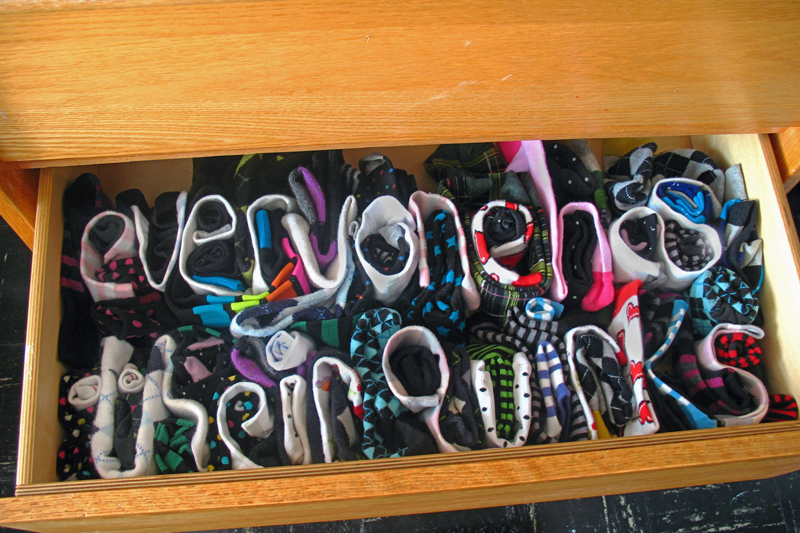
Please don’t feed into the misrepresentation.  You are not “so OCD” just because you organize your sock drawer.  If, on the other hand, you believe that something terrible will happen if you don’t organize it just right, and if the organization and reorganization of your drawer seems to be adding to your distress, well, that’s another story.

Be informed.  And compassionate.

Don’t label something cutesy and funny as “OCD” — OCD is anything but.