Supplements, Nutrition, & OCD: Guest Post by Leah Adair

Leah is on the board of OCD Twin Cities with me, and she’s got the loveliest heart! She is a tremendous encourager, and she also knows more about natural ways to treat OCD than anyone I know. Leah herself has undergone ERP, and I know that she would never argue to replace ERP with the following … these are meant to complement exposure therapy.

With that said, here’s Leah!

xoxo Jackie

***

Jackie asked me to share a little bit about my experience with supplements/nutrition and treating OCD. I am not a doctor, dietitian, or a nutritionist. I am someone who suffers with OCD and I’ve done a lot of research on ways to treat it.


When the beast of OCD first began, I researched all of the possible ways that I could fight it/defeat it.


An interesting fact is that our gut is our second brain. 90% of what we feed into our body transfers to our brain. Fascinating, right?


I started taking a variety of different supplements that have been proven to help with OCD and also anxiety/depression.


I’ve been on meds combined with supplements and I’ve also done strictly supplements. It’s important to find what works for you. It’s also important to talk with your doctor or psychiatrist if you are planning to make any major changes. I had two sessions with a certified dietitian to help me understand supplements.


Nutrition:


It’s crucial to try to eat a healthy fat, protein, and carb at every meal. Carbs = fruit and vegetables. I’ve found that limiting dairy, gluten, and sugar has helped decrease anxiety quite a bit. I still LOVE pizza, , but I definitely feel a difference when I don’t eat a balanced meal.


Healthy fat is so important.
Think: BUTTER!!!  Our brains store fat and we are often lacking healthy fats in our diet. Examples of healthy fat: avocado, dark chocolate (who can argue with eating more chocolate!), eggs, olive oil/olives, fish, nuts, chia seeds, coconuts/coconut oil.


Exercise:


It’s super important to be active. When our bodies are moving, they produce endorphins which trigger a positive feeling equal to that of morphine (with out the addictive component). If exercise seems daunting to you, start small. Walk around the block or do a short video online.


This article highlights 13 reasons exercise benefits our mental health.


Supplements that help OCD:


My top 3 recommendations paired with medication are fish oil, a probiotic, and a multivitamin.


Fish oil: Fish oil helps support serotonin and build it into our bodies. It might sound like it would taste gross, but you don’t even notice the fish taste. I would highly recommend getting the “burp-less” kind. When I forget to take fish oil, I notice that my mood is much lower.


Probiotic: Probiotics are anti-inflammatory microbes that affect the gut in a positive way. Remember when I said our gut is our second brain? Probiotics have some similar effects to an SSRI. Probiotics can be purchased at Walgreens, CVS, or Target. They can also be purchased online. I get mine (with free shipping!) from www.nutrikey.net


Vitamin D: Vitamin D is what we receive from exposure to sunlight. Unless you are a lifeguard, work in construction, or some other job where you are exposed to the sun for several hours each day, you are lacking Vitamin D. This is especially important if you live in a colder climate. I actually take  take 3000 IU’s a day which is 3 tiny capsules. This article is by the Journal of Internal Medicine and highlights they ways that Vitamin D helps fight depression.


Multi-vitamin: It’s important for take a good quality multivitamin. Multi-vitamins have a lot of key nutrients that help our bodies beyond just mental health. Look for a multivitamin that has B vitamins and magnesium/calcium, like this.


5-HTP: I took this for awhile instead of an SSRI. It helps raise serotonin levels in the brain. 5-HTP is the closest natural alternative to an SSRI.


NAC:  I know of a few people with OCD who swear by NAC combined with an SSRI.  I do not take NAC, but I’m definitely considering it. It’s an amino acid/antioxidant. It significantly reduces glutamate which is a major neurotransmitter that leads to over stimulation. Here is an article from the International OCD Foundation on the benefits of NAC.


Inositol: Inositol is able to cross the blood/brain barrier and provide relief from over firing nerves, the stress reaction of over taxed, hyperactive minds. The multivitamin that I take has a small amount of Inositol in it. Inositol is in the B vitamin family. This can be purchased in powder form or capsules. Learn more here.


I hope this was helpful. Be kind and patient with yourself in this journey. It can take time to find the right combination that works for you.
Shattering Stigma as Book Advocates [Guest Post at It Starts at Midnight]

Today, I’m honored to be over on my lovely friend Shannon’s blog, talking about the power of book advocates to break the stigma of mental illness.

ShatteringStigmas-2-e1472245713311It begins:

My young adult novel Truest, which came out last year with HarperCollins, features a teenager with a depersonalization disorder that makes her question whether real life is actually real—or if she is just dreaming it all. To me, it’s a compelling concept, sparking thoughts around philosophy, reality, and the nature of existence, not to mention mental illness and depression. Although I’m not a doctor or psychologist, I still felt qualified to write this story. Why? Because I dealt with solipsism syndrome myself.

To read the rest, click here! Thanks for taking the extra time to hop over and read my thoughts.


5-Year Blogiversary

blog fiveMy blog turns five today!

Since I started this site, I have:

  • written and published a book
  • left management (which allowed me to write and publish a book)
  • written a manuscript (Salt Novel), set it aside, written another manuscript (Yes Novel), then set it aside for the earlier one
  • met and/or interacted with hundreds of brave people with OCD and other lovely people in advocacy
  • partnered with the International OCD Foundation
  • became the communications director for OCD Twin Cities, an IOCDF affiliate
  • recruited hundreds of students to my university
  • become a feminist
  • grown in my faith
  • bought a house and remodeled it
  • listened to the books in The Chronicles of Narnia at least 250 times (but probably more like 400-500) (and The Horse and His Boy makes up probably 33% of that, ha!)
  • successfully maintained my OCD remission
  • met and/or interacted with some incredible bloggers
  • had several incredible babies enter my life (i.e. my friends had kids!)

I’ve been so blessed by everyone who follows my site. Your support and comments and friendship mean the world to me! Here’s to year number six!

Humor me, folks: what accomplishment are you most proud of from the last five years?

Image credit: The Delicious Life

Why Meds?

A blog reader emailed me and asked, “If you are okay with sharing this, could you tell me why you chose to stay on your medication after ERP?”

My response:

For me, meds are a chemical tool to slow my serotonin reabsorption. ERP is a physical tool in that it rewires the brain and a mental tool in that it gives me a new mindset toward uncertainty. I’m grateful for ALL my tools. 🙂

 Also in my toolbox: prayer, deep friendships in which I can be vulnerable, essential oils when needed, Ativan when needed, talk therapy for non-OCD anxiety, and self-care (i.e. naps and ice cream).


 What I’m trying to say is that God has given me an extensive amount of assistance. Some tools only come with privilege or money (having insurance and a paycheck to pay for meds and therapy … and ice cream, ha!); some from transparency (I have the greatest friends); all are sheer grace.


I’m at a stage of my life and faith where my hands are open to all the grace I can get.

Thoughts on ERP, Writing, & Uncertainty

Uncertainty.

For so many years, it was my enemy– or so I perceived it, especially because full-blown clinical obsessive-compulsive disorder made me fear and reject uncertainty even more than the average bear. Everything in my life was about pursuing certainty, answers, black & white.

And, of course, I was miserable.

In 2008, I went through the harrowing but ultimately beautiful process of exposure therapy, which took my OCD out at the knees, giving me the bandwidth to live with uncertainty, questions, and all the shades of gray.

It’s only recently that I’ve recognized exposure therapy as the training ground (or maybe even battle ground) that would let me later pursue my dreams of being an author.

A hard truth: writing is full of uncertainty. 

uncertainty2

Not just writing– but publishing itself too. There is this crazy-making stretch of life in the middle of writing a book that feels both unclear and perpetual. What is this book really about? Who are these characters? Can I do this? Can I finish this? Is this story going to matter to anyone but me? Is this going to even matter to me? Will my writing group like it? Will my agent? My editor? Readers? Will I find success? Will I get another contract?

The writing life is, for many of us (and especially for younger writers), a world in grayscale: a constant state of uncertainty that we have to persist in in order to find any relief or success.

For as many days as I think I’m totally failing at life and writing, I have to remember what it would have been like to be writing and publishing before exposure therapy, back when uncertainty was unbearable. I’m not even sure how it would have been possible to be doing what I’m doing now without exposure therapy laying the groundwork for me to bear the not-knowing, let alone to thrive in it.

“The world doesn’t work that way.” I hear myself and other OCD awareness advocates saying this to sufferers all the time. In context, we mean, “Life inherently is full of uncertainty. You cannot eliminate it.”

The truth of that hits me over and over again in the field of writing.

Exposure therapy was the terrible, grueling practice for the writing life. Uncertainty is rampant; I try to keep my arms open.


Perspective in Three Parts

I.

I keep letting a piece of my identity wipe out and overshadow the whole rest of my identity.

II.

This is still nothing compared to the old dark days of OCD.

III.

Let nothing disturb you,
Let nothing frighten you,
All things are passing away:
God never changes.
Patience obtains all things
Whoever has God lacks nothing;
God alone suffices.

— St. Teresa of Avila

unsplash44

Nothing Like a Good List

Hi folks, a little update:

Wednesday, I had my first session of EMDR (Eye Movement Desensitization and Reprocessing), a treatment which is truly fascinating. I’ll be honest: I’m not sure I entirely understand it yet, but basically– “when a traumatic or distressing experience occurs, it may overwhelm normal coping mechanisms. The memory and associated stimuli are inadequately processed and stored in an isolated memory network” (Wikipedia), and the use of bilateral stimulation (moving eyes back and forth or– as my therapist uses– two small “buzzers,” one for each hand, which alternate buzzing back and forth) allows the patient and therapist to crack into that part of the memory.

I think. On a scale of 1-10 for how much of an EMDR expert I am, I rank at about negative 3.

Talked to my editor on Thursday. It was really good. We agreed on most things, and I felt ready to move forward. It was a great feeling that faded a bit since then. (It’s one thing to feel ready for the next steps; it’s an entirely other thing to actually get myself to take them.)

Friday, I spoke at the Walker Public Library in northern Minnesota. It was a blast! People from the community as well as about twenty high schoolers came to the event, where I talked about Truest, writing, publishing, and brain disorders. Somehow, I end up speaking about OCD at almost every turn. It was one of the main players in my life prior to 2008, so I guess I shouldn’t be that surprised that it would come up when I discuss my history. I’m glad for the opportunities. It feels good to have a chance to share a little about it– and also to take away the stigma of mental illness being “shameful” to discuss. I think when I can mention it in the same breath as my writing life, my day job, etc., it steals away the stigma for the listeners. At least, I hope it does. It was a really fun day, plus my mom came with for the long car ride, and we laughed so hard I almost peed my pants. She’s the best.

Saturday, I needed a break. So I took one, even though I felt sort of guilty about it. I watched a trillion episodes of Criminal Minds on Netflix and took a three-hour nap. It was beautiful, even if it set me back a little bit.

So today I needed to work. I didn’t feel like working, so I called my mom, who encouraged me to make a list. YES. GREAT IDEA. I LOVE LISTS. I’m actually sort of obsessed with them. So I made a list, a long one. And I’ve been busting my butt for hours today crossing things off. When I publish this blog post, that’ll be one more thing off my list. 🙂 I’m cruising and it feels good. I’m trying to decide if I want to wait till tomorrow to work on book brainstorming or not– I need to gauge whether I am avoiding out of fear or just strategically allowing myself more time to let ideas simmer. The latter is okay; the first is not.

How are you? I’d love to hear from you with stories about what you’ve been up to. Are you excited for summer? I am excited that UNW’s graduation is over and that we’ll have a quiet summer with tons of parking … but I’m not ready for it to be in the nineties. It got that hot a week or so ago, and I thought I was melting. Oh Minnesota, land of extremes.

Choosing Joy Over Misery (Plus a Thoughtful Caveat)

melancholyI don’t understand it. I don’t exactly know how to do it. But I think I’m doing it.
Last week, I wrote a long post about choosing joy:

The biggest thing that I’m learning is that I need to love the work and love the process, or I’m going to be miserable. [I read something that] was basically asking if you wanted to be the person who loved the work or the person who loved the reward. Because if you’re the latter, you’re going to spend most of your life kinda miserable. But if you can be the former, you’ll be satisfied.

It’s mysterious to me. I have zero idea how this works.

But I do believe it’s working in my life.

Last week, I got a hard email, an email that would normally spiral me into panic and tears. And, instead, I paused and reminded myself to choose joy, told myself that my writing life is going to have highs and lows but that I’ll persist, and that panic and tears would not solve problems … and there was no panic and there were no tears. Instead, I thought rationally, sought out advice from a friend, waited for a couple hours, then wrote my reply.

It occurred to me: this is how a “normal” person reacts to bad news.

It felt like the first time in my life it happened for me.

I’m growing. Somehow. I don’t know any of the secrets to this yet. Do you? I’d love to hear.

P.S. I want to clarify: this post is not in contradiction to this one. I still believe that many people with brain disorders do not have the capability to simply choose to be happy. But I am finding in my own life that medication and OCD treatment and talk therapy and prayer are tools that are making that more and more possible for me. I am one of the lucky ones who has had so many opportunities and resources. They are opening up new doors for me that were locked even just a year ago. Would love to hear your thoughts.


Worth Saying Again & Again

Exposure therapy is the best avenue we know of for treating obsessive-compulsive disorder.

Close up of hand drawing gears mechanism with chalk

ERP (exposure and response prevention) is what every OCD expert will suggest as the frontline treatment for sufferers.

It works.

It’s hard and scary, but it works.

Catering to compulsions is a band-aid on cancer. It treats symptoms. It cuts leaves off a weed.

ERP is chemotherapy. It goes after OCD itself. It digs out the root.

On this blog, you’ll only hear OCD treatment recommendations for:
1. ERP
2. ERP plus praying for a miracle
3. ERP plus meds
4. ERP plus meds plus praying for a miracle.

You can learn all about ERP therapy at jackieleasommers.com/OCD.

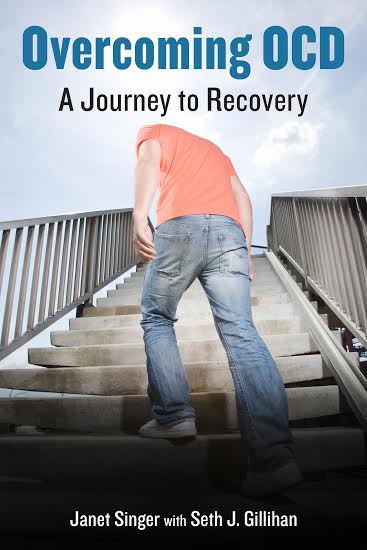
Review: Overcoming OCD: A Journey to Recovery by Janet Singer

overcoming OCDMy friend Janet over at the ocdtalk blog recently wrote a book detailing her family’s experience with her son’s OCD and the treatment of it. I was lucky enough to get a copy of it, and I’m happy to share a review of it here with you.

I was really fascinated to finally hear Dan’s entire story when I’d gotten bits and pieces of it over the years via Janet’s blog posts. I don’t know why I’d expected it to be similar to mine– except that I relate to much of what Janet writes on her blog– but his experience was vastly different from my own! I think that a huge part of that was because Dan was being treated at a younger age than I was. The first scene of this book takes place when Dan is just 19 years old and a freshman in college, whereas I wasn’t even diagnosed with OCD until over a year after I’d finished undergrad. Though my parents are incredibly supportive and tremendous cheerleaders, taking the lead in finding help was absolutely my job. For the Singers, Dan’s parents Janet and Gary were very, very involved in every step of the process.

What I loved about this book:

It realistically portrays the hell of OCD. Nothing is watered down in this book. Families are going to be able to recognize immediately that this family truly understands the torture of OCD.

It shows that the journey to recovery can be long and complicated. I am so happy for the families that discover the right treatment immediately, but for many of us, that’s simply not the case. In my own story, it took me fifteen years just to get diagnosed, then another five years of talk therapy (inappropriate for OCD treatment) and trial-and-error prescriptions before I finally started ERP, the correct treatment.

Janet’s heartbreaking narrative is balanced with Dr. Seth Gillihan’s forthright explanations. I like that readers are given both one family’s personal experience, but that the book still dials back and addresses things more clinically and more generally. While Dan’s medications made him less himself, mine make me more myself, so I thought that Dr. Gillihan’s interjections helped keep the book balanced.

The doubt is palpable– and relatable. As Janet and Gary and Dan struggled to make the best decisions for Dan and their family, they often doubted those choices– and that’s exactly what real life is like. Many times, in my own journey, I questioned whether I should continue with a certain medication, or with meeting a particular psychiatrist, or even with therapy. It’s a scary enterprise, and this book shows that so well.

The emphasis is on hope and on the means by which it comes: exposure and response prevention therapy. People familiar with Janet Singer would expect nothing less.

I hope you’ll read this important book. It’s available at the following links:

Rowman & Littlefield
Amazon
Barnes & Noble