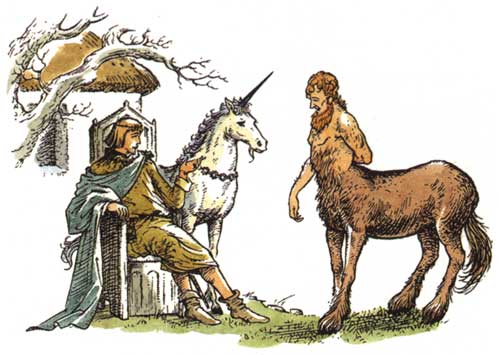
The Last Battle

On this first night of 2012, I am thinking about my favorite book, The Last Battle, written by C.S. (Jack) Lewis.  If you haven’t read The Chronicles of Narnia yet, then 2012 is your year!  These books have been so important in my life that I find myself reading the entire series about 6-8 times a year.  They are well worth the time invested.

In The Last Battle, there is incredible confusion in Narnia– there is an imposter pretending to be Aslan, the great Lion, who is making terrible commandments.  There is one bit of dialogue I’d like to share with you:

You will go to your death, then,” said Jewel.

“Do you think I care if Aslan doomes me to death?” said the King. “That would  be nothing,  nothing at all. Would it not be better to be dead than to have this  horrible fear that Aslan  has come and is not like the Aslan we have believed in  and longed for? It is as if the  sun  rose one day and were a black sun.”

“I know,” said Jewel. “Or if you drank water and it were dry water. You are in the  right,  Sire. This is the end of all things.”

During my darkest OCD moments, this is how I felt– and actually some of my issues I refered to as “black sun obsessions”– obsessions where the ground was taken from beneath my feet, where I felt as if my entire worldview was being dismantled.  Those nights, my soul felt as if there were no place to land.  I was in free-fall.

But, later in the book, the King and Jewel discover the Truth— that an ape is behind this entire masquerade.

But now, as Tirian looked round on the miserable faces of the Narnians, and thought how they would all believe that Aslan and Tash were one and the same, he could bear it no longer.
“Ape,” he cried, “You lie. You lie damnably. You lie like a Calormene. You lie like an Ape.”

What I am trying to say is this: there are no black suns if you love Jesus Christ– only things that appear to be black suns.  He is bigger than our obsessions, and He is the solid ground beneath our feet.  It may feel as though Christianity could crack down the middle like a split log, but God is our gravity.  I was never in free-fall; I was lying in the great palm of my God.

same secrets

“I have come to believe that by and large the human family all has the same secrets, which are both very telling and very important to tell.  They are telling in the sense that they tell what is perhaps the central paradox of our condition—that what we hunger for perhaps more than anything else is to be known in our full humanness, and yet that is often just what we also fear more than anything else.” Frederick Buechner

While I think this quote is universally true, right now I’m thinking specifically in the context of obsessive-compulsives.

Alone, we imagine that no one else could think the horrible things we do.

But when we are in community, we realize that our secrets are pretty much all the same.  I know that’s it’s not necessarily an abracadabra moment, but when you start realizing that other people share your secrets, you feel less like a monster and more like the victim of an ugly disorder.  In other words, you start seeing the TRUTH.

The TRUTH is…

You are not the only one who imagines harming a child.

You are not the only one with excessive concerns about contamination.

You are not the only one who fears you’ve done or thought something blasphemous.

You are not the only one who fears you might be homosexual.

You are not the only one who needs symmetry.

You are not the only one with counting compulsions, who makes lists excessively, who feels a NEED to confess, who is driven to accumulate useless things, who counts, who has unwanted sexual thoughts, who needs to check “one last time” a hundred times.

You’re not a freak– you’re just a textbook case of OCD.  One amongst an entire community of people whose lives have been affected by this thief.  I love the online OCD blogging community– I love that people are sharing their secrets and learning that all our secrets are pretty much the same.


I boast in the cross.

I give the credit for my rescue from OCD to Jesus Christ alone, and I believe that CBT and medicine and doctors were the tools He used.

Tonight I listened to a sermon online given by John Piper of Bethlehem Baptist Church, right here in Minneapolis.  He was talking about something that won’t make sense to some:

“[F]or redeemed sinners, every good thing–[and] indeed every bad thing that God turns for good–was obtained for us by the cross of Christ. Apart from the death of Christ, sinners get nothing but judgment. Apart from the cross of Christ, there is only condemnation. Therefore, everything that you enjoy in Christ–everything you boast in, everything you exult in–is owing to the death of Christ. And all your exultation in other things is to be an exultation in the cross where all your blessings were purchased for you at the cost of Christ’s life.”

Essentially, if I follow the path of blessings back to its source, there I will find the cross–the death–of Jesus Christ.  Because the death of Christ was an act of grace, an act of rescue.

I am grateful and blessed and pleased to be free from the clutches of obsessive-compulsive disorder.  In doing so, I am exulting in the cross of Jesus.

As Piper said, “[Being dead to the world] means that every legitimate pleasure in the world becomes a blood-bought evidence of Christ’s Calvary love and an occasion of boasting in the cross.”

how CBT helps me to see clearly

OCD-related blogs I have been reading:

http://www.pureocanuck.blogspot.com/
http://www.lollyshope.com/
http://ocdtalk.wordpress.com/

The other day, there was a post on Lolly’s Hope that seriously could have been written by me, only a couple years ago.  It told how she was nervous that she’d been rude to the secretary at the doctor’s office and was wondering if she should call back and apologize.  OCD induces such confessions and apologies that are not necessary, simply because the obsession causes such PANIC, and the confession/apology temporarily alleviates that panic.  Your heart will be racing, as well as your mind, believing that things must be solved NOW and that you are going to feel this terrible panicky sensation UNTIL things are solved.  That’s why most of us give in right away.  Heck, I’m the girl who emailed Caribou corporate because my barista gave me a 10-cent discount and I felt guilty as all get-out.  Ridiculous, right?

Yes.

I’ve been reading things from people at all different stages– people who have never heard of CBT/ERP (cognitive-behavioral therapy/exposure and response prevention), people who are undergoing it now, and people like myself– who have gone through that hell, survived it, and are HAPPY on the other side!

I can see clearly now that I’ve undergone CBT.  I am a huge proponent of it as THE BEST TREATMENT THERE IS FOR OCD.  Yes, it is one of the most difficult things I have ever done, but God has given me my life back through it.  It was all worth it.  And the eyesight of my head and heart is 20/20 again!!!


Image credit: See Clearly

I am thankful for …

Jesus Christ’s death and resurrection

chocolate               internet       dear friends                                 

                 mom, dad, sister, brother                      Risperdal

             goals               Northwestern College        Harry Potter

C.S. Lewis           cognitive-behavioral therapy          

           freedom in its various forms            life            hope

the joy of writing     hilarious co-workers      YouTube             

NARNIA                     laughter        inside jokes                        

        attractive men who love Jesus            

soundtracks           cologne               Minnesota         

                                       small towns and big cities           

spring                     summer               fall            (gulp) winter

         awkwardness             youth ministry        babies            

sarcasm                Trinity City Church                   etsy              

conversation              silliness         dorkiness             

books                     audiobooks          

God’s rescuing me from hell and OCD


I’m a Christian and I take MEDS!!!

After I wrote an article for the college newspaper, one of my former professors asked me if next year I would speak to his biblical counseling class.  Apparently, the day after the paper came out, the class had had a whole discussion on whether believers should use medications.  This professor said that in general the class seemed to think that therapy should be “enough.”

And it may be.  For some people.

I’m not going to preach, but I will do a little copy-and-paste job here and share an old story:

A man who couldn’t swim very well was stranded in the middle of the lake. He prayed to God, asking Him to save him from drowning. Shortly after, a man on a boat came by.

“Do you need some help?” He asked, slowing his boat to a stop next to the man.

“No thank you,” The man replied. “God will save me.” The man with the boat shrugged his shoulders and kept going.

Next, a man with a canoe paddled next to him, slowing to a stop and asking, “Do you need some help?”

“No thank you. God will save me.” The man replied, smiling. The man on the canoe shrugged, and paddled on.

Next, a man in a tiny paddle boat came by, stopping next to the man and asking, “Do you need some help?”

The drowning man replied, “No thank you, God will save me.” The man in the paddle boat shrugged, and paddled away.

The drowning man did indeed drown, and when he reached heaven, he asked God “Why didn’t you save me?”

God replied “I gave you three boats. What more did you want?”

lately

I was on the phone with my mom yesterday; she called because she read my last blog post about re-taking the MMPI, so we were discussing that.  I’ve been stressed lately, and struggling with some different things, but the truth of the matter is, I feel lots of freedom and very healthy.  I think it’s because I can compare everything to OCD.

I said to my mom, “Compared to the hell I went through in the throes of OCD, I don’t believe that anything could be worse than hell itself.”


That surprised her.  She said, “You always seemed to be so well put together, seemed to cope so well.”

It made me laugh.  Facades can be so strong.  I was an absolute, total, complete wreck during that time.  I said to her, “I think what happens is that, with OCD, feeling awful just becomes the new norm, so it appears that way.”  Sad but so true.

Hillsong was in the Twin Cities, and Erica and I went to their concert/worship experience last evening.  The last time I went to a concert at Grace Church was in college … Audio Adrenaline and MercyMe … and last night we sat near where I sat all those years ago (would have been 2003).  I can remember that night, eight and a half years ago, and how I felt I was on such shaky ground with God.  Last night, I felt redeemed and free and grateful and healthy.

It just gives me so much hope for others who are in a bad place.  Please, Jesus, free those who are held captive by their own minds.  Work mightily through the means of Your choosing– miracles, medicines, therapies– to restore Your incredible freedom to obsessive-compulsives, and please draw all these rescued people’s eyes to You, to clearly see that You are, even now in 2011, in the business of redemption.

today

… was a hard/stressful day and I agreed to see a therapist (but this time NOT for OCD– wow!).

BUT today was also really good in a couple of ways:

1) I re-took the MMPI last week (read here for my past blog about this test), and I went over the results at the doctor’s office today, and they were saying how HEALTHY my results were. I teared up there in his office and said, “You don’t know. I was a MESS. Praise God.” He said, “Good for you for working so hard and coming so far,” which showed me he completely missed my point. It wasn’t me. That’s for sure.

2) My writing group has a write-up on the NWC English department’s blog. Check it out!

One thing that would really be meaningful for me would be for you to post a comment saying that you read my blog.  I can see the analytics, and I know people are stopping by, but it all feels so anonymous, and I need some names and faces please.  I wish I could sit down and have hot cocoa with you blog readers.  With marshmallows.  Lots of them.

diagnosis

Eve Ensler writes, “I believe in the power and mystery of naming things. Language has the capacity to transform our cells, rearrange our learned patterns of behavior and redirect our thinking. I believe in naming what’s right in front of us because that is often what is most invisible. I believe freedom begins with naming things. Humanity is preserved by it.”

And I agree.

To me, naming an enemy steals away some of that enemy’s power, and that is why I believe diagnosis is so important.

For years, I didn’t know what was wrong with me– only that I thought and worried more than anyone I knew– enough to think myself into panicked circles from which escape was nearly impossible. I couldn’t see this behavior in any of my friends, this dizzying chasing-of-my-own-tail beginning the moment I woke up. I was the odd man out, always stressed to the max, always teetering on the edge of something HUGE– heresy, atheism, a change in direction or pursuit, a redefining of my entire worldview.

But how can you fight against an invisible enemy? Since you can’t see the enemy standing between you and the mirror, instead you see yourself and the fight becomes personal. All the while, the real culprit is standing right there … only it is unnamed.

And then, the diagnosis arrives. OCD is named. There is a transfer of power, even if only minute. And the real war begins.

Anonymous, you feasted on me like a silent maggot,
until I was weary of the ugly business of waking up.
You fed on my tears, licking the salt off of
your fingertips in a greedy appetite for sorrow that
backed me into a boxy corner of paranoia
where I first learned your name.
My move.

I couldn’t have guessed

Tonight I had dinner with some lovely young writing majors at the college where I work, and of course, talking about their senior projects made me think back to my own.  “It’s interesting,” I told them.  “I wrote about having OCD, although at the time I didn’t know that’s what it was.  In my senior project, I called myself ‘a skeptic’ and someone who ‘didn’t understand grace’ when really– a couple years later– I’d be diagnosed, and all of this would be so clear.”

And here, for your viewing pleasure, is a piece of work from my senior project.  (I can’t believe it’s been 8 and a half years since I read this at my Capstone presentation!)  (Oh, and P.S. Don’t judge my writing too critically– I’ve grown a lot!)

If You, Lord, should mark iniquities,
O Lord, who could stand?
But there is forgiveness with You,
That You may be feared.

Psalm 130:3-4

Grace Beneath the Line

There are people who live the scripture verse that instructs, Work out your salvation with fear and trembling, harassed by the pressure to perform. I am one of them. A rotting offering in my hands, I seek God, knowing my gift is sour but too insecure to approach with empty palms.
We who are this way step lightly and with caution through days of deliberation. We twist beneath blankets from fear carried over into sleep, hoping all the while that God is not like us, hard and without mercy. Often we’d rather stay stagnant than move at all, rather close our eyes to the search than squint at a Savior we don’t know—fearing unseen wrath. And we wonder: What if He sees us and turns away His holy face? So we continue inching our way, working out our salvation. With fear. With trembling.
With much trembling.

Last summer at camp, I was the volunteer counselor whose voice cracked and split at the faculty meeting, disturbed by the nature of the game Kierstin explained to us all. A mock heavenly judgment at Pine Haven Christian Assembly in Park Rapids, Minnesota—an activity called “Heaven and Hell”—was intended not only to make the campers think but also to unsettle them with fear.
I knew that Kenny was rolling his eyes behind me, the 20-year-old Target operator, as he said, “It’s just a game”—to me—but while looking ahead at Kierstin, who had planned this controversial activity without a thought of its controversy, now looking helpless and unsure behind the lodge’s wooden lectern.
“Well, maybe we could …” she started.
“No,” said Kenny firmly. “The game is simple. It’s good.”
The game would last 24 hours, during which 20 counselors would defend 10 assigned worldviews—2 counselors for each—while the campers searched for a view they agreed with. When the campers asked us for the Truth, we’d spell out the worldview we were assigned as best we could, try to persuade them, as someone would in real life. Once the kids found the worldview they agreed with, they were to sign up on that counselor’s list.
Troubled with lying to the kids even in the context of a game, I muttered, “It just kills me to think that they’ll ask for the Truth and I’ll give them a lie.” My title of counselor afforded no comfort in temporary deception.
They gave me a real saved-by-grace-through-faith-in-Christ worldview to endorse to keep me pacified and participating.
The following day, only the names collected on my created page—along with another counselor’s twin list—would be welcomed into “heaven”—the right side of the chapel. Those not found in that pretend Book of Life—folded into squares in the back pockets of jeans—would depart to “hell”—on the left.

I’d known Phil for nearly a year; he was a skinny, artistic kid who played bass guitar and drums and who sent me e-mails clever enough to be published. He wore glasses with thick black rims and grew his dark blonde curls long “to look like a rock star.” Still, this witty, intelligent boy was far less than confident when he asked me to write his name on my worldview’s list. After some private calculating, some dialoguing with counselors, and a lot of camper “evangelism,” he added his name to my paper—the action that would “save” him—but even the next day as we all stood in line for pseudo-judgment, Phil looked worried.
Since the campers were to enter the chapel to “approach the throne” one at a time, the procession of casual teenagers curved itself down the rock path from the chapel toward the mess hall. Phil and I were at the line’s end, discussing thoughts on acne, baptism, and poetry.
Phil pushed his glasses up his nose and put his hand through his hair as he carelessly handed over a piece of paper to amuse me. I laughed at his comically malicious thoughts about loud boys in his cabin, but my compliments dropped to the ground in the warm, wet air.
“You okay?” I asked.
“Yeah. No. I don’t know. Jackie … we’re going to heaven, aren’t we?” His
gathered eyebrows told of sincere concern even though he smiled. It was an honest question although he referred only to the action inside the chapel, swallowing campers whole as we spoke.
And because I knew the answer, I smiled softly at his worry and asked, “Well, did you find the Truth?”
“I think so,” Phil said, frowning at the path, “but I’m not sure. You know. Tell me. What’s going to happen in there?” And he looked up and nodded at the white building collecting bodies the way the afterlife would someday collect souls. Phil pressed his mouth shut firmly, and my heart hurt with a huge love for this boy whose fear was so real.

Why did Phil doubt? Why did he fear even a game’s rendition of hell? Christians accept Jesus; we are saved; then, so often, we doubt that the God we love really loves us back. A pastor I know once asked my Bible study, “Do you think your name is written in God’s book in pencil?” and I rutted my brows in my forehead because I lived as if I believed in a God who stands ready with eraser poised over my name if His flitting eyes came to rest on the dark places in my mind. Even David the God-chaser spoke, “Take not your Holy Spirit from me.”
But scripture tells also of grace, of mercy, of a Jesus who’s gentle and of a Spirit
who stays. If we are faithless, He remains faithful, for He cannot deny Himself.
What parts of life pervert pictures of the Christ who promises never to leave nor forsake into One whose mind changes every moment I sin or sing? I may be born guilty, but I am looked on in love; yet some malicious, hot voice asserts it’s a love that keeps strict record of wrongs.
Sunday Schools, churches, parents, camps—when they teach that Jesus doesn’t like sin, do they inadvertently emphasize sinner?

Simon, Simon, behold, Satan has demanded permission to sift you like wheat.
At age seven, I thought of dirty words in my head, running to my mother while hitting my forehead, confessing, “Bad thoughts! I’m thinking bad thoughts!” I was terrified that these tiny seeds would overgrow my entire mind until I was so engulfed in sin that the Lord of my Sunday School would shake a divine finger at me and bar the gates to His heaven.
But even worse was the fear of lying. I knew that lying was sinning and that God hates sinning, and so to protect my heavenly innocence, I wouldn’t answer questions. “Jackie, what do you think?” “I don’t know.” “Jackie, what’s your favorite color?” “I don’t know.” All this in an attempt to ward off what would amount to lies if I were to change my young mind. And in doing so, I lied. My favorite color was purple.
This is the life of a neurotic Christian skeptic who has yet to understand grace.
At eleven, I wondered if I loved God—and even how to love God. But I knew, too, that this was wrong and assumed that hell would drink my soul greedily if I died in that state. I sang the inserted words want to in “I Love You, Lord” quickly, and I still have that pillow with its circular tear stains, evidence of pain that stayed quiet so I wouldn’t wake my sleeping sister. I cried nearly every night from fifth grade to eighth.
Then, at age sixteen, I labored with a heart hostile to the atheism that desired to hold it, fighting doubt alternately wildly and weakly, drinking communion juice that tasted like acid, hearing hypocrite! hissed in my ears that craved the voice of the God I questioned. Fear. Its claws ripped into my brain, and to drive five miles into town was terrifying. I distrusted thoughts of heaven but felt hellfire like a razor to my throat, escalating the intense horror of death. To pass a car, I’d hold my breath.
And then, at twenty, I died. I went blank. I read Matthew 12’s passage about the unpardonable sin, feared I had committed it. Unalterable guilt prescribed in red. Whoever speaks a word against the Son of Man, it shall be forgiven him; but whoever speaks against the Holy Spirit, it shall not be forgiven him, either in this age or in the age to come. And how is one to live without the hope of heaven? What of quiet mutterings questioning the Holy Spirit’s work? What of the testing of the spirits? What of bad thoughts? Are they the equivalent of bad words? Certain condemnation. Sadness to sickness to bitterness. And the hostility hardened my heart to a rock. Now I loved God and believed He was real, and that made it all worse.
Then a pastor sat me down at Caribou, my own personal purgatory, where Dave promised me that there were no black holes in Christianity. I wasn’t expecting his condemnation, but I supposed that he wouldn’t be able to take me far enough in the opposite direction and that his failure to explain the road to heaven to me would leave me scratching at my eyes in the burning blank room I was locked into, severely calloused at this milestone so far down the path of destruction.
But is this really life? Maybe this is the continual death. The hell on earth—but still with a vague, far-off hope.
Until now—it shall not be forgiven him, either in this age or in the age to come. Ah! Even a quick glance at holiness broke me into an Isaiah much too ashamed to cry out, “Woe is me!” In His dazzling, overwhelming beam, all of my sins were laid bare before those eyes and mine. To see—even for a second—God’s holiness is awesome and horrible because it shows that I am ugly with guilt for everything and anything.
But has He not blood-colored vision? Dave reminded me of all the other scriptures of promises undeniable. Therefore there is now no condemnation for those who are in Christ Jesus. We will know by this that we are of the truth, and will assure our heart before Him in whatever our heart condemns us; for God is greater than our heart and knows all things. And the testimony is this, that God has given us eternal life, and this life is in His Son. He who has the Son has the life. There is weight on my side. Many scriptures tip the scale.
Or maybe there is no scale. I am a neurotic Christian skeptic who has yet to understand grace.
It’s still hard to believe Dave sometimes. We get so scared about what happens “after.” But I’m learning how to trust the Lord’s promises in other places, how to read Matthew 12, sleep in peace, and then—the next morning—exhale a deep and quiet breath and read Matthew 13. In faith.

“Jackie … we’re going to heaven, aren’t we?” Phil asked. And now I wonder if his thoughts were only of the chapel’s game. At the age of 17, my own mind had already a vertical focus.
The Judgment Day game was meant to shake the kids, to make them realize the importance of what comes next, to realize how awesomely narrow the road to eternal life really is, but maybe they already know. Maybe they’re already crushed beneath the weight of the stone at the Savior’s tomb, which their sins helped prod into position. Maybe they’ve forgotten that omnipotence rolled it away, and that love, mercy, and grace in bodily form walked barefoot from that grave to find them where they wander—in the corners of locked houses, on their beds that fill with tears, on the road to Emmaus, or at the tables of Caribou Coffee.
Maybe we all need a reminder of saving grace—or a friend to point us to that reminder: He who has the Son has the life. I want to collect Phil and all the others in my arms and weep with them—tremble—for the uncertainty that burdens some of us even daily. I want to hold them while they struggle against the Stealer of Hope. My arms are available, but I know the Lord’s are stronger, and His hands cup themselves beneath the taut thread we creep to heaven; then that slight path lies sagging on His wide, wide palms, and the curve of them keeps us protected from the fall.
Work out your salvation with fear and trembling … if we dare to read further, we find our assurance. Work out your salvation with fear and trembling; for it is God who is at work in you, both to will and to work for His good pleasure.
Yes, Phil, we are going to heaven. We have to trust that.