PANDAS

The PANDAS that I’m talking about has nothing to do with these guys …


… and everything to do with childhood strep throat.

PANDAS = Pediatric Autoimmune Neuropsychiatric Disorders Associated with Streptococcal infections

Say what???

PANDAS describes a set of children in whom an ordinary bacterial strep infection can turn into a neuropsychiatric disorder.  The strep seems to cause the body’s immune system to build up antibodies that – who knows why – turn traitor and attack the basal ganglia in the brain.

In other words, a simple case of strep throat gone to hell.

Sometimes a child gets strep throat, and the body gets confused– instead of fighting off the bacteria, it attacks the basal ganglia … which leads to obsessive-compulsive disorder.

The first time I had an intake with a psychiatrist, she asked about my past medical issues.  “Ummm … I broke my elbow twice,” I said, thinking how a broken bone had nothing to do with my head issues.  I reached: “And I’ve had strep throat like a million times.”  I felt a little stupid and way too thorough.  Keep it to related issues, I thought to myself.  Duh.

But my psychiatrist perked up.  “Did you know there’s a strong connection between strep throat and OCD?” the doctor asked me.

Apparently, this is a little controversial, and some doctors aren’t convinced.  But come on– how many cases of strep-followed-by-rapid-onset-of-OCD do you have to see before you raise an eyebrow at the connection?

My doctor– Dr. Suck-Won Kim, the absolutely brilliant OCD expert at the University of Minnesota– believes there is a strong correlation, and I’m in his court.

A scene cut from my book:

“You have heard of PANDAS?” he asked.

            “I have,” I said, although I couldn’t remember at the moment what it stood for.  “It’s when kids get strep throat and then OCD.  Or something like that.”  I realized that I probably sounded stupid, explaining PANDAS to an OCD expert.

            “So many PANDAS studies … it has to be solved because far more OCD cases are strep-linked than people know.”

            “Yes, I had strep a lot as a kid.”

“YOU DID? YOU SEE?!”  Dr. Lee became animated as if a moment ago I’d said no such link between strep and OCD existed but now he was proving me wrong.

“The first time I met with a psychiatrist, she asked about my medical history.  I didn’t have a lot to share, but I happened to throw it out there that I’d had strep throat a lot, and she said it was probably connected.”

“She knew that?” asked Dr. Lee, impressed.  “That is uncommon.  Most doctors have no clue.” 

For more information on PANDAS, feel free to check out

I think I had strep throat nine times as a child.  Can anyone beat that?  Leave a comment!

quote for ya

Quote

“As we discussed in Chapter 1, the more you fight an obsession, the more frequent and intense it becomes.  This is called a paradoxical effect, something we all experience at times.  For instance, if someone commands you, ‘Do not think of a red elephant,’ you will automatically respond by thinking about a red elephant.”
Edna B. Foa, Ph.D., Stop Obsessing!

CBT intake

“This will be different from other kinds of therapy, Neely,” said Dr. Foster, as if he could read my mind and there see my image of Ruth.  “You’ll have homework and be expected to go through various exposures when we meet together.”  He picked up the top coaster off a stack of them on the coffee table between us and set his coffee mug on it.  It had had writing on it.  I looked at what was now the top coaster on the stack.  It read, “Uncertainty and mystery are energies of life. R.I. Fitzhenry.”

For the next hour Dr. Foster tuned in carefully for any mention of rituals, anxiety, and triggers.  I knew that he was combing through my words for his options, already working on his plan of attack for how he would prompt anxiety in me like a gun’s trigger, asking over and over, “If you couldn’t do that, would you have a lot of anxiety?” I blathered, but he was only seeking one thing: what would stress me out to the max.

“When I hear words that start with the f sound, I start praying over and over again in my head,” I revealed.  

“How would you feel if you were prevented from repeating the prayer at those times?”

My heart clenched a little in my chest.  My prayer was the key to counteracting the whole chain of ugliness that lead to blasphemy and hell.  “Um, anxious, nervous, crazy.”

“Mmm hmmm.”  Dr. Foster was jotting notes furiously.

“It’s because of hell,” I shared, explaining how curse words and the sound of the letter f  made me think of cursing the Holy Spirit, which I believed to be unforgivable.  “I’m always scared of hell—only sometimes it’s in the background, like elevator music.”

 He continued to write and encouraged me to keep talking.  “When you’re nervous about going to hell, how do you calm yourself down?”

 “I can’t calm myself down,” I admitted.  “But I ask my friends and family what they think.  Even though it doesn’t convince me, I still like to hear them say I’m okay.”

 “Hmm,” said Dr. Foster in recognition.  “Seeking reassurance is another of your compulsions, another thing you do to ease your anxiety.  Pay attention this week—I bet sometimes you do this passively, like mentioning that you’re a bad person.  Watch for it.”

 We continued on this way, Dr. Foster asking the questions and me providing the answers, feeling ridiculous and unhelpful and as if I were maybe wasting Dr. Foster’s time. 

 “Do you have any questions?” he asked as we were wrapping things up.

 “My faith plays a huge role in my OCD,” I said.  “Do you … ”                                  

 “I believe in God, yes,” he interrupted.  The way he spoke made me certain that he did not feel about God the way that I did.  I gulped.

 “Ninety-nine-point-nine percent of people are skeptical going into this,” he told me, his face like a stone.  I wondered if he ever smiled, even at home.

 “Okay, because I am,” I said.  It felt appropriate to tell him this, even though I was intimidated by his seriousness.  “I think I understand how this works,” I said, “but I’m a little confused.  Like, for example, a washer would be prevented from washing, and then they’d realize that nothing bad happened when they didn’t wash—they still lived.  So how will that work for me?”

 “You’re misunderstanding a fundamental part of cognitive-behavioral therapy,” said Dr. Foster, folding his hands across his stomach.  “The point is not to take away the person’s uncertainty.  The point is to make him or her okay with uncertainty.”

Well.  That didn’t sound so good.

He continued, “Just because a washer doesn’t get contaminated after being prevented from washing one time doesn’t mean that the person won’t still fear a deadly disease the next time.  Each time is a new adventure.”  He raised his eyebrows.  “And with you, well, we can’t fast-forward to the end of your life and see whether you’re going to heaven or hell.  CBT will teach you how to live with uncertainty.”  He tapped on the top coaster in the pile.  “Energies of life.”

exhausted

I remember feeling SO tired … but not in a I-didn’t-get-enough-sleep way.  Just in a deep, heavy-hearted, there-are-too-many-things-to-manage kind of way … including all your thoughts, which are vomitting all over your mind.

There is rest available.  I wish I could get you to believe that.

“Yes, keep it up,” repeated Dr. Lee, “and you will beat this still.  There is rest for you ahead.”  He narrowed his eyes at me as if he were imagining my successful future.  “But not yet. For now, more work.”

More on CBT this week.

MMPI

That is, the Minnesota Multiphasic Personality Inventory.

It’s 567 true-or-false questions, and I had to take it when I started meeting with my first therapist (whom I disliked and called “Shrinkie” behind her back).

567 questions takes a long time.

567 questions for an obsessive-compulsive takes even longer.

I kept running into statements and BEATING THEM TO DEATH WITH MY BRAIN.

For example, I believe one of the questions was similar to the following:
I believe God hears me when I pray to Him.

Thought process:
I am a Christian– I should put yes.  But then again, I have committed the unforgivable sin, so He probably doesn’t hear my prayers.  But do I really believe I’ve committed that sin?  Maybe.  Maybe not.  Probably.  I should just put yes.  They want me to put yes because it will help the test to identify my beliefs.  But what if that is inconsistent with my beliefs?  On the other hand, maybe I should put no, because then it will identify that as an issue for me.  It’s definitely an issue for me.  But could I really, honestly say that I don’t believe God hears me when I pray?  I’m just being silly when I think that, right?  As a Christian, I should put yes.  I believe yes.  But then again, maybe I’m not a Christian.  If I’ve committed the unforgivable sin, then how can I still call myself a Christian?  I should just put my gut reaction.  Which is yes.  But why put a gut reaction down instead of a thought-out answer?  If I really think it through, then I don’t believe it.  Well, I think I do actually believe it– TODAY– but it could very well be a concern for me tomorrow or every day next week.  Should I put down how I feel right now in this moment, or should I put down how I usually feel, which is no?  I guess that’s not how I usually feel– maybe one-third of the time.  But most so-called “Christians” would think that one-third of the time is huge, in which case, it’s a bigger deal, and I should put down no.  Really– one-third?  Seems like a lot more.  If I think about it again, it’s probably more than one-third.  It’s maybe one-third of the time really BOLD– time when I’m terrified.  But even those other two-thirds I’m still doubtful of my salvation.  It’s just quieter.  So how do I interpret that?  One-third TERROR, two-thirds doubt.  Compared to the normal, which is little to no questioning of one’s salvation, that is a LOT.  So I should put no, so that the test correctly interprets that I have major issues with this particular scenario.

Right?

I’ll come back to it later.

You get the point. 🙂

CBT

“Tell me, Neely.  OCD—do you know about it?”

            Oh wow.  I hadn’t realized that I was going to be quizzed.  “Some,” I said.  “I’ve read a few books, some articles.”

            He nodded his head vigorously.  The sharply combed strands of black hair on his head did not budge.  “Yes,” he said.  “Yes.  Education is critical.  You know how you fight OCD?”

            I wasn’t sure if this was a rhetorical question or not.  I nodded a little, but when I saw that he was waiting for an answer, I said, “With education?”

“With knowledge.  Knowledge is the weapon,” he said, continuing to speak in italics and suddenly launching into war metaphor, “You fight disease—disease fight back.  You have to negotiate carefully.  This is a game of tricking OCD.  Invade without alerting your enemy.  Side-step into enemy territory—your own mind—and take captive a small plot of land, just what you know you can win.  You have to condition your mind to the idea of winning.  Right now, it is used to losing.  What works best is cognitive-behavioral therapy.  You have heard of it?”

The vague sickness I’d been feeling all morning suddenly gathered into a physical reality in the pit of my stomach.  It took only those three seconds to realize that this is what I’d been afraid of.  “Yes,” I said quietly.

“It is the best treatment for OCD that we know of.  Medicine is good, but CBT is better.  There is a man—Jon Foster—you will call him.  He will help you.”  He scrawled the name onto a piece of scrap paper in the messy handwriting of a doctor.  “He is young, but he is good.  You meet with him—I bet he can kill it.”

Dr. Lee met my eye just then, and I could tell he meant what he’d said.  “Kill it?” I managed to squeak out.

“Cognitive-behavioral therapy, very effective,” he said.  “OCD is never cured, but CBT brings it under control.  You will call Jon.”  It was not a question.

“Okay,” I said, taking the piece of paper with Jon Foster scrawled on it. 

I needed to leave.  I needed to process all this.  My indistinct fears now had a name, and I needed to be alone, let my head spin through this like a rolodex.  I started to collect my purse.

            “Listen,” he said, “it will be hell.”  I winced inside and hoped it hadn’t shown on my face.  “Hell,” he repeated.  “CBT is very, very difficult.  You will be asked to do things you cannot imagine doing.  But it is the best treatment.  You have to think like a mother.  A mother would do anything for her child.  You have to do anything asked of you.  But you can do it.  You are Christian.  That is good.  You will need will power and faith to get you through this.”

My heart went into a freefall, and I never felt it land anywhere inside of me.  I swallowed—or tried to.  My throat was suddenly very dry.  “Oh,” I said.  What else was there to say?

OCD101

Hopefully this scene from my novel will give you a better understanding of how OCD works; in it, Neely is attempting to explain OCD to her new friend Gabe.  (By the way, Gabe is just finishing up his chemotherapy– hence the lack of hair.)  Ask your questions in the comments!!  (I would seriously love it if every person who reads this blog asked one question!)

“So, how is Tatum’s Pizza Arcade the best place to tell me about OCD?” he asked while grease from the pizza collected at the corner of his mouth.  He wiped it away.  “I’m … rather curious.”

I’d been planning this for the last week.  “Okay,” I said, “so you get to learn about OCD in three parts tonight.  First, I’m going to tell you about it.  The second and third parts are more experiential.”

“I’m ready to learn.”

“Obsessive-compulsive disorder is basically where you have these intrusive thoughts—they come out of nowhere and assault you—and then to combat them, you perform some kind of compulsion.  Compulsions are more obvious than obsessions—washing your hands til they bleed, checking the oven or the lock on the door over and over and over, being a pack-rat to the furthest extremes, doing weird little rituals.”

“You don’t do any of those things.”

“No.  Well, kind of.  I have my own rituals.  Mine are hard to see because I’m a pure obsessional.”

“So you don’t have compulsions?”  I loved the thoughtful way he chewed his food, the earnest look in those pale blue eyes. 

“No, I do, I do.  They’re just, well, trickier to catch.  They’re mostly in my head or to myself.  Or well masked.”

“I don’t get it,” he said.  “We’re not off to a good start.  And this pizza sucks worse than I remember.”

“Let me start over.  Okay, so an obsessive-compulsive has an intrusive thought—could be anything—maybe ‘I am going to get sick and die.’  So they hate that this thought keeps hounding them, making them feel sick—so they do something about it.”

“Wash their hands,” he supplied.

“Right,” I said.  “You’re getting it.”

“So what about someone who touches the doorknob forty times or something?”

“Same thing.  There’s some intrusive thought—and they’ll perform the ritual to temporarily alleviate the sick feelings from the bad thought.”

“Okay, so how about you?”

“My intrusive thoughts are blasphemous.”

Gabe raised an eyebrow—or what was left of one.  “Liar.”

“They are,” I insisted.  “I think bad thoughts toward the Holy Spirit, and since I’m scared that doing that is unforgivable and that I’m going to hell if I think those things, my head automatically wants to combat those intrusive thoughts.  So I say a prayer, the same one over and over to bat down those thoughts.”

He frowned.  “And there’s no way to just stop them?”

“Gabe,” I said, borrowing from my old friends Jewett and Nash, “do me a favor and don’t think about a red unicorn.  What are you thinking about?”

The corners of his mouth turned up, just slightly.  “A red unicorn,” he admitted.

“Well, stop it,” I said.  “Quit thinking of the red unicorn.  Stop now.  Do not think about that red unicorn.  Stop—”

“Okay, I get it.”

“So … yeah,” I summed up.

“It’s like warfare up there?” he asked.  I nodded. 

After dinner, I said, “I want to show you something.  Come with me.  Bring the tokens.”

We walked to the kiddie arcade.  I looked around.  “What are we looking for?” asked Gabe.

“There it is!”  I pointed to an arcade machine that came up to my hips, with five small holes in the top.  I took Gabe’s hand and pulled him along behind me toward the machine then maneuvered Gabe into place in front of the game.

“Whac-a-Mole?” he asked, doubtful.
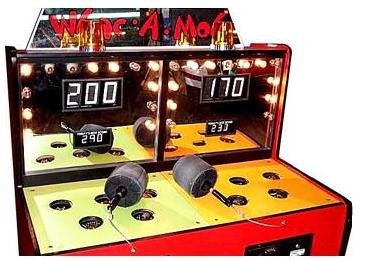
“Whac-a-Mole,” I said, inserting a token into the machine.  “Let’s see you go, Reed.”  I slapped him on the back for luck.

He made a big show of it, shaking out his shoulders, squaring his jaw, performing minor stretches.  I laughed when the plastic moles covered in weathered paint began to pop up randomly from the five holes.  Gabe jumped into action, reached for the foam-covered mallet and began to attack the moles, forcing them back into their respective holes as they showed their faces.

Gabe was pretty good—at least, at first.  The game began slowly, with moles creeping leisurely out of their holes.  But in a short time, several moles began to pop up at each time, and Gabe struggled to keep up.  Before long, the moles were out of control, popping up for only a split-second.  Gabe let out a choked, surprised laugh as the game sped up even faster.  He was wielding the mallet like a boy swiping at the air with a toy sword. 

As the machine lit up and the moles retreated, I laughed at Gabe, who looked legitimately surprised to be getting his butt kicked by five plastic mammals.  Three red tickets popped out of the dispenser attached to the arcade machine.  “What’re those for?” he asked, mallet still in his hand, limp at his side.

“The better you are, the more tickets you get.  Then you trade them in for prizes.”

His jaw dropped.  I threw my head back and laughed.  “Three measly tickets?” he said.  “Put in another token.”  He wound up with the mallet as if it were a baseball bat.

Gabe played a few more games, getting better and better, the red tickets spewing out of the machine like an overgrown tongue.  Still the machine overwhelmed him by the end of every round.

He was no idiot.  “So, this is some sort of metaphor for OCD?” he deduced.  “The experiential part of tonight?”

I smiled.  “You got it.  Blasphemous thought—mole rising.  Say my prayer—bash it down.  Blasphemous thought—mole rising.  Say my prayer—bash it down.  Now, Mr. Reed,” I said, lowering my voice, “this time, pretend it’s salvation on the line.  If you mess this game up—misstep somewhere—you go to hell.  Hell being where you are forever separated from the person you love the most.”  I dropped another token into the machine; in the middle of the cries of kids and beeps and clangs of arcade games, I could swear that I heard that token hit its fellows in the collection bin beneath the token slot.

Gabe frowned but played his hardest.  In the end, when the game had once again gone out of control, it ended.  Another string of tickets whirred out of the dispenser, but Gabe only looked at me, and even when I smiled at him, his blue eyes were sad.  “I’m sorry,” he said. 

my OCD heroes


Jesus Christ*                    Dr. SW Kim           Dr. C. Donahue

*not to be confused with Jim Caviezel 🙂

I was diagnosed with OCD at age 22, approximately 15 years into the struggle.  It took another 4-5 to go through about 11 failed prescription meds, 2 psychiatrists, 1 physician’s assistant, 2 talk therapists (one amazing, one horrendous), and myriad debilitating obsessions before I was connected to Dr. Suck Won Kim, a nationally recognized genius in the realm of OCD medication– and working right at the University of Minnesota!

Dr. Kim speedily got me onto the right medicine (the perfect combination of Prozac, Effexor, and Risperdol) and encouraged me to call Dr. Christopher Donahue, a cognitive-behavioral therapist whose practice was located in Edina.

Cognitive-behavioral therapy is somewhat a paradox.  To me, it was hell and rescue, both at the same time.  CBT is one of the hardest things I’ve ever done but also one of the best.  The premise behind CBT, and more specifically ERP (exposure and response prevention), is to face your obsessions head on and be restricted from performing a compulsion to alleviate the stress.  Can you imagine it?  (To be honest, unless you struggle with OCD, you probably can’t.  But trust me, it’s horrible– in a later post, I’ll detail what my therapy looked like.)

Twelve weeks.  In twelve weeks, CBT works or it doesn’t.

And mine worked.

Think about it.  Fifteen years of torment (including a three-year period where a junior higher cried herself to sleep every night) till it was named.  Five years of running in place.  And then … twelve weeks of hell and freedom.

I am a recruiter for Northwestern College, but sometimes I wish that I could be a fulltime recruiter for cognitive-behavioral therapy, the tool Christ used to set me free.

For those of you out there who are living the impossible life right now, saddled down burdens you cannot bear, terror trilling in your heart from morning till evening, there are steps that you can take.  CBT is the number one way to treat OCD, and while it seems impossible, the alternative is living the impossible every day.

As I wrote this post, I realized that some readers will not even understand the basics of how OCD works– how obsessions and compulsions “complement” one another.  In tomorrow’s post, I’ll try my best to give an OCD101 session!

a memory

Highlight of today: watching several adults (including one senior citizen) ballroom dancing to “Tik Tok” by Ke$ha at the state fair.  Wow.  Just wow. 

Desiree and I spent a few hours working at the great Minnesota get-together this afternoon, manning the Northwestern College booth.  You really get the whole range of folks at the state fair.  My favorite visitor to our booth was a five-year-old girl genius (she could read and write at two!), with whom I discussed the American Girls and Little House on the Prairie books.  Gosh, I hope I have a brilliant baby someday.

A memory came to me while I was sitting in the education building.  Years ago, I wore my “Aslan is on the move” t-shirt (yes, I KNOW it’s nerdy … I can’t help it) to a coffeeshop.  The barista was a gorgeous boy who said, “Nice shirt.”  IT WAS NOT CONDESCENDING OR MEAN IN ANY WAY, and yet, when this hottie commented on it, I realized I was the biggest nerd in the room.  I was wearing a NARNIA shirt, for goodness sakes!  I was worse than a Trekkie.

And afterward I sat down at my table in Caribou with my drink, thinking, “If you are embarrassed to be wearing this shirt, then you are ashamed of it.  And if you’re ashamed of it, then you’re ashamed of Aslan.  And if you’re ashamed of Aslan, then you’re really ashamed of Jesus.”  Of course it became an obsession.  It was just the natural chain of events for about twenty years of my life.

But not anymore.  And tomorrow I am going to post about that.  Stay tuned!

the biggie

I can still remember the day at summer camp when a fellow camper first mentioned the unforgivable sin to me.  It sounded completely foreign, like something a cult-member had made up, nothing like what I’d heard my whole life: Jesus loves you.  Jesus can forgive you for anything.  ANYTHING.

Years later, this unforgivable sin (actually mentioned in Matthew 12 and Mark 3) would become the torment of my life.  Nothing has stolen more joy from me than OCD making me doubt my salvation.

Blasphemy Against the Holy Spirit

22 wThen a demon-oppressed man who was blind and mute was brought to him, and he healed him, so that the man spoke and saw. 23 xAnd all the people were amazed, and said, x“Can this be the Son of David?” 24 But when the Pharisees heard it, they said, y“It is only by Beelzebul, the prince of demons, that this man casts out demons.” 25 zKnowing their thoughts, ahe said to them, “Every kingdom divided against itself is laid waste, and no city or house divided against itself will stand. 26 And if Satan casts out Satan, he is divided against himself. How then will his kingdom stand? 27 And if I cast out demons by Beelzebul, bby whom do cyour sons cast them out? Therefore they will be your judges. 28 But if it is dby the Spirit of God that I cast out demons, then ethe kingdom of God has come upon you. 29 Or fhow can someone enter a strong man’s house and plunder his goods, unless he first binds the strong man? Then indeed ghe may plunder his house. 30 hWhoever is not with me is against me, and whoever does not gather with me scatters. 31 iTherefore I tell you, every sin and blasphemy will be forgiven people, but jthe blasphemy against the Spirit will not be forgiven. 32 And whoever speaks a word kagainst the Son of Man lwill be forgiven, but jwhoever speaks against the Holy Spirit will not be forgiven, either in mthis age or in the age to come.

So of course– my intial thoughts were that cursing the Holy Spirit was unforgivable.  To me, this would clearly be “speaking against the Holy Spirit.”  Immediately, my head began to think of curses toward the Spirit.  I was plagued by this for years actually, so much so that I eventually developed a prayer compulsion to combat it.  If I’d start thinking of a curse in my head, I would instead redirect it to a prayer: “Father God, I love You.”  This happened so frequently that it was liking hearing one track in my head overlaid against the track I heard from the real world.