HOCD Story: Meet Mae, Part 2

Yesterday on my blog, I introduced you to Mae. Today, her story continues with a detailed explanation of her experience with exposure therapy. (For more information about ERP, go to jackieleasommers.com/OCD).

mae erp

First of all, if you go to a therapist and they tell you that you are not gay or try to tell you that it’s just a fantasy, look for someone else. This person does not understand ERP and OCD. The goal of ERP is to EXPOSE you to your deepest fears. I know that sounds like the most terrifying thing, especially if  your obsessions are causing so much anxiety.

I will continue to reiterate this- ERP CHANGED MY LIFE. I don’t say this lightly AT ALL. I was extremely doubtful when it first began that any change would take place. I was ready to fight this OCD beast, but I was also scared of what exposures I would have to do.

Your therapist will personalize your therapy to YOU.

At our initial consultation, my therapist helped me rate my anxiety and we started with the things that made me the least anxious and worked up front here. By the end of ERP, the things that once made me the most anxious were not as bad…

For me it began with a few different recordings, or scripts that I listened to several times per day. It also consisted of not allowing myself to continually ask for reassurance from family members, or google anything having to do with OCD. Anyone with OCD knows that the Internet is a big, dark, deep hole that is nearly impossible to escape once you enter.

I began by listening to the scripts and trying my damn hardest to not neutralize thoughts (ex: not telling myself “this isn’t me” or “I’m not really a lesbian”). I was supposed to just simply (was it really that simple?!) listen to the scripts. The first one began with my therapist recording a script in his voice. I listened to this script as much as possible over the course of 2 weeks (5-10 times per day). Some moments it didn’t cause much anxiety at all; at other moments it was EXCRUCIATING. Sometimes the anxiety was just my mind racing, while other times it was a sinking feeling or my chest would get tight. Sometimes, I just cried.

The next script was one in my voice. This one was a little more convincing and harder to listen to… I listened to this one for about 2 weeks as well.

After four weeks of scripts, my therapist and I came up with some “real-time” exposures. For instance, I didn’t avoid any articles that I saw on the Internet regarding homosexuality. I was supposed to read them or at least acknowledge them. I honestly had never really had issues with homosexuality or gay people before this thought popped into my life. I also didn’t have my heart skip a beat or a queasy feeling in my stomach when I would see any kind of news story on homosexuality before this obsession wreaked havoc on my life.

I also had to sit with different thought patterns I had. If I was with a same sex friend that I found attractive, I was supposed to just let my mind wander and let the thoughts be there. I wasn’t supposed to neutralize them or reassure myself.

I went to the gym a lot and if I thought a woman’s butt was hot, I was supposed to  just appreciate her beauty and not doing anything else with the thought. The gym was probably the hardest exposure for me because there were so many different variables. I wouldn’t know who would be there on any given day. For awhile I even avoided a class taught by someone who is openly gay. I thought going to her class would make me suddenly “become a lesbian” or she would know I was having these thoughts…

It wasn’t until about my tenth or eleventh session that I actually noticed my thoughts shifting. I went to 14 ERP sessions. It all depends, but my therapist said ERP can be anywhere from 10-20 sessions.

I am going to list a few things I that have improved in my life since ERP:

1. SLEEP!
2. Being present with friends and family (I felt like I was in a continual fog for quite a few months).
3. An enjoyment of begin at the gym, work, stores with out feeling like I am constantly checking between people.
4. The ability to read a book or watch a show without thoughts/obsessions/compulsions taking over.
5. Weight- I honestly kind of appreciated losing weight at first, but then it became real sucky to not enjoy food at all.
6. A renewed faith in God. I was very, very angry at God for quite some time. Mental illness is no joke. People don’t talk about it and its a very real thing to so many. My brother has struggled with a wide variety of OCD themes since he was 11. This journey has actually made us a lot closer.
7. I have become more “selectively vulnerable.” If I notice someone seems to be struggling, I gently ask some questions. If anxiety, depression, etc. come up I tell them a piece of my journey. I KNOW that my story has been used to impact others. Also, Jackie Lea’s vulnerability helped me to get help. We are all part of this OCD/ERP puzzle.
8. Work- I enjoy my job so much, but during this struggle it was really difficult for me to focus. I actually feel like I have improved at my job since ERP.
9. I’ve embraced the fact that each day is new. You might still experience setback, frustrations, fear, doubt… Yet, each moment and each day are new.
10. People with OCD have been said to be some of the most intelligent and creative people. I will own that. 😉 For real though, I’ve started doing more creative art projects to really hone in on that gift that I’ve been given. I’ve also looked at my “steel trap” memory as an asset instead of a curse. During my darkest days of OCD, I would get so incredibly frustrated by my ability to recall the most random, detailed memories in my life. Now, I use this skill to make people feel valued and honored by acknowledging important details about them.
11. Sex is something I look forward to now. For a period of time, I was going through the motions in every area of life. I actually feared sex with my husband  because I was worried that the thought would pop in during something that was supposed to be enjoyable.

12. Our family went on a big trip this past year and I was honestly dreading it all year. I thought it would be awful. The trip was actually planned right around the time OCD kicked in. I thought, “There is no way I will be doing better in a year.”

With the trip, I was worried about being away from home, I was concerned that OCD would creep back in with its ugly tactics, I thought that OCD would rob me of experiences on a trip that was intended to be lovely. Guess what?! I had a great time on the trip. It was lovely. I enjoyed it so much, which I consider a huge victory.

I want to once again clarify something. OCD will not completely disappear for many people by doing ERP. What it will do is rewire your brain. I would say my symptoms have improved by 85-90%, which is HUGE. The times that OCD likes to sneak back in are when I am stressed, tired, or duing my menstrual cycle. During these times, I remember to do lots of self care. I make sure I set healthy boundaries, take walks, baths, whatever feels best at that time to make sure I am ok.


Note from Jackie: Thank you for sharing, Mae! I would love to interview someone with HOCD who is homosexual, as HOCD effects both straight and gay people. Both of the people I’ve interviewed so far on this blog have been straight. If you are gay and have struggled with HOCD (in which you doubted your homosexuality and feared you might be straight) and have underwent exposure therapy, contact me! I’d love to feature your story on my blog– anonymously, if you prefer!

HOCD Story: Meet Mae, Part 1

I “met” Mae online about a year ago, when she reached out to me after finding my website. What began as some advice-giving developed into a friendship, and it’s been incredible to watch Mae blossom over the last year as she underwent the difficult, incredible choice of exposure therapy to treat her OCD.

She used to read the “Interviews with a Former HOCD Sufferer” (Interview #1Interview #2Interview #3, Interview #4), and this weekend I asked her if she would be willing to tell her own HOCD story on my blog. She graciously agreed.

Today she’ll share more about her experience with HOCD, and tomorrow she’ll share about her experience with exposure therapy. Mae is terrifically detailed and vulnerable in her story, and I know that will benefit so many of my blog readers.

Thanks,
Jackie

mae hocd

Where do I even begin…

I’ve always been a bit of an “internally anxious person.” When I look back on my life, i had different unwanted thoughts, but it was much easier to dismiss them.

One night after a particularly stressful week at school, my husband and I were having sex (which is normally quite enjoyable!) and the thought “what if I’m a lesbian?” popped into my brain OUT OF NOWHERE.

I could not sleep. Eating was extremely difficult. I lost 20 pounds. I felt like I was in a continual fog. From the moment I woke up to the moment that I attempted to fall asleep, I had continual thoughts surrounding this theme. Sometimes my brain would get bored with the “what ifs” and it would twist and turn things to different things like “you don’t really love your husband” or “hey, check out that co-worker’s butt.” I would walk through a store and continually ask myself, “Is that woman attractive or do I find that man more attractive?”

Every piece of my identity that I had ever known seemed to be crashing before me.

Sometimes I didn’t feel physical anxiety, it was more of a mind game. My head was CONSTANTLY racing with so many competing thoughts. It was extremely exhausting.

Every little thing became an obsession. “Did I like my best friend, she has great boobs and she is smart.” “My instructor at the gym is a lesbian, does she know I’m having these thoughts?” “I’ve always liked boys, I even remember my first crush in elementary school.” “Do I dress feminine enough?” Every.little.thing. consumed me.

OCD likes to latch onto something that is central to our identity or a theme that is close to us. This thought was all consuming for 3-5 months. I tried EVERYTHING. I did mindfulness exercises, I prayed, I tried to eat “whole foods,” I did acupuncture, I worked out SO much, I tried essential oils, I tried natural supplements. I was desperate, but SO SCARED to go on meds and SO SCARED to try ERP. [Jackie interjects: ERP = exposure and response prevention therapy. This is the frontline treatment for OCD.]

I went to three different counselors before I found one that truly did ERP. Do not be dismayed if that freaks you out. I didn’t really understand what ERP was until the tail end of my therapy search. I thought CBT (Cognitive Behavioral Therapy) and ERP were the exact same thing. They are not. ERP is the BEST possible thing you could do for yourself.  I cannot say that I am “cured” or that I waved a magic wand and my obsessive thoughts went away. What I can say is this, for 13 months I felt like I was in hell on Earth in so many ways. I can now say the only time the obsessive thoughts bother me is during my menstrual cycle. Sometimes I will still get a bothersome though outside of my cycle, but now I’m able to let the thought float on by. Whereas 13 months ago these thoughts consumed SO many hours of my day. These were hours that I could have been enjoying time with family, friends, my husband, and I could have been enjoying delicious food too! I had ZERO appetite for quite some time. It sucked.

I can now say that 90% of my life is great thanks to ERP and medication. I understand and honor any individual’s choice on medication. I was very, very skeptical of going on meds. I finally had to acknowledge that a combination of ERP therapy and medication helped SO much.

I’ve accepted and acknowledged that its perfectly normal and ok to enjoy someone else’s appearance (same sex or opposite). We are sexual beings created to admire beauty. I still fully love my husband and find him incredibly attractive. Do I still admire some women’s butts or their outfits? YES! And, instead of that thought and admiration cycling out of control into n endless number of questions I  let the thought be there.

I have written my ERP therapist since finishing session with him. I continually have told him how grateful I am for the work and transformation that took place in my life. Therapy sessions are over, but ERP is a continual practice. It gives you tools in your toolbox to live a healthy life, one that isn’t consumed by doubt, questioning, and anxiety.

The biggest thing I want each of you suffering with HOCD to know is: You are brave. You can do hard things. ERP is scary, but if you are willing to put in the hard work and effort the flip side is incredibly worth it.

HOCD: A Letter to Loved Ones

Here are a couple hard truths:
1) I hear from more OCD sufferers dealing with HOCD than with any other theme.
2) Many of these sufferers are quite young, still in school, unsure how to seek out help, and scared to share their hard-to-explain concerns with parents or other trusted people in their lives.

I want so much to do something meaningful to help them find their footing.

So, I’m writing here a letter that they can show their parents/trusted advisors. I’m hoping to be a voice if they can’t find their own.

Friends, feel free to share this as needed.

hocd letter

Dear friend of a reader of my blog, hello.

You’ve likely been sent to this blog post by someone who wasn’t able to articulate what he or she is going through– suffering from– or someone who was too scared to trust their own voice and explanation. I hope I can help explain a few things.

The person who sent you this has a strong suspicion that he or she is suffering from what is called HOCD or “homosexual OCD.” Two things to know up front: one, this type of OCD affects both gay and straight people, and two, it does NOT mean that the person who sent you here is gay (if they identify as a straight person) or straight (if they identify as gay).

Confused yet? 🙂 Let me explain.

Obsessive-compulsive disorder can take a lot of forms. What most people think about when they hear OCD is someone who is overly worried about germs or order. While those concerns can be true of an OCD sufferer, the stereotype really misses the point, which is that an OCD sufferer has obsessions– the “O”– unwanted thoughts or images that plague them and cause intense anxiety. They try to relieve the anxiety with compulsions– the “C”– which can take almost any form … really, anything that alleviates the panic they feel. For people who have obsessions about germs, illness, or death, the compulsions often include washing their hands, visiting a doctor, or asking for reassurance (“Do you think I’ll get sick? Do you think I’ll die? Do you think I’m okay?”). For those who have religious obsessions, the compulsions often include repetitive prayer, confession, and (again) seeking reassurance (“Do you think that was sinful? Do you think I’ll go to heaven?”).

One common “theme” of OCD is to question one’s sexuality. We call this theme HOCD. It often comes out of nowhere. Someone who is perfectly comfortable with their sexuality, someone who has never, ever questioned it before, can suddenly be triggered– and now, it’s the only thing they can think about. It becomes their obsession, and to alleviate the anxiety, their compulsions are often things like continually checking their bodily responses to men and women, comparing them, seeking reassurance (sometimes from others, sometimes just from themselves). Often, they will end up spending a great deal of time on the internet, trying to find out why they suddenly are worried they are gay (or straight). I’ve talked to many HOCD sufferers who fit every profile of a straight person– except that they cannot shake the obsession of “what if I’m gay?” Some of these sufferers (both gay and straight, remember) feel absolutely tortured– and no wonder! Our sexual identities are so close to our core. I might hear from a young girl who wants nothing more than to fall in love with a man and get married, but all she can think about is “what if I’m actually gay? what if I get married and years from now, have to leave my husband because it turns out I’m a lesbian?” She will start looking at other young woman, wondering, “Do I find her attractive?” She may start losing her usual attraction to men. She might want to stop hanging out with her girl friends for fear of “turning gay.” (Again, note that HOCD can happen for both men and women, those who identify as straight and gay.) The inability to be 100% certain about their sexuality causes them tremendous distress.

(Even that– “tremendous distress”– is not saying enough. HOCD is sheer torture. And for those who are young and not sure where to turn or who are scared that vocalizing their worries will label them as something they are not– or that they deeply fear being– it is hell.)

A conversation with someone struggling with HOCD can be very confusing.

“So, you like men and want to date and marry a man, but you think you like women?”
“No. I mean, yes. I mean, I’m not gay. I mean, I *think* I’m not gay. I don’t want to be gay.”

“So, wait, you’ve identified as a homosexual man and told us all that you are attracted to men, but now you think you might be straight?”
“No. I don’t know. I don’t want to be straight. But I’m scared I might be. I just need to know for sure.”

That– “I just need to know for sure”– is the battle cry of every person with OCD (whether it manifests itself as HOCD or not).

What you need to know is that, no matter what this looks like, HOCD is not really a battle over sexuality– it is really a brain disorder in which the sufferer’s mind demands a certainty that is quite simply not available in real life. A “normal” mind lets thoughts come and go as they please, but someone with OCD has a mind that traps thoughts so that they only go around and around in circles.

That is why, in the proper treatment of OCD (HOCD or otherwise), we don’t treat the symptoms– the obsessions or compulsions. We treat the OCD and the desperate need for certainty.

Treating the symptoms is like reacting to a fire while the arsonist sets another one somewhere else.
Treating the OCD is like going after the arsonist itself.

How is that done? Through ERP (exposure and response prevention) therapy or through ERP plus medication.

ERP is a therapy in which the brain is re-wired to be able to better deal with uncertainty. It uses exposures that trigger the patient’s anxiety but requests that the patient not respond with compulsions. Instead of getting out of the cold water, the patient is taught to stay in the cold water and get used to it. After a time, as most of us know, it no longer feels cold.

ERP therapy can be done with a professional therapist (there is a great database on the International OCD Foundation’s site) or, with dedication, it can be done from home on one’s own, or with the help of family and friends. I have a list of books that will explain how to do that here.

The most important thing for you to know is that this is not really a battle over this child’s sexuality. It is really a larger, overarching brain disorder and inability to handle uncertainty. OCD will typically move on to harder and scarier themes until it is treated, so I recommend that you help the person who directed you here to get professional help sooner than later. Although this might seem like the time for the family (or even a talk therapist) to “talk it out,” that is the equivalent of putting out fires while the arsonist is still at large. ERP therapy takes out the arsonist.

There are lots of additional resources to help you understand OCD, ERP, and your options at jackieleasommers.com/OCD.

Thank you for being a trusted person for my blog reader.

Best,
Jackie Lea Sommers

P.S. I suffered from various themes of OCD for twenty years. Just twelve weeks of ERP therapy brought my life back under my control. It really works.

P.P.S. As always, a reminder: I’m not a therapist or medical professional– I just have OCD and know a lot about it.

A Third Interview with a Former HOCD Sufferer

First, a note from Jackie: I hear from more OCD sufferers about HOCD than about any other kind of OCD, and nearly every story– when boiled down to its bones– looks the same. In the past, I’ve interviewed “Hannah” (she’s asked me not to use her real name on my blog, though she’s very forthcoming about everything else!) about her experience of having HOCD and being set free from it through ERP (exposure and response prevention) therapy.

Hannah’s first interview
Hannah’s second interview

And now … a few more questions for Hannah.

Outdoor portrait of pretty young girl riding bike in a forest.

Hannah, do you see any common themes amongst HOCD sufferers?
Hannah: YES!! I really, really do. One, a lot of HOCD sufferers seem to have a trigger at some point in their young adult or early adult years, and then they go back to their childhood and start collecting “clues.” In other words, something that happened at the time that they haven’t thought about since (she kissed a girl friend on the cheek, for example), but then when they think about it now, it plagues them (“Oh my goodness, that kiss on the cheek was the first indication that I was gay!”). This is obviously unhelpful and unproductive. Two, a lot of HOCD sufferers tend to lose their attraction to the gender they are normally attracted to. This is scary for them, of course, and seems to enforce what HOCD is telling them.

Did this happen to you?
Hannah: No, but it seems to happen for most HOCD sufferers

Do you know anyone who is homosexual who has HOCD?
Hannah: I do. He is a gay man who loves men, but he has HOCD and gets terrified that he is straight. Even though HOCD stands for “homosexual OCD,” it actually doesn’t only attack straight people. OCD can affect anyone.

I agree with you there. I am online friends with an atheist who has scrupulosity, and most people would think that is an incongruous combination. So, Hannah, I’ve been hearing from some HOCD sufferers who are quite young (under 18), living with parents, and unsure how to approach treatment. What do you suggest?
Hannah: I can completely understand not wanting to tell your parents about your struggles– in fact, when I was going through HOCD, I never told my parents. I didn’t tell anyone until many years later. So I get that. But hopefully those young people can tell their parents that they are struggling with OCD, leave out the HOCD details, and still get help. I think it’s best to meet with a therapist who specializes in ERP therapy, but– as you say on your blog– you can do ERP therapy on your own if you’re very driven. [Jackie interjects: see this post for more info!] The important thing is that, one way or another, you do the exposures of ERP therapy.

Recently, I saw an interview with Elizabeth McIngvale, spokesperson for the International OCD Foundation, in which she said, “With the appropriate treatment (ERP or ERP and medication) you can gain control of your OCD and learn to manage your illness.” I loved that, no matter what, she was insisting on ERP therapy. I know you did ERP therapy. Did you/do you take medication too?
Hannah: I do. Every day. But just like you’ve said before, Jackie, I would choose ERP over meds, if I could only pick one.

Blog readers are looking for hope. Can you give them some hope?
Hannah: A lot of hope! I’m an adult woman who once struggled with HOCD, but today I am 100% sure of my sexual identity. I can even be turned on by women and still know– without a doubt– that I am straight. This is achievable. But it takes the hard work of exposure therapy. But even though ERP is hard, it’s worth it.

What is your best advice?
Hannah: Research, not reassurance. In other words, learn as much as you can about OCD, HOCD, and ERP therapy, but don’t resort to the compulsion of asking anyone (including the world wide web) for reassurances. Study HOCD like a medical subject, not from an angle of “Somebody tell me what I want to hear.” Reassurance feels good for about ten minutes; then you go off in search for more reassurance. It’s a compulsion, and it’s unproductive and ultimately unhelpful. Instead, learn about HOCD and how to treat it (ERP), then DO IT. You can research broken bones– or you get get it set, get a cast, have it heal. Push yourself to get the help you need. There is no other solution besides ERP therapy, so what are you waiting for?

Thanks, Hannah! As always, it’s a pleasure to have you on my blog!

Friends, if you have questions for Hannah, please post them below. And please read my letter to OCD sufferers at http://www.jackieleasommers.com/OCD-help.

HOCD More Prevalent Than You Think

Anecdotally, I hear from more OCD sufferers dealing with HOCD than with any other kind.

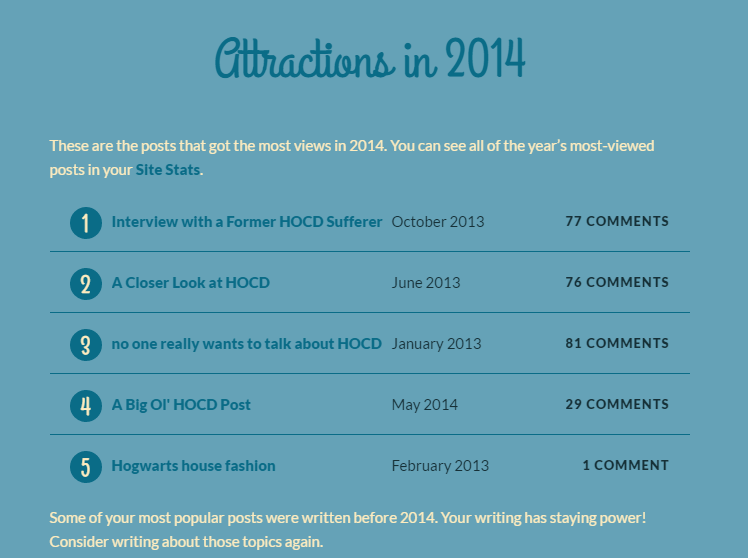
Statistically, my HOCD posts get the most traffic on my blog (see graphic below).

HOCD sufferers, please know you’re not alone.

I invite you to read my interviews with “Hannah,” a former HOCD sufferer who now lives in freedom from HOCD (part one | part two).

Leave your questions below, and if I get enough, I’ll do a third interview with Hannah!

HOCD stats.jpg


Other related posts:
HOCD
A Closer Look at HOCD
A Big Ol’ HOCD Post
OCD Help

What Does Compassion Look Like?

Heart in the stone fenceMany, many OCD sufferers have been contacting me lately: they want to share their story, seek advice, and– in many cases– seek reassurance. Do you really think this is OCD?

My answer is pretty standard for those I believe are truly dealing with OCD. I tell them I’m not a mental health professional but that, in my experience, what they are describing sounds a lot like other cases of OCD. I encourage them to seek out ERP therapy.

They write back: So you really do think this is OCD?

But I know this routine.

It’s usually a compulsion, their asking repeatedly.

I explain this to them, remind them that I’ve already told them what I think.

I just want to make sure, they say. You really, really think this is OCD?

I explain again that their asking me over and over is not healthy for them and that they need to do ERP.

A week later, they’ll message me and ask again. I become a broken record, refusing to give in to their compulsions and doling out tougher and tougher love:

* I’ve told you what I believe and what is the solution. I have nothing more to add.
* Can you see that you’ve asked me X times now? That is a compulsion– seeking reassurance– and I’m not going to give in to it. It’ s unhealthy for you.

Or, in some cases, I won’t respond. What more is there to say?

This troubles me.

On the one hand, I know what it’s like to be gripped with the incredible fear and doubt of OCD. I know how it dials up to a fever pitch, and how desperately you just want. some. relief.

But I also know that compulsions are a short-term non-solution that only exacerbates things. I know that ERP therapy is the long-term solution.

It puts me in a really rough spot. I fear that I come across as cold, hard-hearted, tough, even rude. The years since I underwent ERP therapy have brought such intense clarity to my thinking that sometimes it’s hard for me to empathize in the same way I once could. Don’t get me wrong. I remember the 20 years of OCD hell. I haven’t forgotten. But the almost seven years since my own successful treatment have made me more confident in just about every way– including in what the appropriate treatment for OCD is. I won’t budge on it. I won’t recommend a band-aid. I can’t.

And I can’t cater to compulsions. I did that for myself for too many heartbreaking years, and I won’t give in to something that perpetuates prison for other sufferers.

In my desperate desire for their freedom, I think I come across too tough.

I don’t know the answer to this. I’m frustrated: with myself, with others.

But I know that compulsions kept me locked up and ERP set me free. That’s the line I draw in the sand. Maybe I’m being too tough on hurting souls. But I would be a liar if I gave out band-aids to cancer patients. That’s why I refuse to parry to compulsions.

For those of you involved in advocacy, is this a problem that you’ve had to face? How have you managed it with grace and compassion? I want to fight the good fight, but I feel so frustrated and tired.

This week, I counted up all the emails that the OCD community and I have batted around for the last two years, and it was near 2500. I’ve decided that– for the time being– I can no longer respond to these emails. It’s pushing me into an unhealthy place. I closed the messaging option on my Facebook page and posted this message on my Contact page:

Due to an overwhelming number of emails about OCD, HOCD, ERP, and the like, I am no longer able to respond to personal messages about these matters; I’m not a therapist, and though it honors me that you’d share your story with me, I’ve found that I am not in a place where I can handle such stories in a healthy way. I invite you to read my message to you atwww.jackieleasommers.com/OCD-help. It is everything that I would say to you in an email. I wish you all the best as you pursue freedom from OCD. Godspeed.

These actions have given me a sense of both freedom and failure, but I hope people will understand.

Another Interview with a Former HOCD Sufferer

?????????????????????????????????????????????????????????????????????One year ago (exactly!), I posted an interview with “Hannah,” a former HOCD sufferer who had found freedom from her obsessions and compulsions through ERP therapy. It’s gotten over 6300 views in the last year and is my second-most viewed post after “A Closer Look at HOCD.” Last summer, I said that Hannah would be willing to do a second interview if people had more questions, so this time I’m using questions straight from blog readers.

Tom asked: How do you get past the feeling that the thoughts felt so real even though you knew they were not in line at all with your inner values?
Hannah answered: Just to be clear up front, I am not slamming homosexuality. In fact, even people who are gay get HOCD– they obsess about being straight! The awful thing about HOCD (for both straight and gay sufferers) is that it is a LIE. HOCD lies to us about our sexual identities, which are so central to who we are. Most of the people I’ve met who have HOCD are not anti-homosexuals or homophobes; many of them even campaign and vote for gay rights. But their OCD is lying to them about their own sexuality, and that’s where the anxiety slams into them– hard. That said, how do you get past the feeling that the thoughts feel so real? You let them come. You let yourself think the thoughts. You let your body react however it wants. That is part of ERP therapy– and not just for HOCD alone. In ERP therapy, you let the thoughts come and just be thoughts. You learn how to be comfortable with uncertainty. Listen, I know that sounds awful— it sounded awful to me too!– but now, after having gone through ERP … through embracing uncertainty … I now am confident about my sexuality. It’s backward– ERP always is– but it works. Like Jackie has said a lot on this blog, ERP re-wires your brain.

Roxy asked: Did you find that the body sensations were the hardest to deal with and overcome?
Hannah answered: If not the hardest part, then definitely one of the hardest. I mean, how do you argue with your own body when you have a groinal response to the gender you don’t think you are attracted to (or don’t want to be attracted to)? It feels like “evidence,” right? But, I’ll tell you the truth here: I am straight. 100% straight, and I no longer have any doubts about that. But I still get turned on by images of beautiful women. I just don’t think that’s evidence anymore. It’s evidence that I’m a sexual being but not that I’m homosexual. I’ve found that I actually am super turned on by romantic scenes between homosexual men in books … I’m not gay, and I’m definitely not a man. What does this mean? I’m no psychotherapist, but I simply think it means I’m sexual. And that’s true. I still know I’m straight. But yes, the body’s reaction is a total mindf**k to the OCD brain. Then, if you’re anything like me, you keep “checking”– did I feel something there? How about that time?— that’s a compulsion, of course, and the RP of ERP is “response prevention.”  You have to stop checking.

Howdy asked: I am wondering what it has been like trying to date people. I think [my therapist] thinks I am gay.
Hannah answered: If your therapist is an OCD specialist, then I can almost promise you that he/she doesn’t think you’re gay. That said, since the point of ERP therapy is teaching the client to embrace uncertainty, your therapist is probably wise not to let on either way. But if you truly believe that your therapist thinks you’re gay, I’d find a new therapist. Those who specialize in OCD treatment are going to be wildly familiar with HOCD. As far as your question about dating people, I’ve found that I’ve suffered more from ROCD (relationship OCD) than HOCD, constantly questioning if I was dating (or even liking) the right person, doubting if he was a good person, doubting if we belonged together, etc.  The great thing about ERP therapy is that you can be treated for one type of obsession and yet the ERP works on all areas.

Jake asked: What techniques did you use to accept the doubt/uncertainty?
Hannah answered: Do you know how when you say a word over and over and over again, it starts to lose its meaning? For me, it was like that. Listening repeatedly to lies over and over eventually made them sound ridiculous– and clearly like lies. I’m not sure if that answers your question, but for sure look into ERP therapy, if that’s not what you’re already referring to.  It’s the best treatment out there for HOCD (or any OCD).

Christine asked: Did you have a “backdoor spike” when recovering? How did you deal with this? Did your thoughts consume you? I can’t go an hour without having invasive thoughts, is this normal? What thoughts did you have that stressed you out the most and what did you do to overcome these? Can you remember how quickly you began to feel your anxiety lift after beginning ERP?
Hannah answered: I don’t think I really had a backdoor spike in this area, though I did in some others. I dealt with it by returning to my ERP exposures. Thankfully, when I’d do that … and then go to bed … I’d usually wake up “re-set.” Very different from the days when (to answer your next question) my thoughts consumed me. If I wasn’t obsessing over something in the forefront of my mind, then I was still feeling sick about it while it existed in the background. I’ve had other themes with OCD than just HOCD, and to be honest, some of them were more upsetting than the HOCD, but the most stressful thoughts with HOCD were often when I would worry if I was attracted to my girlfriends. Or if I would worry that one day I would “suddenly” realize that I was gay– after I was married to a man.  I had a romantic same-sex dream one night and woke up “convinced” I was gay. How should one deal with the invasive thoughts? ERP, ERP, ERP. Jackie writes about it a lot on her blog. Maybe she can include a link. [Jackie interjects: go to jackieleasommers.com/OCD for more ERP details!] Finally, how quickly did I feel my anxiety lift after starting ERP? Not right away, that’s for sure– in fact, I think it gets worse before it gets better! At first, the exposures are HORRIBLE, but then– like I said– they start to seem silly (or at least, that’s how it worked for me).  I started feeling relief after about 2.5-3 months.

I want to thank Hannah once again for being so OPEN with my blog readers!  I hope that you all heard her refrain of “ERP, ERP, ERP” loud and clear. That is the message I’m continually sharing on my blog too. If you want to read more about HOCD, check out these posts:

A Big Ol’ HOCD Post
Hannah’s First Interiew
A Closer Look at HOCD
No One Really Wants to Talk about HOCD
Hannah’s Third Interview