Did God give me OCD?

Q: But who are you, O man, to answer back to God? Will what is molded say to its molder, “Why have you made me like this?” — Romans 9:20 (ESV)

A: Thanks for asking.  I’m Jackie Sommers.  I guess you could call me a sass-pot. 

Why do we get OCD?  Is it a punishment from God?  Is it a result of the fall of mankind?  Is it completely arbitrary?  Bad karma?  Simply genetic?  Strep throat gone awry?

I believe that my OCD is indeed from God, given to me for three reasons:
1) To drive me to Him.  The times that I have known most intensely my desperate need for Christ have been some of my most OCD-riddled seasons of life.  When I am given something impossible to handle, then I have to turn to Someone bigger who can take it from my weak hands.
2) So that I would use it to glorify Him.  I wrote a novel about an obsessive-compulsive, a book written for the Lord, to use my talents to honor Him.  I think it’s a beautiful picture of redemption to see the way God allowed me to turn my history of OCD into a creative and beautiful result.
2) To help others who are suffering.  Simply put, I would not be able to sympathize with other sufferers in the same way had I not crawled out of those same trenches.  God was with me every step of the way, and I know that it was He who guided me to cognitive-behavioral therapy, of which I am now a strong advocate.

So, what do you think?  Is OCD from God– or is it something else?  Would love to hear your thoughts!

three obsessive-compulsives walk into a bar

Okay, not quite.

But this past week I did have the blessing of having lunch with two other OCs.  And we met SPECIFICALLY to talk about OCD.

“Harry” suffered most from 8th-11th grade, checking and rechecking the locked door so much that he broke the doorknob at his parents’ home.  His sophomore year of high school, he was terrified that his family would die.  “Hermione” has never struggled with obsessions until last August … when it was like a switch was flipped in her.  First, she worried that she would die young … felt certain it would happen.  Then, last month, her worries for herself transferred to her mom, and now she spends the entire day worrying that her mom will die.

Because of the similarities of their stories, I decided to put them together so they could talk about it.

Needless to say, our lunch was interesting.

Harry told us how one time his sister didn’t come home at the right time, so he naturally assumed she was in an accident … he had so convinced himself that this was the truth that he actually almost told that to his friends, figuring that maybe they could help him grieve.  OCD’s voice is very loud and convincing, friends.

Hermione has been obsessing for five months, and she asked Harry and me (I guess I can be Ron!  Ha!) how to tell when OCD crosses the line into the unbearable territory.  Gosh, what a question!  “It’s terrible right now,” she said.  “I think about my mom dying all day every day.  I really don’t want to take meds or do CBT.  How will I know?”

“You’ll know,” I said.  “You’re not there yet.  There will be a time when you realize that the hell of daily obsessions is so bad that you’re willing to take on the hell of CBT or the hell of side effects just to escape it.”

I hate that it has to get that bad.

Christmas isn’t fun for everyone

My roommate is a Christmas fanatic– every year, she chooses one day after Thanksgiving where we pause everything else to put on some Christmas music, drink hot cocoa, and decorate our apartment.  Every Christmas decoration in the entire apartment belongs to her.  Well, time out, I guess we each paid half for our little four-foot tree.

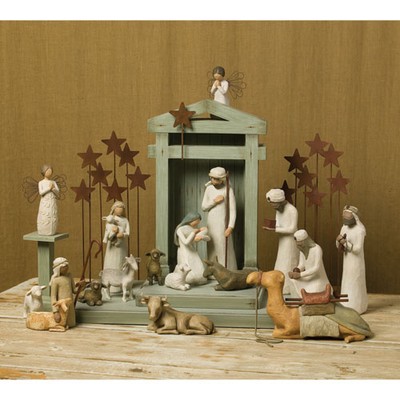
Desiree has this entire Willow Tree nativity set, as seen below.

Can you picture her as a senior in high school, eagerly opening up each element of the scene?  It makes me laugh– but in a good way!  Des is the sweetest girl ever, and this is a great metaphor of each of us.  Des is “steady eddie”– not that she doesn’t have her own issues to deal with– but she is strong and caring and clean and a good cook.  And then there’s me, a tornado who is still learning how to take care of herself.

Christmas is an interesting time for me– to be honest, I am learning to enjoy it.  Growing up, it was a very difficult time of the year for me.  Picture Minnesota in the winter: it gets dark so early, there’s usually piles of snow, and the temperature is below freezing– sometimes dangerously below.  It’s like a dream location for seasonal depression.

And then, with OCD stacked on top of it, pretty much everything about Christmas was a trigger: my mind would race with thoughts of whether I believed in God, and if He was real, if He had saved me.

There is an image of me that we still have somewhere at my parents’ house– me, hovering somewhere around 17-20 years old, with this look at the camera.  I can remember exactly what I was thinking in it.  I was looking at the camera and asking my future self, Are you okay yet?  I hope you don’t feel this way still.

These days, I can answer my past self, I am better.  I am healthier.  And no, most days I do not feel that way.

Praise GOD!  Thank You, Jesus, for cognitive-behavioral therapy.

So tonight I’m thinking about different kinds of folks– I know there are some– actually, MANY– who are like Des, yearly filled with holiday cheer, basking in the glow of the Christmas lights, huddled comfortably around the tree and the nativity scene.  But there are others who spend their holidays the way I did– filled with doubt (laced with the tiniest bit of hope), depression, confusion, and sickness– and all while feeling that instead, they really ought to be happy.

If you are in the second camp, I hear you.  I’ve been there.  This prayer is for you:

Jesus, I celebrate You– I celebrate Your marvelous incarnation, the Word becoming flesh.  Tonight, Lord, I lift up to You all those who are burdened with heavy, laboring hearts this season– whether from depression, anxiety, mental illness, or internal crisis.  YOU ARE STRONG ENOUGH TO HOLD US ALL.  Just as that first Christmas was the initiation of Your inexplicably great rescue plan, I pray that this Christmas will be the start of Your new rescue mission in the lives of these sufferers.  You are Love.  You are Truth.  You are the mighty redeemer.  I entrust my heart to You and ask that You would hold those for whom I’m praying– in a way that is felt.  Amen.

I boast in the cross.

I give the credit for my rescue from OCD to Jesus Christ alone, and I believe that CBT and medicine and doctors were the tools He used.

Tonight I listened to a sermon online given by John Piper of Bethlehem Baptist Church, right here in Minneapolis.  He was talking about something that won’t make sense to some:

“[F]or redeemed sinners, every good thing–[and] indeed every bad thing that God turns for good–was obtained for us by the cross of Christ. Apart from the death of Christ, sinners get nothing but judgment. Apart from the cross of Christ, there is only condemnation. Therefore, everything that you enjoy in Christ–everything you boast in, everything you exult in–is owing to the death of Christ. And all your exultation in other things is to be an exultation in the cross where all your blessings were purchased for you at the cost of Christ’s life.”

Essentially, if I follow the path of blessings back to its source, there I will find the cross–the death–of Jesus Christ.  Because the death of Christ was an act of grace, an act of rescue.

I am grateful and blessed and pleased to be free from the clutches of obsessive-compulsive disorder.  In doing so, I am exulting in the cross of Jesus.

As Piper said, “[Being dead to the world] means that every legitimate pleasure in the world becomes a blood-bought evidence of Christ’s Calvary love and an occasion of boasting in the cross.”

how CBT helps me to see clearly

OCD-related blogs I have been reading:

http://www.pureocanuck.blogspot.com/
http://www.lollyshope.com/
http://ocdtalk.wordpress.com/

The other day, there was a post on Lolly’s Hope that seriously could have been written by me, only a couple years ago.  It told how she was nervous that she’d been rude to the secretary at the doctor’s office and was wondering if she should call back and apologize.  OCD induces such confessions and apologies that are not necessary, simply because the obsession causes such PANIC, and the confession/apology temporarily alleviates that panic.  Your heart will be racing, as well as your mind, believing that things must be solved NOW and that you are going to feel this terrible panicky sensation UNTIL things are solved.  That’s why most of us give in right away.  Heck, I’m the girl who emailed Caribou corporate because my barista gave me a 10-cent discount and I felt guilty as all get-out.  Ridiculous, right?

Yes.

I’ve been reading things from people at all different stages– people who have never heard of CBT/ERP (cognitive-behavioral therapy/exposure and response prevention), people who are undergoing it now, and people like myself– who have gone through that hell, survived it, and are HAPPY on the other side!

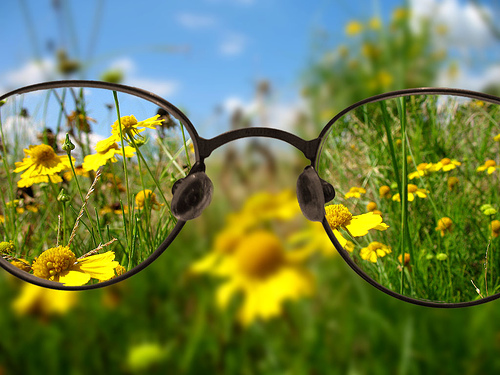
I can see clearly now that I’ve undergone CBT.  I am a huge proponent of it as THE BEST TREATMENT THERE IS FOR OCD.  Yes, it is one of the most difficult things I have ever done, but God has given me my life back through it.  It was all worth it.  And the eyesight of my head and heart is 20/20 again!!!


Image credit: See Clearly

lately

I was on the phone with my mom yesterday; she called because she read my last blog post about re-taking the MMPI, so we were discussing that.  I’ve been stressed lately, and struggling with some different things, but the truth of the matter is, I feel lots of freedom and very healthy.  I think it’s because I can compare everything to OCD.

I said to my mom, “Compared to the hell I went through in the throes of OCD, I don’t believe that anything could be worse than hell itself.”


That surprised her.  She said, “You always seemed to be so well put together, seemed to cope so well.”

It made me laugh.  Facades can be so strong.  I was an absolute, total, complete wreck during that time.  I said to her, “I think what happens is that, with OCD, feeling awful just becomes the new norm, so it appears that way.”  Sad but so true.

Hillsong was in the Twin Cities, and Erica and I went to their concert/worship experience last evening.  The last time I went to a concert at Grace Church was in college … Audio Adrenaline and MercyMe … and last night we sat near where I sat all those years ago (would have been 2003).  I can remember that night, eight and a half years ago, and how I felt I was on such shaky ground with God.  Last night, I felt redeemed and free and grateful and healthy.

It just gives me so much hope for others who are in a bad place.  Please, Jesus, free those who are held captive by their own minds.  Work mightily through the means of Your choosing– miracles, medicines, therapies– to restore Your incredible freedom to obsessive-compulsives, and please draw all these rescued people’s eyes to You, to clearly see that You are, even now in 2011, in the business of redemption.

bullying my bully, part two

Such an interesting post on this same topic on ocdtalk’s blog!

In my story, Neely discovers this concept through a brochure in her psychiatrist’s office, but in my own life, it came out of NOWHERE.  (God??)  All I’d ever heard of it before was from a friend with an eating disorder who called it “Ed” and talked about it as something separate from herself.  So I randomly started to do something similar, imaginging my OCD as a black dot. 

In real life, people stumble into things, but most of the time in fiction, characters have to be forced.  That’s why I altered my story a little bit as I told Neely’s story.  I mean, how crazy is it to just one day start imagining a little black dot riding in the car’s passenger seat?!

Here’s another scene:

“My OCD wants me to think that thought,” I’d spell out in my head as I continued through the neighborhood, realizing that autumn’s chill had definitely hit Minnesota at full force.  “It’s not actually my thought.  I’m just the messenger.” 

It was an awkward dance, one where I sidled up to the thought and tried to hold its hand.  One foot in front of the other, a stealthy warrior on a tiptoed journey toward freedom. 

“Oh, you’re along?” I said to the black dot that was jogging to keep up with my longer strides.  “Well, keep up, won’t ya?”  I “dressed” it in a child’s train conductor costume and laughed under my breath as it seethed in humiliation.  “Chugga-chugga-choo-chooooo!” I said, pulling a fake train whistle above my head.  “Aren’t you a cute little conductor?”  It glared at me.

Another day, another walk, this time my little black dot in a Scottish kilt and a tiny tam beret.  The day after, a doll-sized sailor suit and white sailor hat.  It had toddled behind me, trying to keep a low profile, which was just fine by me.  By the end of the week I’d landed on an outfit for keeps—a pink tutu with tights and ballet slippers, which my OCD hated worse than all the rest.  I was bullying my bully, and it felt powerful.  Whenever my mind started to race, I said to my OCD in its ballerina getup, “You there!  Start twirling!”  And so it would, even as it boiled with rage.  “Keep on twirling!” I said with a smile.  “I’ll tell you when you can stop … little one.”

I felt an odd sense of control that I’d never had before, not completely free of OCD, but like someone separate from it.  I didn’t need to get my toes wet; I could stand on the dry bank, command my orders, and get back to work.

Isn’t it interesting that something that seems so crazy is actually what’s keeping an obsessive-compulsive from craziness?  I’d love to hear your thoughts on this concept.  Leave a comment!

CBT prep …

  I looked at the back cover of Freedom for Today’s Obsessive-Compulsive.  Apparently Steve Jewett and James Nash were some big names in the OCD world.  “Open this book,” the back cover read, “and unlock the doors of your mind’s prison.  What lies ahead of you is freedom.”  The goal was appealing, and I liked the confident wording.  Just straight to the point: “What lies ahead of you is freedom.”  Well, okay.

            I opened to a random page and read, If I were to say to you, ‘Don’t think about a red unicorn,’ what would happen next?  Why, immediately, you’d begin to think of a red unicorn!  In fact, I’m sure that’s what’s in your mind’s eye right now as you continue to read this page.  That is what we’re dealing with as we fight OCD.  An obsessive-compulsive experiences an intrusive, unwanted thought, and because it is intrusive, he feels disgusted by it, wants to stop thinking that particular thought.  But just as my telling you, ‘Don’t think about a red unicorn’ results in your immediately doing so, the obsessive-compulsive’s panic and desire to stop thinking the intrusive thought actually drive him to continue thinking about that very thing.”

            Well, that was certainly true enough.  When my worst thoughts arose in my mind and I tried to stamp them out, it was a battle of escalation.  The harder I fought, the harder I needed to fight. 

            “In cognitive-behavioral therapy (CBT),” the book continued, “we encourage the obsessive-compulsive to give in to those intrusive thoughts, to stop fighting them.  Time and time again, CBT experts have found that it is when an obsessive-compulsive stops fighting the intrusive thoughts and actually embraces them that he finds freedom from them.”

            Oh gosh.  I set the book down, my heart beginning to race.  It wasn’t new information to me—Ruth’s brochure had given me the basics of behavior therapy—but the way it was worded gave me a chill.  “Give in to those intrusive thoughts.” 

             “So I’m reading this book for Dr. Foster, right?” I said a couple nights later at Rosie’s Place to Stella before she opened her laptop.  “It’s like reading my own biography.”

            “Yeah?” she asked, taking a sip of something foamy.  “What do you mean?”

            “Well,” I said, “you know how all my ‘issues’ seem so bizarre?  Some of them are not bizarre at all, I mean in the world of OCD.  I’m textbook.  It’s crazy really.” 

            “Like?”  Stella began to sort through the tangled mess of beads she was wearing—black, red, maroon, picasso jasper.  These, in addition to a floral chambray shirt and hiking shorts.

            “Okay,” I said, “so there are all these made-up scenarios, and the book circles back to revisit these same examples.  One of them is a dad who’s sure he’s going to kill his baby girl, so he won’t even hold her.  He gets all these images in his head of suffocating her, stabbing her in her little chest, shaking her, drowning her.”

            “Ew,” she said, still fussing with her beads.

            “Yeah, but these thought make him completely sick,” I explained.  “It’s clear to everyone else, including his wife and therapist, that he would never ever hurt his daughter.  I mean, they’re not freaking out.  He’s the one avoiding alone time with his daughter.

            “And there’s this lady who thinks she might be a lesbian even though she isn’t attracted to women.  Every woman she walks by, she thinks, ‘Am I attracted to her?  Do I want to kiss her?’ then she imagines herself kissing that woman.  She’s just sick over it, but instead of thinking, ‘Oh, I guess not.  That’s not a pleasing image to me,’ she thinks, ‘I must be gay.  Why else would I be thinking so much about kissing women?’  This is called HOCD—homosexual OCD.

“But then get this.  One of the example scenarios is about this girl who has these blasphemous images attack her mind.  She … she pictures herself having sex with Jesus.”  Stella looked bemused, but I continued.  “She doesn’t want to think about that, but there are all these triggers in her normal day—when she sees someone praying, or a cross around someone’s neck, or a kissing scene in a movie or on TV.  And whenever there’s nothing else to think about, that’s where her thoughts go.  She believes that her thoughts are blasphemous, so she believes that she will go to hell.  She thinks about hell all the time.  The book even said that she confessed to her priest, and even he said she was fine, but she couldn’t believe it.  Whenever the image of having sex with Christ came into her head, she said a Hail Mary to alleviate her guilt and drive the image away.  Eventually she had to quit her job because she was too distracted saying her Hail Marys to get work done.”

            Stella’s eyebrows furrowed.  “Gosh, that does sound like you!”  She abandoned the necklaces she’d been working on and clasped her hands together on the table between us, leaning forward as she listened.

            “I know!  I mean, elements are different, for sure, but the basic idea is the same.”

            Stella sighed.  “I used to think that OCD meant that people were super clean.”  She chewed on the inside of her cheek.  I knew what she was thinking, even though she didn’t say it aloud: It’s so much worse than that.

            “Yeah,” I said, agreeing both with what was said and unsaid.  “Even the people who are really clean, or who wash their hands all the time—they’re driven to it.  They think something horrible is going to happen if they don’t do it. It’s so much bigger than just being a neat freak.  It kinda drives me nuts when people with quirks say, ‘I’m a little OCD myself.’”

Stella nodded violently.  “Remember that receptionist job I took at that plastic surgeon’s?  One day this nose-job lady came in, right?  She sat beside a burn survivor, pointed at his dressings, then at her own protective shell covering the bridge of her nose, and said, ‘I know how you feel.  Hang in there.’”

“I don’t believe you,” I said, jaw dropped.  “You’re joking.”

“I’m not,” she said.  “I’ve never been so pissed at a job site before.  I’d take the call center perverts over those rich bastards any day.”  She shook her head in disbelief.  “So … therapy?”

            “Therapy,” I said.  “I guess it’s like a pyramid, and you climb to the top, step by step—if you don’t reach the pinnacle event, CBT probably won’t work.  In the book examples, the dad had to write down all the ways he was going to murder his daughter—graphically!—and then record himself reading it, and he had to listen to it over and over.” 

Stella looked disgusted.

            “The HOCD person had to rate women’s butts and record everything in a notebook, and she had to read a couple LGBT novels.  And the one with religious obsessions had to write a story about having sex with Jesus Christ and then read it over and over again without saying any Hail Mary prayers.”

            Stella made a face but nodded slowly.  “So what will you have to do?”

            I shrugged.  “All I know is that it will be terrible.”

            And for once, I appreciated it when Stella didn’t reassure me.  There was more strength in knowing she agreed.  “I don’t know what to do,” I confessed. 

            “Write about it,” she said.  So I did.


OCD

There he is, that scarlet beast,
black horn like a railway spike.
I check myself against the blood-red giant,
close my eyes, cover my ears,
two-thirds of the famous monkey trio
where I sit cross-legged between cloven hooves.
Do not think of a red unicorn.  Do not do it.
But I can feel his wet, warm breaths like humid whispers

as he lowers his nostrils to my neck, crimson ears at salute
like a maddening accusation.

CBT intake

“This will be different from other kinds of therapy, Neely,” said Dr. Foster, as if he could read my mind and there see my image of Ruth.  “You’ll have homework and be expected to go through various exposures when we meet together.”  He picked up the top coaster off a stack of them on the coffee table between us and set his coffee mug on it.  It had had writing on it.  I looked at what was now the top coaster on the stack.  It read, “Uncertainty and mystery are energies of life. R.I. Fitzhenry.”

For the next hour Dr. Foster tuned in carefully for any mention of rituals, anxiety, and triggers.  I knew that he was combing through my words for his options, already working on his plan of attack for how he would prompt anxiety in me like a gun’s trigger, asking over and over, “If you couldn’t do that, would you have a lot of anxiety?” I blathered, but he was only seeking one thing: what would stress me out to the max.

“When I hear words that start with the f sound, I start praying over and over again in my head,” I revealed.  

“How would you feel if you were prevented from repeating the prayer at those times?”

My heart clenched a little in my chest.  My prayer was the key to counteracting the whole chain of ugliness that lead to blasphemy and hell.  “Um, anxious, nervous, crazy.”

“Mmm hmmm.”  Dr. Foster was jotting notes furiously.

“It’s because of hell,” I shared, explaining how curse words and the sound of the letter f  made me think of cursing the Holy Spirit, which I believed to be unforgivable.  “I’m always scared of hell—only sometimes it’s in the background, like elevator music.”

 He continued to write and encouraged me to keep talking.  “When you’re nervous about going to hell, how do you calm yourself down?”

 “I can’t calm myself down,” I admitted.  “But I ask my friends and family what they think.  Even though it doesn’t convince me, I still like to hear them say I’m okay.”

 “Hmm,” said Dr. Foster in recognition.  “Seeking reassurance is another of your compulsions, another thing you do to ease your anxiety.  Pay attention this week—I bet sometimes you do this passively, like mentioning that you’re a bad person.  Watch for it.”

 We continued on this way, Dr. Foster asking the questions and me providing the answers, feeling ridiculous and unhelpful and as if I were maybe wasting Dr. Foster’s time. 

 “Do you have any questions?” he asked as we were wrapping things up.

 “My faith plays a huge role in my OCD,” I said.  “Do you … ”                                  

 “I believe in God, yes,” he interrupted.  The way he spoke made me certain that he did not feel about God the way that I did.  I gulped.

 “Ninety-nine-point-nine percent of people are skeptical going into this,” he told me, his face like a stone.  I wondered if he ever smiled, even at home.

 “Okay, because I am,” I said.  It felt appropriate to tell him this, even though I was intimidated by his seriousness.  “I think I understand how this works,” I said, “but I’m a little confused.  Like, for example, a washer would be prevented from washing, and then they’d realize that nothing bad happened when they didn’t wash—they still lived.  So how will that work for me?”

 “You’re misunderstanding a fundamental part of cognitive-behavioral therapy,” said Dr. Foster, folding his hands across his stomach.  “The point is not to take away the person’s uncertainty.  The point is to make him or her okay with uncertainty.”

Well.  That didn’t sound so good.

He continued, “Just because a washer doesn’t get contaminated after being prevented from washing one time doesn’t mean that the person won’t still fear a deadly disease the next time.  Each time is a new adventure.”  He raised his eyebrows.  “And with you, well, we can’t fast-forward to the end of your life and see whether you’re going to heaven or hell.  CBT will teach you how to live with uncertainty.”  He tapped on the top coaster in the pile.  “Energies of life.”

exhausted

I remember feeling SO tired … but not in a I-didn’t-get-enough-sleep way.  Just in a deep, heavy-hearted, there-are-too-many-things-to-manage kind of way … including all your thoughts, which are vomitting all over your mind.

There is rest available.  I wish I could get you to believe that.

“Yes, keep it up,” repeated Dr. Lee, “and you will beat this still.  There is rest for you ahead.”  He narrowed his eyes at me as if he were imagining my successful future.  “But not yet. For now, more work.”

More on CBT this week.