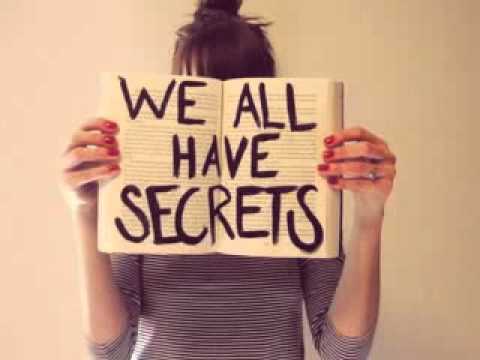
5 Secrets

we all have secrets1. I worry that people won’t like Truest— or even worse, that it will fade into obscurity within months of its release. It happens all the time.

2. I wish I was married and am envious of my friends who are. I need to move to Australia. Just about any boy with that accent will do. 😉

3. I’m a feminist. I’m only starting to say it to people.

4. A superbly written book will delight me while simultaneously plunging me into a manic state. I worry so much that I won’t measure up.

5. When I haven’t seen someone in a long time and we get together, I spend the whole time imagining they are shocked by how unhealthy I am. It makes it hard to enjoy reunions that should be special.

Your turn.

P.S. Do you know who owns this image? It’s everywhere online, and I’d love to give proper credit.

Seeking Publisher Permissions

copyrightWhen I first wrote Truest, I had lines of poetry strewn throughout its pages like seeds in a garden.

Though I’ve been focusing on fiction since 2008, I actually studied poetry in college. I love it: the mystery, the close-packed imagery, the way every word has so much weight. It was only natural that I’d include poetry in any novel I’d write.

This can create problems though.

When an author uses song lyrics or lines of poetry in her novel, she has to get permission from the original publisher to use it.

I ended up narrowing what I used down to one set of lyrics, two full poems, and three other lines of poetry. One poem was in the public domain. This includes most works first registered or published in the United States before 1923, and that means the copyright has expired, so you can use these things without seeking special permission.

For the song lyrics, I had to track down the band’s music publisher. Then I sent an email to them and was informed that, though the music was by the band, the lyrics were written by just one member, so they pointed me to another publisher. I investigated that publisher’s website, and they said their permissions were done through a different publisher, so I contacted them. Then they instructed me to seek through yet another publisher. I think I’ve landed in the right place. They just asked me for additional details about Truest. No word yet on whether they’ll say yes or no.

For one of the lines of poetry, I filled out an online form for the publisher (which, by the way– it’s not always as easy as you might think to figure out the original publisher, especially if that poet is e.e. cummings, who has poetry collections galore), and they said, “Yes. No charge.” Phew.

For the other two lines of poetry, I had to snail mail (no email accepted) a request. It was granted with stipulations– I had to pay $190 for the use for my first 10,000 copies of Truest, after which, I’d need to query again (and probably pay again too).

For the other full poem, I have heard nothing as of the writing of this blog post. It’s fair to say I’m on pins and needles over this one because the poem is pretty important to the story, and I’ll have to re-write parts of my book if I don’t get the permission here.

What’s the take-away from this?

Use things in the public domain– or write your own and attribute it to a fake poet or lyricist.

Of course there will be times when an existing line works so perfectly that you simply must use it– or else maybe it’s a famous line and the fame is part of the reason you need it. There are always exceptions. But I’m being a lot choosier about what I put in my next novel.
Vulnerability

Broken light bulb on shiny surfaceI have a friend right now who is– after many years of avoiding– finally getting help for her OCD. It’s been a journey even to summon the courage to get a diagnosis, and I’m so terribly proud of her.

One thing my friend said to me was that she was afraid to admit to people that she was broken … and that that would be the only way they’d see her from then on.

I turned the tables on her, asking, “Is that how you see me? Forever broken?”

She said, “Of course not. Quite the opposite– I’ve always admired (and envied) your strength!”

The truth of the matter is that we’re all broken. But– in my life– every time I have ponied up and shared my vulnerabilities with others, I have been met with love. I have literally had friends tell me, after I’ve confessed my struggles, “This makes me love you even more.”

If you’re like me, you’re a bit (or more) repulsed by people who “are perfect.” How in the world can they possibly understand my life? Won’t they judge me? It has to be an act, right?

I’m drawn to the real, the genuine, the honest, broken authenticity that comes when people vulnerably acknowledge their brokenness.

My own brokenness has been met, time and time again, with grace that is more precious to me than saving face.

I hope that will be your experience too.

The Art of NOT Writing: Breaks, Blocks, & Boredom

I was just answering some questions over on Quora and re-visited this. Thought I’d re-post it in case anyone’s feeling stuck lately.

Jackie Lea Sommers's avatarJACKIE LEA SOMMERS

A lot of blog readers have asked– in some form or another– how I deal with writer’s block, and also what I do when I simply don’t feel like writing.

First of all, I must admit to you that I wrote almost every single day from spring 2008 to winter 2013. In January of this year, my wunderkind writing guru Judy Hougen gave me permission to not write, and I started to take some much-needed breaks.

Secondly, you should know that I did not write from fall 2003 to fall 2006. I had just graduated from a creative writing program which had required me to put my heart through a meat grinder, and I was exhausted.

With those disclaimers out in the open, let’s dive in.

not writing2

BREAKS.

I think there’s a time and place for taking a break from writing. I have never regretted my three-year hiatus after finishing undergrad, but…

View original post 1,061 more words

Tuesday Q&A: Jessica Bishop

My friend and comrade-in-advocacy, Alison Dotson, just started a cool new series on her blog where she introduces us to inspirational people in the OCD community. Her first interview is with a young woman who just finished a round of residential treatment at McLean. Follow Alison’s blog to stay up-to-date on this series!

Alison Dotson's avatarAlison Dotson

Welcome to the first of a new series I’m launching today, Tuesday Q&A! The “Tue” in “Tuesday” kinda, sorta rhymes with “Q,” doesn’t it? (Humor me.) Over the past few years, I’ve met some pretty amazing and inspirational people in the OCD community, and I want to share some of their stories with you.

Jessica

Let’s kick it off with Jessica Bishop, a 24-year-old who has OCD–and who’s working to spread awareness and give others hope.

Q. Jess, you’re such an inspiration. I chose you for my first Q&A because you recently completed residential treatment at McLean Hospital in Boston and are now doing well back in the “real world.” How did you realize this more intensive type of treatment was right for you? Did you try other treatments first?

A. I realized that this type of treatment was right for me because I was attending therapy three times a week, which did not help…

View original post 630 more words

Bed Feng Shui

BRASS COMPASSI know you’re going to think I’m kidding, but the truth of the matter is that I don’t sleep well if my bed is aligned east-west.

My first experience of this was in high school. My sister and I shared a room for most of our childhood, and both of our beds had the headboard pointing north. Our room was small-ish. There weren’t a lot of ways to arrange it. Still, we made a crazy switch in high school (a terrible switch that HGTV would have murdered us for) and realigned the beds. One headboard faced east and one west.

I had nightmares every night for a week– then we changed the room back.

Over the years, I started to learn this about myself. When I would move into a new place, the first thing I would check in a room would be to make sure that I could align my bed the right way.

Back in June of 2012, I took a writing retreat to Wisconsin. I was six months into writing the book that would become Truest, though at that point, it was still a year away from being finished. I stayed outside of Hudson in a little apartment, and I. slept. HORRIBLY. Just awful. Every night. After a couple nights of this, it suddenly occurred to me, “Maybe this bed is east-west.” I was in an unfamiliar place and couldn’t figure out my directions, so I looked it up on Google Maps, figured out my location, and … east-west.

Last month, I stayed in Duluth to write. I noticed immediately that my bed was east-west. Sure enough: the first two nights, I slept terribly. Eventually, my poor sleep caught up with me and I was able to konk out the last couple nights.

I know it sounds crazy, but actually, some people (including me) think there’s really something to it. Apparently it has to do with the earth’s magnetic fields. If you google it, you’ll find a bunch of articles.

Check out this one:

Scientists have long suspected that humans like many other animal species have an innate magnetic compass, but have been unsure as to how this affects us. The new research shows that some mammal species always graze and sleep facing north or south and that the earth’s magnetic field is probably polarizing and causing his.

Following this, further studies have suggested that humans who sleep in an East-West position have far shorter rapid eye movement or REM sleep cycles, in which dreams occur, compared with North-South sleepers who got more REM sleep.

Life. It’s weird, huh?

P.S. Bet you all stop now to think what direction you sleep!

HOCD More Prevalent Than You Think

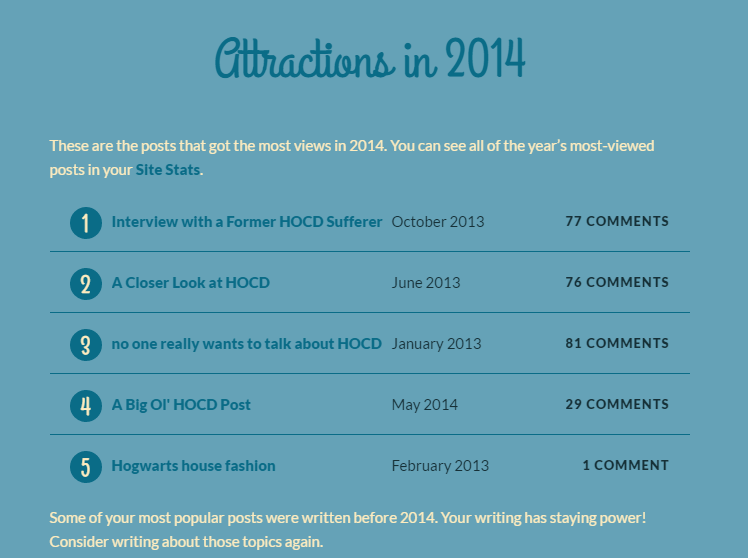
Anecdotally, I hear from more OCD sufferers dealing with HOCD than with any other kind.

Statistically, my HOCD posts get the most traffic on my blog (see graphic below).

HOCD sufferers, please know you’re not alone.

I invite you to read my interviews with “Hannah,” a former HOCD sufferer who now lives in freedom from HOCD (part one | part two).

Leave your questions below, and if I get enough, I’ll do a third interview with Hannah!

HOCD stats.jpg


Other related posts:
HOCD
A Closer Look at HOCD
A Big Ol’ HOCD Post
OCD Help

Dear Diary: January 2015

dd jan 2015 2Today is my spiritual birthday! Nineteen years ago, I made the best decision of my life and signed everything over to Jesus. It’s been a wild journey with him ever since!

This month has been packed to the gills. I celebrated the new year with my best friend Eir, I watched Truest start cropping up for pre-order on online bookstores all over, I turned 33 and didn’t have a third-of-a-century crisis in any way.

I spent close to a week up in Duluth on a writing retreat, where I hammered out 10k words in three days. I’m absolutely thrilled about my work in progress! The characters are gripping my heart, making me laugh, making me cry. And the best thing is that I’ve been absolutely LOVING the writing process lately. 2014 was a bit harrowing, and– truth be told– there were many stretches where I didn’t feel like I was enjoying writing anymore. Over and over, I’d ask myself, “Is this still what you want?” Sometimes I’d have to really think about it, but my answer always was yes. And now: to enjoy it again? Delicious. Hard, hard work. But good work.

Some exciting things are coming up for me! I’ll be reviewing my galleys soon, making last-minute changes and corrections to the manuscript, and the cover will be revealed next month! I’ve been so eager to show the world– I hope you’ll all love it as much as I do!

Poetry 2015 Review: Polar by Dobby Gibson

I’m reading one book of poetry each month this year!

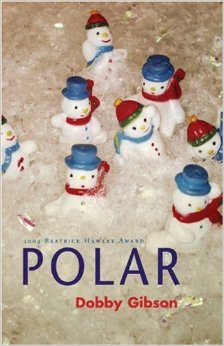
For January, I read Polar by Dobby Gibson. For February, I’ll be reading Stupid Hope by Jason Shinder. You should read it too. For a list of all poetry books I’m reading this year, click here.

polarDobby Gibson is a local poet. I’ve seen him around Minneapolis, tweeted with him a little. He used to be my friend Alison’s boss! I’ve read two of Dobby’s other books (reviews here and here), and I loved them both.

I think Polar is his first book, and I found it less accessible than his later two. That said, I still very much enjoyed it. To me, this collection felt like a blender of Billy Collins and Annie Dillard, whose poetry is nothing like the other. Dobby was a comfortable middle ground between the deeply accessible and the brilliantly obscure.

“Two hands for undressing, / one mouth for lies, / a moment for every question / we save only for ourselves.” Love this.

Or how about this? “It’s luncheon-meat cold, and even winter rain / isn’t anything new, but it hurls itself / at us like a smashed chandelier.” Yes.

One of the biggest things that stood out to me was his vocabulary, which is clearly massive. For Gibson, it’s like an arsenal that has every weapon available, and he need only choose the best one for the situation.

He does. Over and over again.

Did you read Polar this month too? What did you think? Feel free to leave a comment. If you blogged about it, include a link!

I hope you’ll track down a copy of Stupid Hope for next month!