quote for ya

Quote

“As we discussed in Chapter 1, the more you fight an obsession, the more frequent and intense it becomes.  This is called a paradoxical effect, something we all experience at times.  For instance, if someone commands you, ‘Do not think of a red elephant,’ you will automatically respond by thinking about a red elephant.”
Edna B. Foa, Ph.D., Stop Obsessing!

CBT intake

“This will be different from other kinds of therapy, Neely,” said Dr. Foster, as if he could read my mind and there see my image of Ruth.  “You’ll have homework and be expected to go through various exposures when we meet together.”  He picked up the top coaster off a stack of them on the coffee table between us and set his coffee mug on it.  It had had writing on it.  I looked at what was now the top coaster on the stack.  It read, “Uncertainty and mystery are energies of life. R.I. Fitzhenry.”

For the next hour Dr. Foster tuned in carefully for any mention of rituals, anxiety, and triggers.  I knew that he was combing through my words for his options, already working on his plan of attack for how he would prompt anxiety in me like a gun’s trigger, asking over and over, “If you couldn’t do that, would you have a lot of anxiety?” I blathered, but he was only seeking one thing: what would stress me out to the max.

“When I hear words that start with the f sound, I start praying over and over again in my head,” I revealed.  

“How would you feel if you were prevented from repeating the prayer at those times?”

My heart clenched a little in my chest.  My prayer was the key to counteracting the whole chain of ugliness that lead to blasphemy and hell.  “Um, anxious, nervous, crazy.”

“Mmm hmmm.”  Dr. Foster was jotting notes furiously.

“It’s because of hell,” I shared, explaining how curse words and the sound of the letter f  made me think of cursing the Holy Spirit, which I believed to be unforgivable.  “I’m always scared of hell—only sometimes it’s in the background, like elevator music.”

 He continued to write and encouraged me to keep talking.  “When you’re nervous about going to hell, how do you calm yourself down?”

 “I can’t calm myself down,” I admitted.  “But I ask my friends and family what they think.  Even though it doesn’t convince me, I still like to hear them say I’m okay.”

 “Hmm,” said Dr. Foster in recognition.  “Seeking reassurance is another of your compulsions, another thing you do to ease your anxiety.  Pay attention this week—I bet sometimes you do this passively, like mentioning that you’re a bad person.  Watch for it.”

 We continued on this way, Dr. Foster asking the questions and me providing the answers, feeling ridiculous and unhelpful and as if I were maybe wasting Dr. Foster’s time. 

 “Do you have any questions?” he asked as we were wrapping things up.

 “My faith plays a huge role in my OCD,” I said.  “Do you … ”                                  

 “I believe in God, yes,” he interrupted.  The way he spoke made me certain that he did not feel about God the way that I did.  I gulped.

 “Ninety-nine-point-nine percent of people are skeptical going into this,” he told me, his face like a stone.  I wondered if he ever smiled, even at home.

 “Okay, because I am,” I said.  It felt appropriate to tell him this, even though I was intimidated by his seriousness.  “I think I understand how this works,” I said, “but I’m a little confused.  Like, for example, a washer would be prevented from washing, and then they’d realize that nothing bad happened when they didn’t wash—they still lived.  So how will that work for me?”

 “You’re misunderstanding a fundamental part of cognitive-behavioral therapy,” said Dr. Foster, folding his hands across his stomach.  “The point is not to take away the person’s uncertainty.  The point is to make him or her okay with uncertainty.”

Well.  That didn’t sound so good.

He continued, “Just because a washer doesn’t get contaminated after being prevented from washing one time doesn’t mean that the person won’t still fear a deadly disease the next time.  Each time is a new adventure.”  He raised his eyebrows.  “And with you, well, we can’t fast-forward to the end of your life and see whether you’re going to heaven or hell.  CBT will teach you how to live with uncertainty.”  He tapped on the top coaster in the pile.  “Energies of life.”

“Light is sown like seed for the righteous
And gladness for the upright in heart.”
Psalm 97:11

The mighty Creator reaches into the canvas bag
slung over His celestial shoulder, and His hands,
which hold the cosmos, take out a small
ball of light like a tiny white sun.

He gently runs his hand over the top of the sphere
and tiny particles break off from the surface like
pin pricks of light, like glitter, which He takes and
scatters toward the earth, a gift for His people.

There is still that glowing orb of gladness in His hands.
He rakes a furrow into the surface of my chest
and places it there with His own fingers,
then closes the rut with His palm.

exhausted

I remember feeling SO tired … but not in a I-didn’t-get-enough-sleep way.  Just in a deep, heavy-hearted, there-are-too-many-things-to-manage kind of way … including all your thoughts, which are vomitting all over your mind.

There is rest available.  I wish I could get you to believe that.

“Yes, keep it up,” repeated Dr. Lee, “and you will beat this still.  There is rest for you ahead.”  He narrowed his eyes at me as if he were imagining my successful future.  “But not yet. For now, more work.”

More on CBT this week.

I have a friend who is struggling with depression right now.  She has plans to see a therapist soon, but today, she told me that she feels ashamed.  “Like if Jesus is the savior of my life, why am I like this?” she asked me.

My poor, dear friend.  I’ve been there.  All the questions, most notably: why doesn’t it seem like Jesus is enough?  I am definitely that cheeky pot that sassed back to the Potter, “WHY did you make me like THIS?”  There was no answer for a long time.  But now that I’ve been sharing my story– in chapels, youth groups, online, in personal conversations, and in my novel– and I see the way that God is using it … well, I get it now.

My friend feels ashamed.  I told her not to feel that way.  But as I sat at my office desk and thought about it some more, it settled over me that as sinners, our shame is natural– but Christ has redeemed His people, has lifted up our heads.  Do the two cancel each other out?

And to my mind came this quote from Aslan, “You come of the Lord Adam and the Lady Eve.  And that is both honor enough to erect the head of the poorest beggar, and shame enough to bow the shoulders of the greatest emperor on earth. Be content.”

I am not saying that we should be happy for mental illness. 

But I am confident that God knows what He is doing.  He has His reasons. 

God, give us faith to trust You.


MMPI

That is, the Minnesota Multiphasic Personality Inventory.

It’s 567 true-or-false questions, and I had to take it when I started meeting with my first therapist (whom I disliked and called “Shrinkie” behind her back).

567 questions takes a long time.

567 questions for an obsessive-compulsive takes even longer.

I kept running into statements and BEATING THEM TO DEATH WITH MY BRAIN.

For example, I believe one of the questions was similar to the following:
I believe God hears me when I pray to Him.

Thought process:
I am a Christian– I should put yes.  But then again, I have committed the unforgivable sin, so He probably doesn’t hear my prayers.  But do I really believe I’ve committed that sin?  Maybe.  Maybe not.  Probably.  I should just put yes.  They want me to put yes because it will help the test to identify my beliefs.  But what if that is inconsistent with my beliefs?  On the other hand, maybe I should put no, because then it will identify that as an issue for me.  It’s definitely an issue for me.  But could I really, honestly say that I don’t believe God hears me when I pray?  I’m just being silly when I think that, right?  As a Christian, I should put yes.  I believe yes.  But then again, maybe I’m not a Christian.  If I’ve committed the unforgivable sin, then how can I still call myself a Christian?  I should just put my gut reaction.  Which is yes.  But why put a gut reaction down instead of a thought-out answer?  If I really think it through, then I don’t believe it.  Well, I think I do actually believe it– TODAY– but it could very well be a concern for me tomorrow or every day next week.  Should I put down how I feel right now in this moment, or should I put down how I usually feel, which is no?  I guess that’s not how I usually feel– maybe one-third of the time.  But most so-called “Christians” would think that one-third of the time is huge, in which case, it’s a bigger deal, and I should put down no.  Really– one-third?  Seems like a lot more.  If I think about it again, it’s probably more than one-third.  It’s maybe one-third of the time really BOLD– time when I’m terrified.  But even those other two-thirds I’m still doubtful of my salvation.  It’s just quieter.  So how do I interpret that?  One-third TERROR, two-thirds doubt.  Compared to the normal, which is little to no questioning of one’s salvation, that is a LOT.  So I should put no, so that the test correctly interprets that I have major issues with this particular scenario.

Right?

I’ll come back to it later.

You get the point. 🙂

a poem

THREE DAYS WITHOUT EFFEXOR

 Streetlights reflect in puddles

like small potholes of light,

but even that image can’t inspire

the poet to breathe.

Depression sits in her like a saucer,

completely removable,

given the right circumstances,

given the right medicine.

But for now the saucer lies in her chest,

shrapnel of melancholia,

a cup overflowing with eagerness

only to sleep, to sample oblivion.

Kissing Doorknobs

The other night, I posted the following on Facebook:
I definitely feel called by God to the novel I’m writing. “Kissing Doorknobs” (a YA novel about OCD) was huge in my life … like finding a friend who understood me. I hope the same for my novel! OCD is such an alienating disorder, so anytime you can find someone/something that understands you, it’s huge, like a reminder that you’re not alone.
 
I wanted to tell everyone a little more about the book Kissing Doorknobs, a story about a young girl named Tara and her battle with OCD.  Tara counts sidewalk cracks, kisses her fingers before she touches the doorknob, and recites prayers to calm herself. 
 
After I read this book, I handed it over to my mom, knowing it would help her understand me better.  I highly recommend this quick and easy read for anyone who has or suspects they might have OCD– but also for those of you who love an obsessive-compulsive. 
 
Here are some quotes from the book that jived with me:
 
“I was eleven years old and still in possession of my own thoughts.”  Because, believe me, in the throes of it all, ugly, unwanted thoughts were being fired at me like bullets.
 
“One tear fell down my right cheek.  Unbelievably and instantly, my left cheek felt cheated!”  Yep.  I used to do this with tapping my feet or fingers.
 
“I worried about death and heaven and Judgment Day.”  It was wonderful to encounter myself in the story.  It helped me to realize that I was normal– well, normal for an OC.
 
“I wanted to confess everything.  Everything.”  Enough said.
 
“I knew my worries weren’t normal.  I knew because my friends had worries too, but they were nothing like mine.  Mine were perpetual.”  Picture a girl who cried in bed every night for three years.
 
“It was like playing two video games at once or watching television and listening to the radio.  It was noisy.  It was exhausting.  It was stressful.”  See my poem that illustrates this.
 
“[I] was too afraid of the answer to ask him the question.”  Hence, my own parents didn’t even know that I cried every night.  5th-8th grade.  Doesn’t it break your heart?
 
“She never minded my doubts and consistently reassured me that I was not going to hell.”  Raise your hand if you’ve been this person in my life.  Okay, you can all put your hands down now!
 
“It was like paying attention to a dozen things at once.”
 
“Although [my parents] wanted to help, they didn’t know how, or even what was wrong with me.”
 
“I felt sick but wasn’t sure of what.”  In my own book, I describe it this way: “a nagging feeling in the back of my throat, the feeling you get when you’ve made a huge mistake but haven’t told anyone yet.  An ugly, wooden expectancy, guilt taking up space but not quite filling the emptiness.”
 
“I suspected she was always thinking things that were different from what she said.” and “they could all think something about me that they weren’t telling me.  They could pretend.”  In my own life, it spiralled into paranoia.  I thought my friends were demons trying to trick me into hell.  More on that later; aren’t you pumped? 😉
 
“doubt that I’d ever win the war for my freedom.”  Because OCD is slavery, to be honest.
 
I love hearing your comments and questions, so please leave one on here or on Facebook.  Thanks guys!

CBT

“Tell me, Neely.  OCD—do you know about it?”

            Oh wow.  I hadn’t realized that I was going to be quizzed.  “Some,” I said.  “I’ve read a few books, some articles.”

            He nodded his head vigorously.  The sharply combed strands of black hair on his head did not budge.  “Yes,” he said.  “Yes.  Education is critical.  You know how you fight OCD?”

            I wasn’t sure if this was a rhetorical question or not.  I nodded a little, but when I saw that he was waiting for an answer, I said, “With education?”

“With knowledge.  Knowledge is the weapon,” he said, continuing to speak in italics and suddenly launching into war metaphor, “You fight disease—disease fight back.  You have to negotiate carefully.  This is a game of tricking OCD.  Invade without alerting your enemy.  Side-step into enemy territory—your own mind—and take captive a small plot of land, just what you know you can win.  You have to condition your mind to the idea of winning.  Right now, it is used to losing.  What works best is cognitive-behavioral therapy.  You have heard of it?”

The vague sickness I’d been feeling all morning suddenly gathered into a physical reality in the pit of my stomach.  It took only those three seconds to realize that this is what I’d been afraid of.  “Yes,” I said quietly.

“It is the best treatment for OCD that we know of.  Medicine is good, but CBT is better.  There is a man—Jon Foster—you will call him.  He will help you.”  He scrawled the name onto a piece of scrap paper in the messy handwriting of a doctor.  “He is young, but he is good.  You meet with him—I bet he can kill it.”

Dr. Lee met my eye just then, and I could tell he meant what he’d said.  “Kill it?” I managed to squeak out.

“Cognitive-behavioral therapy, very effective,” he said.  “OCD is never cured, but CBT brings it under control.  You will call Jon.”  It was not a question.

“Okay,” I said, taking the piece of paper with Jon Foster scrawled on it. 

I needed to leave.  I needed to process all this.  My indistinct fears now had a name, and I needed to be alone, let my head spin through this like a rolodex.  I started to collect my purse.

            “Listen,” he said, “it will be hell.”  I winced inside and hoped it hadn’t shown on my face.  “Hell,” he repeated.  “CBT is very, very difficult.  You will be asked to do things you cannot imagine doing.  But it is the best treatment.  You have to think like a mother.  A mother would do anything for her child.  You have to do anything asked of you.  But you can do it.  You are Christian.  That is good.  You will need will power and faith to get you through this.”

My heart went into a freefall, and I never felt it land anywhere inside of me.  I swallowed—or tried to.  My throat was suddenly very dry.  “Oh,” I said.  What else was there to say?

OCD101

Hopefully this scene from my novel will give you a better understanding of how OCD works; in it, Neely is attempting to explain OCD to her new friend Gabe.  (By the way, Gabe is just finishing up his chemotherapy– hence the lack of hair.)  Ask your questions in the comments!!  (I would seriously love it if every person who reads this blog asked one question!)

“So, how is Tatum’s Pizza Arcade the best place to tell me about OCD?” he asked while grease from the pizza collected at the corner of his mouth.  He wiped it away.  “I’m … rather curious.”

I’d been planning this for the last week.  “Okay,” I said, “so you get to learn about OCD in three parts tonight.  First, I’m going to tell you about it.  The second and third parts are more experiential.”

“I’m ready to learn.”

“Obsessive-compulsive disorder is basically where you have these intrusive thoughts—they come out of nowhere and assault you—and then to combat them, you perform some kind of compulsion.  Compulsions are more obvious than obsessions—washing your hands til they bleed, checking the oven or the lock on the door over and over and over, being a pack-rat to the furthest extremes, doing weird little rituals.”

“You don’t do any of those things.”

“No.  Well, kind of.  I have my own rituals.  Mine are hard to see because I’m a pure obsessional.”

“So you don’t have compulsions?”  I loved the thoughtful way he chewed his food, the earnest look in those pale blue eyes. 

“No, I do, I do.  They’re just, well, trickier to catch.  They’re mostly in my head or to myself.  Or well masked.”

“I don’t get it,” he said.  “We’re not off to a good start.  And this pizza sucks worse than I remember.”

“Let me start over.  Okay, so an obsessive-compulsive has an intrusive thought—could be anything—maybe ‘I am going to get sick and die.’  So they hate that this thought keeps hounding them, making them feel sick—so they do something about it.”

“Wash their hands,” he supplied.

“Right,” I said.  “You’re getting it.”

“So what about someone who touches the doorknob forty times or something?”

“Same thing.  There’s some intrusive thought—and they’ll perform the ritual to temporarily alleviate the sick feelings from the bad thought.”

“Okay, so how about you?”

“My intrusive thoughts are blasphemous.”

Gabe raised an eyebrow—or what was left of one.  “Liar.”

“They are,” I insisted.  “I think bad thoughts toward the Holy Spirit, and since I’m scared that doing that is unforgivable and that I’m going to hell if I think those things, my head automatically wants to combat those intrusive thoughts.  So I say a prayer, the same one over and over to bat down those thoughts.”

He frowned.  “And there’s no way to just stop them?”

“Gabe,” I said, borrowing from my old friends Jewett and Nash, “do me a favor and don’t think about a red unicorn.  What are you thinking about?”

The corners of his mouth turned up, just slightly.  “A red unicorn,” he admitted.

“Well, stop it,” I said.  “Quit thinking of the red unicorn.  Stop now.  Do not think about that red unicorn.  Stop—”

“Okay, I get it.”

“So … yeah,” I summed up.

“It’s like warfare up there?” he asked.  I nodded. 

After dinner, I said, “I want to show you something.  Come with me.  Bring the tokens.”

We walked to the kiddie arcade.  I looked around.  “What are we looking for?” asked Gabe.

“There it is!”  I pointed to an arcade machine that came up to my hips, with five small holes in the top.  I took Gabe’s hand and pulled him along behind me toward the machine then maneuvered Gabe into place in front of the game.

“Whac-a-Mole?” he asked, doubtful.
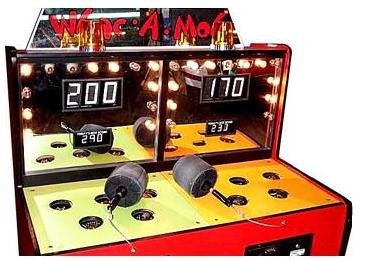
“Whac-a-Mole,” I said, inserting a token into the machine.  “Let’s see you go, Reed.”  I slapped him on the back for luck.

He made a big show of it, shaking out his shoulders, squaring his jaw, performing minor stretches.  I laughed when the plastic moles covered in weathered paint began to pop up randomly from the five holes.  Gabe jumped into action, reached for the foam-covered mallet and began to attack the moles, forcing them back into their respective holes as they showed their faces.

Gabe was pretty good—at least, at first.  The game began slowly, with moles creeping leisurely out of their holes.  But in a short time, several moles began to pop up at each time, and Gabe struggled to keep up.  Before long, the moles were out of control, popping up for only a split-second.  Gabe let out a choked, surprised laugh as the game sped up even faster.  He was wielding the mallet like a boy swiping at the air with a toy sword. 

As the machine lit up and the moles retreated, I laughed at Gabe, who looked legitimately surprised to be getting his butt kicked by five plastic mammals.  Three red tickets popped out of the dispenser attached to the arcade machine.  “What’re those for?” he asked, mallet still in his hand, limp at his side.

“The better you are, the more tickets you get.  Then you trade them in for prizes.”

His jaw dropped.  I threw my head back and laughed.  “Three measly tickets?” he said.  “Put in another token.”  He wound up with the mallet as if it were a baseball bat.

Gabe played a few more games, getting better and better, the red tickets spewing out of the machine like an overgrown tongue.  Still the machine overwhelmed him by the end of every round.

He was no idiot.  “So, this is some sort of metaphor for OCD?” he deduced.  “The experiential part of tonight?”

I smiled.  “You got it.  Blasphemous thought—mole rising.  Say my prayer—bash it down.  Blasphemous thought—mole rising.  Say my prayer—bash it down.  Now, Mr. Reed,” I said, lowering my voice, “this time, pretend it’s salvation on the line.  If you mess this game up—misstep somewhere—you go to hell.  Hell being where you are forever separated from the person you love the most.”  I dropped another token into the machine; in the middle of the cries of kids and beeps and clangs of arcade games, I could swear that I heard that token hit its fellows in the collection bin beneath the token slot.

Gabe frowned but played his hardest.  In the end, when the game had once again gone out of control, it ended.  Another string of tickets whirred out of the dispenser, but Gabe only looked at me, and even when I smiled at him, his blue eyes were sad.  “I’m sorry,” he said.