Resistance: The War of Art

war-of-art4I had in the past attempted to read Steven Pressfield’s The War of Art: Break Through the Blocks and Win Your Inner Creative Battles, but I’d been waylaid, I think due to the way he talks about mental illness in the book.

But this time I pressed through, and I really enjoyed it! I listened to the audio book on a long trip for work, and it only took about three hours from beginning to end. I probably could have read it even faster with the book in my hand.

The War of Art is about Resistance. It’s about anything that stops us from getting our creative work done– and about how to overcome it. Pressfield makes an extensive list of things that play into resistance: procrastination, of course, but also sex, trouble, drama, victimhood, self-doubt, fear, criticism, love, stardom. He’s not afraid to add things to the list that you and I would rather keep off it. This was pretty eye-opening for me.
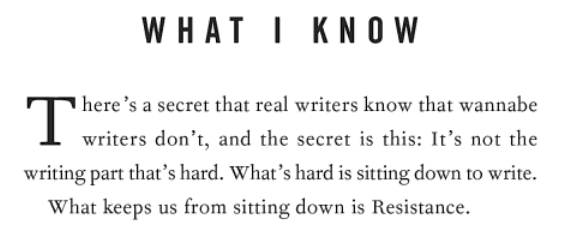
war-of-art

In the second part of the book, he talks about “becoming a pro”– how to overcome Resistance. To be a professional, we need to show up, be prepared, be patient, ask for help, accept no excuses, among other things.

A quick excerpt:

In my younger days dodging the draft, I somehow wound up in the Marine Corps. There’s a myth that Marine training turns baby-faced recruits into bloodthirsty killers. Trust me, the Marine Crops is not that efficient. What it does teach, however, is a lot more useful.

The Marine Corps teaches you how to be miserable.

This is invaluable for an artist.

Wow. Pressfield goes on to say:

The artist committing himself to his calling has volunteered for hell, whether he knows it or not. He will be dining for the duration on a diet of isolation, rejection, self-doubt, despair, ridicule, contempt, and humiliation.

Tell us how you really feel, Steven. 😉

But, honestly, this resonated with me. Writing is a mix of joy and misery; publication too. But what am I supposed to do? Ignore my calling? No. I need to become a pro.
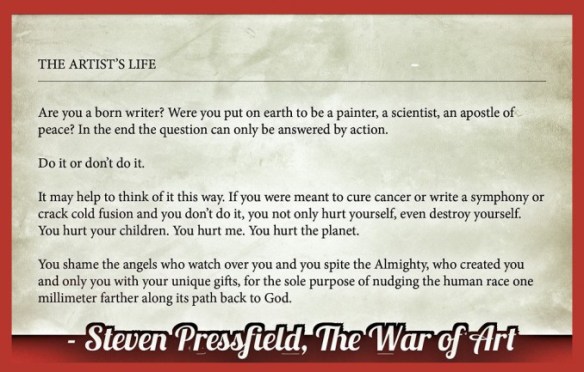
war-of-art3

In the last part of his book, Pressfield talks about muses and angels– he takes the book to a whole other plane, reflecting on how the artist isn’t really in charge anyway. I’m sure he loses a lot of readers here, but not this girl. As a person of faith, I already believe something similar.

All told, this was a fast read and well worth it. In the days since finishing it, I’ve been able to recognize areas of Resistance in my life and to deal with them accordingly. Great, thoughtful book.
Thoughts on ERP, Writing, & Uncertainty

Uncertainty.

For so many years, it was my enemy– or so I perceived it, especially because full-blown clinical obsessive-compulsive disorder made me fear and reject uncertainty even more than the average bear. Everything in my life was about pursuing certainty, answers, black & white.

And, of course, I was miserable.

In 2008, I went through the harrowing but ultimately beautiful process of exposure therapy, which took my OCD out at the knees, giving me the bandwidth to live with uncertainty, questions, and all the shades of gray.

It’s only recently that I’ve recognized exposure therapy as the training ground (or maybe even battle ground) that would let me later pursue my dreams of being an author.

A hard truth: writing is full of uncertainty. 

uncertainty2

Not just writing– but publishing itself too. There is this crazy-making stretch of life in the middle of writing a book that feels both unclear and perpetual. What is this book really about? Who are these characters? Can I do this? Can I finish this? Is this story going to matter to anyone but me? Is this going to even matter to me? Will my writing group like it? Will my agent? My editor? Readers? Will I find success? Will I get another contract?

The writing life is, for many of us (and especially for younger writers), a world in grayscale: a constant state of uncertainty that we have to persist in in order to find any relief or success.

For as many days as I think I’m totally failing at life and writing, I have to remember what it would have been like to be writing and publishing before exposure therapy, back when uncertainty was unbearable. I’m not even sure how it would have been possible to be doing what I’m doing now without exposure therapy laying the groundwork for me to bear the not-knowing, let alone to thrive in it.

“The world doesn’t work that way.” I hear myself and other OCD awareness advocates saying this to sufferers all the time. In context, we mean, “Life inherently is full of uncertainty. You cannot eliminate it.”

The truth of that hits me over and over again in the field of writing.

Exposure therapy was the terrible, grueling practice for the writing life. Uncertainty is rampant; I try to keep my arms open.


Expectations vs. Reality

I just sent myself a letter five years into the future about what my expectations of being a published author were versus what my reality looks like. The chasm is vast and disappointing, and I needed to write this letter just to put it down in words and to cast it into the future with the wild hope that I won’t always be as lost as I feel right now.

My friend Kathy Ellen recently posted this on one of her Instagram accounts:

great mail day

It made me think.

What if the thing that has made me unhappiest is also the thing that has made me happiest?

Do you run to or from a paradox?

Perfectionism Digs a Deep Hole

Exhibit A.

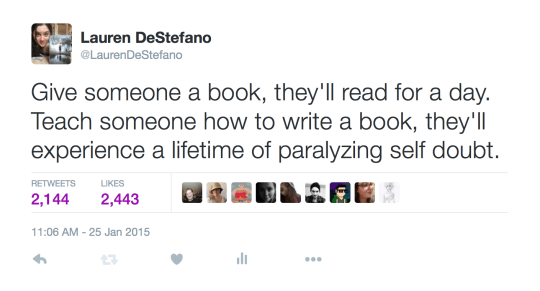
doubt

Exhibit B.

mm no

Exhibit C.

ideas

Exhibit D.

brene

Exhibit E.

Runner crossing finish line

Achiever. That’s honestly my #2 strength after Learner via StrengthsFinder. But so often it doesn’t feel like a strength; it feels crippling.

Perfectionism is something I’ve battled my whole life. I didn’t just want an A on the test, I wanted the highest score in the class. I might get 100% but if someone else also got an extra credit point, I’d feel like I didn’t perform well.

Performer. My freedom from OCD has given me so much freedom in this area too. I’m learning that my worth isn’t based on my performance.

But it’s still a lie I all too often believe.

I’m a writer. But I can never measure up to my own standards for myself, and so I walk around defeated even when I’m living my dream.

I don’t have answers to this. I just needed to share. Thanks for listening.

Reflection on my 2-Year Anniversary of My Book Deal

So, today is not actually the anniversary of my book deal. That was two days ago. But today is the day that I announced it on social media. And while congratulations and accolades were pouring in from all over, I was experiencing my first panic attack.

I’m still not sure if I should call those experiences in late 2013 panic attacks. They were certainly brought on by panic. And they were certainly extremely physical. If there’s a better way for me to label it, please let me know.

It’s weird to look back on it now. On this day in 2013, I talked to my beloved editor for the first time. It was a wonderful call. She told me how much she loved my characters and my story, how excited she was to work with me. And then, she mentioned– almost in passing– such a significant change to my story that, later that night, I experienced the most visceral, physical reaction I’ve maybe ever gone through.

Just another reminder how much social media lies. In my memory, I was replying to comments about how excited I was– while I was sobbing in my apartment, praying my guts out, my heart racing, my mind racing, everything racing.

This pattern would unfortunately continue for a few months. Finally, I talked to my psychiatrist about the panic, about how I wanted something– anything– that would reduce the physical reaction. That’s when I first got my prescription for Ativan (Lorezapam). I continue to take this very sparingly, usually just a few times a month, though sometimes more than once in a day.

This also prompted me to go back into therapy. I started meeting with Amanda, my darling therapist, who has been a voice of reason, a true supporter, and– best yet– someone who legitimately likes me. I am still meeting with her, although now it’s about once a month, whereas we used to meet once a week.

And here’s the thing: I survived. I learned how to communicate with my editor. I learned how we are partners. I took nearly all of her suggestions– but I held out on that one, the one thing that caused that first night of extreme panic. And in the end, I can truly say that I love my novel. I’m so happy with how it turned out, so proud of it.

I’ve learned such a tremendous amount about publishing and writing and myself over the last two years. And I’m not ashamed of the Ativan or of the therapy; how could I be ashamed of getting myself help when I recognized I needed it? I’ve learned how to partner with an editor. I’ve learned how and when to disagree with an editor. I’m a better, smarter person and a better, cleverer writer and have a better, clearer understanding of my emotional and chemical make-up.

The last two years were some of the hardest of my life. But some of the best.

Being a Creator is Uncomfortable

Writing a novel is a long, difficult journey full of emotions. Some days I’m thrilled with my work; some days it disgusts me. Sometimes I feel a sort of writer’s high; often I am in a slump.

But amidst all the join and pain of writing, I experience this level of … discomfort. Discomfort is probably the best word for it.

unsplash9

I’ve been thinking a little bit about it, and I have a few random thoughts. Do you care if I use bullet points? Thanks.

  • My discomfort stems from having something incomplete. I understand that the nature of creation is that something is being created and that likely doesn’t happen in a moment. But I hate having messy drafts. I want to know that if I got hit by a bus today, something could still be done with my manuscript. (Gruesome much, Sommers?)
  • I think this discomfort is a huge reason for how driven I am in writing. I go into beast mode as I write and revise. And it’s all because I want to get the manuscript back to a modicum of order.
  • Does this say something about my innate desire for order? Maybe. (Though you would not think that if you looked at my bedroom. #tornado)
  • I’m thinking about God creating– some think he made the world in a literal six days (and rested on the seventh), some think those days are just metaphors, some think there is no God. But I’m intrigued at the idea of him hammering through all this creative work and then finally getting a chance to rest. Sometimes I feel that way too. I have to get this work done before I can properly rest and recover.
  • I understand that I need to learn to live with this discomfort. It’s been the major lesson of my adult life: learning to embrace uncertainty, learning to stay knee-deep in discomfort until I acclimate. I am trying to stretch these lessons to my creative life. I tell myself I only need to revise 1000 words a day … but then I barrel through and do 10k because I can and because it’s uncomfortable and because I want to get things back to good. But how much more will I learn if I stay in the discomfort? I don’t know.

Just some thoughts for you. Would love to hear if these ideas prompted any reaction in you.

Thanks for being lovely.