looking back … and ahead

2012 was a good year.

In January, I had just aside my OCD manuscript and was 50 pages into writing adult fiction about a woman who was a late discovery adoptee when I read The Fault in Our Stars by John Green.  The book walloped me in the best way possible, inspiring me to drop the LDA story and try my hand at young adult literature.  12 months later, I am head-over-heels in love with writing for this demographic– not to mention deeply in love with the characters in my book.

In February, I posted one of my most frequented links, about how medication is scary.

In March, my friend Ashley encouraged me to get serious about my blogging, and the rest is history.  I started blogging with a lot more frequency after that, trying to refine and define what exactly Lights All Around was about.  In the end, it boils down to three things: faith, creativity, and OCD.

I believe it was in April that I wrote and submitted a post for the Rage Against the Minivan blog, never guessing that it would actually be chosen and posted months and months later.

In May, I left my job in management, moving into my old role as an admission counselor only.  At the time, it was devastating to me, but in the months since, I have come to realize it was a true blessing in disguise.  I had wondered if it might, but it was hard to see past the sadness.

In June, I spent a week tucked away in an apartment above a Wisconsin garage, writing like a maniac and finishing the first draft of Truest.  It was a bad draft, but that’s what first drafts are supposed to be.  At least it was in the computer.

July, I nursed my crush on the Olympian Michael Phelps and posted a mildly scandalous short story about Adam and Eve, one of my most-commented-on posts.

In August, I read The Night Circus by Erin Morgenstern, which, alongside The Fault in Our Stars, was one of the best books I read all year.  (I love that I can measure my months by the words I encountered.)

September marked the end of an era as I ventured to the University of Minnesota Medical Center to meet with my beloved psychiatrist for the final time before he retired.

In October, the International OCD Foundation flew me out to an event of theirs in Boston to read an excerpt from my OCD novel that had won an international creative expression contest.  There, I fell in love with the IOCDF.

November I decided to speak out even louder than usual about cognitive-behavioral therapy, explaining to blog readers what my life was like before and after CBT and also details of what my CBT experience was like.  I got emails from people after this, asking for even more details, even some fellow Minnesotans wondering specifically about my own therapist.

In December, I finished yet another draft of Truest while on an artist retreat I had been selected for.  I am committed to this story.  My writing group has helped and continues to help me SO MUCH with revisions, and I decided to purchase a short mentorship with a Minneapolis editor.

Which brings us to now.  And what’s ahead for me?

I have gotten into the habit of blogging, and I love it.  I will keep speaking loudly about OCD and CBT and ERP.  God has been so good and so faithful to me, and even today, when I was feeling very low, I was still able to be grateful that I have a permanent love in my savior.  I will keep reading as much as I possibly can and review the books here on my blog.  I will keep writing– because I love it, and because I crave it, and because I have to.  I will continue to meet with my brilliant writing group and start my online mentorship next month.

2012 was good.  Here’s to an amazing 2013.

20122013

enabling OCD and telling the truth

I have not written about this in the past because this is not an area that I have a good grasp on.  To me, there is a fine line between enabling an obsessive-compulsive and just being a helpful supporter of that person.  When I was going through cognitive-behavioral therapy, my therapist had me tell my roommate and friends that they were no longer able to reassure me about anything silly.  I was instructed to tell them that if they did this, it would interfere with my therapy and decrease its opportunity for success.

So, all those times when I would ask, “Do you think that is okay?  Is this sinful?  Do you think I’m going to hell?” … they were supposed to answer it with something like, “I’m not allowed to answer that question.”  Or “I don’t answer silly questions.”  Or “I’m not going to answer and enable your OCD.”

It’s a hard position for them to be in.  For the OC too!

As a Christian who believes the Bible when it says, “The truth will set you free,” I had (and still have) a hard time thinking that it is not helpful for a friend to tell someone the truth– shouldn’t that help set them free?

But then I think how I asked those questions for years and years, and all that stated truth piled up like a mountain but never moved me.  Why was it that listening to a LIE– an audio recording telling me repeatedly that I was going to hell– is what ultimately unlocked the doors of my prison?

A student at the university where I worked asked me that earlier this fall– how listening to a lie could rescue me.  I didn’t have an answer for her then.  The more I thought about it afterward though, I realized that what had happened was that listening repeatedly to a lie started to make the lie SOUND like a lie– and that was the truth!  CBT helped me recognize truth, and so in that way, it was still truth that set me free.

Does that make sense?

I’m still processing all of this and would love insight on this!

~4

OCD and suicidal thoughts

Recently Janet at the OCDtalk blog posted about her friend whose obsessive-compulsive son had just committed suicide.  The post broke my heart.  It reminded me of earlier this fall in Boston where I met Denis Asselin, the winner of the International OCD Foundation Hero Award.  Denis’s son Nathaniel, who suffered from intense body dysmorphic disorder (on the OCD spectrum), took his own life in 2011.  It was beautiful but devastating to listen to him talk about his beloved son.  My heart is heavy as I think about these families, now missing an important member, and about the horrific pain that these young men were experiencing that made them see no other way out.

It’s a dark, heavy topic, but tragically important to discuss.

OCD is so often thought of as simply being neat or orderly– or sometimes even anal retentive about certain things.  Media portrays obsessive-compulsive disorder as a quirky, nitpicky, and sometimes comical disorder, but let me level with you: OCD is debilitating, devastating, and torturous.

Can you imagine feeling nothing but sheer, unadulterated terror for days, sometimes weeks, on end?

I remember some of my darkest, hardest, most terrifying days.  I lived in the Brighton Village Apartments with Becky and Tricia.  During the day, I was given the small grace of suspending my obsessions– at least enough to make it through work (most days– not all), for which I am grateful.  In the evenings, I would return to our apartment, where I would drown in an ocean of terror.  My soul felt untethered, lost, condemned; I felt the hot, ugly breath of hell on my neck all evening.  I felt unforgiven and completely cut off from the God I wanted so desperately.  (It is making me cry right now as I write about those dark days.)  And the torture of not knowing— heaven or hell?  saved or condemned?  found or eternally lost?  heard or ignored?– was the worst kind of mental anguish.

Those apartment buildings were built like an X, with the pool and laundry facilities at the center where all four wings came together.  I remember– and this is not an isolated event but something that happened every time I was in that third-floor laundry room– I would look over the balcony down to the first-floor pool area, usually empty, and I would thinkIf I threw myself off this ledge head-first, I would finally know: heaven or hell.  I would have my answer, instead of the torture of not knowing.

But what if the answer was hell?  I couldn’t hurry that on.  What I wanted even more was annihilation— to cease to exist.  I craved oblivion.  That is true pain for you.

I realized that I was already in hell– just of a different stripe.  I was living like a condemned person, in TERROR and heartache and loneliness, and in constant combat with the blasphemous thoughts that plagued my mind.

Most people wouldn’t have guessed it.  I smiled a lot at work.  I even managed to fool those closest to me who knew the anguish I was experiencing.  But I would look over that balcony at the hard floor, and I would think about it.  OCD is that devastating.  I believe obsessive-compulsives (even those who take their own lives) are some of the strongest people you will ever meet.  They fight a constant war.  It is no wonder to me that many want to lay down their weapons and surrender.

And yet, here I am, eight years later, happy and healthy and secure in my faith, enjoying life and friendships and a growing relationship with Jesus Christ.  I am not tormented by my own thoughts, and uncertainty isn’t anguish any longer.  I want to gently take the faces of the anguished obsessive-compulsives into my hands, stare them directly in the eye, and tell them, There is hope.  There is help.  It doesn’t have to stay this way.  I would hug them and cry with them and personally drive them to my cognitive-behavioral therapist.  I was once where you are.  Follow me to freedom.

If you are struggling today with intrusive thoughts, obsessions that plague you, compulsions that take over your life, THERE IS HOPE.  I promise you.  This is a disorder– just a disorder, albeit a powerful, ugly, life-thieving one.  Follow me to freedom.  There is Truth, and it is not what you are hearing from your OCD.  Rescue is possible.  Follow me to freedom.  Email me.  Joy, happiness, laughter, truth, peace, safety– these may seem like impossibilities, but they can be yours too.

suicide

OCD and the Unpardonable Sin

Scrupulosity: OCD centered around religious themes.

The story of my life.

The obsession: for many years, my head would repeat blasphemous things over and over, sometimes triggered by certain sounds and sometimes by non-specific phrases about hell, demons, souls, the devil.

The compulsion: I began to repeat one particular phrase– “Father God, I love You”– over and over in my head as a way to stem the other thoughts.

It became very difficult to handle everything that was going on: these blasphemous thoughts would crowd me– I mean, really crowd me (the image I have is of these thoughts bumping and grinding on me like dirty brutes at a dance club), and I’d be warding them off by repeating this repetitive prayer over and over (and over and over and over).  And on the outside, it didn’t look like anything.

Those who were closest to me (dear friends and roommates and family members) knew that I was going through hell, but they couldn’t see the battle that was taking place.  They only knew of it when I told them or on nights when I broke down sobbing in fear of eternal damnation.

It is hard to describe exactly what it feels like to feel as though you’re wearing a sentence of hell on your shoulders.  Here’s a shot:

Condemnation (or supposed condemnation) is like being in a tank of water with only inches of air at the top.  You have to lean your head back to put your lips to the air, and the whole while you must keep treading water.  There is no opportunity for distraction.  It consumes every moment of your life.

Anyone reading this understand me?

If so, please read this sermon.  I think it might help.  My heart aches for you, but there is hope.  Lovers of Jesus Christ don’t belong in hell.  Let’s talk.

Mental illness is a medical problem.

One thing that frustrates me to no end is when people treat mental illness like moodiness, as if you can just snap out of it, instead of like the medical issue it is.  This mindset is so pervasive that it has infiltrated even those with mental disorders.  It broke my heart to sit across the table from an obsessive-compulsive who thought she should be able to just “pray away” her OCD.  Now, of course I think that prayer matters.  But I think also that you pray about cancer– and then undergo chemotherapy— and pray some more.

whatifwe

OCD stereotypes and Pure-O

Just like any other group, obsessive-compulsives have their own stereotype, which is quite often perpetuated by media.  When most people hear “OCD,” they think of a neat-freak.  The truth of the matter is that, for some, washing and ordering are just symptoms of the problem.  Oh, and about 2/3rds of OCs are hoarders, so … yeah, that neat-freak stereotype falls a little flat.

monk

Personally, I identify as a pure obsessional (in our community we call it “pure-o”), which is actually a misnomer, because we pure-o’s still have compulsions.  My most common obsessions were about sin and hell, and then my primary compulsions were seeking reassurance* and internal repetitive prayer.**

* This usually centered around whether or not I was hellbound or whether or not something was “okay” and not sinful.  With some people, it would be an overt, “Do you think this was wrong?” or “Do you think I’m going to hell?” but with others, I would be more passive about it.  For example, at work, I would say something like, “I am terrible at this,” and then wait for someone to say, “No, Jackie, you’re not!  You’re great at your job!”  Both are forms of seeking reassurance, and it is a real compulsion.  I know because if I would try to keep myself from doing it, my heart would flood with terror.

** This was prompted by certain words and sounds– for me, usually curse words, words that sounded like curse words, and the sound of the letter f– and would include repeating the phrase “Father God, I love You; Father God, I love You” over and over in my head.  This was my way to combat the direction I knew my mind would go when I heard those sounds, which would be to curse at the Holy Spirit, what I believed to be unforgivable.

If you weren’t a close friend of mine, chances are you probably wouldn’t even notice my compulsions (although a roommate did notice what appeared to be a facial tic– when the repetitive prayer was cycling through my mind and someone was having a conversation with me, it would be so hard to keep both going that I would shake my head– just a little bit, like an Etch-a-Sketch– to “clear away” that repetitive prayer, et al, and focus back on what my friend was saying).  So there’s that.

And I am not a neat-freak.  Not by a long-shot.  Ask anyone who has ever lived with me, and they will tell you that I am a slob.  My friend Tracy would say I’m a “piggy”!

I know obsessive-compulsives who are washers, checkers, orderers, hoarders, but actually, most of those I talk to are pure-o.  You live with us, work with us, are friends with us– and you don’t even know it because we don’t fit the stereotype.  There is this joke that goes “I have CDO.  It’s obsessive-compulsive disorder, but the letters are in alphabetical order AS THEY SHOULD BE,” and I just find it so annoying because it seems to belittle OCD so much.  Even for those who are orderers and who would be upset by something like that.  People just don’t understand that there is a drive– a terror– so much fear and this feeling of disgust and wrongness if we don’t perform our compulsions.

It’s so much more than being organized or neat, even for those who are organized and neat.

What are some stereotypes you or others have of OCD?  I’d love to share the truth!

Oh, and don’t even get me started on the non-obsessive-compulsive people (those who are just straight-up clean or quirky) who then label themselves as “OCD” … grrrrrrrrrrrrrrrrrrrrr.  Yeah, maybe if it stood for “obnoxious chump disorder.”  😉


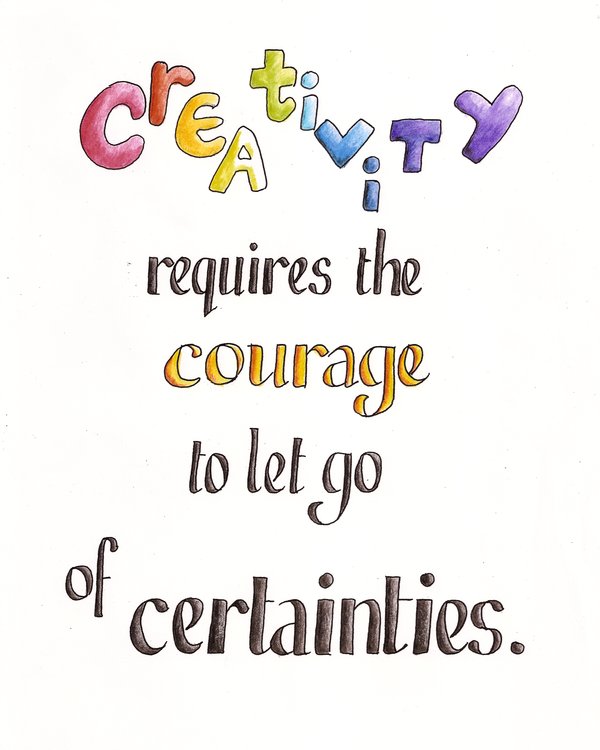
letting go of certainties


I thought this picture was particularly fascinating because you can replace “creativity” with “cognitive-behavioral therapy.”    And those are two of the most important things in my life.

I always thought that certainty was the goal and that doubt was the adversary, but it was just another lie.

What do you think of this quote?

the two biggest liars I know

The two biggest liars I know:

1) Satan, the father of lies.

2) Obsessive-compulsive disorder.

And one of the most often-repeated and terrifying lies is this: you will always feel this way.

It’s not true.  It’s not only a lie but a dangerous one– it pushes us to do something to relieve the anxiety.  And then those compulsions become their own monsters.  We build our lives on this ugly foundation of deception.

Thoughts are just thoughts; they do not necessitate actions.  OCD tells lies like you will hurt your child, you will cause someone to kill himself, if you don’t do that just right then something bad will happen, it is all your responsibility.

LIES.

You do not keep the world spinning on your own.

In fact, you don’t keep it spinning at all.

Learn the enemy’s voice– and when you hear it, know that what it says is a lie.  It’s the only language it speaks.

holidays are hard for some of us

Last year, I posted that Christmas isn’t fun for everyone, and today I am thinking again how that is true.  And not only Christmas, but other holidays too.

Thanksgiving is just behind us, and to be honest, I am glad.  Mine was fine, very lowkey– I spent it with my sister and brother, eating pizza and banana cream pie, watching the Dallas game and hushing my voice when the Cowboys fell behind the Redskins and my brother raged at the TV screen.  It was fun, very chill, lazy, and we all met up at Mom and Dad’s house, even though the parents were in Missouri to see Grandma and the rest of Mom’s family.

But it’s these winter holidays that do me in.  While everyone else is giddy with anticipation, I am anxious mostly for them to be OVER.  Somehow there is an expectancy surrounding the actual holiday, something that stresses me out and makes me just want to return to normalcy.

I think, for me, it’s a combination of the cold weather (it snowed all afternoon in Minnesota on Thanksgiving), the claustrophobia of bundling up in jackets and scarves, real or imagined seasonal depression, and memories of high school, when the holidays were the hardest.

1997.  Thanksgiving.  It was the first real breakdown of my life.  I can remember it like it was yesterday and not fifteen years ago.  Was God real?  How could anyone ever really know?  And if I didn’t know, then wasn’t I hellbound?  (Such a paradox, I know– if there was no God or heaven, then there would also be no hell.)  I was in 10th grade, and OCD was swallowing me whole, and it would still be another seven years before it would even have a name.

I was in Missouri with the rest of the family, breaking away from the games and conversation and cooking upstairs to retreat to Grandma’s basement, lock myself in the bathroom, and sob.  The ground had been taken from underneath my feet, and all I could do was weep– all while hiding it from the rest of the family, all those happy Christians upstairs, secure in their beliefs.

I can picture myself now, doubled over on the bathroom floor, lost and sad and scared and not understanding that God Himself could supercede my disbelief and make Himself known to me.  It was a dark year that followed.  I was scared of everything, especially of dying without knowing that God was real.  I held my breath when I’d pass a car on the highway, knowing I was inches from my death– and maybe eternal death.

OCD, you thief.  I hate you with such intensity.

For years after that, I could not return to Missouri without being triggered into a complete relapse which would take weeks to recover from.  Once I went to college, I refused to return.  I wonder what my mom’s side of the family thought– if they wondered if I was stuck-up or selfish for not making that 11-hour drive to see them.  It was only once a year, for goodness sakes.  They didn’t know any of the background, didn’t know the way that just crossing that state border into Missouri had become the instant switch for me to question my faith.

Christmas stumbled along after Thanksgiving, and it was just as hard.  And so, these holidays over the years cemented themselves into difficult seasons that I would have to survive.  And even though November and December are nothing like they were even ten years ago, those memories are strong.

I know there are a lot of people out there who will have such a hard time this season, those of you who have Christmas hang over you like a stormcloud, who will breath a sigh of relief when you return to “life as usual” on the day after New Years.  I’m so sorry, and I totally understand.  I hope that this year will be different for you– that God will supernaturally supercede your painful memories and depression and general feelings of wrongness, and that He will give you joy in your hearts instead of these.

As Christmas approaches, my prayer for you is this: Jesus Christ, You are the Word that became flesh, a holy incarnation that blows my mind every time I stop to consider it.  Please overwhelm us with the sacred mystery of it all in ways that memories, depression, OCD, anxiety, and other mental illnesses can’t defeat.  Jesus, be the mighty redeemer that You have been and continue to be and REDEEM this holiday season for those of us who need a rescue.  Hold us in real ways that we can feel.  Amen.

all about CBT

Some people have been asking for more details on cognitive-behavioral therapy, the incredible tool that God used to set me free from obsessive-compulsive disorder.  It is my pleasure to share with you about CBT!  Please note that I am not a mental health professional– but I did have a wildly successful experience with CBT and am a huge advocate.

This is the preferred method of treatment for OCD; specifically, it is called Exposure and Response Prevention (ERP).  Long name, but actually, it is exactly what it says!  The patient is exposed to something that triggers an obsession and then the response (the compulsion) is prevented.  This therapy actually re-wires the brain– the brain physically changes in this therapy– and it helps an OC to live with uncertainty.

CBT either works or doesn’t in 12 weeks.  My psychiatrist, national OCD expert Dr. Suck Won Kim, told me beforehand that it would be worthless to meet with a CBT therapist longer than 12 weeks and that Dr. Chris Donahue wouldn’t ask me to meet any longer than those 12 weeks.  Three months.  You can handle anything for three months, right?

The first couple weeks were most intake.  Dr. Donahue asked lots of questions to help assess what my obsessions and compulsions were, and what triggered the obsessions.  He was basically probing to find what buttons to push later: “How much would that stress you out if you couldn’t do XYZ after ABC happened?” and that sort of thing.  I knew it would all come back to “haunt” me, but I was all in.  This honestly felt like my last hope for a normal, happy life.

I took the YBOCS (Yale-Brown Obsessive-Compulsive Scale) test and found out that I was a moderate case, which surprised me.  But then again, there are some people who can’t leave their homes, can’t touch a loved one, people who wash their hands with Brillo pads and bleach.  

Dr. Donahue outlined the measurable goals of my treatment plan: a fifty-percent reduction in distress when focused on upsetting stimuli and six consecutive weeks of no avoidance or rituals.  Three months was starting to sound like a long, long time.

Then Dr. Donahue and I wrote a story together.  Well, he started it and it was my homework to finish it.  Since my obsessions were primarily focused around hell, we had to do imaginative therapy (since, obviously, there is no way to really, literally expose me to hell).  So I wrote this story about an imagined worst day ever (I mean, really bad– I go to hell in it).  If you’d like me to share with you the story, I will.

My therapist recorded this story (along with his own additions to it) digitally, and I was sent home with an 18-minute recording from the pit of hell.  My job was to listen to it four times a day– two times through, twice a day– every day and record my anxiety levels when prompted.  And I needed to do this consistently until my anxiety levels reduced by 50% from what they were the first time through.  Oh, and I couldn’t perform my compulsions either to make myself feel better.

It. Was. Awful.

I won’t lie to you, listening to that recording– that exposure– was like torture.  It was being triggered left and right and not being allowed to do anything to ease my anxiety.  Doesn’t this sound like some type of cruel and unusual punishment?  It’s what it felt like, and I honestly wanted to quit at about week 8 or 9 when my anxiety levels weren’t dropping.

I hated it.  It made me sick to my stomach, made my heart race, terrified me.  I tried to listen to the recording right away in the morning, in order to get half of my required listenings out of the way early in the day, but eventually, I couldn’t do it that way anymore– the weight of beginning my morning in such misery made it hard to get out of bed, and I had to push it all back later in the day just so that I wouldn’t dread waking up.

But something clicked around week 10 or 11.  Praise. The. Lord.  It clicked, and all of the sudden, I was in the driver’s seat again!  I controlled my OCD and not the other way around.  One day I was listening to the recording– this device of torture and grief– and I thought, This is so annoying.  And then I smiled and thought, Finally.

This, of course, is a brief description of my experience.  I could tell you so many more things– about how hard it was, about what other exposures look like for other kinds of OCs, about the tools Dr. Donahue gave me for success.  It’s all detailed in my fictionalized account of it, my novel Lights All Around, which you can read here.

It was one of the hardest things I have ever had to do– but not as hard as living for 20 OCD-riddled years without help.  I hated to go through CBT, but I loved to have gone through it.  It rescued me and those twelve weeks are a defining period of my life.  I remember being so angry and upset with my therapist, absolutely despising him and the exposures, and feeling certain that I was going to fail at this, my last shot at freedom.  I very nearly quit.

But that moment came right before everything changed.

If OCD is ruining your life, you need to undergo cognitive-behavioral therapy.  It will be hard.  It will be hell.  But it will be worthwhile.

Questions, anyone?

To read a stark account of my life before and after CBT, check out this blog post!