A Closer Look at HOCD

Since I first blogged about HOCD, more and more people have been coming out of the woodwork in my life to say, “That’s me.”  I’m realizing every week just what a common OCD theme it is to struggle with and question one’s sexuality, even when there is really very little reason to do so.  When I talk to obsessive-compulsives with HOCD, it’s very clear to me that they are straight (they want to be straight, they are not generally attracted to the opposite sex, etc.), but OCD– that old bastard– won’t give them any rest.

I decided to conduct a small, not-scientific-at-all study on my own so that I could compare responses and see what trends I could see.  I asked the same 8 questions to 4 of my friends– one male and one female, each with HOCD, and one male and one female, both who are homosexual.  I’m so grateful to them for their thorough and honest responses, which I have edited down without changing any of the meanings obvious in the larger context.

I’d like to share them with you.

1. When did you first start to wonder if you were gay? How old were you? Was there a particular experience that “triggered” your questioning?

finalHOCD1

2. When you first suspected you were gay, how did you feel? What emotions went through you, both as you considered what it would mean for yourself internally and for your relationships externally?

finalHOCD2

3. How long did the debating (am I gay/am I not?) last? Was this something you knew or something you were/are trying to figure out?

finalHOCD3

4. When you pictured yourself interacting romantically with someone of your same sex, what emotions did you experience? Also, how sure of those emotions were you? (Did you waffle back and forth between your reactions, or were you certain and set on a particular reaction?)

finalHOCD4

5. Did you/do you want to be gay?

finalHOCD5

6. Do you struggle/have you struggled with any OCD-related obsessions (HOCD or otherwise)? Have you been diagnosed with OCD?
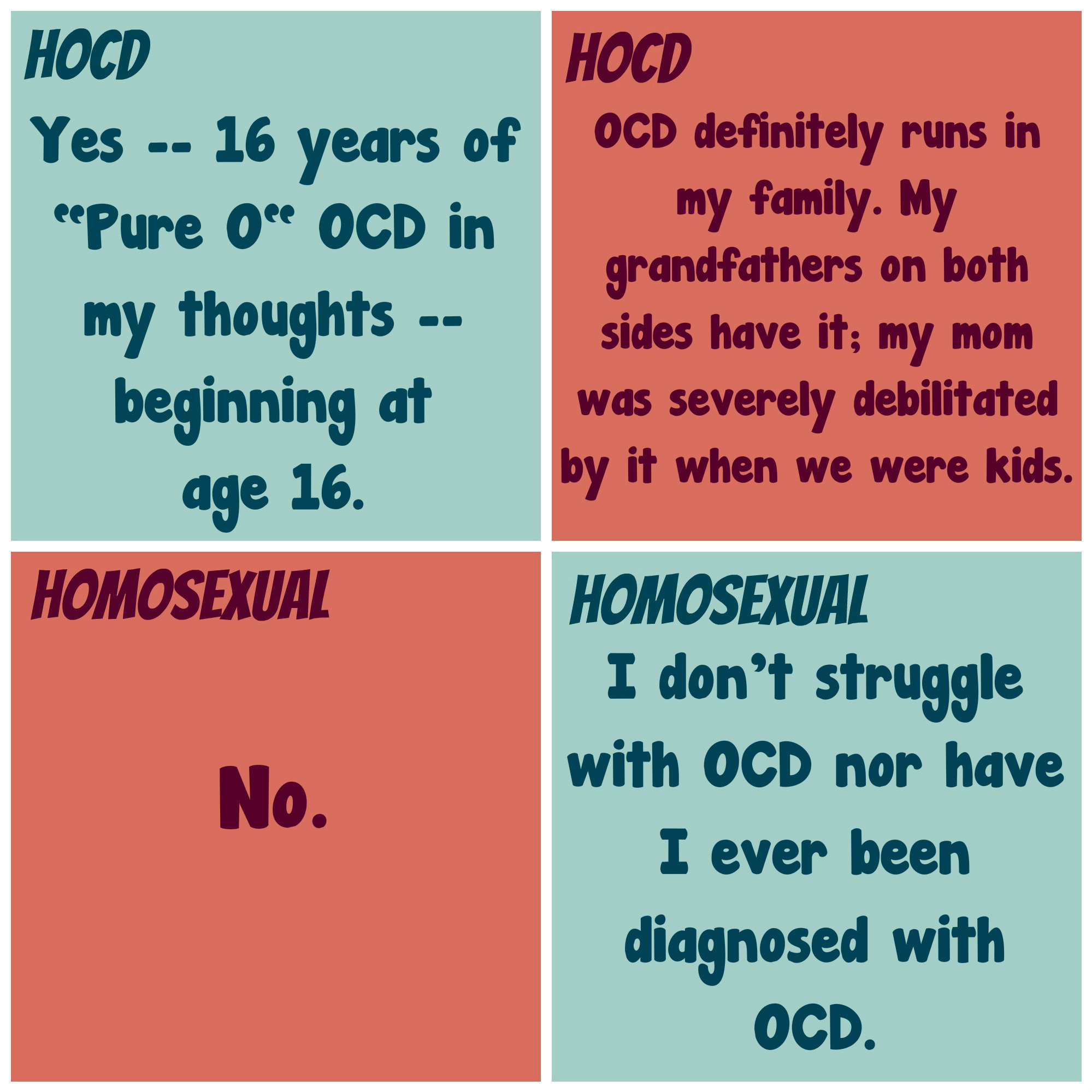
finalHOCD6

7. In general, do you find yourself primarily attracted to the opposite sex or your same sex?

finalHOCD7

8. Do you find people of both genders attractive? 
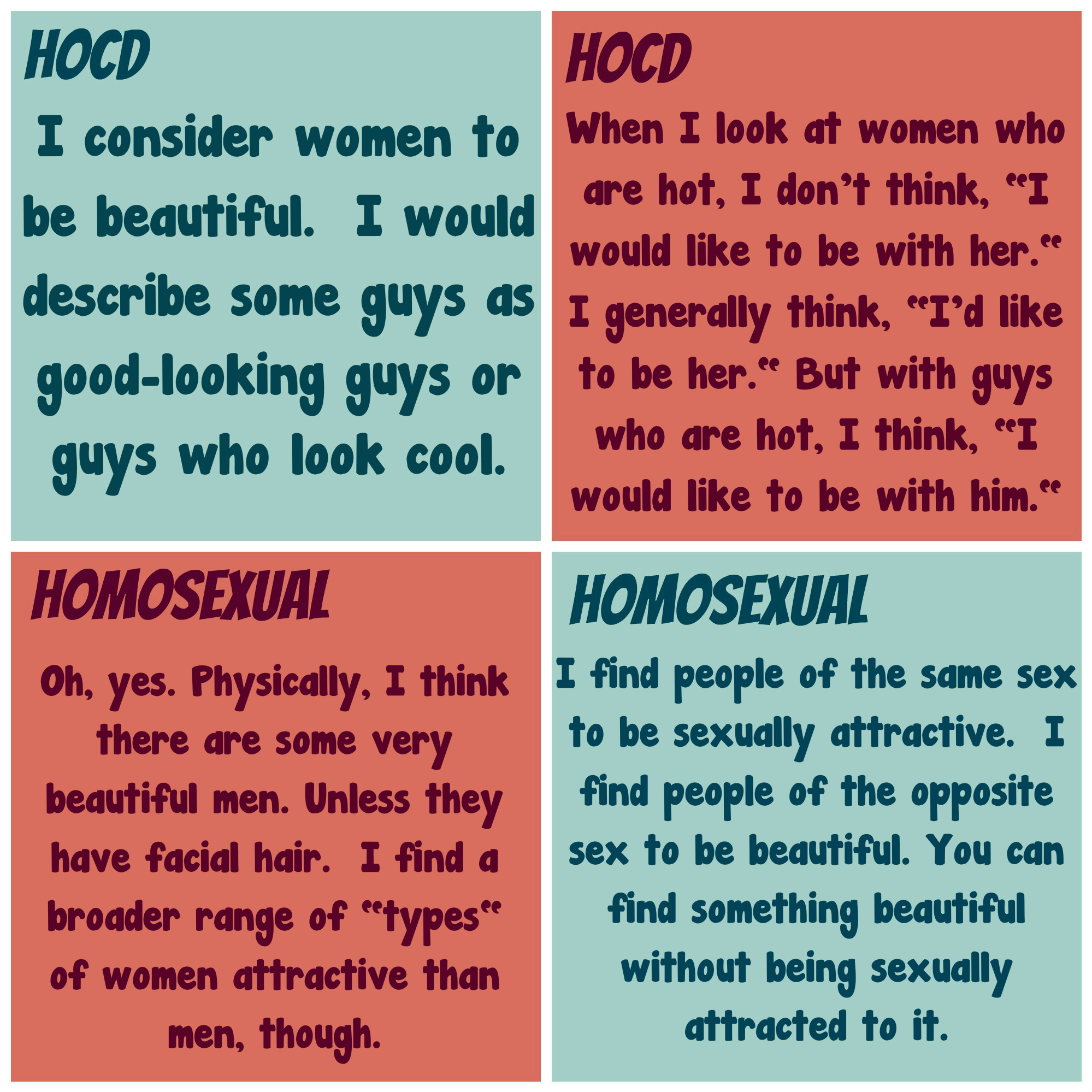
finalHOCD8

I’d be so fascinated to hear reactions to these answers from my blog readers.  What did you notice?  What surprised you?  Are there any trends you are seeing or sensing?

A couple things I noticed:

* In both the male and female HOCD answers, their sexual questioning was triggered by a relatively minor event.  In contrast, the homosexual response from both genders was more of a large-scale “I knew I was different.”

* My gay friends seemed to fear people’s responses and reactions more than they actually feared being homosexual.

* Both HOCD responses toward imagining romantic interactions with the same sex were primarily negative– disinterest, nausea– even though there may have been physical reactions that seemed to say otherwise.

* Those with HOCD thoughts were already deeply struggling with other areas of OCD.

Everyone agreed that both genders can be attractive– but note that doesn’t equate being attracted to them.

I’d love to hear from my readers.  What are your thoughts?

Disclaimer that I should probably have put at the top: I think it is obvious that this blog post is not at all about discussing the morality of homosexuality.  This blog post is about discovering what we can about HOCD in comparison to homosexuality.  All four of the people who so graciously agreed to be interviewed are my friends, if you think I will so much as let you breathe an insult in their direction, just get ready to feel my wrath.  There are avenues for you to debate homosexuality and/or homophobia; this blog is NOT one.  >calms down, flashes big smile<

Related posts:
Interview with a Former HOCD Sufferer
Another Interview with a Former HOCD Sufferer
No One Wants to Talk about HOCD
A Big Ol’ HOCD Post
A Third Interview with a Former HOCD Sufferer

ERP & Imaginal Exposures

I’ve written elsewhere on this blog about Exposure and Response Prevention therapy (ERP) and how different my life is after I underwent an intense 12 weeks of this type of cognitive-behavioral therapy.  ERP is exactly what the name says it is: you are exposed to something that will trigger your obsessions and then you are prevented from responding with a compulsion that will relieve your anxiety.

For example, someone who has contamination obsessions and hand-washing compulsions might be made to touch garbage and then is not allowed to wash her hands.  Instead, she sits with that anxiety, feeling it intensely.  If someone has HOCD obsessions and seeking reassurance compulsions, she might have to look through a Victoria’s Secret catalog and is not allowed to ask, “Am I gay?  Am I straight?”

So, what happens when you have Pure-O obsessions?  What if your obsession is that you will kill your newborn daughter and your compulsion is to stay away from her crib?  What if your obsession is that you’re going to blaspheme God and go to hell and your compulsion is repeating a prayer in your head?

Then what?  You can’t really kill your daughter (um, big DUH there, but you get it!) and you can’t really go to hell, so how in the world are you able to practice an exposure then?

"little sad song" by *TrixyPixie on deviantART

“little sad song” by *TrixyPixie on deviantART

Imaginal exposures, baby.  Brilliant and brutal.

In situations like these, what you might be expected to do is to write down all the ways you could kill your daughter, read it into a digital recorder, and then listen to it over and over.  Or maybe you’ll create a story in which you go to hell, where you’re forever condemned, and you read that story again and again.

If you’re an obsessive-compulsive, trust me, these imaginal exposures are going to FREAK. YOU. OUT.  They will be so triggering and so terrifying that your anxiety is going to spike, no problem.

Meanwhile, no compulsions allowed.

Meanwhile, ERP is re-wiring your brain.

Meanwhile, you’re stepping toward freedom.  And “all” you had to do was listen to a story.

This was my particular brand of ERP actually.  I had to listen to my recording for about 80 minutes a day until my anxiety levels (self-measured at the beginning, middle, and end) decreased by 50%.  For the first ten weeks or so, my anxiety levels were NOT dropping, and I very nearly gave up.  I mean, why put myself through this misery and terror every day if it was doing no good?

But then.

Sometime during week eleven, those anxiety levels started to drop.  I developed a whole new way of looking at my intrusive thoughts.  I tiptoed up to OCD.  I can still remember the day when I was listening (again) to that horrid recording, and instead of feeling anxious, my thought was, “This is getting so annoying.

And then I laughed … because … because finally.  You know what I mean.

OCD Stockholm Syndrome

First things first, I am a guest blogger on Monday at my friend Hannah’s blog, Prayers of Light.  Over there you can read a little something I wrote about Digory Kirke, about finally getting to hear the rest of the story.  Fellow Narnia geeks like me and Hannah are more than welcome to check it out!

Let’s talk about OCD Stockholm Syndrome, yes?

OCD.  Obsessive-compulsive disorder.

Stockholm Syndrome.  When hostages love their captors/abusers.

OCD Stockholm Syndrome.  When obsessive-compulsives ironically cling to the disorder that holds them in bondage.

“OCD Stockholm Syndrome” isn’t a real term, but it’s a real thing– and one I don’t think we talk about that often.  It’s confusing and senseless, and I don’t claim to understand it myself.  But this blog is in the business of shining light in dark places (mmm, lights all around!), so I thought I’d write about it.

I hate OCD.  I really do.  I think it is an ugly, vile, reprehensible disorder that steals joy and leaves people in shackles.  So, tell me why it is that, after my cognitive-behavioral therapy was over, I asked my therapist, “Do I still have OCD?” and when he said, “Yes,” I felt relief.

I think I was worried about what I would lose.  OCD had woven its way through me and entangled itself so deeply through me that a big part of me was worried that I would lose my personality if I lost OCD.  I also thought I’d lose my reputation as the “thinker” amongst my circle of influence.  As a Christian, I worried that I would lose my desperation for Christ if this disorder vanished because, after all, hadn’t it motivated me toward loving my God?

Once I watched a talk show where an audience member asked a question to the girl on the stage suffering from anorexia.  The audience member had formerly been through treatment for anorexia herself, and she asked (with incredible insight), “Sometimes don’t you feel like anorexia is your best friend?” and the girl on the stage answered, “Yes.”

At the time that I watched this talk show, I had not yet undergone ERP, and I remember thinking, I understand that.

It’s bizarre, I know.

When I communicate with other obsessive-compulsives, there is often a theme of therapy-avoidance that runs deeper than just a distaste for the hard work and anxiety that characterizes Exposure and Response Prevention therapy.  There is this deep-seated worry that ERP will not only erase OCD and anxiety from their lives– but a part of themselves.

I didn’t like to talk about this with people because it seemed so contrary to everything I stood for.  How could I hate OCD with everything inside of me– and yet still cling to it with such a quiet desperation?  It made no sense, and even to this day, I still have not figured it out.

freedom

But I wanted to talk about it on my blog because it’s a real thing– a real thing that sometimes prevents sufferers from the relief that is available to them.  I don’t know a lot about this strange phenomenon, but I do know this: I was worried about losing my personality, reputation, and desperation for Christ, but now that my OCD is under control, I am finally the Jackie I was supposed to be; I am still a deep thinker but now my thoughts are productive and not circular, and I actually have a greater capacity for deep thought because I am not sent reeling in terror by my thoughts; and I finally feel the nearness of God.  Whatever was lost doesn’t compare to what I gained.

Satan is the accuser; Christ is our defender.

Recently, one of my blog readers asked me how I could tell when a thought came from OCD or from God, especially because one of my formerly intrusive thoughts was of a Bible verse that seemed to condemn me.  She wrote, “I keep reading that Bible verses spontaneously popping into one’s head is a prime way God speaks to people.”

What a great question.  One I’m not entirely sure I’m qualified to tackle, although I do know that the more I learn about and understand my OCD, the easier and easier it is for me to spot it.  I can recognize its tell-tale voice from a mile away now.  And while I don’t think that OCD = Satan (at all), they are both my enemies and they are both accusers.

Here is the (in flux) conclusion (is that an oxymoron?) I’ve come to:

I guess the big thing is this: when OCD would bring up that Bible verse, it worked like an intrusive thought and brought deep anxiety to me, but with God … his kindness leads us to repentance, not to shame.  The voice of God showers me with kindness, grace, conviction that leads to change … but I don’t think God’s voice is one of shame and accusation. In fact, scripture even tells us that SATAN is the accuser and CHRIST is the one who defends us.

Remember, Satan used and twisted scripture when Christ was going through his temptations, so we know that it’s part of the devil’s arsenal.

frustration4My friend Erica told me something fascinating she’d once heard: “The Holy Spirit does not motivate with guilt.”  Likewise, my incredibly wise writing professor Judy said, “I know the voice of God because that voice invites me to move closer without shame while the voice of Satan fills me with an electric dread that makes me want to hide.”

As always, I encouraged this blog reader to explore Exposure and Response Prevention therapy.  In the four years since my ERP, the voice of OCD has become so easy to recognize.  I finally know my enemy’s voice.

And better yet, I know my savior’s.


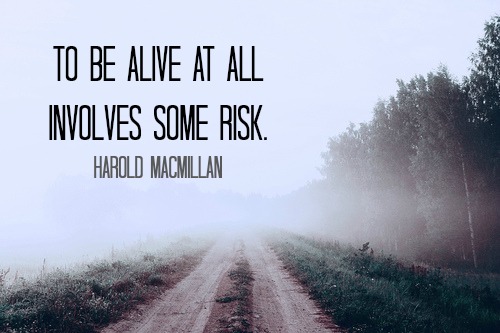
Life is Risky Business

riskyquoteThe sooner we acknowledge this, the closer we are to freedom.

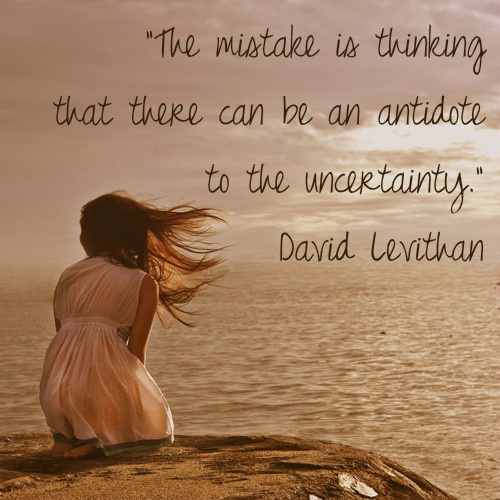
If you’re an obsessive-compulsive who fears uncertainty,
please explore my website to learn about
cognitive-behavioral therapy, your next step.


Have More Discussions.

I’m participating in an HR initiative at Northwestern in which I’ve been paired up with a mentor, and together we’re going through the book True North by Bill George, the former CEO of Medtronic.  It’s all about “discovering your authentic leadership,” and in addition to reading the book, I’m doing all the exercises found in the accompanying workbook.  The workbook exercises are deep and thought-provoking and quite fascinating.

I had to draw a timeline of my life up till this point, including the ups and downs, and then I had to split it up into five chapters and give each a name.  Here are mine:

1. “She Thinks Too Much”: early childhood

2. “She Smiles on the Outside”: my school years, in which I was well-liked, very smart, and excelling at most things, except that my spiritual life and mental health were in shambles, though most people weren’t aware (hence, the chapter title)

3. “She REALLY Thinks Too Much”: the tumultuous college years and the year afterward, leading up to my OCD diagnosis

4. “Stumbling Toward Freedom”: the 5+ year search for the right medication and therapy … and for peace

5. “Redefining My Goals and Passions”: life right now

So, here’s the interesting part (I think).

I had to fill out this ginormous chart that asked the same four questions about each different chapter.  One of the questions was, “What should I have done more or less of during this chapter?”

"Tate Couple" by Matthew Dartford

“Tate Couple” by Matthew Dartford

The answer to the first chapter was easy.  I knew I needed to have more discussions and less secrecy.  My childhood was full of so much fear, and I wish that I’d been willing to just sit with my parents and discuss those fears.  Who knows– maybe it would have incited our family to help me seek the counseling I needed, even at that early age.

The answer to the second chapter was the same.  More discussions, I wrote.  I remember crying every single night for at least three years in a row, and I warned my sister (who shared a room with me) not to tell our parents.  Now I look back and think, Why not?  Why not tell?  It would have been the first step toward healing.

Chapter three.  I started to discover a theme as I wrote, MORE DISCUSSIONS!!!  At this age, I was frozen in fear of the answers, so I wouldn’t even ask the questions.  (If that makes sense.)  The very thing that had made me cry for three years straight was “solved” in one conversation in one night with my mother.  At this time of my life, around 10th grade, I started to try to share things more, since the secrets I’d kept from 5th to 8th grade had made me so sick.

In chapter four, I had to draw a smiley face next to my answer of More discussions.  And it’s true– the awkward bungling that I survived jumping around from therapist to therapist and from medication to medication was its own kind of discussion, one I very nearly wanted to give up on (after a really bad reaction to Paxil, I almost threw in the towel and just accepted that this is how life is going to be).  Yet, eventually those discussions lead me to cognitive-behavioral therapy, to freedom.

And so it was easy as I thought about chapter five, life as I know it right now, to think about what best suggestions to give myself for current and future success.  Have more discussions, I wrote, because this openness, this sharing, this ability to lay one’s cards on the table is what rescues people.

It’s hard, people.  I know that.  But we need to talk about our issues.  That’s the path toward freedom.