A Third Interview with a Former HOCD Sufferer

First, a note from Jackie: I hear from more OCD sufferers about HOCD than about any other kind of OCD, and nearly every story– when boiled down to its bones– looks the same. In the past, I’ve interviewed “Hannah” (she’s asked me not to use her real name on my blog, though she’s very forthcoming about everything else!) about her experience of having HOCD and being set free from it through ERP (exposure and response prevention) therapy.

Hannah’s first interview
Hannah’s second interview

And now … a few more questions for Hannah.

Outdoor portrait of pretty young girl riding bike in a forest.

Hannah, do you see any common themes amongst HOCD sufferers?
Hannah: YES!! I really, really do. One, a lot of HOCD sufferers seem to have a trigger at some point in their young adult or early adult years, and then they go back to their childhood and start collecting “clues.” In other words, something that happened at the time that they haven’t thought about since (she kissed a girl friend on the cheek, for example), but then when they think about it now, it plagues them (“Oh my goodness, that kiss on the cheek was the first indication that I was gay!”). This is obviously unhelpful and unproductive. Two, a lot of HOCD sufferers tend to lose their attraction to the gender they are normally attracted to. This is scary for them, of course, and seems to enforce what HOCD is telling them.

Did this happen to you?
Hannah: No, but it seems to happen for most HOCD sufferers

Do you know anyone who is homosexual who has HOCD?
Hannah: I do. He is a gay man who loves men, but he has HOCD and gets terrified that he is straight. Even though HOCD stands for “homosexual OCD,” it actually doesn’t only attack straight people. OCD can affect anyone.

I agree with you there. I am online friends with an atheist who has scrupulosity, and most people would think that is an incongruous combination. So, Hannah, I’ve been hearing from some HOCD sufferers who are quite young (under 18), living with parents, and unsure how to approach treatment. What do you suggest?
Hannah: I can completely understand not wanting to tell your parents about your struggles– in fact, when I was going through HOCD, I never told my parents. I didn’t tell anyone until many years later. So I get that. But hopefully those young people can tell their parents that they are struggling with OCD, leave out the HOCD details, and still get help. I think it’s best to meet with a therapist who specializes in ERP therapy, but– as you say on your blog– you can do ERP therapy on your own if you’re very driven. [Jackie interjects: see this post for more info!] The important thing is that, one way or another, you do the exposures of ERP therapy.

Recently, I saw an interview with Elizabeth McIngvale, spokesperson for the International OCD Foundation, in which she said, “With the appropriate treatment (ERP or ERP and medication) you can gain control of your OCD and learn to manage your illness.” I loved that, no matter what, she was insisting on ERP therapy. I know you did ERP therapy. Did you/do you take medication too?
Hannah: I do. Every day. But just like you’ve said before, Jackie, I would choose ERP over meds, if I could only pick one.

Blog readers are looking for hope. Can you give them some hope?
Hannah: A lot of hope! I’m an adult woman who once struggled with HOCD, but today I am 100% sure of my sexual identity. I can even be turned on by women and still know– without a doubt– that I am straight. This is achievable. But it takes the hard work of exposure therapy. But even though ERP is hard, it’s worth it.

What is your best advice?
Hannah: Research, not reassurance. In other words, learn as much as you can about OCD, HOCD, and ERP therapy, but don’t resort to the compulsion of asking anyone (including the world wide web) for reassurances. Study HOCD like a medical subject, not from an angle of “Somebody tell me what I want to hear.” Reassurance feels good for about ten minutes; then you go off in search for more reassurance. It’s a compulsion, and it’s unproductive and ultimately unhelpful. Instead, learn about HOCD and how to treat it (ERP), then DO IT. You can research broken bones– or you get get it set, get a cast, have it heal. Push yourself to get the help you need. There is no other solution besides ERP therapy, so what are you waiting for?

Thanks, Hannah! As always, it’s a pleasure to have you on my blog!

Friends, if you have questions for Hannah, please post them below. And please read my letter to OCD sufferers at http://www.jackieleasommers.com/OCD-help.
HOCD More Prevalent Than You Think

Anecdotally, I hear from more OCD sufferers dealing with HOCD than with any other kind.

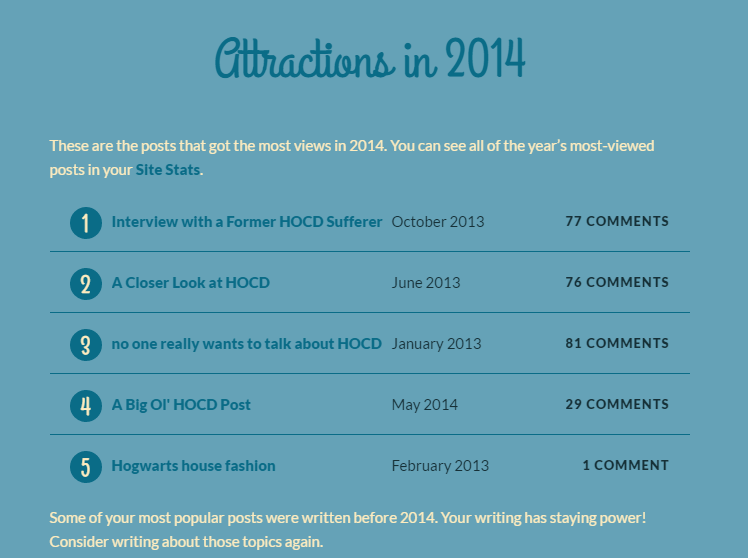
Statistically, my HOCD posts get the most traffic on my blog (see graphic below).

HOCD sufferers, please know you’re not alone.

I invite you to read my interviews with “Hannah,” a former HOCD sufferer who now lives in freedom from HOCD (part one | part two).

Leave your questions below, and if I get enough, I’ll do a third interview with Hannah!

HOCD stats.jpg


Other related posts:
HOCD
A Closer Look at HOCD
A Big Ol’ HOCD Post
OCD Help

Another Interview with a Former HOCD Sufferer

?????????????????????????????????????????????????????????????????????One year ago (exactly!), I posted an interview with “Hannah,” a former HOCD sufferer who had found freedom from her obsessions and compulsions through ERP therapy. It’s gotten over 6300 views in the last year and is my second-most viewed post after “A Closer Look at HOCD.” Last summer, I said that Hannah would be willing to do a second interview if people had more questions, so this time I’m using questions straight from blog readers.

Tom asked: How do you get past the feeling that the thoughts felt so real even though you knew they were not in line at all with your inner values?
Hannah answered: Just to be clear up front, I am not slamming homosexuality. In fact, even people who are gay get HOCD– they obsess about being straight! The awful thing about HOCD (for both straight and gay sufferers) is that it is a LIE. HOCD lies to us about our sexual identities, which are so central to who we are. Most of the people I’ve met who have HOCD are not anti-homosexuals or homophobes; many of them even campaign and vote for gay rights. But their OCD is lying to them about their own sexuality, and that’s where the anxiety slams into them– hard. That said, how do you get past the feeling that the thoughts feel so real? You let them come. You let yourself think the thoughts. You let your body react however it wants. That is part of ERP therapy– and not just for HOCD alone. In ERP therapy, you let the thoughts come and just be thoughts. You learn how to be comfortable with uncertainty. Listen, I know that sounds awful— it sounded awful to me too!– but now, after having gone through ERP … through embracing uncertainty … I now am confident about my sexuality. It’s backward– ERP always is– but it works. Like Jackie has said a lot on this blog, ERP re-wires your brain.

Roxy asked: Did you find that the body sensations were the hardest to deal with and overcome?
Hannah answered: If not the hardest part, then definitely one of the hardest. I mean, how do you argue with your own body when you have a groinal response to the gender you don’t think you are attracted to (or don’t want to be attracted to)? It feels like “evidence,” right? But, I’ll tell you the truth here: I am straight. 100% straight, and I no longer have any doubts about that. But I still get turned on by images of beautiful women. I just don’t think that’s evidence anymore. It’s evidence that I’m a sexual being but not that I’m homosexual. I’ve found that I actually am super turned on by romantic scenes between homosexual men in books … I’m not gay, and I’m definitely not a man. What does this mean? I’m no psychotherapist, but I simply think it means I’m sexual. And that’s true. I still know I’m straight. But yes, the body’s reaction is a total mindf**k to the OCD brain. Then, if you’re anything like me, you keep “checking”– did I feel something there? How about that time?— that’s a compulsion, of course, and the RP of ERP is “response prevention.”  You have to stop checking.

Howdy asked: I am wondering what it has been like trying to date people. I think [my therapist] thinks I am gay.
Hannah answered: If your therapist is an OCD specialist, then I can almost promise you that he/she doesn’t think you’re gay. That said, since the point of ERP therapy is teaching the client to embrace uncertainty, your therapist is probably wise not to let on either way. But if you truly believe that your therapist thinks you’re gay, I’d find a new therapist. Those who specialize in OCD treatment are going to be wildly familiar with HOCD. As far as your question about dating people, I’ve found that I’ve suffered more from ROCD (relationship OCD) than HOCD, constantly questioning if I was dating (or even liking) the right person, doubting if he was a good person, doubting if we belonged together, etc.  The great thing about ERP therapy is that you can be treated for one type of obsession and yet the ERP works on all areas.

Jake asked: What techniques did you use to accept the doubt/uncertainty?
Hannah answered: Do you know how when you say a word over and over and over again, it starts to lose its meaning? For me, it was like that. Listening repeatedly to lies over and over eventually made them sound ridiculous– and clearly like lies. I’m not sure if that answers your question, but for sure look into ERP therapy, if that’s not what you’re already referring to.  It’s the best treatment out there for HOCD (or any OCD).

Christine asked: Did you have a “backdoor spike” when recovering? How did you deal with this? Did your thoughts consume you? I can’t go an hour without having invasive thoughts, is this normal? What thoughts did you have that stressed you out the most and what did you do to overcome these? Can you remember how quickly you began to feel your anxiety lift after beginning ERP?
Hannah answered: I don’t think I really had a backdoor spike in this area, though I did in some others. I dealt with it by returning to my ERP exposures. Thankfully, when I’d do that … and then go to bed … I’d usually wake up “re-set.” Very different from the days when (to answer your next question) my thoughts consumed me. If I wasn’t obsessing over something in the forefront of my mind, then I was still feeling sick about it while it existed in the background. I’ve had other themes with OCD than just HOCD, and to be honest, some of them were more upsetting than the HOCD, but the most stressful thoughts with HOCD were often when I would worry if I was attracted to my girlfriends. Or if I would worry that one day I would “suddenly” realize that I was gay– after I was married to a man.  I had a romantic same-sex dream one night and woke up “convinced” I was gay. How should one deal with the invasive thoughts? ERP, ERP, ERP. Jackie writes about it a lot on her blog. Maybe she can include a link. [Jackie interjects: go to jackieleasommers.com/OCD for more ERP details!] Finally, how quickly did I feel my anxiety lift after starting ERP? Not right away, that’s for sure– in fact, I think it gets worse before it gets better! At first, the exposures are HORRIBLE, but then– like I said– they start to seem silly (or at least, that’s how it worked for me).  I started feeling relief after about 2.5-3 months.

I want to thank Hannah once again for being so OPEN with my blog readers!  I hope that you all heard her refrain of “ERP, ERP, ERP” loud and clear. That is the message I’m continually sharing on my blog too. If you want to read more about HOCD, check out these posts:

A Big Ol’ HOCD Post
Hannah’s First Interiew
A Closer Look at HOCD
No One Really Wants to Talk about HOCD
Hannah’s Third Interview

HOCD Questions

Some of you remember when I interviewed Hannah, a former HOCD sufferer, on my blog.

Hannah is open to a second interview, if there are enough questions from blog readers. First, if you haven’t already read her first interview, read it at the link above. Then leave your questions for Hannah in the comments below.

I’ll curate.

Sweet Freedom

freedom in redAlison Dotson, president of OCD Twin Cities, and I were emailing recently about how sometimes we feel as if we say the same thing post after post, article after article, especially since they usually involve our own stories with OCD, and history doesn’t change.

But I reminded her that even if we’ve heard our stories over and over, someone else might be hearing it for the first time. Not to mention that sometimes those of us with OCD need to hear the truth multiple times before it is finally able to sink into our heads and hearts.

So here it is again:

I was in bondage to obsessive-compulsive disorder for twenty hellish years. I was plagued by ugly, intrusive thoughts that caused me intense anxiety and even terror. Many days I felt completely out of control of my own thoughts, and I hated the ugliness that polluted my mind. I was sad, lonely, depressed, lost, engaged in an ongoing war where the battlefield was my own brain.

And then an amazing psychiatrist named Dr. Suck Won Kim gave me not only a prescription but also the phone number to a cognitive-behavioral therapist in the area, along with the warning that ERP therapy “will be hell” and the encouragement that I had to do it anyway.

And I did. For twelve grueling weeks, I practiced the exposure therapy assignments set out by Dr. Christopher Donahue, and after twelve weeks of hell … I was free. Free for the first time since I was seven years old. I could barely even remember what freedom felt like, what it felt like to be master of my own thoughts, to rule over my OCD instead of having it rule me, and so it was actually a little scary at first.

But let me tell you: you get used to freedom, joy, and light pretty darn fast.

The last five years have been magnificent.

Please, please ask me questions if you have them.

For (lots!) more about OCD and ERP, go to jackieleasommers.com/OCD

Image credit: Jesus Solana

A Big Ol’ HOCD Post

I’ve posted several times on this blog about HOCD (homosexual OCD– when OCD causes someone to question his or her sexual identity), and the statistics don’t lie: it is one of the biggest reasons that people end up on my blog.

HOCD stats

Anecdotally, most of the emails I receive from my fellow OCD sufferers are from those who are battling HOCD.  I had an inkling that HOCD was far more common than most people would imagine, but ever since I started talking openly about it on my blog, I’m more convinced than ever.

Many of the people I talk with have a very similar story: they have never questioned their sexual orientation before X happened, now it is all they can think about, they are constantly “testing” themselves to see if their sexual attraction has now changed.  Many already have a history of OCD, though perhaps it’s never broached their sexuality before now.  Some– though never having had this problem before– cannot seem to generate any attraction to the gender they have always been drawn to, while they are suddenly feeling attraction (and even bodily responses) to the gender they have never entertained liking before.  They are scared, confused, exhausted.  Their minds are going wild.  Some are single and feeling grief that their futures “must” now look different than they’d always dreamed.  Some are dating or married and terrified to tell their partner about the fears and obsessing they’ve been experiencing.  Some of them say they would rather die or be alone forever than to be gay (if they are really straight) or straight (if they are really gay).  That’s intense, folks.

(Please note that I am avoiding using specific terms because HOCD affects both straight and gay people.  I’m trying to keep my post very generic so that I don’t write just to the straight crowd.)

But I get it.  Our sexuality and sexual preferences are so core to our identities, and when OCD causes us to question them, it is an intense experience.  It’s torture.  Hellish.  Exhausting.

I’m sorry.

The good news is that you’re not alone.  Not even close.  There are so many others who are struggling with this– and there are sufferers who have come out on the other side.

Here’s the truth:

* You have an illness.  It’s OCD and it will attack whatever is most important to you.
* You need to treat your illness.  The best treatment is exposure and response prevention (ERP) therapy.
* ERP therapy treats OCD, not just HOCD– this is important because, if you were to somehow get rid of your HOCD obsessions and compulsions, it is incredibly likely that OCD would just move on to a new theme– often a bigger, harder, scarier one.
* For some people with HOCD, the most intense anxiety is caused over not knowing their sexual orientation.  My friends who are gay tell me that their anxiety was not around not knowing, but more around logistics of coming out and how they’d be received. **I’d love to hear people’s thoughts on this, gay, straight, bisexual, or HOCD sufferer.***
* Many do anything to avoid ERP because they are scared of what ERP will reveal about themselves.  Bad idea.  OCD is your cancer; don’t put off ERP, your chemo.  ERP is recognized worldwide as the best treatment for OCD.  In other words, I’m not just advocating some hokey, weird techniques.
* Are there other ways to treat HOCD? You can try medication (probably an SSRI) or hope for a miracle.  Your (much) better option is to proactively commit yourself to ERP therapy.
* I highly recommend finding an ERP specialist to guide you through your therapy.  If you meet with a therapist who does not mention “exposures” as a part of your therapy, find a new therapist.
* You can do ERP therapy on your own, if needed, but you should get a book to guide you through it, such as Stop Obsessing by Edna Foa or Freedom from Obsessive-Compulsive Disorder by Jonathan Grayson.
* I am not an ERP therapist.  I cannot be your therapist.  I can be your cheerleader.

I’m sure you’re so ready to have your life back– to be in control of your own thoughts again.  Your path is clear!  I’m so excited for you!

For more about HOCD, OCD, and ERP, go to jackieleasommers.com/OCD.

Interview with a Former HOCD Sufferer

interviewHey peeps!  Since I’ve been getting so much traffic on my blog in regard to HOCD (homosexual OCD), I thought I’d do another post on it.  This interview is with “Hannah,” who tells me she is ready to bare all (except for her real name, ha!) for the sake of helping others better understand HOCD, that obsessive-compulsive phenomenon where a straight person obsesses over being gay or a gay person obsesses over being straight.  

I think you’ll enjoy this interview.  Hannah said there was no question too personal, so I really went for it!  🙂  If you have additional questions, leave them in the comment section, and maybe we can force more truths out of Hannah.

Disclaimer: This post is not intended to make a statement on homosexuality itself.  It’s intended to open up our eyes to HOCD, which is a lie that both straight and homosexual obsessive-compulsive people battle with.  It’s not about the morality of homosexuality– it’s about people who believe lies about their sexuality at the hand of OCD.  My blog readers are ahhh-may-zing, so I doubt I even need to say this, but nevertheless: if comments get mean or stray away from the topic of HOCD, they will be deleted.  You’re a fool if you think I’ll let you bash any of my friends, gay or straight.

Jackie: Tell us a little about your history with HOCD.
Hannah: I was in junior high when I first started questioning if I was gay.  It came on really suddenly, like, in a MOMENT.  One minute I was this boy-crazy girl and the next I wondered if maybe I was gay.  But the thing was, I didn’t want to be gay … at all.  AT ALL.

Jackie: What triggered this sudden change?
Hannah: I found one of my (girl) friends attractive.  OCD doesn’t need something big to work with.  It will take whatever you’ll give it.

Jackie: What was your reaction?
Hannah: Cold dread.  I mean, I was terrified.  I didn’t want to be gay.  I wanted to like men– I DID like men– but suddenly it was all I could think about.  Every girl I would see, I would think, “Do I think she is pretty?” and then, of course, I had to take it a step farther: “Would I want to kiss her?”  Every girl, I’d start imagining myself kissing her.  It made me sick.

Jackie: It made you sick?  Readers will wonder how you didn’t realize then that you weren’t gay, you know!
Hannah:  Yes, I know.  Because it doesn’t FEEL obvious.  I kept focusing on what I was doing: thinking of kissing every girl.  That felt like evidence that I was gay.  The fact that it made me sick barely registered, for some reason.  I guess it’s just how OCD works.  It’s all very confusing.  Well, then of course, there was the fact that I DO think girls are beautiful.  Sometimes more beautiful than men.  Their bodies definitely are.  Most of us can agree to that, haha!

Jackie: So there was a part of you that found women attractive then?
Hannah: Yes.  There still is.  Women are hot!

Jackie: But you’re not gay?  Or maybe bisexual?  I know I already know these answers, but I think this will help my blog readers process things.
Hannah: No, your questions are fine.  I told you anything goes, right?  Haha!  No, I’m not gay, and I’m not bisexual either.  I know that now.  And the key to learning that was learning to be uncertain, as opposite as that sounds.

Jackie: Okay, we’ll dive into that more in a bit here.  But tell us more about what happened when you first started wondering about it.
Hannah: Well, I couldn’t STOP wondering about it.  Like I said, every girl I saw, I thought about kissing her.  I think it was like my way of “testing” myself– to see what my instincts would tell me, to see what I really wanted.  I hated doing this though.  This was the compulsion actually for me.  The “testing” was like what you talk about about seeking reassurance.  If I thought about kissing the girl and it still made me sick, then I was still okay, still not gay.  (Again, no offense to your gay readers!  This was just my experience.)  I thought about this so much that one night I had a DREAM where, in it, I kissed a girl.  When I woke up, I thought for sure I was gay.  I was having gay dreams!

Jackie: It carried over from real life!
Hannah: I know that now.  But it felt like this stamp of homosexuality.  I was so scared.  I didn’t want to tell my family that I was gay.  I still didn’t even WANT to be gay.  Oh, and this one thing.  I still liked boys.

Jackie: So, you didn’t want to like women, you felt sick about liking women, you ACTUALLY liked men, but you still thought you might be gay?
Hannah: It’s OCD.  It feels confusing.  You know what it’s like.

Jackie: I do.  I really do.  So, what changed?  You’re pretty confident now in your sexuality, yes?
Hannah: I am!  And it feels awesome!  I love knowing I’m straight– and get this, this is so good– I can even appreciate the female body now, and I am not joking, I could see a NAKED WOMAN today and I could GET TURNED ON BY HER and I would STILL know I am straight.  Because I am.

Jackie: And that came about how?
Hannah: Exposure and response prevention therapy.  You preach it.  I preach it.  Cue Hallelujah chorus.

Jackie: You could see a naked woman and get turned on by seeing a naked woman, and you still wouldn’t doubt your sexuality?
Hannah: Not for one second.  I’m as straight as they come.  I love men.  I want to be married to a man someday and have sex with a man and build my life with a man, and it doesn’t make me flinch to say that I think boobs are hot.  Like, super hot.

Jackie: You’re hilarious.  You’ve come so far!  I’m sure there are HOCD sufferers out there who can’t imagine admitting something like that.  And people who are probably thinking you must be bisexual if you feel that way.
Hannah: Haha!  People can think that all they want!  I am FREE from my HOCD and totally straight.

Jackie: You’ve come so far through ERP.  It’s amazing, right?
Hannah: Amazing, for sure.  And hard.  But good.  It made me able to think clear finally.  If I like men and want to be romantic with men and DON’T want to be that way with women, then I am not gay.  It’s obvious, like you said.  And the more I realized that I am in control of my own response to it, the more freedom I found.  That’s why I can say women are hot.  Doesn’t bother me anymore.

Jackie: So, your advice?
Hannah: ERP.  For sure.  Best treatment out there.  For the gay obsessive-compulsives too, the ones who obsess that they are straight and that causes them as much anxiety as the opposite thought caused me.  ERP is absolutely the best treatment for OCD.  I know you know that.

Jackie: I absolutely do.  Do you still struggle with OCD?  Not just HOCD, but other obsessions and compulsions?
Hannah: Rarely.  ERP kinda took care of OCD, you know?  Instead of just one issue, it went after OCD itself.  I know you know these things, but your readers need to know.  ERP is the solution.  A one-stop shop.

Jackie: And you think women are more attractive than men?
Hannah: I think the female body is more attractive, but I am attracted TO men.

Jackie: But you know you’re not gay?
Hannah: Yep.  But that certainty only came through embracing UNCERTAINTY, the whole point of ERP.

There you have it, folks.  

My thanks goes out big-time to Hannah for her willingness to be interviewed and her awesome vulnerability.  The bottom line is ERP is the best treatment for OCD.  

In other words, just what I’ve been saying on this blog for the last two years. 🙂

Related posts:
Another Interview with a Former HOCD Sufferer
No One Wants to Talk about HOCD
A Closer Look at HOCD
A Big Ol’ HOCD Post
A Third Interview with a Former HOCD Sufferer

A Closer Look at HOCD

Since I first blogged about HOCD, more and more people have been coming out of the woodwork in my life to say, “That’s me.”  I’m realizing every week just what a common OCD theme it is to struggle with and question one’s sexuality, even when there is really very little reason to do so.  When I talk to obsessive-compulsives with HOCD, it’s very clear to me that they are straight (they want to be straight, they are not generally attracted to the opposite sex, etc.), but OCD– that old bastard– won’t give them any rest.

I decided to conduct a small, not-scientific-at-all study on my own so that I could compare responses and see what trends I could see.  I asked the same 8 questions to 4 of my friends– one male and one female, each with HOCD, and one male and one female, both who are homosexual.  I’m so grateful to them for their thorough and honest responses, which I have edited down without changing any of the meanings obvious in the larger context.

I’d like to share them with you.

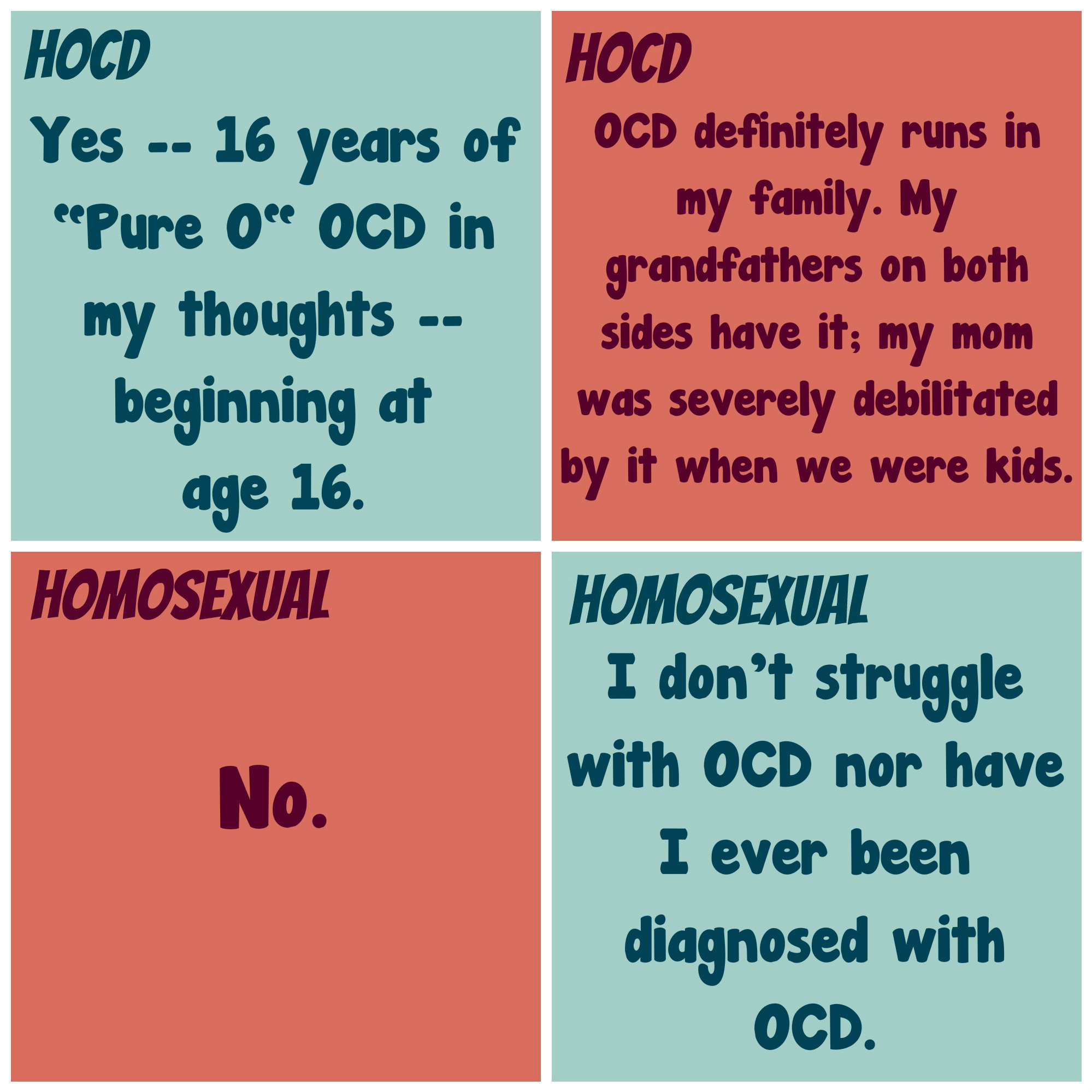
1. When did you first start to wonder if you were gay? How old were you? Was there a particular experience that “triggered” your questioning?

finalHOCD1

2. When you first suspected you were gay, how did you feel? What emotions went through you, both as you considered what it would mean for yourself internally and for your relationships externally?

finalHOCD2

3. How long did the debating (am I gay/am I not?) last? Was this something you knew or something you were/are trying to figure out?

finalHOCD3

4. When you pictured yourself interacting romantically with someone of your same sex, what emotions did you experience? Also, how sure of those emotions were you? (Did you waffle back and forth between your reactions, or were you certain and set on a particular reaction?)

finalHOCD4

5. Did you/do you want to be gay?

finalHOCD5

6. Do you struggle/have you struggled with any OCD-related obsessions (HOCD or otherwise)? Have you been diagnosed with OCD?

finalHOCD6

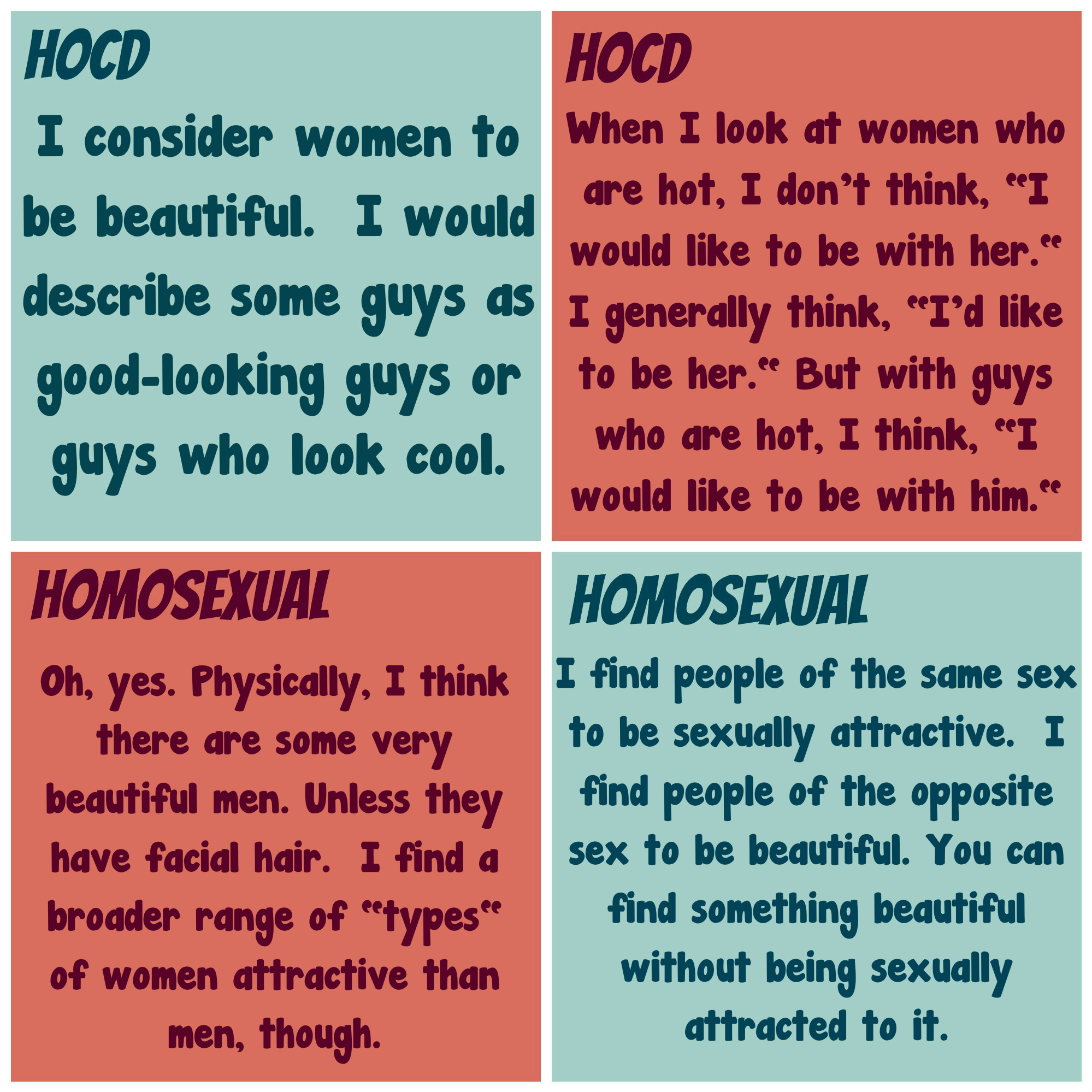
7. In general, do you find yourself primarily attracted to the opposite sex or your same sex?

finalHOCD7

8. Do you find people of both genders attractive? 

finalHOCD8

I’d be so fascinated to hear reactions to these answers from my blog readers.  What did you notice?  What surprised you?  Are there any trends you are seeing or sensing?

A couple things I noticed:

* In both the male and female HOCD answers, their sexual questioning was triggered by a relatively minor event.  In contrast, the homosexual response from both genders was more of a large-scale “I knew I was different.”

* My gay friends seemed to fear people’s responses and reactions more than they actually feared being homosexual.

* Both HOCD responses toward imagining romantic interactions with the same sex were primarily negative– disinterest, nausea– even though there may have been physical reactions that seemed to say otherwise.

* Those with HOCD thoughts were already deeply struggling with other areas of OCD.

Everyone agreed that both genders can be attractive– but note that doesn’t equate being attracted to them.

I’d love to hear from my readers.  What are your thoughts?

Disclaimer that I should probably have put at the top: I think it is obvious that this blog post is not at all about discussing the morality of homosexuality.  This blog post is about discovering what we can about HOCD in comparison to homosexuality.  All four of the people who so graciously agreed to be interviewed are my friends, if you think I will so much as let you breathe an insult in their direction, just get ready to feel my wrath.  There are avenues for you to debate homosexuality and/or homophobia; this blog is NOT one.  >calms down, flashes big smile<

Related posts:
Interview with a Former HOCD Sufferer
Another Interview with a Former HOCD Sufferer
No One Wants to Talk about HOCD
A Big Ol’ HOCD Post
A Third Interview with a Former HOCD Sufferer

no one really wants to talk about HOCD

HOCD stands for “homosexual obsessive-compulsive disorder,” and I think it’s about time I wrote about it on my blog.

HOCD is essentially when someone has intrusive thoughts and worries that he or she might be gay, even though they have been straight for years with no doubts … and even though they are attracted to the opposite sex and want to be with the opposite sex.

A better term would actually be “sexual orientation obsessive-compulsive disorder” because these worries sometimes torment gay people who suddenly wonder if they might be straight.

Just to be clear … this post is not about homosexuality and is not meant to spark debate about homosexuality.  This post is about questioning whether you’re gay when you’re not (or vice versa), and that is a common thread amongst obsessive-compulsives, one I feel that most people would rather not discuss.  People can argue till they are blue in the face about what to think about homosexuality, but there is only one way to look at a disorder that makes you question something that never needed to be questioned: that disorder is a liar.

Why don’t people want to talk about it more?  I confess, I myself don’t, especially not in a platform like this blog.  Because no one understands an obsessive-compulsive like another obsessive-compulsive, and it’s so hard to explain the internal riot occurring while going through any obsession.  Many OCs are upfront about their obsessions with those they are closest to … then they (we) use those friends to solicit reassurance from.  Do you think that was bad?  Do you think I cleaned the dishes well enough and the kids won’t get sick?  Do you think it was stealing when I took a paperclip home from work today?  The friends tell us, No, it wasn’t bad; yes, you cleaned well; no, you’re not a thief.

But when an OC is struggling with HOCD, it’s very hard to ask friends, Do you think I really might be gay?  We are less worried about their answer than about their secret judgments toward us after the question is asked.

I remember in 8th grade thinking that my friend looked pretty one day, and it set me off on a trail of questions and doubts: did that mean I was gay?  Did that mean I liked her?  Was attracted to her?  I was the most boy-crazy girl that I knew, and inside my head, I was asking these questions.

Now that I am on the other side of cognitive-behavioral therapy, it is so unbelievably clear to me: If I liked only men and wanted to date only men, then I was not gay.  But I can remember the questions: But do you only want to date men?  It’s crafty, OCD is.  It plays dirty.  It makes us second- and triple- and quadrupal-guess ourselves.  It’s all so exhausting.

I just wanted to write a post on it to explain what it is and to say that it is such a common obsession.  I think the more we can see how it’s just the same old story with OCD, the more we can see clearly that we are not alone and that OCD is just that old liar who only has a small bag of tricks.

Related posts:
Interview with a Former HOCD Sufferer
Another Interview with a Former HOCD Sufferer
A Closer Look at HOCD
A Big Ol’ HOCD Post
A Third Interview with a Former HOCD Sufferer

Guest blogger! What If?????

One incredibly common theme for obsessive-compulsives is to obsess about one’s sexual orientation.  A female OC could be attracted to men her whole life and have no real homosexual desires but she could still obsess like mad that she is secretly a lesbian … yes, in spite of having no feelings for women.  Those who suffer from HOCD (homosexual OCD) are tormented by continual questioning of their sexuality.  My blogger friend over at the Pure O Canuck Blog has written very honestly about this struggle.  Thanks for checking out her blog and subscribing!
Thanks,
Jackie

 What if?????
by Pure O Canuck

 I’m back from my vacation, and amazingly – OCD gave me some much-needed reprieve.  The hardest parts from an anxiety perspective were “getting there” and “getting back”.  Don’t ask me why.
I was in Palm Springs with three friends.  One of them was my closest girlfriend who I’ve known for over 25 years.  We don’t live in the same city anymore, and she is married with kids, so it was a fantastic chance to re-connect, re-live old funny memories (we laughed so much!) and just relax.  The weather was fantastic, and I had a wonderful time.
While we were visiting Palm Springs one of the large events taking place was an event called The White Party, which is a HUGE gay party.  I laughed with my therapist that this would be a fantastic exposure for some of his male HOCD clients.  For me, not so much.  It was just a bunch of great looking athletic men walking around town.  I did have a few triggers while on holiday though.  One of them was reading one of the local tourist magazines – I read that Palm Springs has a large gay and lesbian population.  Estimates are that at least 40% of the population is gay or lesbian.  My mind said to me “With that large of population what are the odds that you’re not going to run into a lesbian???”  Amazingly though, it wasn’t on my mind continuously.  Another trigger was while we were at a restaurant.  I was just people watching, and I saw two women walking out of the restaurant with their arms around each other.  Then one of the women proceeded to grab the other’s bum.  A small surge of anxiety, but nothing much.
I’m struggling with my exposure.  And when I returned from my holiday, my therapist slammed me with reality.  He was pretty hard on me (well, as hard as he can be on me…..he’s really a very kind guy).  But he was realistic.  You see, my latest BIG fear is that someday, given my history (horrible father relationship, unsuccessful relationships with men), I will meet a lesbian woman, become friends with her, and then fall in love.  It’s along the same lines of my ROCD fear that I have when I’m in a relationship.  I avoid other men because I’m afraid that I’ll fall in love with someone else and have to leave my partner etc etc.  My therapists response to this was: “Would that be so horrible if for some reason you found yourself in love with a woman?”  (Of course then my OCD says “your therapist really thinks you’re bi-sexual and he’s now trying to help you come to terms with that”.)
WHAT?  OF COURSE IT WOULD BE HORRIBLE!!!  That’s why I have HOCD!!
I just really want to be able to let go of this fear.  And my OCD wants me to figure out WHY I have this fear.  Does it mean that I’m really afraid of my true self?  Does it mean that I won’t ever truly be able to be happy until I figure this out?  It’s so hard to find love these days, am I sacrificing my whole happiness by not opening myself up to being with a woman? Maybe I’m really bi-sexual?  All of these crazy thoughts go through my head.  It’s horrible.
(Just writing this blog post is an exposure for me, because my OCD is saying “These people are going to read this and think that I really DO sound like I might be bi-sexual.”)
Why can’t I just be like anyone else and live my life until something actually happens????
This theme is rampant in the lesbian community too.  I’ve watched three movies with this theme.  It goes something like this:  The woman is living happily with her male partner, thinking, feeling straight, and along comes a lesbian woman who woos her into her web and their life is perfect, and wonderful and fantastic forever more.  Learning to accept the fact that this might happen to me, and not avoiding is one BIG hurdle I have in order to overcome my OCD.  It scares the crap outta me.
Another big theme we’re working on at the moment is the wonderful “groinal” response and arousal etc.  For any of you who suffer from any kind of sexual obsession, you will understand the distress that this causes.  I watched one of those aforementioned lesbian movies a few weeks ago, and I actually thought the movie was pretty good!  (It was practically impossible for me to actually allow myself to like a lesbian movie by the way.)  And watching some of those sex scenes were pretty darn sensual.  Was I sexually aroused?  I don’t know.  Maybe?  My therapist explains to me that people can get aroused from watching many types of sex scenes.  But then my OCD says “You don’t get turned on when you watch heterosexual sex scenes.”.  Some times I feel like my OCD wants me to just throw my arms up in the air and say “I’m gay!”.  And be done with it all.  Anyway, this “groinal response” is another big hurdle for me to overcome in my recovery.  My therapist wants me to try and become sexually aroused while watching these lesbian movies.  And live with the consequences.  Right now I’m just trying not to figure it out one way or the other.

At the end of the day I have to accept that I COULD find myself falling in love with a woman someday.  I have to accept that watching lesbian porn MIGHT turn me on sexually.  But at this point COULD = WILL, and MIGHT = DOES.  My therapist says that I have to want to overcome my OCD more than avoiding this possibility.  When he puts it that way I find it SO HARD to commit.  It’s days/times like these that I feel like I haven’t made any progress AT ALL.