Thoughts on Rejection

no thanksEvery aspiring writer is told she is going to have to learn to deal with rejection, that rejection is simply a normal part of the road to publication.  I’d read how Stephen King hammered a big ol’ railroad spike into his wall and then hung rejection after rejection on the spike till they pulled it out of the wall.  Jo Rowling was told to get a day job because of the unlikelihood she could make money in children’s books.  Twenty-six publishers rejected the future Newberry Medal-winning A Wrinkle in Time.  Gone with the Wind?  Rejected by 38 publishers.

knew I’d experience rejection as I pursued publication; I braced myself for it.

It still hurt.

I’ll admit that with Truest, what will be my debut YA novel, I made it through the gauntlet rather easily.  But please remember thatprior to Truest, I’d poured four years of my life into a novel that never even got an agent.  I sent out maybe forty queries, and one agent asked to read the manuscript.  Then kindly said no and suggested edits.

Four years is a lot of your life, time, energy, emotions.  Your heart.

I actually started writing Truest while waiting to hear back from literary agents regarding Lights All Around.  When the onslaught of rejections came, I was protected– cushioned– from the sting by the excitement I had for my new project.  That taught me to fill my waiting time with work.

I’ve heard of authors receiving very cruel rejections, but those I received were quite cordial.  In fact, a couple of them sounded more like a yes than a no.

From an agent:

Thank you so, so much for your giving me the chance to consider TRUEST, even so late in the game! I appreciate it more than you know. I came away from Big Sur so impressed by you, certain that you have the authorial (and editorial) eye, the professionalism, and the charming/witty personality to be incredibly successful in this industry. And now that I’ve had a chance to read your work, I’m even more impressed and even more certain. You are a truly talented writer, with a masterful command of language and of your characters. You make it look effortless, like the best of the best do. All of your characters are fully round and compelling, and your depiction of small town teen life is vivid and fully engaging. I even spent a good half hour trying to find the August Arms radio program because it sounded so marvelous and right up my alley!
However, after much soul-searching and late night agonizing, and with so much regret, I’m afraid I don’t feel I’m the right agent for TRUEST. I get lost in your writing in the best way, and I believe TRUEST is about something (which I mean as high praise).  […] I will be first in line to buy my copy of TRUEST. 
From an editor:
It’s always such a pleasure reading the submissions you send my way and TRUEST was certainly no exception. This is a powerful contemporary story with a cast of layered yet relatable characters. I’m going to pass because I struggled to connect the complicated chronology of the framework but I recognize that there is definitely something special here. West and Silas (what fantastic names!) form a magnetic relationship and their stark differences play off each other with vigor. The dark tension lurking beneath the surface of the storyline is captivating and makes for a compelling read.

These kind, gentle rejections are interesting to process.  They are encouraging, on the one hand, but on the other: they’re still a no.

I feel terrifically blessed in regard to Truest.  I queried my first round of YA agents on July 11, 2013, and Steven Chudney offered me representation on August 7, less than one month later.  (By the way, as I look at the dates now, I’m shocked that it took less than one month– it felt like about four.)  Steven suggested some edits, and I returned the manuscript to him on September 9.  Steven sent the manuscript out into the world on September 16.  November 12, Steven told me that Jill Davis at HarperCollins loved my story and would be sharing it with her boss.  November 20, HarperCollins made me a two-book offer.

Those four months and nine days felt so much longer than that.  Remember that while things were cooking with Steven– and later, with Jill– I was still getting rejections.

All told:
30 rejections from literary agents
4 rejections from editors

Anyway, I realize that this is a meandering post about rejection.  I can be done now.  Except that I want to say that rejection is hard.  It hurts so bad to have someone turn down your “baby” (novel, short story, memoir, etc.).  Those four months and nine days felt like I’d willingly hopped aboard the Rollercoaster of Agony and Anticipation.  But they were worth it because now my dreams are coming true!

P.S. Check out literaryrejections.com for some amazing facts about books that endured rejection to eventually become bestsellers.

P.P.S. Click here to learn more about my novel Truest.
Schrödinger’s Book

neil gaiman maybe


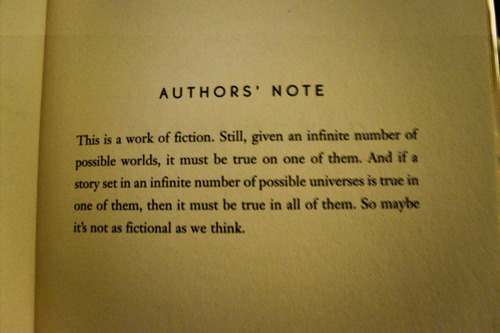
I think this might be from a Neil Gaiman book.  In any case, it’s funny.  To me.

On the other hand, it would send my character Laurel (from Truest) into a manic spiral.  The many-worlds interpretation does not sit so well with her.

Semi-related posts:
Solipsism Syndrome, Anyone?
More Thoughts on Solipsism Syndrome

From Hit-or-Miss to Hard Work

In undergrad, my best writing mostly came about by accident.  I stumbled into the right story or else caught myself on a “good” writing day or else was incited to revise in order to better my grade.  Even then I knew that you couldn’t wait for inspiration to strike, but it was hard to imagine that anything could get done if inspiration never arrived.

These days, though, my best writing is produced by hard work.  It comes about because I show up and sit down and force myself to produce words.  I know that even an “uninspired” night– after night after night after night– can still be productive.  I have learned that showing up produces a bad first draft.  After which, showing up then produces a better second draft.  Rinse and repeat.

Showing up matters.  In some ways, it’s what matters the most.

work hard

Related posts:
Writing is Hard
I Repeat: Writing is Hard
Trusting the Creative Process

My Conflict with Conflict

love hateI have a problem.  Sometimes when I read books, the conflicts the characters engage in make me absolutely irate or even sick to my stomach.  I want these lovely characters to get to enjoy themselves.

But then, when I read a book where the stakes are not high enough, where the conflict just isn’t present, I feel so cheated.

This tug-o’-war happens to me not only as a reader but as a writer too.  My writing group will tell you that one of my biggest faults is not including enough conflict for the characters.  (I just feel so bad for them!)  Thankfully, they force me to go back and raise the stakes.  Even I know that it is for the best.

Not to mention any thoughts on conflict in real life …

Related post:
Publishing Peace (and Conflict)

That Time Anne Lamott Responded to Me

Let’s be honest: this week has been hard.  Really hard.

Writing-wise.

I am writing a first draft, and it’s going horribly (as writing a first draft is wont to go), and I’m stumbling into evening after evening of soul-shaking, identity-questioning doubts about my writing abilities.

I’m a fraud.
I don’t know how to write a book.
I don’t have a second book in me.
My agent and editor and everyone else will discover that I’m just a one-book girl.

Goodreads hosted an event “Ask Anne Lamott” this past week, and just now, I have found the time to sift through her responses.  You need to know that Anne Lamott always seems to be speaking directly to my heart– we are both writers, Christians, and women who wildly, desperately need help– and so all of her responses to various reader-posed questions felt like balm.  This one, in fact, felt like validation:

Anne Lamott

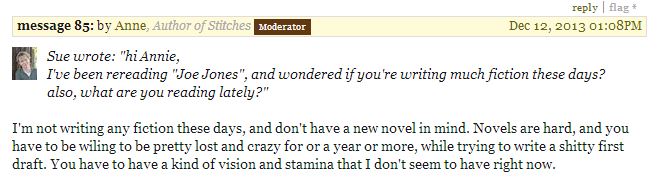
“You have to be pretty lost and crazy” in writing fiction.  Yes, okay, I reassure myself.  This is just the way of things; this is The Way It Goes.

But then, there it was– an actual response to me.  Me!  Jackie Lea Sommers!

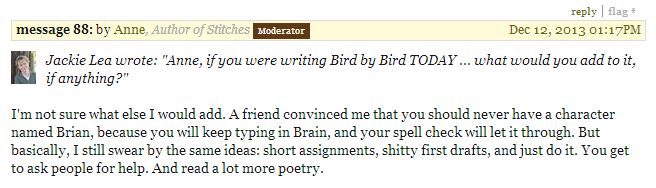
Anne Lamott to Me

“Short assignments, shitty first drafts, and just do it.”  Yes, thank you.  That is how my next novel will get written: day after day writing something bad, then making it less bad, then making it good, then making it great.  I’m in the bad stage right now, and that’s okay.

“You get to ask people for help.”  Yes, thank you.  I actually stopped in to my beloved writing professor’s office just yesterday to vocalize my fears, and she said that if I needed encouragement in the zen of writing or someone to commiserate with, I could just ask.  I will definitely be asking.  And then, last night, I met with [some, but not all, of] my writing group, women who let me vent about Penn and Maggie, my newest characters, and about their problems.  My group members listened and encouraged and offered suggestions, and it was lovely.  And I’m so terribly grateful for my beta readers too!

“And read a lot more poetry.”  I couldn’t agree more.  I think I’ll start with some Mary Oliver tonight.  I haven’t yet had a chance to crack open her latest, A Thousand Mornings.  Then Christian Wiman’s Every Riven Thing.  It sounds like respite.

The Joy of Creation: Why I Love Being a Fiction Writer

writer5On the one hand, the fiction writer has absolute power and total freedom.  She can invent new worlds and move seamlessly between them.  She is the inventor of personalities, the puppeteer manipulating decisions, the master event-planner, and the goddess of details.  The fiction writer laughs at limits, shoulders through barriers, imposes her own laws.  She is wild with creativity.

On the other hand, the writing pushes back, and that too is beautiful.  Characters refuse to be whom she asks them to be; they choose their own names, dig in their heels, are stubborn as hell.  And despite all her planning, sometimes the events unfold in ways she couldn’t orchestrate on her own.

It’s the combination of these two things– this unfettered freedom that slow-dances with the art’s own identity– that makes the fiction writer love to write.

Related posts:
Date a Girl Who Writes
My Writing Process
Love in the Form of Story


Emerging Artists Collective

writing girl againMy college writing mentor Judith Hougen started an artist group in the Twin Cities called the Emerging Artists Collective, and we had our first meeting in November.

I cannot tell you how amazing it was to be gathered with other Christian artists (writers, filmmakers, visual artists) to discuss faith and writing.

The thing that stood out to me most was a quote Judy shared.  I have been looking online, and I can’t find the quote, but it went something like this: “The older I get, what I mean by Christianity and what I mean by writing are largely the same thing.”

I love that.

It’s true that in my own life, my faith and my writing have become terrifically wrapped up.  When I write, I feel like I have spent time with God.  It all feels very mysterious to me, but I love that too (of course I do).

Related posts:
The Faith of a Pantser
Why Christians Should Write


To My Teachers

In 1957, Albert Camus won the Nobel Prize for Literature, whereupon Camus wrote this note to one of his teachers:

19 November 1957

Dear Monsieur Germain,

I let the commotion around me these days subside a bit before speaking to you from the bottom of my heart. I have just been given far too great an honour, one I neither sought nor solicited.

But when I heard the news, my first thought, after my mother, was of you. Without you, without the affectionate hand you extended to the small poor child that I was, without your teaching and example, none of all this would have happened.

I don’t make too much of this sort of honour. But at least it gives me the opportunity to tell you what you have been and still are for me, and to assure you that your efforts, your work, and the generous heart you put into it still live in one of your little schoolboys who, despite the years, has never stopped being your grateful pupil. I embrace you with all my heart.

Albert Camus

It made me think of the teachers who have most impacted my life– in particular, my writing life.

Mrs. Schmidt, you let me interrupt what we were doing that day in sixth grade to declare that I wanted to start a class newspaper– and then you let me run with it.  In fact, it was an article I wrote for the A8 Express that I entered into a Young Authors Conference contest that year, an article that won me a “scholarship” to attend that conference, where I sat amongst other 10- to 12-year-olds and thought, “I want to be good at this.  I want to be the best one in this room.”  Thank you for always, always encouraging my creativity.  You’re an amazing teacher, and while I have told you that before, now I’m telling everyone else.

Mrs. Grams, I can remember when you arrived at our high school.  I was a junior in high school; you were fresh out of college, newly married, and I was completely smitten by you.  My junior and senior year were one giant attempt to please you, and your approval was always so, so ready.  You gave me my earliest editorial experiences, and you let me read one of my short stories in front of the classroom.  Did you know I first discovered e.e. cummings in your classroom?  (I like to think of it as an incredible byproduct of standing near to you.)  And when you returned my portfolio to me, it said, “All I can say is KEEP WRITING.”  Those words propelled me into college.

Judy Hougen, when I sat in your Intro to Poetry class my first year of college, I was terrified that I would be found out as a fraud.  Instead, you took me aside after class one day and asked if you were crushing my poet-spirit.  Maybe you saw the fear in my eyes!  But you gave me three years of the best (and most intense) writing instruction of my life, and your red pen helped me develop a thicker skin, one I’d need for the harder edits that would come post-college.  You talked about writing and faith like they were a knot I’d never be able or want to untie.  Your theology around memoir writing has stuck with me for the last decade.

Dear Deb, Betsy, and Judy, thank you for your investment in me.  I am a better writer– and a better person— because of you.

thank you2

OCD: Unwelcome but not Unexpected

How many times do I have to say that OCD is a joy-thief before I should realize: Oh.  Hmm.  You’re pretty happy right now.  OCD will be along shortly to steal that away?

I should learn to brace myself.

On Friday, November 22, I announced on Facebook and on my blog that Harper Collins offered me a two-book deal.  Shortly thereafter, amidst all the “likes” and congratulatory comments and joyful sharing, OCD came calling.

I spent the majority of the evening obsessing over future revisions.  

not you again

I practiced ERP, walking myself through that lovely mantra of “it’s POSSIBLE, but it’s not LIKELY,” then discussing with a friend (asking for no reassurance), and also spending time in prayer.

Life, as I continue to learn, is risky, and the more I learn to embrace risk and uncertainty, the happier I am.

Which is why I flat-out refuse to flat-out refuse any revision suggestions.  I will consider everything my wonderful editor suggests, knowing that God is in control and that Jill loves my characters too.

In this sense, I’m growing as an obsessive-compulsive in remission, an author, and as a person.

Jackie 1
OCD 0

Related posts:
Uncertainty is the Key
Uncertainty
Taking Risks