Writing and/or Life, Both Hard

rumiWriting.

Either I’m not doing it right and still need to learn the universe’s secrets, or else the truth is that writing is masochism.

No, stop. I shouldn’t say that. Believe me, I love to write. Sometimes.

But it is really, really hard.

Why does it so often seem like other writers have their acts together?  They feel confident in their abilities.  They are clever and funny and smart … gahhh, I know I can be those things too.  But mostly I just feel insufficient and terrified that I’ll be found out.

Not just writing either.  Life.  I’m 32, and I feel like I know so little about how to be successful at Life.  I retreat in fear to my favorite things night after night: my bed, my prayer journal, my Jesus.

A few lines from Truest (as it stands today):

And while I sit in the stand and pray, I have the same sensation—that I am being outlined, defined, and that the definition doesn’t come from me.

I am trying to hold so many things—and failing—but this one thing is holding me.

Please tell me, people: do any of you get so overwhelmed that you become paralyzed? Have you fallen in love with a vocation that gnaws on your heart? Have you figured out any ways to be still and yet productive?

All I know is Jesus, Jesus, Jesus— thankfully, he’s more than enough.


YA Junkie [& proud of it]

A few odds and ends from the Land of YA Lit …

I joined Oblong Insider because I EVEN WANT BOOKS I DON’T KNOW THAT I WANT.  Yes, it’s true.  I signed up for a YA book subscription where someone else chooses books for me because WHY NOT.  I filled out a form that asked for my favorite books and authors so they could get a feel for what I liked, and then– voila!— the other day, I got my first package!

Look at this stuff!  I got Faking Normal by Courtney C. Stevens (a book for which I’ve read great reviews!), an awesome “I read YA” book bag, and a matching button.  Too cute!

ya swag

Yes, of course I love buying and choosing books on my own, but this is so fun and exciting, like unwrapping a birthday present!

Also, someone muttered some fightin’ words online:

fighting back

Seriously??!  What is wrong with people?

Also, thought Teen Librarian’s Toolbox posted an interesting article about how we guide teens into a safe discussion about sex in literature.  You can read it here.

Also, my friend Mary has got me thinking and dreaming about what the cover of Truest will look like.  (Note: I will likely have no say in this.)  But an author can dream, right?

Also, Maggie Stiefvater is going to be at the SCBWI summer conference.  I thought about going, but in the end, I think I’ve decided to stay put.

Also, Buzzfeed’s 19 True Struggles of Being Addicted to YA Books as an Adult.

Also, also, also … !

I love YA lit.

Writerly Thoughts on Predestination, Conflict, & Rescue

I.

It’s an old debate: do humans have free will, or are “choices” predestined by God?

I have a friend who thinks the former while I lean more toward the latter (honestly, I most prefer to live in the gray area between the two), and we were talking briefly about this.  The Big Question, of course, is If there’s no free will, then why would God predestine the sinful fall of man?

My response was that I think that rescue and redemption are more valuable to God than there being no need for them, that somehow God gets more glory from saving a fallen world than from not needing to save a perfect one.

My friend didn’t buy it, didn’t think it made sense.

II.

My writing critique group met recently, and it was a great evening.  We didn’t actually critique anything, only shared about our current projects (and a couple people shed some tears, it’s true).  One of my friends is writing a young adult novel for her MFA program, and the problem she keeps running into is that she loves her characters so much that she doesn’t want to hurt them.

“It’s what I always used to yell at you for, Jackie!” she said to me.  “And now I’m doing it myself!”

If you’re not a writer, you probably can’t understand, but trust me– it can be hard to create characters you adore and then force them through hell.

But we have to.

Why?

If there’s no conflict, it’s not a good story.

Reaching_by_fotomachineIII.

I started to think about that in terms of the story of the world.  God is the ultimate creator, the supreme artist, and the universe and its inhabitants are his masterpiece.

Is the same principle at work here?  Did God as an Artist determine that the great Story of the world would not be good without conflict?  Every good writer knows that a story needs a conflict and a climax.  Could that be the very simplest of explanations for the fall of man and the cross of Christ?  God was writing a story, and he wanted it to be great.

You’re welcome to chime in in the comments!


Image credit: fotomachine

Defining My Roles

Recently I sat down and defined my values and leadership principles, and it was a great exercise for me.

I decided to make a list of some of my primary roles and my corresponding principles too.

definitionsMay I be a courageous and humble leader who remembers that rule-keeping does not bring life. May I be a sister who loves, listens, laughs, and leads. May I be a daughter who celebrates her parents, along with the roots and wings they have given me. May I be a selfless friend who honors those whose lives are mixed with mine. May I be a gutsy and generous writer who cherishes story in all its forms. May I be a Christian who delights in her Savior, eagerly receiving and giving grace.


Image credit: Grace Easton

Oceans & Revisions

I went to praise chapel at Northwestern the other day. Though UNW has worship chapel every week, this was a special one for the semester since the entire orchestra was on stage, a powerful treat.

They played Hillsong’s “Oceans.”

wanderSpirit lead me where my trust is without borders
Let me walk upon the waters
Wherever You would call me
Take me deeper than my feet could ever wander
And my faith will be made stronger
In the presence of my Savior

When I sang, “Take me deeper than my feet could ever wander,” I immediately thought of Truest and all its many rounds of revisions.

Here is the truth: on my own, Truest would have been finished a long time ago.  And it wouldn’t have been nearly as good. But so many people have been put into my life to press me further down that path than my feet could ever wander on their own.

And the result?

A better novel.  Also, my faith was made stronger: my faith in the creative process and my faith in God.


Image credit: if you know the owner of this image, please let me know.

Major & minor themes in the Christian worldview [and what that means for my writing]

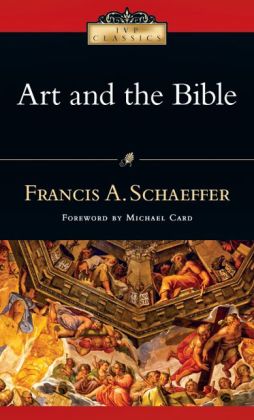
art and the bibleMy dear friend Elyse recently loaned me a book called Art and the Bible, written by Francis Schaeffer.  It was less a book and more an essay, and I read it in one sitting.  Let me tell you, it was refreshing to have someone explore so many ideas related to the Christian worldview and the value of art.

The idea that stood out to me the most was this: the Christian world view has both a major and minor theme.  The minor theme is that the world has revolted and is revolting against God, that Christians will never be perfect this side of heaven.  The major theme is that God is at work redeeming the world.

What does that mean for the Christian artist? It’s okay for your art to show both themes too.

Why does this matter to me? Because, as a Christian artist who has suffered from OCD, I’ve sometimes wondered if my responsibility to my faith meant that I needed to focus only on the positive.  The answer is no.  It should be emphasized over the minor theme, but the minor theme has its place in my writing too.

I wish that all Christian artists realized this. We need more gritty, raw Christian art and fewer poems about rainbows and puppies.  If you have art like this– especially written work– you should submit your work to Crux Literary Journal.  We’d be thrilled to take a look.

Surprises on the Journey to Publication

First, some truths as the groundwork:

* I love being a writer.  Sometimes I feel that I have no choice– I simply must write– but even if I did have the choice, I’d want to be a writer.

* I have an amazing agent and the sweetest, loveliest, most brilliant editor ever, and I feel like I won the jackpot.

* My contract is with HarperCollins, the publishing house of my dreams, the publishing home of C.S. Lewis and Melina Marchetta.  I am utterly humbled and full of deep gratitude.

writerAnd now, some things that are surprising me on my journey toward publication:

* It’s still really hard.  I think I’ve been laboring under the idea that the hard part was getting the book deal, and after that, smooth sailing.  Nope.  My edits come fast and furious, and I don’t think I’ve ever been stretched as much as a writer as I have been since I got my book deal.

* My skin is not as thick as I thought it was.  I’ve prided myself on being a writer with a pretty thick skin– I welcome criticism and can (usually) take it in stride.  I’m learning that maybe I’m more tender than I imagined.

* I have a lot of self-doubt. I once thought that getting a book deal would be like an eternal validation stamp: OFFICIAL WRITER.  I would be someone who Knows What I Am Doing.  Nope.  If anything, I feel even more doubt than ever.

* It’s a true partnership.  I was ready to take orders from my editor– aye, aye, captain, that sort of thing– but she asks more questions than she gives answers.  She raises the questions and then lets me answer them in my own way in what I write.  There’s more freedom than I imagined, and she is a great listener.

* One last thing: it took a long time to finalize the deal. It was offered in November, and I signed my contract in February.

I know that some of you blog readers are on your own writing journeys and are interested to hear how mine goes, so I thought I’d share these things with you.  Now I want to hear from you: what expectations do you have for after you get that first book contract?  Were any of my surprises also surprises to you?


Image credit: Laura Makabresku

My Hunger Mountain Story

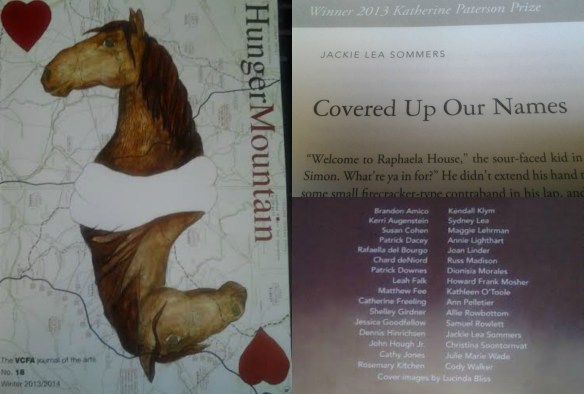
Hunger Mountain 18 is finally out, and it includes my short story “Covered Up Our Names.”

HMcollage


(You may recall that I had this crazy idea about teenaged wards of the state living in hospice care, wrote the story and submitted it to Hunger Mountain with no expectations, and then won the 2013 Katherine Paterson Prize for it!)

Now that it’s been published, the rights have reverted back to me, so I have posted it over at Crux Literary Journal, the online arts project I curate.  I hope you’ll take ten minutes or so to read it and tell me what you think!

The Good & Bad of Writing

writer__s_block_by_arzu88-d3hg9efAm I a whiner?  Sometimes I feel like it.

The truth of the matter is that writing is just plain hard.

When I am writing a first draft, I wish I was revising. I tell myself it’s so much harder to make something out of nothing than it is to make something better out of something okay.  In a first draft, I still don’t know my characters very well, so I’m not entirely sure of what they should do or how they should react to people or events. I typically have no idea how the story will actually end, so I’m writing blind and terrified that because I see no ending now I won’t see an ending ever. I have to cast deep into my well of creativity because everything– absolutely everything– is brand new. (It gives me so much appreciation for my God who created ex nihilo [Latin, “out of nothing”].) It’s physically exhausting and mentally draining, and (at least in me) it prompts deep, deep doubts about myself.  In the early days of a first draft, I desperately long for revisions– when I will know my characters well and will be perfecting the story and imagery.

When I am revising, I wish I was writing a first draft. Deep in revisions, I feel bored to death with the process. It feels so stagnant and dull compared to the excited fervor of creation. It feels nit-picky and brutal, a journey to endure as a longsuffering artist.  And everything needs to be moving forward, finding its place.  You have to “kill your darlings.” You can’t keep putting things on the backburner to deal with another day– “another day” has come and the time is here. It’s like finding yourself in the middle of a battle without armor.  I think longingly of the days of freewriting and drafting, how carefree they were, how it didn’t matter if things fit together, how fun it was to be coming up with new adventures for my characters, how exciting it was getting to know them.

I am finding that the old adage “the grass is always greener on the other side of the fence” is true in my writing life.  I don’t want that to be true, and I want to find ways to love and appreciate whatever stage I’m in.

How?

I don’t know the answer yet, but I suspect it might look something like this:

1) I need to reflect on what I love about writing in general, about words, ideas, stories.
2) I need to count my blessings. I honestly do feel terrifically grateful to be a writer– even with all its woes.
3) I need to remember that every stage has its own merits and to start focusing on those positive parts instead of the negative.
4) I need to respect the creative process.
5) I need to be healthier.

What other suggestions do you have for me?


Image credit: Arzu88 on deviantArt

The Point of No Return … in Reading

Definitely past the Point of No Return | Image credit: unknown.

Definitely past the Point of No Return | Image credit: unknown.

Picture me in a cheap hotel in Aberdeen, South Dakota.  I’m there to recruit the following day.

But right now it’s a little after midnight, and I’m nearing the end of Harry Potter and the Deathly Hallows for the very first time. I’m counting horcruxes on my fingers every ten minutes, turning pages like a speedster, heart pounding.

I’d passed the Point of No Return.  I knew that book would be finished before I went to bed, no matter how long it took.  (I think I managed to fall asleep around 2 or 2:30 am.)

I try to be smart about reading at bedtime, but sometimes you just have to MAKE. IT. HAPPEN.  That night.  No matter what.  No matter how few hours of sleep you’ll get or how much it will suck to get up, no matter how much you’ll have to struggle through work or school the next day.

I’ve thought about what constitutes my reading Point of No Return: fewer than 100 pages left (usually), nearing the climax of the book, characters I’m invested in, and probably some kind of fear. 🙂

What’s your Point of No Return in reading?