In Support of the English Major

I was an English major.

The conversation usually went like this:
What are you going to do with that– teach?

No, I’m not an English education major, just English.

So, like, you’re gonna … read and write?  Good luck with that.

If I could re-do all those conversations, I’d answer differently now.  When asked What are you going to do with that? my answer would be:

Whatever I want.

My English degree is going to teach me to think critically and communicate well, skills that any employer is going to want from his/her workers.  I’m going to have my creativity stoked, my writing skills honed, and my worldview shaped and sharpened by reading the works and thoughts of some of the greatest minds in history.  I’m going to be able to problem solve, think on my feet, fashion thoughtful responses and do it all with style.  I can use my English degree as a stepping stone toward a graduate degree in a wide variety of fields, if I choose.  Or I can choose to be gainfully employed by a company that needs a hard-working creative thinker.

And write my stories and poetry at night.

That’s what I’m going to do with my English major.

And now that I've stepped off my soapbox, please enjoy this comic, which is even funnier because of its terribly limited view of what an English major can do.

And now that I’ve stepped off my soapbox, please enjoy this comic, which is even funnier because of its terribly limited view of what an English major can do.

Related posts:
My History as a Writer
Date a Girl Who Writes
Why Write?

A Detailed Post about ERP

ERPI have written many times about Exposure and Response Prevention therapy, and lately, many people have been contacting me for more details about it, especially how they can do ERP on their own from home.

GIANT DISCLAIMER:
I AM NOT A THERAPIST.  NOT EVEN CLOSE.  

I am an obsessive-compulsive 31-year-old female who successfully underwent a twelve-week ERP experience four and a half years ago.  I say “successfully” because at the end of the twelve weeks, I then spent the next year and a half without obsessions or compulsions.  (Can you even imagine?  It sounds like a different life, right?  It was.)  In the three years after that, I have only had a handful of obsessive bouts (probably fewer than five), which I have been able to manage well with my ERP tools and which didn’t last longer than one day.  You can gauge for yourself if that sounds like success to you.  For me, it has been like happy freedom after spending twenty years in slavery to OCD.

With all of that said, I’m going to give my very best advice in this post.

SKIP TALK THERAPY AND PURSUE EXPOSURE AND RESPONSE PREVENTION THERAPY.  Talk therapy (where you spend an hour with a therapist discussing your problems) can actually, in some cases, perpetuate your OCD, especially if your compulsions include confession and seeking reassurance.  Your talk therapy sessions will essentially become one-hour opportunities for you to confess to your therapist and seek reassurance from him or her.  That is the opposite of what you want to do.

FIND A COGNITIVE-BEHAVIORAL THERAPIST WHO IS SKILLED IN ERP.
Begin by asking him or her questions about the techniques they use to treat OCD.  If the therapist doesn’t mention cognitive-behavioral therapy or exposure and response prevention therapy, keep looking.  You don’t want to waste your time spinning your wheels with someone who doesn’t know how to do exposure therapy.

WHAT WILL USUALLY HAPPEN IN ERP:
Your therapist will begin by asking lots of questions to get a real understanding of your OCD.  Remember, there are several different kinds of OCD, and in order for your therapist to really mold your treatment plan around you as an individual, he is going to need to ask for lots of details.  If it seems like he is zoned in on what will cause you the most anxiety, you’re probably right.  In ERP, your therapist is looking to trigger your anxiety and then prevent you from doing anything to alleviate that anxiety.  (Good times!)

You will probably create a fear hierarchy, a list of various things that would cause you intense anxiety.  Then you’ll probably start with the least scary item and work your way up to the top.  The top item on your fear hierarchy will probably seem IMPOSSIBLE.  Continue anyway.  By the time you actually get to that item, ERP may have already re-wired your brain enough to be able to handle it.  I need to repeat: focus on the item you’re at, even though the temptation is to stress about the next, scarier item.  Your therapist is not going to force you to do anything, and it’s going to be a better experience for you if you simply focus on each individual day and what you have to do that day.

Your exposures will be specific to you, though, in general, if you have contamination fears, you will probably have to interact with things that you deem unclean (in fact, probably with things that really are!).  If your OCD is more concerned with order, you may be asked to sit with things out of place.  If you have HOCD, you may be asked to read LGBT literature or to look at scantily-clad members of your same gender.  If you have harm thoughts or other anxieties that you’re not able to actually expose yourself to, you’ll likely need to do imaginal exposures, which may involve writing graphic stories and then reading them or possibly recording the story and listening to it on repeat.

If you’re doing this on your own (and are not guided by a therapist), I recommend doing the recording.  It was more anxiety-inducing for me to listen to a recording than it was for me to quickly read over the story I had written.  Make the story bad– the worst things you can imagine.  And perhaps opt to use lots of details: instead of just using large, blanket statements like “I am thinking a blasphemous thought, and I will go to hell for it,” try “I think of cursing God, and I know I will go to hell, where I will be lost and alone forever.”  Describe it.

The first time you do your exposure, keep track of your anxiety level, 0-100, where 0 is no anxiety at all and 100 meant you were clawing at the ceiling.  Then, every time you do your exposure, rate your anxiety level at the beginning, middle, and end of it.  Keep doing that exposure until your anxiety level is half of what it was when you first started.  Then, you can probably move on to a higher, scarier exposure on your fear hierarchy.

If your exposure (when you start it) is not causing you much anxiety, then chances are you have something a little off.  You’ll need to talk to your therapist or think through your exposure to see if you’re hitting the nail exactly on its head.  (I read a story once where the OC thought her obsession was one thing, say, worrying that she would hurt her child, but the exposures weren’t causing intense anxiety, so she and her therapist took a closer look at it, and together they realized that her actual, larger fear was that she would never know if she would hurt her child … similar but a little different, enough that they changed her exposure to fit better.)  If you have been doing your exposure for a while and the anxiety levels are dropping, then that is a good thing, my friend.  That means that ERP is re-wiring your brain correctly.

Keep all your anxiety ratings in one place so that you have a visual representation of how ERP is working as you watch the anxiety levels drop.  It may be a while before you start seeing a downward movement.  That’s okay.  Keep going.  In my experience, my anxiety levels didn’t start to drop until about week ten.  After that, they plummeted quickly.

ERP is a scary experience, so I do recommend paying the money to see a therapist IF you can afford it and IF the person is well-trained in exposure therapy.  If you decide to create your own ERP experience, buy a book that will guide you, such as Stop Obsessing! by Edna Foa or Freedom from Obsessive-Compulsive Disorder by Jonathan Grayson.  Talk to your friends and family ahead of time and spell out for them what your compulsions are, asking them to not aid you in these, even when it is difficult.  It may be helpful for you to tell them that aiding your compulsions is akin to them being on Team OCD instead of Team You.

Many people choose to pair ERP with medication.  I did.

I spent fifteen years with OCD before I was diagnosed, then another five before I began ERP.  That was twenty years that OCD stole from me, so when I began ERP, I essentially knew it was my last hope, short of some supernatural miracle.  You might not be mentally in that place yet, ready to put your nose to the grindstone and make it happen.  You’ll know when you’re ready.  Just know this: most obsessive-compulsives I talk to who have gone through ERP say their big regret is not pursuing ERP sooner.  ERP is hard … but it is not (not-not-NOT) harder than living daily life with OCD.

And what is happening while you go through these exposures?  I meant it when I said that your brain is being re-wired.  In this therapy, the brain changes, allowing an obsessive-compulsive more room to live with uncertainty (the root of it all).

ERP gave me back my life.  I am happy again, have joy again, love life.  I no longer fight a daily battle with my own mind.

Related posts:
OCD, ERP, & Christianity
ERP & Imaginal Exposures
Preparing for ERP Therapy
Medication vs. Exposure Therapy
All About CBT


The Faith of a Pantser

Plotter: a writer who plans out his or her novel.
Pantser: one who writes by the seat of his or her pants.

Confession: I am a pantser.

I have tried to be a plotter.  Here is the evidence, blurred in case I use it one day:

Kipp plot blur

I sat down and figured out the timelines of events for seven characters and subplots.

And then I proceeded to stare at my blank screen and could. not. make. it. happen.

I returned to my pantser ways.

It occurred to me the other day that pantsers need to have a lot of faith in the writing process: we are stepping into the unknown, armed with no conclusion, shielded by no outline.  Instead, we have to simply believe that the writing process will take over: write, feedback, revise, repeat.  It’s so, so risky.

What if no conclusion presents itself?
What if I get my characters into trouble I can’t save them from?
What if I’m walking blindly over the edge of a cliff?

Thankfully I’ve learned (and continue to learn) to love risk and uncertainty.  (Thanks, ERP!)

And so I’ll walk that tightrope, trusting the creative process is a net beneath me.

Related posts:
Pantsers Unite!
Trusting the Creative Process
Fiction: How I Start
Truth Tripline
My Writing Process

On Being a Novelist and Feeling like a Fraud

The thoughts currently living in my head:

* Everyone is going to realize what a phony you are.

* You have no more usable ideas.

* Writing a novel is beyond your ability.

* You may have done it twice, but the third time is either a charm or a strike– and you’re proving that you don’t belong in this game.

* Others write first drafts that are at least readable.

* You’ve bitten off more than you can chew.

* You need to go back to step one.

WHY CAN’T I JUST FREAKIN’ LET GO AND WRITE A CRAPPY FIRST DRAFT?

*off to read Bird by Bird to find some good company*

Young desperate girl writing with an old typewriter. Conceptual image.

Billy Collins & Validation

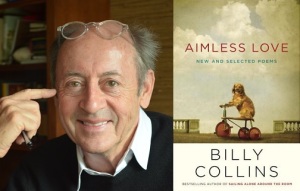
Last night, my friend Elyse and I ventured downtown to hear Billy Collins, my favorite poet, read at the Pantages Theatre.

He read for about an hour, a lot of new stuff from Aimless Lovehis new book (I read all the new poems in one sitting– I can do that for no other poet than Billy Collins) but also some old favorites like “The Revenant” and “The Lanyard.”

If you’re not familiar with Billy Collins, please come out from under the dark rock you’re living beneath (I kid, I kid!).  No, but really, in case you didn’t know, Billy Collins is a brilliant and hilarious poet.  Hearing him read live is such a treat for his deadpan delivery.  Elyse remarked, “It’s like attending a comedy event … but a really highbrow one.”

We laughed and laughed and laughed– and then made those soft sighs and murmurs that follow poignant poems.

Afterward, he had a very short Q&A session (which he called a conversation) wherein he said (and I’m paraphrasing as best I can here), “If you read great work and feel appreciative, you’re not a writer.  Writers read and feel a burning jealousy.”

YES!  I was so just discussing this on my blog.

It was a delightful evening with delightful company.  Elyse and I were some of the youngest people in the audience, and I felt bad for the rest of my generation that was spending their Friday without Billy.

Click this image to link to the book's Goodreads page.

Click this image to link to the book’s Goodreads page.


For the Next Time I Start Writing a New Novel

Dear Jackie,

By the time you start writing your next novel, you will have forgotten a few things, and in those moments, I hope you’ll come back to this post and be reminded.

* Writing a novel is hard.  The beginning stages kind of suck.  You barely know your characters until you’ve written the whole first draft, and so for a couple months, you’re essentially writing blind.  You forget that.  In those difficult days of editing, you think longingly of the “carefree” days of freewriting, having forgotten that you felt completely lost and simultaneously terrified that you were wasting your time.

* This is just what it is like at the start of a new novel.  You feel lost and lonely, and every scene feels stilted and confused.  You haven’t yet figured out your character’s deep-seated desires, let alone their surface ones, and you certainly aren’t aware of their secrets and many of their motivations.  You will.  You just need to spend time with them.  That’s how you get to know any new friend.

* It all seems so touch-and-go at the start.  You feel sort of committed to your idea, kind of committed to the characters.  Everything seems masterful in your head, and then the moment you start to type it out, it feels thin and aimless.  That’s because it is thin and aimless– for now— but that is just what it’s like at the start of a new novel.  At least for you.

* One thousand words each day will get you one thousand words a day closer to a completed first draft.  And when you force yourself to show up and sit down, your characters will show up too, and that’s essentially the only way you’re going to get them to spill their guts to you.  So keep showing up.

* First drafts are meant to be terrible.

* You don’t see most writers’ first drafts, just like most people won’t see yours.  So calm down.

* Remember that E.L. Doctorow quote?  “Writing a novel is like driving a car at night. You can only see as far as your headlights, but you can make the whole trip that way.”  Those are someone else’s words explaining your experience, because, really, it’s quite universal.  Remember that.

* Sometimes you’ll go down rabbit holes that lead nowhere.  Even if there aren’t novels down there, there are still lessons.

* Pumps need to be primed.

* Quit complaining to everyone and go write one thousand more words.

Love,

Jackie Lea, who is fumbling in the darkness of the beginnings of a first draft and wanted to remind future Jackie Lea of what it is like

headlights

I repeat: writing a book is hard.

I know I just recently blogged about this, but I just wanted to emphasize it again.  Not to toot my own horn (ummm, I don’t even have a book deal yet!), but to wave some sort of banner over those who are DOING IT.

Writing a book means this: days that turn into months that turn into years of writing and revising, hours upon hours invested into researching minute details, the sacrifice (and also joy) of building a platform from the ground up, giving up evenings with friends to stay home and research literary agents, headaches, crafting the perfect query or proposal, taking a permanent seat on an emotional rollercoaster.

Kristin Cashore is a YA author I admire.  She wrote GracelingFire, and Bitterblue.  Click here to read about the journey it was to get Bitterblue to where it needed to be (hint: after three years on a first draft, her editor suggested she start over from scratch).  There are even pictures.  Read this, and you’ll better understand the agony of writing.

bukowski


Guest Blogger: I Walk with a Limp (aka What I Wish I’d Known in Christian College)

Hi friends, Jackie here.  I’d like to introduce you to my friend Cindy, a truly brilliant woman whom I’ve referenced before.  She is so, so good for me and has challenged my thinking time and again.  Sometimes I want to just post her emails on my blog (and if you’re smart enough to find it, you’ll realize I *have* done this before).  Over the last, oh, two years, Cindy and I have had an amazing ongoing conversation about how much we’ve learned since undergrad, how much we’ve grown.  I asked her to write something to share with my blog readers.  Here it is.

I Walk with a Limp

I walk with a limp recently due to a running injury.  This injury knocked me out, slowed me down, yet I stubbornly ignored it for two months before finally going to the doctor and getting it put into an air cast.  The cast is huge and noticeable.  It causes me to limp.

Jacob of the Bible walked with a limp also.  He wrestled with God all night until God won the match by simply touching his hip.  For the rest of his life, Jacob walked with a limp to remind him of his humility before God.
* * *
I was at youth group in high school when I made the comment that the Bible is our weapon.  I meant that the Bible is our spiritual weapon and that we use it to combat the forces of evil in our world.  I meant it in the way that Paul describes – putting on the whole armor of God.  But over the years, I didn’t use the Bible as a weapon against evil.  I used it as a weapon against others.  Those who didn’t believe as I did, think as I did, act as I did, vote as I did, interpret the Bible as I did.  My Bible was my gun and I looked at its texts as if I was staring down the scope of a shotgun.  I lined up the perfect text against whatever or whomever I found lacking, and I fired.
* * *
Paul writes in Galatians that Jesus breaks down divisions.  That there isn’t Jew or Greek, slave or free, male or female, because Christ made us one.  We Christians recite this passage from memory, and then we turn around and start creating divisions.  Categories of people.  Those who are saved and those who are lost.  Those who read the Bible the right way and those who read it the wrong way.  Those who say they believe in Jesus and those who actually do.  Those who vote the right way and those who don’t.
We look at the ways people screw up and we use their sins to put them into the “other” category.  Separate from us — those who got it right.
When I arrived at Christian college, I arrived ready to perfect my faith.  I sought more shells to load into my spiritual weapon.  I wanted someone to teach me the Biblical texts I needed to create divisions between faiths that called themselves “Christian.”  I wanted proof that those churches weren’t doing it right, because they didn’t really believe in Jesus.  Because they didn’t believe in Jesus the right way.  Because they didn’t believe in Jesus my way.
Never mind that Paul says we’re all one in Christ.  I read his words as, “All who believe in Christ the way I believe in Christ are one, and everyone else is out.”
* * *
I got the idea, at some point, that the Christian faith wasn’t worth it if it wasn’t really hard.  Uncomfortable.  Outside the grain.  Counter-cultural.  What I failed to recognize was that Jesus dug right into culture.  He made the poor and meek and thirsty feel comfortable, welcome, loved.  He said, “My yoke is easy and my burden is light.”
My Christianity believed that Jesus gave me His burden, believed that I should want to be like Jesus, but it never considered my role in relieving the burdens of others.  Those whose burdens were heavy.  Those who needed love.  Those whom I’d placed into the “other” category.  It never considered that instead of sitting back and judging culture that Jesus dove right in to it.  That maybe I too should be diving in with arms full of love and grace and healing.
* * *
A pastor at my church preached on the story of Jesus crossing the Sea of Galilee with His apostles.  Jesus said, “Let’s go across to the other side of the lake,” so into the boat they all went.  The ship undoubtedly rocked gently, sweetly, like rocking a baby in a cradle, and Jesus succumbed to the lull of the seas and fell asleep.  Yet as the ship continued across the sea, the gentle waves grew stronger as the wind began to blow wildly.  With the boat rocking furiously, the disciples shook Jesus awake, panicked, terrified that they were going to capsize.  Jesus got up, rebuked the seas, and then asked His apostles, seemingly incredulously, “Where is your faith?!”
The pastor discussed that across the Sea of Galilee was Syria — a country of others.  Non-Jews.  Yet Jesus said, “Let’s go to the other side of the lake,” and His disciples got in the boat.
In the Christian church today, the pastor explained, Jesus is asking us to do the same thing.  He is saying, “Let’s go to the other side of the lake,” and on the other side of the lake are “others,” those who have been ostracized and excluded and broken down.  We get into the boat, but the seas get rough, and we cry out to God, demand to know why He isn’t saving His church, insist that it’s too hard to bridge this gap between us and the others, that we will never make it to the other side.
“Where is your faith?!” I can almost imagine Him saying.
* * *
In my Christian walk, I walk with a limp.  The limp won’t allow me to forget all the pain I’ve caused others by seeing the world as “us” and “them,” by using my Bible as a weapon against the others instead of using it to combat the evil that plagues us all.  It’s a limp that reminds me of how many times I’ve looked out at a rocky sea, a small boat, and told Jesus, “No thanks.  I’m not getting into that boat.”
I still screw up, judge, categorize, ridicule, doubt.  But I pray and I seek grace and I do my best to see people as Jesus did, to break down divisions, to see everyone as one in Him.  And when Jesus says, “Get in the boat.  Let’s go to the other side of the lake together,” I seek the strength to take His hand and climb on in.

When a Writer Reads

readerWhen a writer reads, a lot is happening.

If the book is good, there is one level of enjoyment, a second of envy, and a third of collecting style and ideas for future mimicry.  If the book is amazing, sometimes the envy hits like a punch in the gut.  If the book is flabbergasting, sometimes the enjoyment wins out and puts the envy on the backburner until the book is over.  Sometimes.

If I’m re-reading a book I love, my brain is whirring like a machine: pictures … could I introduce characters with pictures? The author started with a flood of memories … interesting way to get it all on the table.  Dual POV … is it working?  Structure, repetition, imagery, setting … 

Whirr …

Whirr …

Whirr …

I never regret being a writer, since it’s one of my truest joys, although it makes my life exponentially more difficult.  The closest I get to that regret though is probably when I’m reading.  It’s been a while since I’ve been able to just. simply. read.

It’s easier to read outside of my genre, which makes sense, since the envy lessens.  I don’t have aspirations to be an incredible fantasy writer, so it’s easier to give fantasy writers their due accolades and move on.  But then again, my favorite genre is contemporary, the genre in which I write, so of course I want to read those books.  And they’re often going to be the ones that will propel my writing the most.

What a strange tightrope writers walk!  There is almost nothing I love more than a good book– and yet, I’m doomed to have my enjoyment tainted simply because I’ve chosen that writing life for myself (or that life has chosen me).

I read a lot of book blogs, and I marvel at how differently a reader reads from the way a writer reads.

This sounds like a lament, and I suppose it is a little.  But then again, I get to be a writer, and for that it’s all worth it.