The Good & Bad of Writing

writer__s_block_by_arzu88-d3hg9efAm I a whiner?  Sometimes I feel like it.

The truth of the matter is that writing is just plain hard.

When I am writing a first draft, I wish I was revising. I tell myself it’s so much harder to make something out of nothing than it is to make something better out of something okay.  In a first draft, I still don’t know my characters very well, so I’m not entirely sure of what they should do or how they should react to people or events. I typically have no idea how the story will actually end, so I’m writing blind and terrified that because I see no ending now I won’t see an ending ever. I have to cast deep into my well of creativity because everything– absolutely everything– is brand new. (It gives me so much appreciation for my God who created ex nihilo [Latin, “out of nothing”].) It’s physically exhausting and mentally draining, and (at least in me) it prompts deep, deep doubts about myself.  In the early days of a first draft, I desperately long for revisions– when I will know my characters well and will be perfecting the story and imagery.

When I am revising, I wish I was writing a first draft. Deep in revisions, I feel bored to death with the process. It feels so stagnant and dull compared to the excited fervor of creation. It feels nit-picky and brutal, a journey to endure as a longsuffering artist.  And everything needs to be moving forward, finding its place.  You have to “kill your darlings.” You can’t keep putting things on the backburner to deal with another day– “another day” has come and the time is here. It’s like finding yourself in the middle of a battle without armor.  I think longingly of the days of freewriting and drafting, how carefree they were, how it didn’t matter if things fit together, how fun it was to be coming up with new adventures for my characters, how exciting it was getting to know them.

I am finding that the old adage “the grass is always greener on the other side of the fence” is true in my writing life.  I don’t want that to be true, and I want to find ways to love and appreciate whatever stage I’m in.

How?

I don’t know the answer yet, but I suspect it might look something like this:

1) I need to reflect on what I love about writing in general, about words, ideas, stories.
2) I need to count my blessings. I honestly do feel terrifically grateful to be a writer– even with all its woes.
3) I need to remember that every stage has its own merits and to start focusing on those positive parts instead of the negative.
4) I need to respect the creative process.
5) I need to be healthier.

What other suggestions do you have for me?


Image credit: Arzu88 on deviantArt
Why I Believe in God

About a month ago, a co-worker asked why we believed in God.  Obviously faith is a huge, huge part of it, but he wasn’t asking about faith.  He wanted to know what evidence we’d experienced that contributed to our beliefs.

Personal experience, some people said.

Another co-worker cited the teleological argument of the watchmaker: if you come upon a watch on a beach, you asume there was a watchmaker.

Me?  I shared one story and one historical finding.

bowI’m not sure I’m ready to share the story on my blog yet.  It’s such a special, intimate, significant experience in my life that most readers might think is silly, and I’m not ready to subject it to that yet.  I will say, though, that there was a moment in my life when I asked God for something and he gave it to me only seconds later.  Not a physical object but a thought/memory.  There was no other possible explanation for it but God, and it came at a very low time of my life, when OCD was like a railroad spike splintering my faith, and this experience mattered so much that I fell to my knees in awe and gratitude.

As for the historical finding, it comes from a book I read called Humilitas, which was written by Australian historian John Dickson. It examines the historical timeline of the virtue of humility, attempting to locate the turning point in history where humility went from being something people looked down on to being something people admired.

The turning point was the crucifixion and resurrection of Jesus Christ.

There are others things I could add: Can Man Live without God by Ravi Zacharias presents a fascinatingly different kind of apologetics as it examines not whether God is real but whether life has value and meaning if God is not real.  Other personal experiences with God throughout the years, most specifically an evening under the stars I spent with him. The backward nature of Christianity: how people can find joy in suffering, how we can lose our lives to gain them, how the last shall be first.

How about you? Do you believe in God, and if so, why?  

Keep comments civil, peeps.  I know we’re capable of having a mature, intelligent discussion on God.

Image credit: Hungry for God


The Point of No Return … in Reading

Definitely past the Point of No Return | Image credit: unknown.

Definitely past the Point of No Return | Image credit: unknown.

Picture me in a cheap hotel in Aberdeen, South Dakota.  I’m there to recruit the following day.

But right now it’s a little after midnight, and I’m nearing the end of Harry Potter and the Deathly Hallows for the very first time. I’m counting horcruxes on my fingers every ten minutes, turning pages like a speedster, heart pounding.

I’d passed the Point of No Return.  I knew that book would be finished before I went to bed, no matter how long it took.  (I think I managed to fall asleep around 2 or 2:30 am.)

I try to be smart about reading at bedtime, but sometimes you just have to MAKE. IT. HAPPEN.  That night.  No matter what.  No matter how few hours of sleep you’ll get or how much it will suck to get up, no matter how much you’ll have to struggle through work or school the next day.

I’ve thought about what constitutes my reading Point of No Return: fewer than 100 pages left (usually), nearing the climax of the book, characters I’m invested in, and probably some kind of fear. 🙂

What’s your Point of No Return in reading?


Where I Get My [Literary] News

I thought some of you literary-type folks might be interested to know how I [attempt to] keep my finger on the pulse of the reading, writing, and publishing world.

book necklaceI subscribe to the following e-newsletters:
Publisher’s Weekly Daily Newsletter
Publisher’s Weekly Children’s Bookshelf
Publisher’s Weekly Tip Sheet
Shelf Awareness Pro
Shelf Awareness for Readers
Goodreads YA Newsletter*
Goodreads Newsletter*
* Sign up in your Goodreads email preferences

I use Google Alerts for my favorite authors as well as topics like “YA publishing.”

I follow 98 different blogs (including over 70 related to reading and writing) and manage to do so through Bloglovin.

I follow authors, editors, agents, and reviewers on Twitter.

I also subscribe to Writer’s Digest, though I’m not always the best at sitting down and going through the magazine.  An issue arrived in the mail today, though, and I sat down and scoured it thoroughly.  It had a great feature about literary magazines and what their editors are looking for.

I attend writing conferences when I’m able.

I have a Ticketmaster account with my “favorites” listed, so that I’ll get an email if they are coming to town.  I also get an e-newsletter from the local theatre venues in the Twin Cities so that I’m aware if any of my favorite writers are scheduled to speak or read in Minneapolis or St. Paul.

Does this seem wildly unmanageable?  It’s actually not (most days)– and yet it helps me stay in touch with my literary world!  Hope this helps!

Image credit: Peg and Awl on Etsy

The Outgoing Introvert

In undergrad, I didn’t want to spend any time alone.  Because my writing instructor insisted that we take time just to be, I would force myself to lie on my bed in ten-minute increments, doing nothing.  Just lying there, resting, being alone.  I’d feel so rushed and eager to do-do-do and be back with people that I’d check the clock and be shocked that it had only been three minutes and I had seven to go.

I took the Myers-Briggs Type Indicator, and I tested as an ENFJ … and 100% extrovert.

introvertAs my writing life grew deeper, and as I grew older, I watched this do a complete flip.

These days, I am a solid introvert: I value my alone time, I feel drained after spending a lot of time with company, I absolutely have to build in time for rest, recharging, and solitude.

And yet, I’m still quite outgoing.  I’m not shy.  I am a good public speaker.  My job is all about hospitality.  I think it shocks a lot of people when they first learn that I’m an introvert, probably because they have misconceptions about what “introvert” and “extrovert” really mean.

Even now, if I take the Myers-Briggs, it still tells me I’m an ENFJ.  The test just can’t interpret my outgoing answers in way for it to regard me as an introvert.  But trust me, I am.  No close friend of mine would argue with that.

How about you?  Do you get your energy from being with people or from being alone?  Do you fit into the stereotype– a quiet, shy introvert or a loud, outgoing extrovert– or are you like me, a mix that defies the expectations?

Image credit: couldn’t find source.  Let me know if you know!

The Value of an Education: Paying for College

moneyWhen I chose to attend an expensive private college, my parents didn’t bat an eye.  Okay, maybe they did behind closed doors, but in front of me, they never complained, never argued with my decision, never made me feel guilty for choosing a school that cost far more than any of the state universities.

Not only that, but they helped me to pay for it.  Growing up, my dad set aside college money for me every year on my birthday.  (I remember while growing up thinking I’d so much rather have new toys than these mysterious dollars deposited into an account somewhere.)

I graduated with student loan debt– but not much.  I wasn’t saddled with a burden too big for me to bear.  In fact, I paid off my loans about three years after I graduated.

I’m blessed.  I know it.

And that’s the point: I am so grateful for this incredible gift, this huge sacrifice my parents made to help put me through school– not only school, but the school of my choice!  As a college recruiter, I so often see parents who refuse to help their children pay for a college degree.  For some of them, it’s not a choice: they simply cannot help.  There is no money available to help put their child through school.  But for others, it is a decision.  These parents believe that their child will not understand the value of an education unless they put themselves through school on their own.

It frustrates me.

Perhaps when I was 18 years old, I couldn’t understand this, having been so coddled and supported by my amazing parents.  But I certainly did at 21.  And more and more every year since then.  I never, ever take my college education or experience for granted, and I am so terribly grateful to my parents for their sacrifices.  (If you were to ask them, they would say, “It was no sacrifice.”  That’s the kind of people they are.)

In the US, the family is expected to assist the student in paying for an education.  Even the terminology of the index number the FAFSA is coming up with shows this: it is calculating an expected family contribution (EFC).  I’m not sure when it became popular for parents to ask their children to tackle the cost of college on their own, but it frustrates me when families say that students won’t understand the value of an education unless they foot the bill.

That simply isn’t true in my case.

There are a about a million caveats to every side of the debate, I know.  But I just wanted to throw my thoughts out on the table.

And, Mom and Dad?  Thank you from the bottom of my heart for never making me feel guilty for choosing Northwestern.  Thank you for the years of hard work and saving.  These things, more than anything else, showed me the value of an education.

Love you.

Image credit: Pixabay

OCD in Remission: Eyes on OCD or Eyes on the Journey?

I recently received a fascinating email from a young woman with obsessive-compulsive disorder, who posed a question that made me stop and think.

I would love it if you could offer me your take on this: is it better to keep my eyes on my feet (IE journey), or is it a good idea to keep an eye on my OCD?

Essentially, she was asking if it was smarter to keep an eye on the illness (knowing that OCD is never cured, only managed) or if it was better to ignore OCD while she could and just enjoy the journey.

periphery2Here’s what I said:

Such a good, thought-provoking question.  I imagine that the answer might be different from person to person, but as for me, I think the answer is a little bit of both.
 
My OCD has been in remission since ERP five years ago.  These days, I don’t pay a terrible amount of attention to my OCD because it’s no longer intruding on my life on a regular basis.  That said, if I have an off day, OCD is the first thing I “check”– did I take my meds, am I having intrusive thoughts and need to practice some exposures again, etc.?
 
I think it’s BEST to keep your eyes on the journey.  But you still have peripheral vision. 🙂

For more about the ERP therapy that set me free, go to jackieleasommers.com/OCD.

Image credit: toxicbarbie13

The State of the Blogger

My admissions team just hosted 200 high school students for an overnight visit event.  It’s a wonderful event, and the students have a great time.  It’s probably our most fun event of the year: games and worship and chapel and classes and tours and lots of good food!

But for an introvert, it’s a type of annihilation.

I spent most of today sleeping.  My battery was on less than empty, and I needed today to recharge.

So tonight I had a bowl of Lucky Charms, took a hot shower, slapped on some Valor essential oil, and prayed.  Lately, I feel a sense of being held together only when I am in prayer or writing a letter to my future, calmer, more-accomplished self through FutureMe.org.

I’m reading Code Name Verity by Elizabeth Wein, and it’s so amazing that it makes me feel like I write drivel.

My to-be-read list is out of control.

What should I read next???

What should I read next???

I chose to watch the final episode of season 3 of Downton Abbey tonight.  No spoilers, but UGH.

My next draft is due March 24th, and I need to find a rhythm.  I made myself a three-step to-do list tonight, which sounds easy enough, but each step is flabbergastingly huge and one is nearly inconceivable.  Writing is so hard.

I wish I could just push pause on life for a few months– to catch up on sleep, to catch up on reading, to learn to be a better writer.  But I am trying to have faith: I will find a rhythm, butt-in-seat will mean a better manuscript a month from now, and God will not abandon me or our book.

I think I need some chocolate milk.  That’s step zero.  Then I dive back in.

All In: Ideas & Writing

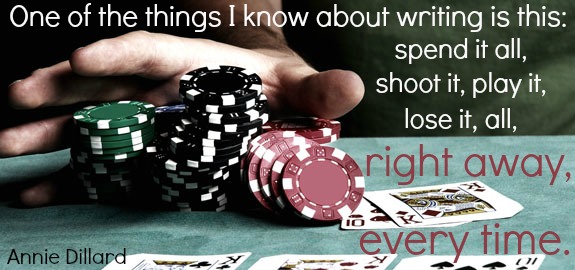
I try to take this quote of Annie Dillard’s deeply to heart as I write fiction:

“One of the things I know about writing is this: spend it all, shoot it, play it, lose it, all, right away, every time. Do not hoard what seems good for a later place in the book or for another book; give it, give it all, give it now. The impulse to save something good for a better place later is the signal to spend it now. Something more will arise for later, something better. These things fill from behind, from beneath, like well water. Similarly, the impulse to keep to yourself what you have learned is not only shameful, it is destructive. Anything you do not give freely and abundantly becomes lost to you. You open your safe and find ashes.”

If I have a great idea, and if it fits into the story I’m working on, I don’t hold back, don’t reserve it for another time.  Remember when I plotted out that giant multi-storyline monster (and then subsequently abandoned it)?  In my current WIP, I am using some of the ideas from this story, even though they “fit” better with this whole plotted-out beast.  Who is to say if those other projects will ever see the light of day?  Better to spend my currency now before I’m in a country where it’s no longer acceptable payment.

For me, it’s about faith.  Faith that if I use my best ideas now, new ideas will come later.  It’s about having a generous spirit, about rejecting any parsimonious parts of my writer-heart, knowing that that sort of frugality reflects fear.  I want to write out of faith instead of fear.  Always.

all in2


Image credit: original from inc.com, edited by Jackie Lea Sommers.

Obsessing vs. Brainstorming

I’ve had a very, very active brain for pretty much my entire life.  I’m the girl people always described as “the one who thinks too much.”  I have thoughts and ideas rush me like little hurricanes, and this is just as true after ERP therapy as it was before.

But there’s a huge difference too: productivity.

Before ERP, my thoughts were often OCD-induced intrusive thoughts that led me down dark avenues over and over again.  My thinking was circular, and I could re-visit the same ideas an uncountable number of times each day.  I was a hamster on a treadmill or a dog chasing its tail– that is, expending a lot of energy but going nowhere.

After ERP, my thoughts are much more welcome to me.  I can choose to focus on the ones I want.  I may still be lying awake at night, but it’s productive, and I end up jotting tons of notes and ideas down in my phone.  I start in one place, but an hour later, I’ve traveled some distance and often have huge realizations about my fictional characters and storylines.

Believe me, the latter is much more fulfilling.


For more about the ERP therapy that set me free, go to jackieleasommers.com/OCD.

I'm SO over this.

I’m SO over this.