what it feels like

I just had an OCD dream.  Is that even possible?

In it, my mom was talking about Halloween and beseeching me to guard myself against dark powers on that day (my mom is not generally a nut about these kinds of things, but she was very passionate in my dream), and I was telling her that I was protected because I have Christ … when I began to doubt my salvation.  In my dream. 

Weird.  Never have done that before.

And I woke up to those same old feelings of terror that dominated me for so long.

I was reading OCDTalk blog and read a post about what OCD felt like (the link will take you there).  She wrote:

* You have that feeling you get after swerving to avoid a potentially fatal car accident.

* You have that feeling you get when you take your eyes off of your child in a store for one minute, and then he/she is gone.

With the above examples, your physical and mental distress dissipates once the blackboard scratching stops, you avoid the accident, or you’ve located your child. But try to imagine having those feelings of intense anxiety repeatedly, perhaps hundreds of times a day. That is what some sufferers say life with severe OCD feels like.

Those were the two examples that resonated most with me– I wrote a couple things over the past three years trying to describe what OCD felt like.  Here’s a poem that reminds me of how I just woke up from my dream– the feeling that I’m trying to let drain out of me right now as I blog:

TERROR

 I remember in junior high when for Christmas I received
an old-fashioned alarm clock, two bells like golden mushrooms
and the tiny hammer that trilled between them. 
The alarm was like crashing through four levels of reality
in mere seconds, like being doused with water from the Atlantic,
like defibrillator plates on my chest, shocking me into the morning,
like frozen hands slapping my brain.  These days,
it is as though the golden clock of my childhood has taken up residence
inside my chest, where it is continuously ringing, jolting me back to the
Issue at Hand whenever I forget, for a moment, to be scared.

Here’s another line from my book:

I worked myself into hysterics by that evening, an amusement park ride spinning out of control.  Terror licked at my heart and felt permanent: I just knew that nothing would ever be right again. 

And here’s one last one.  I hope it helps you to understand.

It reminded me of my later years of high school, when Charlotte’s and my friend Terri started to go to parties in our classmates’ cornfields, where she would steal cigarettes from boys’ mouths to take her own drag.  Jeremy Mason’s back forty was the preferred party spot for our small class, although from time to time, the melee would move over to Madison Prewett’s pasture pond.  And sometimes, as if they were begging to be stereotyped, the group would convene for indiscretion at the railroad trestle just outside of the Collins Falls city limits.

At the time, I was stuck in my own paradoxical world—worrying that God wasn’t real, and that because I thought so, He would send me to hell—and so had no time for petty crimes like underaged drinking, which would only muddy my already-soiled “record.” 

            The one time I made it out to the trestle was on a Sunday afternoon, the day after a party where half of my class had gotten minors.  Terri had shirked the police but dropped her cell phone while fleeing the scene, so the next day, she asked me and Charlotte to help her look.  Charlotte, who had just gotten both her license and the Voyager, drove us to the scene in a reckless fashion she’d never outgrow.

            The site had an abandoned, makeshift fire pit and empty cans of Coors Light scattered all around like eggs at an Easter hunt.  The fire pit had a few hay bales around it that someone or another had brought out in his pickup truck, and all this was at the base of the western hill.  From the top of that hill, the trestle bridge ran out straight to the eastern bank, at least 120 feet high in the center of
the bridge and about a quarter of a mile from one end to the other.  It looked rickety and ominous, like the oldest rollercoaster at the amusement park.

            “Call my number,” demanded Terri, as we started to climb the western hill.  “I ran this way, trying to get into the trees.” 

            We were nearly at the top when we heard the old Nokia ring.  Terri located it and wiped it off on her jeans.  “Good as new,” she pronounced.

            The three of us turned around and looked down the hill, then across the long stretch of tracks with the support frames branching out beneath them like Tim Burton’s grotesque version of gothic
giraffe legs or the Imperial walkers on planet Hoth.  “Let’s go across it,” said Terri, her eyes shining.

            “Oh gosh,” said Charlotte.  “Really?”

            “I’ve done it before,” said Terri.  “It’s really not that big of a deal.”

            “What if a train comes?” I asked.

            “That’s the point,” said Terri.  “It’s scary because you don’t know if a train could be coming just around the corner.  I mean, it probably won’t, but you don’t know that.  If a train comes, then you
have to run for it.”

            “Okay,” I said, and the words shocked me as they left my mouth.  I felt as if someone had bumped into me and I’d accidentally burped them out. 

            “Really?” asked Terri.

            “Yeah, really?” asked Charlotte.

            Now my stomach was reeling as I looked down the side of the hill we’d come up.  It was a long way down.  I moved over to the tracks and stood in the middle of them, facing the bridge.  It was so far across, and so terribly narrow.  I wondered briefly if we could somehow climb down the support beams if the worst came to the worst.  “Let’s just do it,” I said.  “Let’s get going.  It’s going to be fine.”

            And so we walked across the trestle then, a quarter mile from safety to safety, and the whole time we marched across those wooden slats, none of us spoke but Terri, who said, “Whoa,” in the
middle of the bridge, when she looked over the edge.  She said, “It’s actually worse in daylight,” and then we continued on, a silent march, ears tuned for any shrieking whistle just around the bend.  I felt bent over with tension, as if my shoulders were knotting up the way water boils in a pot.  My stomach felt hollow and greasy. 

            It’s nothing, I told myself.  Nothing is coming.   But it didn’t calm me. My heart beat like a steady roll on a snare.  It was one of the most terrible and memorable experiences of my young life, and my mind was ravaged with images of three bodies lying still in the rushes below.  Every step felt like sheer panic flowing up from my toes to my chest, rattling my heart then moving like a laser beam to my head, where I manufactured nightmares.

            And now, all these years later, this memory was like putting a finger on the pulse of that evening: absolute terror, only this time, there was no safety in sight.  Just the feel of walking on an endless, narrow railroad trestle, listening, straining for the sound of destruction on its way to meet me.


CBT prep …

  I looked at the back cover of Freedom for Today’s Obsessive-Compulsive.  Apparently Steve Jewett and James Nash were some big names in the OCD world.  “Open this book,” the back cover read, “and unlock the doors of your mind’s prison.  What lies ahead of you is freedom.”  The goal was appealing, and I liked the confident wording.  Just straight to the point: “What lies ahead of you is freedom.”  Well, okay.

            I opened to a random page and read, If I were to say to you, ‘Don’t think about a red unicorn,’ what would happen next?  Why, immediately, you’d begin to think of a red unicorn!  In fact, I’m sure that’s what’s in your mind’s eye right now as you continue to read this page.  That is what we’re dealing with as we fight OCD.  An obsessive-compulsive experiences an intrusive, unwanted thought, and because it is intrusive, he feels disgusted by it, wants to stop thinking that particular thought.  But just as my telling you, ‘Don’t think about a red unicorn’ results in your immediately doing so, the obsessive-compulsive’s panic and desire to stop thinking the intrusive thought actually drive him to continue thinking about that very thing.”

            Well, that was certainly true enough.  When my worst thoughts arose in my mind and I tried to stamp them out, it was a battle of escalation.  The harder I fought, the harder I needed to fight. 

            “In cognitive-behavioral therapy (CBT),” the book continued, “we encourage the obsessive-compulsive to give in to those intrusive thoughts, to stop fighting them.  Time and time again, CBT experts have found that it is when an obsessive-compulsive stops fighting the intrusive thoughts and actually embraces them that he finds freedom from them.”

            Oh gosh.  I set the book down, my heart beginning to race.  It wasn’t new information to me—Ruth’s brochure had given me the basics of behavior therapy—but the way it was worded gave me a chill.  “Give in to those intrusive thoughts.” 

             “So I’m reading this book for Dr. Foster, right?” I said a couple nights later at Rosie’s Place to Stella before she opened her laptop.  “It’s like reading my own biography.”

            “Yeah?” she asked, taking a sip of something foamy.  “What do you mean?”

            “Well,” I said, “you know how all my ‘issues’ seem so bizarre?  Some of them are not bizarre at all, I mean in the world of OCD.  I’m textbook.  It’s crazy really.” 

            “Like?”  Stella began to sort through the tangled mess of beads she was wearing—black, red, maroon, picasso jasper.  These, in addition to a floral chambray shirt and hiking shorts.

            “Okay,” I said, “so there are all these made-up scenarios, and the book circles back to revisit these same examples.  One of them is a dad who’s sure he’s going to kill his baby girl, so he won’t even hold her.  He gets all these images in his head of suffocating her, stabbing her in her little chest, shaking her, drowning her.”

            “Ew,” she said, still fussing with her beads.

            “Yeah, but these thought make him completely sick,” I explained.  “It’s clear to everyone else, including his wife and therapist, that he would never ever hurt his daughter.  I mean, they’re not freaking out.  He’s the one avoiding alone time with his daughter.

            “And there’s this lady who thinks she might be a lesbian even though she isn’t attracted to women.  Every woman she walks by, she thinks, ‘Am I attracted to her?  Do I want to kiss her?’ then she imagines herself kissing that woman.  She’s just sick over it, but instead of thinking, ‘Oh, I guess not.  That’s not a pleasing image to me,’ she thinks, ‘I must be gay.  Why else would I be thinking so much about kissing women?’  This is called HOCD—homosexual OCD.

“But then get this.  One of the example scenarios is about this girl who has these blasphemous images attack her mind.  She … she pictures herself having sex with Jesus.”  Stella looked bemused, but I continued.  “She doesn’t want to think about that, but there are all these triggers in her normal day—when she sees someone praying, or a cross around someone’s neck, or a kissing scene in a movie or on TV.  And whenever there’s nothing else to think about, that’s where her thoughts go.  She believes that her thoughts are blasphemous, so she believes that she will go to hell.  She thinks about hell all the time.  The book even said that she confessed to her priest, and even he said she was fine, but she couldn’t believe it.  Whenever the image of having sex with Christ came into her head, she said a Hail Mary to alleviate her guilt and drive the image away.  Eventually she had to quit her job because she was too distracted saying her Hail Marys to get work done.”

            Stella’s eyebrows furrowed.  “Gosh, that does sound like you!”  She abandoned the necklaces she’d been working on and clasped her hands together on the table between us, leaning forward as she listened.

            “I know!  I mean, elements are different, for sure, but the basic idea is the same.”

            Stella sighed.  “I used to think that OCD meant that people were super clean.”  She chewed on the inside of her cheek.  I knew what she was thinking, even though she didn’t say it aloud: It’s so much worse than that.

            “Yeah,” I said, agreeing both with what was said and unsaid.  “Even the people who are really clean, or who wash their hands all the time—they’re driven to it.  They think something horrible is going to happen if they don’t do it. It’s so much bigger than just being a neat freak.  It kinda drives me nuts when people with quirks say, ‘I’m a little OCD myself.’”

Stella nodded violently.  “Remember that receptionist job I took at that plastic surgeon’s?  One day this nose-job lady came in, right?  She sat beside a burn survivor, pointed at his dressings, then at her own protective shell covering the bridge of her nose, and said, ‘I know how you feel.  Hang in there.’”

“I don’t believe you,” I said, jaw dropped.  “You’re joking.”

“I’m not,” she said.  “I’ve never been so pissed at a job site before.  I’d take the call center perverts over those rich bastards any day.”  She shook her head in disbelief.  “So … therapy?”

            “Therapy,” I said.  “I guess it’s like a pyramid, and you climb to the top, step by step—if you don’t reach the pinnacle event, CBT probably won’t work.  In the book examples, the dad had to write down all the ways he was going to murder his daughter—graphically!—and then record himself reading it, and he had to listen to it over and over.” 

Stella looked disgusted.

            “The HOCD person had to rate women’s butts and record everything in a notebook, and she had to read a couple LGBT novels.  And the one with religious obsessions had to write a story about having sex with Jesus Christ and then read it over and over again without saying any Hail Mary prayers.”

            Stella made a face but nodded slowly.  “So what will you have to do?”

            I shrugged.  “All I know is that it will be terrible.”

            And for once, I appreciated it when Stella didn’t reassure me.  There was more strength in knowing she agreed.  “I don’t know what to do,” I confessed. 

            “Write about it,” she said.  So I did.


OCD

There he is, that scarlet beast,
black horn like a railway spike.
I check myself against the blood-red giant,
close my eyes, cover my ears,
two-thirds of the famous monkey trio
where I sit cross-legged between cloven hooves.
Do not think of a red unicorn.  Do not do it.
But I can feel his wet, warm breaths like humid whispers

as he lowers his nostrils to my neck, crimson ears at salute
like a maddening accusation.

PANDAS

The PANDAS that I’m talking about has nothing to do with these guys …


… and everything to do with childhood strep throat.

PANDAS = Pediatric Autoimmune Neuropsychiatric Disorders Associated with Streptococcal infections

Say what???

PANDAS describes a set of children in whom an ordinary bacterial strep infection can turn into a neuropsychiatric disorder.  The strep seems to cause the body’s immune system to build up antibodies that – who knows why – turn traitor and attack the basal ganglia in the brain.

In other words, a simple case of strep throat gone to hell.

Sometimes a child gets strep throat, and the body gets confused– instead of fighting off the bacteria, it attacks the basal ganglia … which leads to obsessive-compulsive disorder.

The first time I had an intake with a psychiatrist, she asked about my past medical issues.  “Ummm … I broke my elbow twice,” I said, thinking how a broken bone had nothing to do with my head issues.  I reached: “And I’ve had strep throat like a million times.”  I felt a little stupid and way too thorough.  Keep it to related issues, I thought to myself.  Duh.

But my psychiatrist perked up.  “Did you know there’s a strong connection between strep throat and OCD?” the doctor asked me.

Apparently, this is a little controversial, and some doctors aren’t convinced.  But come on– how many cases of strep-followed-by-rapid-onset-of-OCD do you have to see before you raise an eyebrow at the connection?

My doctor– Dr. Suck-Won Kim, the absolutely brilliant OCD expert at the University of Minnesota– believes there is a strong correlation, and I’m in his court.

A scene cut from my book:

“You have heard of PANDAS?” he asked.

            “I have,” I said, although I couldn’t remember at the moment what it stood for.  “It’s when kids get strep throat and then OCD.  Or something like that.”  I realized that I probably sounded stupid, explaining PANDAS to an OCD expert.

            “So many PANDAS studies … it has to be solved because far more OCD cases are strep-linked than people know.”

            “Yes, I had strep a lot as a kid.”

“YOU DID? YOU SEE?!”  Dr. Lee became animated as if a moment ago I’d said no such link between strep and OCD existed but now he was proving me wrong.

“The first time I met with a psychiatrist, she asked about my medical history.  I didn’t have a lot to share, but I happened to throw it out there that I’d had strep throat a lot, and she said it was probably connected.”

“She knew that?” asked Dr. Lee, impressed.  “That is uncommon.  Most doctors have no clue.” 

For more information on PANDAS, feel free to check out

I think I had strep throat nine times as a child.  Can anyone beat that?  Leave a comment!

CBT intake

“This will be different from other kinds of therapy, Neely,” said Dr. Foster, as if he could read my mind and there see my image of Ruth.  “You’ll have homework and be expected to go through various exposures when we meet together.”  He picked up the top coaster off a stack of them on the coffee table between us and set his coffee mug on it.  It had had writing on it.  I looked at what was now the top coaster on the stack.  It read, “Uncertainty and mystery are energies of life. R.I. Fitzhenry.”

For the next hour Dr. Foster tuned in carefully for any mention of rituals, anxiety, and triggers.  I knew that he was combing through my words for his options, already working on his plan of attack for how he would prompt anxiety in me like a gun’s trigger, asking over and over, “If you couldn’t do that, would you have a lot of anxiety?” I blathered, but he was only seeking one thing: what would stress me out to the max.

“When I hear words that start with the f sound, I start praying over and over again in my head,” I revealed.  

“How would you feel if you were prevented from repeating the prayer at those times?”

My heart clenched a little in my chest.  My prayer was the key to counteracting the whole chain of ugliness that lead to blasphemy and hell.  “Um, anxious, nervous, crazy.”

“Mmm hmmm.”  Dr. Foster was jotting notes furiously.

“It’s because of hell,” I shared, explaining how curse words and the sound of the letter f  made me think of cursing the Holy Spirit, which I believed to be unforgivable.  “I’m always scared of hell—only sometimes it’s in the background, like elevator music.”

 He continued to write and encouraged me to keep talking.  “When you’re nervous about going to hell, how do you calm yourself down?”

 “I can’t calm myself down,” I admitted.  “But I ask my friends and family what they think.  Even though it doesn’t convince me, I still like to hear them say I’m okay.”

 “Hmm,” said Dr. Foster in recognition.  “Seeking reassurance is another of your compulsions, another thing you do to ease your anxiety.  Pay attention this week—I bet sometimes you do this passively, like mentioning that you’re a bad person.  Watch for it.”

 We continued on this way, Dr. Foster asking the questions and me providing the answers, feeling ridiculous and unhelpful and as if I were maybe wasting Dr. Foster’s time. 

 “Do you have any questions?” he asked as we were wrapping things up.

 “My faith plays a huge role in my OCD,” I said.  “Do you … ”                                  

 “I believe in God, yes,” he interrupted.  The way he spoke made me certain that he did not feel about God the way that I did.  I gulped.

 “Ninety-nine-point-nine percent of people are skeptical going into this,” he told me, his face like a stone.  I wondered if he ever smiled, even at home.

 “Okay, because I am,” I said.  It felt appropriate to tell him this, even though I was intimidated by his seriousness.  “I think I understand how this works,” I said, “but I’m a little confused.  Like, for example, a washer would be prevented from washing, and then they’d realize that nothing bad happened when they didn’t wash—they still lived.  So how will that work for me?”

 “You’re misunderstanding a fundamental part of cognitive-behavioral therapy,” said Dr. Foster, folding his hands across his stomach.  “The point is not to take away the person’s uncertainty.  The point is to make him or her okay with uncertainty.”

Well.  That didn’t sound so good.

He continued, “Just because a washer doesn’t get contaminated after being prevented from washing one time doesn’t mean that the person won’t still fear a deadly disease the next time.  Each time is a new adventure.”  He raised his eyebrows.  “And with you, well, we can’t fast-forward to the end of your life and see whether you’re going to heaven or hell.  CBT will teach you how to live with uncertainty.”  He tapped on the top coaster in the pile.  “Energies of life.”

exhausted

I remember feeling SO tired … but not in a I-didn’t-get-enough-sleep way.  Just in a deep, heavy-hearted, there-are-too-many-things-to-manage kind of way … including all your thoughts, which are vomitting all over your mind.

There is rest available.  I wish I could get you to believe that.

“Yes, keep it up,” repeated Dr. Lee, “and you will beat this still.  There is rest for you ahead.”  He narrowed his eyes at me as if he were imagining my successful future.  “But not yet. For now, more work.”

More on CBT this week.

Kissing Doorknobs

The other night, I posted the following on Facebook:
I definitely feel called by God to the novel I’m writing. “Kissing Doorknobs” (a YA novel about OCD) was huge in my life … like finding a friend who understood me. I hope the same for my novel! OCD is such an alienating disorder, so anytime you can find someone/something that understands you, it’s huge, like a reminder that you’re not alone.
 
I wanted to tell everyone a little more about the book Kissing Doorknobs, a story about a young girl named Tara and her battle with OCD.  Tara counts sidewalk cracks, kisses her fingers before she touches the doorknob, and recites prayers to calm herself. 
 
After I read this book, I handed it over to my mom, knowing it would help her understand me better.  I highly recommend this quick and easy read for anyone who has or suspects they might have OCD– but also for those of you who love an obsessive-compulsive. 
 
Here are some quotes from the book that jived with me:
 
“I was eleven years old and still in possession of my own thoughts.”  Because, believe me, in the throes of it all, ugly, unwanted thoughts were being fired at me like bullets.
 
“One tear fell down my right cheek.  Unbelievably and instantly, my left cheek felt cheated!”  Yep.  I used to do this with tapping my feet or fingers.
 
“I worried about death and heaven and Judgment Day.”  It was wonderful to encounter myself in the story.  It helped me to realize that I was normal– well, normal for an OC.
 
“I wanted to confess everything.  Everything.”  Enough said.
 
“I knew my worries weren’t normal.  I knew because my friends had worries too, but they were nothing like mine.  Mine were perpetual.”  Picture a girl who cried in bed every night for three years.
 
“It was like playing two video games at once or watching television and listening to the radio.  It was noisy.  It was exhausting.  It was stressful.”  See my poem that illustrates this.
 
“[I] was too afraid of the answer to ask him the question.”  Hence, my own parents didn’t even know that I cried every night.  5th-8th grade.  Doesn’t it break your heart?
 
“She never minded my doubts and consistently reassured me that I was not going to hell.”  Raise your hand if you’ve been this person in my life.  Okay, you can all put your hands down now!
 
“It was like paying attention to a dozen things at once.”
 
“Although [my parents] wanted to help, they didn’t know how, or even what was wrong with me.”
 
“I felt sick but wasn’t sure of what.”  In my own book, I describe it this way: “a nagging feeling in the back of my throat, the feeling you get when you’ve made a huge mistake but haven’t told anyone yet.  An ugly, wooden expectancy, guilt taking up space but not quite filling the emptiness.”
 
“I suspected she was always thinking things that were different from what she said.” and “they could all think something about me that they weren’t telling me.  They could pretend.”  In my own life, it spiralled into paranoia.  I thought my friends were demons trying to trick me into hell.  More on that later; aren’t you pumped? 😉
 
“doubt that I’d ever win the war for my freedom.”  Because OCD is slavery, to be honest.
 
I love hearing your comments and questions, so please leave one on here or on Facebook.  Thanks guys!

CBT

“Tell me, Neely.  OCD—do you know about it?”

            Oh wow.  I hadn’t realized that I was going to be quizzed.  “Some,” I said.  “I’ve read a few books, some articles.”

            He nodded his head vigorously.  The sharply combed strands of black hair on his head did not budge.  “Yes,” he said.  “Yes.  Education is critical.  You know how you fight OCD?”

            I wasn’t sure if this was a rhetorical question or not.  I nodded a little, but when I saw that he was waiting for an answer, I said, “With education?”

“With knowledge.  Knowledge is the weapon,” he said, continuing to speak in italics and suddenly launching into war metaphor, “You fight disease—disease fight back.  You have to negotiate carefully.  This is a game of tricking OCD.  Invade without alerting your enemy.  Side-step into enemy territory—your own mind—and take captive a small plot of land, just what you know you can win.  You have to condition your mind to the idea of winning.  Right now, it is used to losing.  What works best is cognitive-behavioral therapy.  You have heard of it?”

The vague sickness I’d been feeling all morning suddenly gathered into a physical reality in the pit of my stomach.  It took only those three seconds to realize that this is what I’d been afraid of.  “Yes,” I said quietly.

“It is the best treatment for OCD that we know of.  Medicine is good, but CBT is better.  There is a man—Jon Foster—you will call him.  He will help you.”  He scrawled the name onto a piece of scrap paper in the messy handwriting of a doctor.  “He is young, but he is good.  You meet with him—I bet he can kill it.”

Dr. Lee met my eye just then, and I could tell he meant what he’d said.  “Kill it?” I managed to squeak out.

“Cognitive-behavioral therapy, very effective,” he said.  “OCD is never cured, but CBT brings it under control.  You will call Jon.”  It was not a question.

“Okay,” I said, taking the piece of paper with Jon Foster scrawled on it. 

I needed to leave.  I needed to process all this.  My indistinct fears now had a name, and I needed to be alone, let my head spin through this like a rolodex.  I started to collect my purse.

            “Listen,” he said, “it will be hell.”  I winced inside and hoped it hadn’t shown on my face.  “Hell,” he repeated.  “CBT is very, very difficult.  You will be asked to do things you cannot imagine doing.  But it is the best treatment.  You have to think like a mother.  A mother would do anything for her child.  You have to do anything asked of you.  But you can do it.  You are Christian.  That is good.  You will need will power and faith to get you through this.”

My heart went into a freefall, and I never felt it land anywhere inside of me.  I swallowed—or tried to.  My throat was suddenly very dry.  “Oh,” I said.  What else was there to say?

OCD101

Hopefully this scene from my novel will give you a better understanding of how OCD works; in it, Neely is attempting to explain OCD to her new friend Gabe.  (By the way, Gabe is just finishing up his chemotherapy– hence the lack of hair.)  Ask your questions in the comments!!  (I would seriously love it if every person who reads this blog asked one question!)

“So, how is Tatum’s Pizza Arcade the best place to tell me about OCD?” he asked while grease from the pizza collected at the corner of his mouth.  He wiped it away.  “I’m … rather curious.”

I’d been planning this for the last week.  “Okay,” I said, “so you get to learn about OCD in three parts tonight.  First, I’m going to tell you about it.  The second and third parts are more experiential.”

“I’m ready to learn.”

“Obsessive-compulsive disorder is basically where you have these intrusive thoughts—they come out of nowhere and assault you—and then to combat them, you perform some kind of compulsion.  Compulsions are more obvious than obsessions—washing your hands til they bleed, checking the oven or the lock on the door over and over and over, being a pack-rat to the furthest extremes, doing weird little rituals.”

“You don’t do any of those things.”

“No.  Well, kind of.  I have my own rituals.  Mine are hard to see because I’m a pure obsessional.”

“So you don’t have compulsions?”  I loved the thoughtful way he chewed his food, the earnest look in those pale blue eyes. 

“No, I do, I do.  They’re just, well, trickier to catch.  They’re mostly in my head or to myself.  Or well masked.”

“I don’t get it,” he said.  “We’re not off to a good start.  And this pizza sucks worse than I remember.”

“Let me start over.  Okay, so an obsessive-compulsive has an intrusive thought—could be anything—maybe ‘I am going to get sick and die.’  So they hate that this thought keeps hounding them, making them feel sick—so they do something about it.”

“Wash their hands,” he supplied.

“Right,” I said.  “You’re getting it.”

“So what about someone who touches the doorknob forty times or something?”

“Same thing.  There’s some intrusive thought—and they’ll perform the ritual to temporarily alleviate the sick feelings from the bad thought.”

“Okay, so how about you?”

“My intrusive thoughts are blasphemous.”

Gabe raised an eyebrow—or what was left of one.  “Liar.”

“They are,” I insisted.  “I think bad thoughts toward the Holy Spirit, and since I’m scared that doing that is unforgivable and that I’m going to hell if I think those things, my head automatically wants to combat those intrusive thoughts.  So I say a prayer, the same one over and over to bat down those thoughts.”

He frowned.  “And there’s no way to just stop them?”

“Gabe,” I said, borrowing from my old friends Jewett and Nash, “do me a favor and don’t think about a red unicorn.  What are you thinking about?”

The corners of his mouth turned up, just slightly.  “A red unicorn,” he admitted.

“Well, stop it,” I said.  “Quit thinking of the red unicorn.  Stop now.  Do not think about that red unicorn.  Stop—”

“Okay, I get it.”

“So … yeah,” I summed up.

“It’s like warfare up there?” he asked.  I nodded. 

After dinner, I said, “I want to show you something.  Come with me.  Bring the tokens.”

We walked to the kiddie arcade.  I looked around.  “What are we looking for?” asked Gabe.

“There it is!”  I pointed to an arcade machine that came up to my hips, with five small holes in the top.  I took Gabe’s hand and pulled him along behind me toward the machine then maneuvered Gabe into place in front of the game.

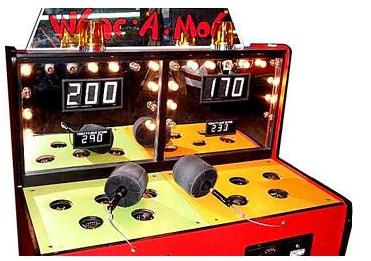
“Whac-a-Mole?” he asked, doubtful.

“Whac-a-Mole,” I said, inserting a token into the machine.  “Let’s see you go, Reed.”  I slapped him on the back for luck.

He made a big show of it, shaking out his shoulders, squaring his jaw, performing minor stretches.  I laughed when the plastic moles covered in weathered paint began to pop up randomly from the five holes.  Gabe jumped into action, reached for the foam-covered mallet and began to attack the moles, forcing them back into their respective holes as they showed their faces.

Gabe was pretty good—at least, at first.  The game began slowly, with moles creeping leisurely out of their holes.  But in a short time, several moles began to pop up at each time, and Gabe struggled to keep up.  Before long, the moles were out of control, popping up for only a split-second.  Gabe let out a choked, surprised laugh as the game sped up even faster.  He was wielding the mallet like a boy swiping at the air with a toy sword. 

As the machine lit up and the moles retreated, I laughed at Gabe, who looked legitimately surprised to be getting his butt kicked by five plastic mammals.  Three red tickets popped out of the dispenser attached to the arcade machine.  “What’re those for?” he asked, mallet still in his hand, limp at his side.

“The better you are, the more tickets you get.  Then you trade them in for prizes.”

His jaw dropped.  I threw my head back and laughed.  “Three measly tickets?” he said.  “Put in another token.”  He wound up with the mallet as if it were a baseball bat.

Gabe played a few more games, getting better and better, the red tickets spewing out of the machine like an overgrown tongue.  Still the machine overwhelmed him by the end of every round.

He was no idiot.  “So, this is some sort of metaphor for OCD?” he deduced.  “The experiential part of tonight?”

I smiled.  “You got it.  Blasphemous thought—mole rising.  Say my prayer—bash it down.  Blasphemous thought—mole rising.  Say my prayer—bash it down.  Now, Mr. Reed,” I said, lowering my voice, “this time, pretend it’s salvation on the line.  If you mess this game up—misstep somewhere—you go to hell.  Hell being where you are forever separated from the person you love the most.”  I dropped another token into the machine; in the middle of the cries of kids and beeps and clangs of arcade games, I could swear that I heard that token hit its fellows in the collection bin beneath the token slot.

Gabe frowned but played his hardest.  In the end, when the game had once again gone out of control, it ended.  Another string of tickets whirred out of the dispenser, but Gabe only looked at me, and even when I smiled at him, his blue eyes were sad.  “I’m sorry,” he said. 

paranoia

The following scene is from my novel, a conversation between Neely and her therapist as Neely explains the time after college she finally CRACKED.  My story is fiction, but this re-telling is VERY true to life for me.  It was a terrifying time of life.  I remember enjoying only food and fiction at the time, the two things I thought I could trust.  I was even scared of my poor roommates.

It started simple enough: I’d modeled my new shorts in the hall of our post-college apartment.  “What do you think?” I asked Trapper.

“I like them,” she said—but a little off-handedly—as she moved past me and into her own bedroom.

In my room, I examined myself in the full-length mirror, wondering over her tone.  “Do you honestly like them?” I called to her.

“Yes,” she answered from her room.

She’s lying, I thought.  She doesn’t like them.  I frowned into the mirror.  If Trapper was lying about something small like this, what else could she have lied about?  Maybe she didn’t like any of my clothes.  Maybe she didn’t even like me!  I felt suddenly dizzy.

“You ready to go get supper?” she said, appearing in my doorway.

“Oh!  Oh, yeah.  Okay.” 

“You okay?” she asked.

“Yeah.”  Why did she live with me, hang out with me, go to dinner with me if she didn’t like me?  Maybe it was all an act—the whole friendship—and eventually, the truth would come out.  It would hurt worse because I’d believed we were such good friends.  It was a calculated plot to ruin me.

Trapper chattered in the driver’s seat on the way to dinner, but I wasn’t listening.  I was thinking in fast-forward mode, possibilities inciting nausea.  Like a pinprick of light, I wrestled my way to a new “realization”: Trapper McKay was a demon.  Our “friendship” was a ploy that allowed her to deceive me and lead my soul into hell.  I felt sure I was going to vomit. 

She turned the volume up, steering with her right hand while her left raked the air.  “My milkshake brings all the boys to the yard,” Trapper sang, looking over at me and grinning while the breeze from the window whipped strands of red hair across her face.  Meanwhile, I staggered in the knowledge that one of my closest friends was methodically planning my annihilation. 

During dinner, my reeling thoughts crossed another line as I realized that if Trapper was faking, then anyone could beI glanced around the restaurant, realizing a horrendous new truth.  Everyone was a demon.  I was living in a real-life Truman Show, only with more destructive actors, and they with far uglier ambitions.

“Neels,” Trapper said.  “You’re acting really weird.  Whatcha thinkin’ about?”

I couldn’t let her know what I’d uncovered, that I was catching on.  “Not much.  I’m fine,” I peeped.

“You?  Fine?  We should throw a party.”  When I smiled weakly, she said, “Neels, it’s a joke.”

“Yeah,” I said, forcing out laughter.  “Yeah, I know.”  But I spent the next month faking my way through life, shocked at my discovery and desperate to keep it under wraps.


“Did it feel silly and serious at the same time?” Ruth asked me.

“Yes!” I said, nodding violently.  “I was ultra-aware that I was being ridiculous, but it just didn’t matter.  My head had gotten stuck in its regular loop, and when that happens, it’s pretty hopeless until it wears me out.  During the workday, I talked with prospective students, joked with my co-workers—but really, I was wondering if they could tell I knew the ‘truth.’”  I made quotation marks with my fingers.  “Sometimes I’d forget—find myself feeling all right—but then I’d remember: these people were demons and trying to trick me into hell.  I retreated from people—even my friends.” 

“This was after college, you said?” asked Ruth.

“Yeah, three or four years ago.”  I was glad Ruth didn’t see me shudder: I didn’t want her to think I was a drama queen.  “My best friend Charlotte—the same girl who was with that first day on the playground?—at the time she was finishing up undergrad in Chicago and applying for med school back here in Minnesota.  She’d call and while she gabbed, I’d think, ‘She’s acting friendly now so that the betrayal will be even more painful.’  Paranoia made me a real loner.”

seven years old

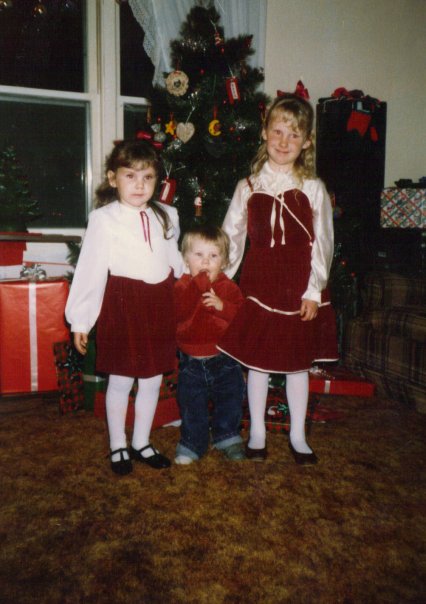
My little sister Kristin (4), baby brother Kevin (1), and me (7) — at least, this is my best guess of our ages at this time.  (Mom?)

My OCD struck at age seven.  I had curse words running through my head as if I were some foul-mouthed sailor, when the truth of the matter was that I was a shy (Yes, really!  Hard to believe now!) girl from a conservative home, who would have never DARED to utter those phrases outloud.

I drew on real life as I detailed this scene about my protagonist Neely in my book:

“On summer vacation, I’d lie on my back outside and picture the sky littered with profanity.  Then I’d erase it with my mind until it was clear again.  This would maybe take ten minutes.  Then I’d pick up my book—all I ever did was read—and immediately, all those words would swarm back.  Seven years old,” I said again, making a face.  “I felt stained.”  I glanced again at her notes, wondering if she’d written down the word stained, if she’d underlined it. 

“I’m sorry, Neely,” said Ruth, narrowing her eyes at me slightly.  They were outlined in dark eyeliner and, although apologetic, they were also at peace, as if nothing in the world could truly surprise her. 

“My brother Joseph was two years old at the time, just a baby.  I’d watch Joseph playing—usually the sandbox—and be so jealous: his mind was so uncluttered!  I mean, he was thinking things like ‘digging is fun’ or ‘I have to go potty’—my head was a garbage dump. 

“At the time, my mom and I thought I was going crazy.  She said she barely got a minute of peace that summer—I was always looking for her and confessing, ‘Bad thoughts!  I’m thinking bad thoughts!’”  I felt sorry for myself, a seven-year-old wracked with guilt. 

I have this image in my head of running to find my mom under the clothesline, smacking my fist against my forehead, and confessing.  My poor mom.

I wish we’d known then.  It would be another fifteen years before my OCD would be named, but I’ve wondered what life would have been like had we caught it back in the summer of 1989.  Drat you, internet, for coming along too late!  Out of curiosity, I googled “my daughter is attacked by bad thoughts”– just to see what would have popped up had Mom had access to the world wide web back then.  Four or five of the links were about OCD.

My heart breaks for the obsessive-compulsive children out there, wild minds racing, hearts terrified, robbed of childhood.