
 Myth #1: You won’t have to research.
Ha. Ha ha ha. HA. Once upon a time, I thought that only non-fiction writers and historical novelists had to do research for their books. If someone wrote contemporary fiction, well, she would already know how life works … and anything else she could make up, right? Gosh, that was so short-sighted, it’s comical to me now. Of course, we often hear the phrase “Write what you know” (sidenote: I much prefer my writing mentor Judy’s “Write till you know”), but for most of us, that’s about one book’s worth of content. After that, guess what, you have to write another one. And it has to be different. Full of things you might not know. And even that first book … look, you’re still gonna have to research. I have read books about Greek mythology, philosophy, string theory, antiques. I’ve watched YouTube videos to learn about carpentry. I ask questions every single day to my wide network of friends, am super involved on Quora, and spend hours researching the finest details– details that, if done right, the reader will not even notice.
Myth #2: You must plot.
Nah. Sure, many writers do. But many don’t. Each writer has his or her own proclivity toward planning or “pantsing” (writing by the seat of one’s pants). You may have seen J.K. Rowling’s hand-drawn outline for Order of the Phoenix. Then again, Ray Bradbury said:
When you plot books you take all the energy and vitality out. There’s no blood. You have to live it from day to day and let your characters do things.
There are tremendously successful books on both sides– and some that employed a combination of tactics. With my WIP, I pantsed the first 6-12 months, then– after I knew my characters better– ploted it out before revisions.

Myth #3: You must know what you’re doing.
You just need to not give up until you get there. This can take years and years … are you willing to invest that time? Do you feel called to it?
That said …
Myth #4: Anyone can do it.
Here I defer to Ann Patchett, who shares this story in her book This is the Story of a Happy Marriage (it’s sooooo good … I briefly reviewed it here):
…my husband had told her I was a novelist. Regrettably, I admitted this was the case. That was when she told me that everyone had at least one great novel in them.
I have learned the hard way not to tell strangers what I do for a living. Frequently, no matter how often I ask him not to, my husband does it for me. Ordinarily, in a circumstance like this one, in the Masonic Lodge in Preston, Mississippi, I would have just agreed with this woman and sidled off (One great novel, yes, of course, absolutely everyone), but I was tired and bored and there was nowhere to sidle to except the field. We happened to be standing next to the name-tag table. On that table was a towering assortment of wildflowers stuck into a clear glass vase. “Does everyone have one great floral arrangement in them?” I asked her.
“No,” she said.
I remember that her gray hair was thick and cropped short and that she looked at me directly, not glancing over at the flowers.
“One algebraic proof?”
She shook her head.
“One Hail Mary pass? One five-minute mile?”
“One great novel,” she said.
“But why a novel?” I asked, having lost for the moment the good sense to let it go. “Why a great one?”
“Because we each have the story of our life to tell,” she said. It was her trump card, her indisputable piece of evidence. She took my silence as confirmation of victory, and so I was able to excuse myself.
I couldn’t stop thinking about this woman, not later that same day, not five years later. Was it possible that, in everybody’s lymph system, a nascent novel is knocking around? A few errant cells that, if given the proper encouragement, cigarettes and gin, the requisite number of bad affairs, could turn into something serious? Living a life is not the same as writing a book, and it got me thinking about the relationship between what we know and what we can put on paper.
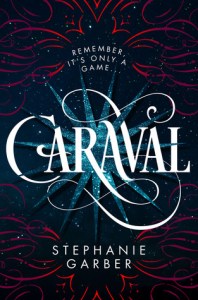 Caraval by Stephanie Garber | Scarlett’s grandmother has told her and her sister Tella stories about Caraval since they were young– an audience-participation game that is like a magical carnival. Scarlett has always longed to go, but getting tickets now— less than two weeks before her marriage to a mysterious count she has never met– is not the ideal timing. At Caraval, Tella goes missing, and the game revolves around the sisters. Julian, the young sailor who brought the girls to Caraval, is shrouded in mystery too, and Scarlett can’t tell who is friend or foe, or whether the game is really just a game.
 Harry Potter & the Cursed Child by J.K. Rowling, Jack Thorne, and John Tiffany | I think I went into this screenplay with reasonable expectations. I waited quite a while to read it because I knew that it was not going to be like “the 8th Harry Potter book,” as some stores touted. First, it’s a screenplay, not a novel; I knew I couldn’t expect the same thing. Because I went into it with realistic expectations, I loved it!
 The Poem She Didn’t Write and Other Poems by Olena Kalytiak Davis | This one was staggering. I absolutely adored it. It was like e.e. cummings had become a female spoken word artist. The rhythms were impossible to miss, even without hearing them, and I was exposed to a new vocabulary. I thought it the poem topics were really brave, and there were quite a few that she approached from such a stunningly unique perspective. The title poem, in particular, was mind-blowing. I will be purchasing her other books.
 Chinoiserie by Karen Rigby | This was the 2011 winner of the Sawtooth Poetry Award– and well deserved. Beautiful writing, rich imagery, the poems took me to other places, something I always love. I was happy to let this collection sink into my bones.
 1. How long it would be before I’d sign the actual contract


 JACKIE LEA SOMMERS