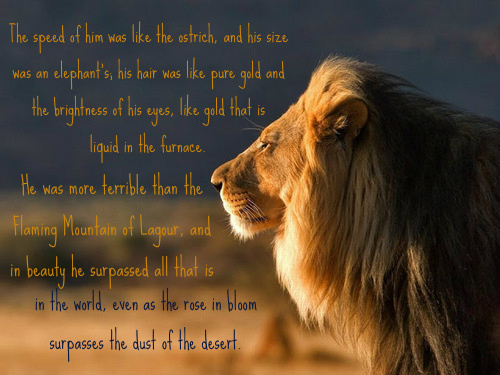
the Great Lion
Image
2

I have heard it credited to Saint Augustine: “Make me chaste — but not yet.”
For a long time, that was my thought about heaven. I wanted to go there someday— but definitely not today.
Heaven scared me, and it still does sometimes. There is so much I don’t understand about it:
* How can something last forever?
* Won’t it get boring?
* If all imperfection is gone, who will I even be?
* Will we have goals?
* Will I still write?
* Will there be any challenges?
* Will I interact with others or only be focused on God?
Even now, thinking about it has made me a little uneasy.
My co-worker believes that heaven will be on earth. I seem to think it will be entirely separate. I know that I will be with Christ, and since He is my true love, I will be happy. But I still get a little scared sometimes. I’m so used to this earth, as messed up and sinful as it is. I know what it is like to desire things and work for them and how to draft and re-draft chapters in a bookstore on the weekends.
I used to be even more scared of heaven– before I read The Last Battle by C.S. Lewis, that culminating seventh and final book of the Narnia series. I won’t tell you what happens in it (my favorite book), but it eases my mind about heaven. It reminds me not of the questions I have but of the JOY I’ll experience being in the presence of my Savior.

Several things have recently come together to inspire me to write this post. First of all, you should know that, in general, I have not been the biggest supporter of fan fiction because
1. It is usually bad.
2. Or dirty.
3. And I’d rather invent my own characters and world instead of piggybacking on someone else’s.
In fact, I have gone so far as to write a scene describing it as such:
The leader of Emmaus University’s brand-new fan fiction club was named Mallory Stevens, and somehow I’d agreed to be the club advisor. “Can it be crossover fan fiction?” one girl asked us at the sign-up table on Club Day. “I have some stories where Harry Potter stumbles through a wardrobe at Hogwarts and finds himself in Narnia.”
“That sounds great!” Mallory gushed, while I inwardly cringed. “Are the Pevensies there too?”
“Yeah,” said the girl, flushing with pride, “I think Harry and Lucy are going to fall in love. Maybe. We’ll see.” She bared her teeth when she smiled, looking more than a little pleased with herself. I smiled back, but really, I was mortified that one of my creative writing professors would walk by at any moment and see that I was mopping the floors in literary hell.
But is that assessment too harsh?
Just last week John Green (whom I adore, and whose story The Fault in Our Stars was the inspiration for my novel) posted a video with his thoughts on fan fiction:
To summarize, he rather likes it because it allows people to explore areas the author didn’t without making it canon: “to write and write creatively without there being an authoritative voice about the story.” Fair enough.
And, let’s be honest, I already do this. Just the other week I posted this story, exploring life after The Last Battle. And then, last Monday, I wrote a whole post about how I think about the Narnia characters outside of just the books, including– and I quote— “Because I have the heart of a thirteen-year-old teenybopper, I often wonder about the love story of the king and queen of Archenland. There is so much teenage angst in it that it almost makes me want to write fan fiction. Almost.”
Writing and posting “Nine Names” plus thinking about Cor and Aravis plus John Green’s video all intersected in such a way that …
I have to admit …
this week, I chose to write some fan fiction.
I decided to try a writing prompt from fanfiction.net, one where I’m given 50 words/themes, and my challenge is to write one sentence about each. I liked this idea because it was different, intriguing, and because it was a challenge to write fifty tiny vignettes that somehow gave snapshots into a story and yet were not really a story themselves— not quite.
I am embarrassed, but without further ado, I present to you my Narnia fan fiction, which– to be honest– I hope is the last of its kind. 🙂
#01 – Comfort
In those early weeks at Anvaard, she’d nightmare and cry out in her sleep, but when she’d sit up in her bed, slick with sweat and heart pounding louder than the hooves of the 200-horse army of her dreams, he’d be there—silent in the corner, gentle but with a newfound ferocity in his eyes.
#02 – Kiss
He didn’t speak in those midnight wakings but would take her small, dark hand into his pale one and wait for her breathing to slow, and when it did, he’d press his mouth to her fingers and leave her, knowing she’d sleep soundly till morning.
#03 – Soft
He didn’t know that though her breathing slowed, her heart always beat faster.
#04 – Pain
Daylight was a different story: “At least when you’re sleeping, you quit arguing,” Cor muttered after yet another fight.
#05 – Potatoes
She stares at them warily—back home, they were flavored with garlic and onion and made her eyes sting—but next Corrin passes a big dish of yellow butter, and she’s grateful for these northern lands.
#06 – Rain
It was so dry on the other side of the desert that on the first night of rain, she marches straight out into it and laughs.
#07 – Chocolate
It takes Corrin twenty minutes to convince them to bite into the horrid-looking brown thing.
#08 – Happiness
There are nights they spend around the fire sharing poetry and songs, and when Corrin embellishes his stories, Cor and Aravis catch each other’s eye across the fire and smirk.
#09 – Telephone
“I’m only telling you what Hwin told me Bree told her he’d heard Cor mention to the king,” Corrin says, “but you can make of it what you will.”
#10 – Ears
Why do her ears and face get hot when she thinks of him talking to his father about her?
#11 – Name
One night he stays after her nightmare and hears her whisper, “Shasta,” before she smiles in her sleep.
#12 – Sensual
He didn’t tell anyone about his dream that night, especially not Corrin.
#13 – Death
He’s been thinking of his mother a lot and what she’d think of him now—even taller than Corrin and (secretly) enjoying his education.
#14 – Sex
The Queens of Narnia give Aravis her first exposure to late-night girl-talk, and the young Tarkheena is grateful they can’t see her blush in the darkness of the room.
#15 – Touch
Another argument; only this time, he closes his eyes and takes her hand.
#16 – Weakness
She didn’t want him to let go, but her pride made her withdraw.
#17 – Tears
“Just something in my eye,” Cor tells his twin, who would be merciless.
#18 – Speed
When she needs to be alone, she rides like a maniac up into the mountains.
#19 – Wind
The wind rolls down from Stormness Head like a gale, like a baptism.
#20 – Freedom
Only once has she gone to the border, staring southward across the desert, realizing for the first time that she had been in slavery there too.
#21 – Life
She returns to Anvaard with new purpose, a clearer mind.
#22 – Jealousy
When he sees Corrin and Aravis whispering on the terrace, he seethes, but when they hug before parting, it’s a night for the history books: for once, it’s he who knocks his brother down.
#23 – Hands
Aravis is small but strong, and she pulls Cor off of his brother, shouting at him while he shouts at Corrin while Corrin just laughs and laughs.
#24 – Taste
“Listen to me, you idiot!” she says, taking his face in her hands and shutting him up by putting her mouth over his.
#25 – Devotion
His response is … enthusiastic.
#26 – Forever
The two retreat to the garden to share overdue truths.
#27 – Blood
King Lune only rolls his eyes when he sees Corrin’s bruises the next morning; Cor apologizes handsomely to his brother without letting go of her hand.
#28 – Sickness
Joy floods the king’s heart, soaking the cough that sits in his chest like a sponge.
#29 – Melody
She grins when she hears the crown-prince whistling after breakfast, knowing she is the reason for the tune.
#30 – Star
“Your father says they are people,” she whispers to him while she stares at the sky. “Can you imagine such beauty?” He says, “Yes,” and he is looking at her.
#31 – Home
She was confused at first over where to call home; then she dreamed of the lion and knew.
#32 – Confusion
There is concern in all their eyes when the king mutters nonsense before it’s even dark.
#33 – Fear
“Something’s wrong with Father,” Corrin says, and it’s that tone of voice—serious, like Corrin never is—that scares Cor the most.
#34 – Lightning/Thunder
They hold each other through the storm, and when it grows late, neither wants to leave.
#35 – Bonds
“Let’s get married,” he whispers, “so that we can stay like this.” “That almost sounds like a proposal,” she responds, an eyebrow raised, intrigued.
#36 – Market
Aravis asks Bree if she should do some of their old-fashioned “raiding” for the gown, and he grins, remembering.
#37 – Technology
Lasaraleen sends her regrets, but also a present: a most interesting wind-up toy that reminds Aravis of her friend’s pet monkey; they hide it in Corrin’s room.
#38 – Gift
The king looks strong on his son’s wedding day, and he tears up as he tells her, “The lion returned him safely to me; today I give him to you.”
#39 – Smile
He will never forget the way she looked at him while he made his promise: all at once, he saw her as a child, a proud Tarkheena, a humbled princess, a future queen and mother, and he loved all of the girl she had been and was now and would be.
#40 – Innocence
They are awkward with each other that first night, but sweet; the future king and queen have a few things to figure out first before they can manage a kingdom.
#41 – Completion
She purrs like a cat as she curls into his side to sleep, and he has never been happier.
#42 – Clouds
The fog from Stormness is thick on the day they leave for their honeymoon in Terebinthia; Aravis wonders if it’s a sign, but Cor can’t fear the fog, not anymore.
#43 – Sky
“Their majesties are missing out on the good views, shut up in their cabin as they’ve been,” comments one sailor. “I think they rather like the views inside,” quips another with a wink.
#44 – Heaven
This is perfect, to discover each other while carried on the waves of the Great Eastern Ocean.
#45 – Hell
But the lion meets them with hard news on the island; to put it quite gently, King Lune has gone home to Aslan’s country.
#46 – Sun
How can it shine when his father is gone? “Because he is not gone,” she tells him, though he didn’t ask aloud.
#47 – Moon
“I’m not ready to be king,” he whispers on the deck that night as they return to Archenland.
#48 – Waves
The ship rocks gently as a cradle, reminding him that he is safe between those great paws.
#49 – Hair
When he returns to the cabin, she is sleeping soundly, her dark hair lying silken on the pillow. She doesn’t nightmare anymore, he realizes, then understands it’s because of him.
#50 – Supernova
The lion’s strength fills him like light, like brilliance.

deviantART by ~TealHeadlight
I have to confess that I think about characters far beyond what actually appears in the written pages of books. My favorite characters to think and dream about are those from Narnia.
Edmund. To me, the most fascinating character in the whole series. My favorite line of his is when he says, “But even a traitor may mend. I have known one that did.” And he looked very thoughtful, or so the book tells us. I read layers and layers into that. I love to think about Edmund returned to England after years spent as a king in Narnia, about that crazy heart change that occured. I wonder what his parents thought of the change when they saw him again after the air raids were over, if they thought it was the Professor who had been a good influence, or that country air, or the opportunity to explore a big house. I picture that Edmund was a quieter boy when he returned, and that when he spoke, it was often profound. He had, after all, been an adult– and royalty– a warrior and known for his commitment to justice.
Susan. I have dedicated much time to pondering “The Problem of Susan,” which we encounted in The Last Battle. Where did things go wrong for Susan? And how could she turn her back on it all when she had been present at the Stone Table? I have struggled through it the best way I can– by writing, both a poem and a short story.
Aravis and Cor. Because I have the heart of a thirteen-year-old teenybopper, I often wonder about the love story of the king and queen of Archenland. All Lewis tells us is that they argued so much and made up so much that, when they got older, they got married so as to go on doing it more conveniently. This is one of the few love stories in the Narnia series (the only other I can think of is Caspian and Ramandu’s daughter), so naturally, I am drawn to it. I can’t help but think that Cor, in his quieter ways, thought that she would fall for his twin brother. There is so much teenage angst in it that it almost makes me want to write fan fiction. Almost.
Professor Kirke. I would have loved to have been a fly on the wall listening to the conversation between the Pevensies and the professor after their long sojourn in Narnia. Can you even imagine Digory’s great relief when he learned that they had witnessed the demise of Jadis, whose presence in Narnia can be traced directly back to the professor’s youth? We obviously get no glimpse into this, since The Lion, the Witch, and the Wardrobe was written before The Magician’s Nephew. Lewis was well aware that there were gaps and inconsistencies in his series, and even intended to go back and fix them, but it just never happened.
Anyway, you already knew I was a nerd. Now you know that I’m kind of beyond hope of any rescue from it. In fact, it’s Friday night, and I’m sitting alone in Dunn Bros, looking at Narnia fan art. It’s all over for me. Haha!

deviantART by ~secrethope
(On a sidenote, there is a startling amount of Lucy-Tumnus pairing. Um, gross. Really, really gross.)
Books matter to me. So, so much.
So when my friend, who is halfway through The Book Thief, asked, “Now, who is Rudy again?” I about died.
Now, I deeply love this friend; she is brilliant and fun and cares so much about people and justice and mercy. But come on. Who is RUDY? WHO IS RUDY STEINER??! Why are you reading this book if you can’t remember one of the MAIN CHARACTERS?!!! Where is the RESPECT?
Okay, done ranting. I think.
I am not this way with all books– but there are certain, choice stories where I am quite literally offended if a friend doesn’t like them, almost as if I were the author. When my friend Jessica read Narnia for the first time, I was upfront with her: “Please tell me you liked them. I will actually be offended if you didn’t.” She did. Phew.
When my roommate told me that The Fault in Our Stars was “good, but not great,” I didn’t want to throw her off a cliff or anything. When my sister couldn’t get into The Sky is Everywhere, I didn’t want to disown her. I don’t have to worry about what I’d do to someone who didn’t like Stargirl because I have never met such a fool.
But The Chronicles of Narnia, The Book Thief, Peace Like a River … do not disrespect these stories.
Or else feel my wrath. 🙂

I spent last weekend with my incredible friend Cindy, whom I know from Northwestern. Cindy went to law school at Georgetown and now lives and works in Washington, DC, and she was kind enough to take the Amtrak to Boston to spend the weekend with me. So, so good.
We did lots of fun stuff, but to be honest, some of the best parts of the weekend were just all the wonderful conversations. You have to understand that Cindy is 100% brilliant, and you can talk to her about absolutely anything, and she has all this valuable insight. One night, we ate a late dinner at the Cactus Club (where, btw, I had the most incredible chicken and avocado quesadillas), and we got to talking about Rene Descartes (since I had begun his book Meditations on the flight out to Boston and because he is playing quite a significant role in my YA book) and about his dream argument and the way he was establishing universal doubt. It led to a great conversation on uncertainty and how healthy it actually is (in fact, it was the key to my therapy!).
Cindy and I talked about how certain statements and discussions used to jar us in regard to faith, but how as we got older, we both reached a point where we decided, “Look, I am committed to this Christianity thing. I think it is true, even though I can’t really know that. But I’m not going to be swayed by every new scientist and fact and detail and argument that arises. I’ve made a choice and I’m sticking with Christ regardless.”
I’d like to hear what you think about this. My assumption is that different ages will have different reactions.
Not to go all Narnia-nerd on you (but let’s be honest, I can’t always help it), but I told Cindy it reminded me a lot of Puddleglum the Marshwiggle in The Silver Chair. Are you familiar? Let me set the scene for you.
Puddleglum and friends are in the Underworld, and the evil Queen of Underworld is strumming her magical guitar and has tossed some sweet-smelling something-or-another into the fire, and the marshwiggle and his friends are falling under her spell as she tries to convince them that there is no Overworld.
“But we’ve seen the sun!” they argue. The queen asks what a sun is, and they describe it as very large, very bright lamp.
“You’ve seen my lamp,” she contradicts, “and so you imagine a bigger and better one and call it a sun.” The same argument is repeated when they bring up Aslan. “You’ve seen a cat,” she said, “and you imagine a bigger and better one and call it a lion.”
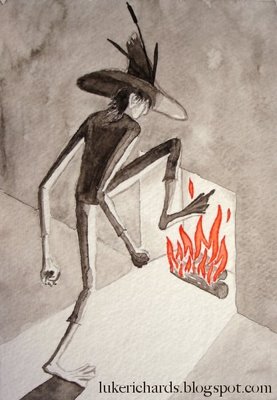 But Puddleglum puts his foot into the fire, shocking him into clarity, and he essentially says, “It’s sad that if you’re right, we’ve still managed to make a play, fake world that licks your real world hollow.” Then he goes on to say, “I’m going to live like a Narnian, even if there isn’t any Narnia. I’m going to serve Aslan, even if there isn’t any Aslan.”
Cindy and I feel the same way about Christianity. Now, don’t get me wrong: I believe Christianity is real, and I believe Christ is real and is alive today and is working in my life. But I will allow for doubt. Uncertainty in certain dosages can be very healthy, and I have made a choice to serve Jesus Christ, no matter what.
Thoughts?
She dreamed often of a lion, tawny gold and glorious, with light that scattered from his mane as if it were born inside of him. In her dreams, she stood beside him, staring east across a vibrant sea, and when she woke, it was always with the refrain, He has nine names.
She hated to wake. The sea in her sleep was alive but behaved, and in the days since the accident, her days were a horror. She was in a stupor, flummoxed with loss. How can I be the only one left? The mornings were darker than her dreams.
Her aunt and uncle had planned the funeral, which, she realized, was perhaps not the best choice, but she herself was of no use to anyone. Then again, no one expected much of her at a time like this. And when that dreaded service came, with the nine closed coffins at the front of the sanctuary, she could not greet the guests or be consoled but instead fled to the solace of the church nursery, where she sat in a chair meant for a small child, her arms wrapped tight about her body, rocking back and forth as if the motion itself would somehow comfort her. There is no one left.
On the wall was a mural of Noah’s Ark—painted in the friendly, child-safe version that curtailed the dreadful details. Instead, there was a large boat with a smiling man on board, surrounded by animals, and above them stretched a rainbow in the primary colors of youth. Two giraffes poked their heads from the roof of the ark; a dove carried an olive branch back to the man; pairs of smiling anthropomorphic animals stood together on the deck. Two elephants, two horses, two monkeys, two zebras. One lion.
The lion. He has nine names.
She grimaced as she brushed away thoughts of her dream.
“Susan?” Aunt Alberta said, leaning her head inside the nursery door. “Oh, there you are. The service—it’s about to start.”
She nodded. “I’ll be there in a moment.”
No tears had come yet, although she was certain that they would—and when those floodgates opened, she wondered if they would ever close again. Her mother and father, her brothers, her sister, her cousin, and three friends—all gone, leaving her life as shredded as the railway tracks that day. She had seen the bodies before they’d closed the coffins. Nine plastic faces smiling serenely, as if they were all in on a secret she did not know.
Her throat caught as she stood to her feet for the service. She wanted to blame someone, but whom would she blame? She glanced again at the mural on the wall, all those happy animals looking as if they were talking beasts. She frowned; it was as if—as if—it was like a moment of déjà vu. Stop it, she told herself. Just get through the service, through the burial. Just hold together for a few more hours.
And yet, as she walked back toward the sanctuary, now full of mourning guests, it happened again. This time an image burned in her mind as if it were a memory from another life: a stone table, cracked in two, empty of life or death, but full of meaning and magic. And when she opened the door to the sanctuary, she uttered a loud gasp when she saw the crucifix at the front of the room. The guests turned to look.
He has nine names. And now she knew two.

I know that I’ve blogged recently about whom I write for, but I was thinking about that more this past weekend, as I was reading Alan Jacobs’s book The Narnian, a biography of C.S. Lewis’s creative life, and I had additional thoughts … or maybe questions.
If they won’t write the kind of books we want to read, we shall have to write them ourselves; but it is very laborious. C.S. Lewis to J.R.R. Tolkien
Now, I am certainly not saying that there are no books being written that I want to read (hello, I am practically panting for Marchetta’s new book to arrive in the mail!), but this does bring up the question for me of whether it is okay to write for oneself or if it is more noble to write for others.
What I am trying to do right now with Truest is to write the kind of story that I would like to read. Is that a selfish way to write? Is that even a smart way to write? It’s not that I am not taking any criticism … I just keep my list of whom to please in my mind (#1 God, #2 me, #3 John Green). (Man, it makes me laugh every time I post that list … John Green. Oh gosh. I wonder if he will ever know how influencial he has been on the writing of Truest.)
“Better to write for yourself and have no public, than to write for the public and have no self.” —Cyril Connolly
Anyway, blog world, I’d love to hear your thoughts on this.

This issue has been pawing at me for the last week or so.
Here’s my dilemma:
As a fanatic writer, I have a hard time incorporating Jesus Christ into my writing in a way that is not alienating to non-believers.
As a critical reader, I find the number of books that can do this well to be sorely lacking.
Look, I know that there is a vibrant “Christian fiction” genre out there, but if I step into that area of the bookstore, I seem to be surrounded by Amish romances. Really? Amish romances? That is what Christian fiction has boiled down to? I have no– read my lips, NO– interest in reading such a book.
I want books like Perelandra by C.S. Lewis (which was full of dense theological arguments that were presenting in a fascinating and thrilling cosmic duel that draws in all readers), books like Peace Like a River by Leif Enger (which somehow manages to show a believer’s real relationship with Christ without stepping for even one moment into sentimentality).
Even worse than that issue is that I worry that I am contributing to the problem. I’m not writing any poems about how God blessed us with puppies and rainbows or anything, but I am really struggling to find a way to speak to all audiences while still mentioning the name of my Savior.

This was my prayer the other night, which I am showing to you in the hopes that you will join me in praying it:
Jesus Christ, my hope, my love, I BEG THAT YOU WOULD SHOW ME HOW TO WRITE CHRISTIAN FICTION THAT GLORIFIES YOU AND CALLS OUT TO UNBELIEVING HEARTS.
Jesus, I want to do something big for You. Unfortunately, without Your assistance, I can do NOTHING. HA! I even need You just to enable me to worship rightly. I NEED YOU, JESUS. My heart wants this so badly– I so desperately, so deeply want to honor You through my writing and want to draw people to You through story. It seems almost insurmountable to me– the idea of writing incredible, realistic fiction that both honors You and appeals to both believers and non-believers and that will minister to hearts of all kinds. Jesus, I know it is possible with You, but I think that is the ONLY way it is possible. And I plead for it. It’s like my heart is begging for this, Jesus, to honor You in this way, and I need Your guidance and direction just to even come close. Help me to get there. Help me to persist even if it takes so very, very long to get there.
I want what I write to matter; I want it to be infused with meaning and with YOU, and I don’t know how to do that without alienating the very people that I want to have read the book.
May I please throw all this responsibility back on You and ask that You simply use these hands as Your tools? When I sit at my laptop to write, Holy Spirit, I pray that it would be You who guides the words I write.
Amen.
 JACKIE LEA SOMMERS