The Bible & Creativity

The Bible starts with creativity: “In the beginning, God created the heavens and earth” (emphasis mine).

God is referred to as a potter (Isaiah 64:8), a weaver (Psalm 139), an author (Acts 3:15; Hebrews 12:2), and a singer (Zephaniah 3:17*).

In the Old Testament, God carefully describes his plans for the tabernacle, and it involves art. In fact, one chief artisan is even called out by name for his incredible work: “See, I have chosen Bezalel son of Uri, the son of Hur,of the tribe of Judah, and I have filled him with the Spirit of God, with wisdom, with understanding, with knowledge and with all kinds of skills—to make artistic designs for work in gold, silver and bronze, to cut and set stones, to work in wood, and to engage in all kinds of crafts” (Exodus 31).

Then, of course, there’s Christ and his many parables.

Not to mention the extensive space given to the Psalms, beautiful poetry/lyrics that were often set to music.

Or that the Bible itself is a written work of art.

God is lauded as the Creator, and then we are told we are created in his image.

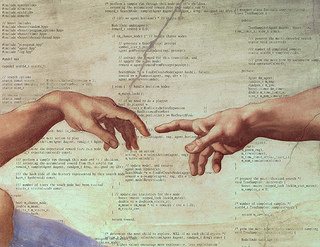
Christianity and creativity have held hands ever since the world began– actually, even before that.
creativity

*Some people believe where this verse says God will “rejoice over you with singing” that rejoice over you means he dances.

Image credit: Anders Sandberg

The Darkest Days

artwork  in retro style,  woman and cup of teaThere is a little Caribou Coffee in Long Lake, Minnesota, where I sat one morning since I’d arrived too early to my visit to Orono High School. I stared at my steaming hot cocoa and repeated to myself: You are going to hell. 

Swallow that down, I told myself. You are going to hell, and there is nothing you can do to change it. This realization is your eternal reality.

In the car, I’d been listening to “Spirit” by Switchfoot on repeat: I’ve found all that I want, all that I long for, in You.

It was true then. It’s true now. But in those days, it was a truth that I imagined fell on deaf ears. Spirit, come be my joy.  It was the cry of my heart, but I knew I was damned and that joy would be forever inaccessible to me.

I can’t detail exactly how creepy it is become a cardboard person.

To ride the rollercoaster to the deepest depths and then to climb off there.

A reader asked me if I’d ever felt like God wasn’t with me through the storms of my life.  Have I felt that way? Yes, intensely.

But I was wrong.

Praise God I was wrong.

All these years later, God has stormed in, torn off my blindfold, wrapped me in his arms, and repeated truth to me till I came to believe it.

Do I still have moments where I doubt? Yes.

But my anchor holds.

I wrote this to remind myself of the truth– the truth that no disorder or devil can withhold from me because my God is stronger:

anchor manifesto

Christ, my Gravity

OLYMPUS DIGITAL CAMERAI’m not sure if you’ll understand what I mean when I say that for most of my life I felt untethered.  I had this weird sensation of floating away into nothingness, and I hated it. So ungrounded, so aimless.

That’s why I so often refer to Christ as “my gravity.” He tethers me to something– to him! to reality! to meaning!– and puts weights in my shoes. It’s probably my second most-used descriptor for Jesus, the first being “my rescuer.”

And, really, for me, the two terms mean almost the same thing.

Image credit: Hirni Pathak

Is Mental Illness a Spiritual Issue?

mentalillnessspiritualissue2

The question is complicated; my answer is too.

Yes and no.

As a Christian, I believe that basically everything is a spiritual issue because I believe in a sovereign God. My particular set of beliefs means that I believe that writing is a spiritual practice for me, that the food I eat represents my spiritual discipline, that my obsessive-compulsive disorder has a spiritual purpose (one that was hidden to me for many, many years) of refining me, showing me the beauty of freedom and the glory of grace. Because I am a spiritual person, all things are spiritual to me. There is no way that I can separate my OCD from my experience of Christ because it is so clearly evident to me the way that God has worked in my life through my mental illness, recovery from it, and subsequent advocacy. I would be a liar if I tried to tried to divorce these two items in my own head and heart and speech.

But I also believe that mental illness is an illness like any other. Just as I wouldn’t hyper-spiritualize someone’s fight with cancer or diabetes or even a common cold, so I wouldn’t approach mental illness as anything other than a medical illness. I wouldn’t assume that someone got pneumonia as a direct result of their sin … or that they were spiritually unfit … or that something demonic was going on. I feel the same way about OCD and other anxiety disorders. I feel no shame– spiritual or otherwise– over my OCD, just as I wouldn’t feel ashamed if I were to break a bone. (Granted, it’s taken me a long time to get to this point; a heaping side of shame comes quite standard with your plate of religious scrupulosity!)

So, do I pray about OCD? Yes, of course. But I pray about my headaches too.

I realize that this is a touchy subject for many people, and I hope that I’ve presented my thoughts in a balanced way. Because I believe that so many people would misinterpret my “yes,” I usually bellow out a resounding “no,” but in this post, I wanted to try to delineate my thoughts on each. I’d love to hear your thoughts and continue this conversation, and I hope that you’ll extend grace to me as I try to tiptoe through this minefield!

Related posts:
Unashamed
OCD, ERP, & Christianity
Why I Believe in God
God’s Sovereignty, OCD, the Cross, & His Purposes

Image credit: Unsplash, modified by me


The Dance of Uncertainty & Faith

How do you reconcile the uncertainty inherent in OCD with your faith in God?

I had planned to write an entire blog post about this, but then I remembered that Anne Lamott had already said in just five sentences what would take me a muddy, fumbly, long-winded essay to say, so I will let her quote do its thing:

I have a lot of faith. But I am also afraid a lot, and have no real certainty about anything. I remembered something Father Tom had told me–that the opposite of faith is not doubt, but certainty. Certainty is missing the point entirely. Faith includes noticing the mess, the emptiness and discomfort, and letting it be there until some light returns.

I welcome your thoughts.

uncertainty and faith

Image credit: Matthew Smith

One Word: Grace (Revisited)

Remember how I chose one word to focus on in 2014?  That one word is grace.

Giving grace to myself.
Still learning.  I’ve allowed myself more time away from writing this year than in all of the last five years combined.  And when I feel guilty about it, I remind myself, Grace.  I repeat what my wise friend Judy has said– that I need to trust that the writing will still be there for me when I return to it.

Giving grace to others.
Honestly, this is easier for me to do than to dole it out to myself.  When you have screwed up as much as I have, it makes it a lot easier to say to others, “It’s okay” and “Me too” and “It’s forgotten.”  I love that.  I am so happy to see this aptitude for grace is so tremendously strong amongst my group of dear friends.  I learn so much from them.

Receiving grace from God.
I was recently reading the book of Galatians and marveling once again over the incredible truth that rule-keeping does not bring life.  “Doing things for God is the opposite of entering into what God does for you” (MSG). I feel such gratefulness, such freedom.  I marvel at this gift.

I am spending this week in northern Minnesota, alone in a (really nice) condo, attempting to knock out a ton of necessary revisions. Leave me lots of comments this week because I’ll be going crazy from writing in solitude by the end of it! If you pray, pray for me!

grace

Image credit: unknown

Writerly Thoughts on Predestination, Conflict, & Rescue

I.

It’s an old debate: do humans have free will, or are “choices” predestined by God?

I have a friend who thinks the former while I lean more toward the latter (honestly, I most prefer to live in the gray area between the two), and we were talking briefly about this.  The Big Question, of course, is If there’s no free will, then why would God predestine the sinful fall of man?

My response was that I think that rescue and redemption are more valuable to God than there being no need for them, that somehow God gets more glory from saving a fallen world than from not needing to save a perfect one.

My friend didn’t buy it, didn’t think it made sense.

II.

My writing critique group met recently, and it was a great evening.  We didn’t actually critique anything, only shared about our current projects (and a couple people shed some tears, it’s true).  One of my friends is writing a young adult novel for her MFA program, and the problem she keeps running into is that she loves her characters so much that she doesn’t want to hurt them.

“It’s what I always used to yell at you for, Jackie!” she said to me.  “And now I’m doing it myself!”

If you’re not a writer, you probably can’t understand, but trust me– it can be hard to create characters you adore and then force them through hell.

But we have to.

Why?

If there’s no conflict, it’s not a good story.

Reaching_by_fotomachineIII.

I started to think about that in terms of the story of the world.  God is the ultimate creator, the supreme artist, and the universe and its inhabitants are his masterpiece.

Is the same principle at work here?  Did God as an Artist determine that the great Story of the world would not be good without conflict?  Every good writer knows that a story needs a conflict and a climax.  Could that be the very simplest of explanations for the fall of man and the cross of Christ?  God was writing a story, and he wanted it to be great.

You’re welcome to chime in in the comments!


Image credit: fotomachine

Defining My Roles

Recently I sat down and defined my values and leadership principles, and it was a great exercise for me.

I decided to make a list of some of my primary roles and my corresponding principles too.

definitionsMay I be a courageous and humble leader who remembers that rule-keeping does not bring life. May I be a sister who loves, listens, laughs, and leads. May I be a daughter who celebrates her parents, along with the roots and wings they have given me. May I be a selfless friend who honors those whose lives are mixed with mine. May I be a gutsy and generous writer who cherishes story in all its forms. May I be a Christian who delights in her Savior, eagerly receiving and giving grace.


Image credit: Grace Easton

Oceans & Revisions

I went to praise chapel at Northwestern the other day. Though UNW has worship chapel every week, this was a special one for the semester since the entire orchestra was on stage, a powerful treat.

They played Hillsong’s “Oceans.”

wanderSpirit lead me where my trust is without borders
Let me walk upon the waters
Wherever You would call me
Take me deeper than my feet could ever wander
And my faith will be made stronger
In the presence of my Savior

When I sang, “Take me deeper than my feet could ever wander,” I immediately thought of Truest and all its many rounds of revisions.

Here is the truth: on my own, Truest would have been finished a long time ago.  And it wouldn’t have been nearly as good. But so many people have been put into my life to press me further down that path than my feet could ever wander on their own.

And the result?

A better novel.  Also, my faith was made stronger: my faith in the creative process and my faith in God.


Image credit: if you know the owner of this image, please let me know.