A Big Ol’ HOCD Post

I’ve posted several times on this blog about HOCD (homosexual OCD– when OCD causes someone to question his or her sexual identity), and the statistics don’t lie: it is one of the biggest reasons that people end up on my blog.

HOCD stats

Anecdotally, most of the emails I receive from my fellow OCD sufferers are from those who are battling HOCD.  I had an inkling that HOCD was far more common than most people would imagine, but ever since I started talking openly about it on my blog, I’m more convinced than ever.

Many of the people I talk with have a very similar story: they have never questioned their sexual orientation before X happened, now it is all they can think about, they are constantly “testing” themselves to see if their sexual attraction has now changed.  Many already have a history of OCD, though perhaps it’s never broached their sexuality before now.  Some– though never having had this problem before– cannot seem to generate any attraction to the gender they have always been drawn to, while they are suddenly feeling attraction (and even bodily responses) to the gender they have never entertained liking before.  They are scared, confused, exhausted.  Their minds are going wild.  Some are single and feeling grief that their futures “must” now look different than they’d always dreamed.  Some are dating or married and terrified to tell their partner about the fears and obsessing they’ve been experiencing.  Some of them say they would rather die or be alone forever than to be gay (if they are really straight) or straight (if they are really gay).  That’s intense, folks.

(Please note that I am avoiding using specific terms because HOCD affects both straight and gay people.  I’m trying to keep my post very generic so that I don’t write just to the straight crowd.)

But I get it.  Our sexuality and sexual preferences are so core to our identities, and when OCD causes us to question them, it is an intense experience.  It’s torture.  Hellish.  Exhausting.

I’m sorry.

The good news is that you’re not alone.  Not even close.  There are so many others who are struggling with this– and there are sufferers who have come out on the other side.

Here’s the truth:

* You have an illness.  It’s OCD and it will attack whatever is most important to you.
* You need to treat your illness.  The best treatment is exposure and response prevention (ERP) therapy.
* ERP therapy treats OCD, not just HOCD– this is important because, if you were to somehow get rid of your HOCD obsessions and compulsions, it is incredibly likely that OCD would just move on to a new theme– often a bigger, harder, scarier one.
* For some people with HOCD, the most intense anxiety is caused over not knowing their sexual orientation.  My friends who are gay tell me that their anxiety was not around not knowing, but more around logistics of coming out and how they’d be received. **I’d love to hear people’s thoughts on this, gay, straight, bisexual, or HOCD sufferer.***
* Many do anything to avoid ERP because they are scared of what ERP will reveal about themselves.  Bad idea.  OCD is your cancer; don’t put off ERP, your chemo.  ERP is recognized worldwide as the best treatment for OCD.  In other words, I’m not just advocating some hokey, weird techniques.
* Are there other ways to treat HOCD? You can try medication (probably an SSRI) or hope for a miracle.  Your (much) better option is to proactively commit yourself to ERP therapy.
* I highly recommend finding an ERP specialist to guide you through your therapy.  If you meet with a therapist who does not mention “exposures” as a part of your therapy, find a new therapist.
* You can do ERP therapy on your own, if needed, but you should get a book to guide you through it, such as Stop Obsessing by Edna Foa or Freedom from Obsessive-Compulsive Disorder by Jonathan Grayson.
* I am not an ERP therapist.  I cannot be your therapist.  I can be your cheerleader.

I’m sure you’re so ready to have your life back– to be in control of your own thoughts again.  Your path is clear!  I’m so excited for you!

For more about HOCD, OCD, and ERP, go to jackieleasommers.com/OCD.

Writing and/or Life, Both Hard

rumiWriting.

Either I’m not doing it right and still need to learn the universe’s secrets, or else the truth is that writing is masochism.

No, stop. I shouldn’t say that. Believe me, I love to write. Sometimes.

But it is really, really hard.

Why does it so often seem like other writers have their acts together?  They feel confident in their abilities.  They are clever and funny and smart … gahhh, I know I can be those things too.  But mostly I just feel insufficient and terrified that I’ll be found out.

Not just writing either.  Life.  I’m 32, and I feel like I know so little about how to be successful at Life.  I retreat in fear to my favorite things night after night: my bed, my prayer journal, my Jesus.

A few lines from Truest (as it stands today):

And while I sit in the stand and pray, I have the same sensation—that I am being outlined, defined, and that the definition doesn’t come from me.

I am trying to hold so many things—and failing—but this one thing is holding me.

Please tell me, people: do any of you get so overwhelmed that you become paralyzed? Have you fallen in love with a vocation that gnaws on your heart? Have you figured out any ways to be still and yet productive?

All I know is Jesus, Jesus, Jesus— thankfully, he’s more than enough.


The Invisible Fight

There’s a scene in C.S. Lewis’s Voyage of the Dawn Treader where Lucy, Edmund, Eustace, and Caspian land on an island inhabited by invisible people who seem to be enemies.  The group talked over their best options for escape and realized they would likely need to fight:

“Surely,” said Lucy, “if Rhince and the others on the Dawn Treader see us fighting on the shore they’ll be able to do something.”

“But they won’t see us fighting if they can’t see any enemy,” said Eustace miserably. “They’ll think we’re just swinging our swords in the air for fun.”

Couldn't find the owner of this awesome pic, but I love how many stories it tells.

Couldn’t find the owner of this awesome pic, but I love how many stories it tells.

It makes me think of OCD. Not only of OCD but other mental illnesses too.

People often cannot see the evidence of a mental illness, and so they think we’re just “swinging our swords in the air for fun.”  It’s difficult– because the enemy is so very, very real, and the stakes are high (sometimes it’s literally life-or-death), but since mental illness is invisible, the fight doesn’t always warrant the respect it’s due.

For some of us, we look perfectly “normal.” We go to work, we smile often, laugh at our friends or co-workers.  And for some of us, the battle against intrusive thoughts is almost entirely internal (especially for those of us with Pure-O, whose compulsions are usually also invisible).

I am not at all trying to pit visible illnesses against invisible ones; every individual struggle matters.  My point is just to say this: you don’t know what the person next to you is fighting. Be kind to all people.


For (lots!) more about OCD and ERP, go to jackieleasommers.com/OCD.

The Good & Bad of Writing

writer__s_block_by_arzu88-d3hg9efAm I a whiner?  Sometimes I feel like it.

The truth of the matter is that writing is just plain hard.

When I am writing a first draft, I wish I was revising. I tell myself it’s so much harder to make something out of nothing than it is to make something better out of something okay.  In a first draft, I still don’t know my characters very well, so I’m not entirely sure of what they should do or how they should react to people or events. I typically have no idea how the story will actually end, so I’m writing blind and terrified that because I see no ending now I won’t see an ending ever. I have to cast deep into my well of creativity because everything– absolutely everything– is brand new. (It gives me so much appreciation for my God who created ex nihilo [Latin, “out of nothing”].) It’s physically exhausting and mentally draining, and (at least in me) it prompts deep, deep doubts about myself.  In the early days of a first draft, I desperately long for revisions– when I will know my characters well and will be perfecting the story and imagery.

When I am revising, I wish I was writing a first draft. Deep in revisions, I feel bored to death with the process. It feels so stagnant and dull compared to the excited fervor of creation. It feels nit-picky and brutal, a journey to endure as a longsuffering artist.  And everything needs to be moving forward, finding its place.  You have to “kill your darlings.” You can’t keep putting things on the backburner to deal with another day– “another day” has come and the time is here. It’s like finding yourself in the middle of a battle without armor.  I think longingly of the days of freewriting and drafting, how carefree they were, how it didn’t matter if things fit together, how fun it was to be coming up with new adventures for my characters, how exciting it was getting to know them.

I am finding that the old adage “the grass is always greener on the other side of the fence” is true in my writing life.  I don’t want that to be true, and I want to find ways to love and appreciate whatever stage I’m in.

How?

I don’t know the answer yet, but I suspect it might look something like this:

1) I need to reflect on what I love about writing in general, about words, ideas, stories.
2) I need to count my blessings. I honestly do feel terrifically grateful to be a writer– even with all its woes.
3) I need to remember that every stage has its own merits and to start focusing on those positive parts instead of the negative.
4) I need to respect the creative process.
5) I need to be healthier.

What other suggestions do you have for me?


Image credit: Arzu88 on deviantArt

OCD & Faith

I was recently asked how my faith survived 20 years of abuse at the hand of OCD.  This fellow sufferer wondered how I reconciled/justified my continued believe in God after so much hurt and such a sense of betrayal.

It’s a great question.

I am a Christian, that is, I believe that Jesus Christ is God’s only son, that he came to earth to rescue men, died on a cross on a Friday, and rose again to life the following Sunday.  

It’s actually the story of the cross and the resurrection that have allowed me to cling to my faith.

The agony of the cross shows me that Jesus understands my suffering; we identify with one another. And the victory of the resurrection prompts me to have hope in my suffering, knowing that only a weekend separated the worst story from becoming the best; I am filled with hope that, just as I identify with him in his suffering, I will also identify with him in his victory.

The truth is that without the gospel of Christ, it would be difficult for me to justify my continued faith.


For more about my faith, go to jackieleasommers.com/faith.
For (lots!) more about OCD and ERP, go to jackieleasommers.com/OCD.

cross and resurrection

OCD in Remission: Eyes on OCD or Eyes on the Journey?

I recently received a fascinating email from a young woman with obsessive-compulsive disorder, who posed a question that made me stop and think.

I would love it if you could offer me your take on this: is it better to keep my eyes on my feet (IE journey), or is it a good idea to keep an eye on my OCD?

Essentially, she was asking if it was smarter to keep an eye on the illness (knowing that OCD is never cured, only managed) or if it was better to ignore OCD while she could and just enjoy the journey.

periphery2Here’s what I said:

Such a good, thought-provoking question.  I imagine that the answer might be different from person to person, but as for me, I think the answer is a little bit of both.
 
My OCD has been in remission since ERP five years ago.  These days, I don’t pay a terrible amount of attention to my OCD because it’s no longer intruding on my life on a regular basis.  That said, if I have an off day, OCD is the first thing I “check”– did I take my meds, am I having intrusive thoughts and need to practice some exposures again, etc.?
 
I think it’s BEST to keep your eyes on the journey.  But you still have peripheral vision. 🙂

For more about the ERP therapy that set me free, go to jackieleasommers.com/OCD.

Image credit: toxicbarbie13

The State of the Blogger

My admissions team just hosted 200 high school students for an overnight visit event.  It’s a wonderful event, and the students have a great time.  It’s probably our most fun event of the year: games and worship and chapel and classes and tours and lots of good food!

But for an introvert, it’s a type of annihilation.

I spent most of today sleeping.  My battery was on less than empty, and I needed today to recharge.

So tonight I had a bowl of Lucky Charms, took a hot shower, slapped on some Valor essential oil, and prayed.  Lately, I feel a sense of being held together only when I am in prayer or writing a letter to my future, calmer, more-accomplished self through FutureMe.org.

I’m reading Code Name Verity by Elizabeth Wein, and it’s so amazing that it makes me feel like I write drivel.

My to-be-read list is out of control.

What should I read next???

What should I read next???

I chose to watch the final episode of season 3 of Downton Abbey tonight.  No spoilers, but UGH.

My next draft is due March 24th, and I need to find a rhythm.  I made myself a three-step to-do list tonight, which sounds easy enough, but each step is flabbergastingly huge and one is nearly inconceivable.  Writing is so hard.

I wish I could just push pause on life for a few months– to catch up on sleep, to catch up on reading, to learn to be a better writer.  But I am trying to have faith: I will find a rhythm, butt-in-seat will mean a better manuscript a month from now, and God will not abandon me or our book.

I think I need some chocolate milk.  That’s step zero.  Then I dive back in.

All In: Ideas & Writing

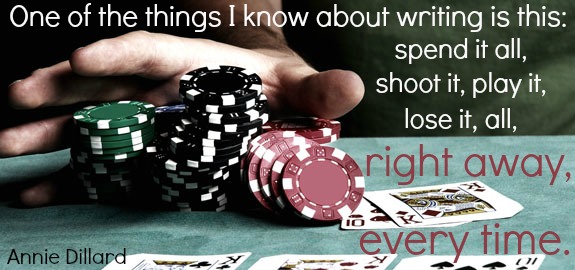
I try to take this quote of Annie Dillard’s deeply to heart as I write fiction:

“One of the things I know about writing is this: spend it all, shoot it, play it, lose it, all, right away, every time. Do not hoard what seems good for a later place in the book or for another book; give it, give it all, give it now. The impulse to save something good for a better place later is the signal to spend it now. Something more will arise for later, something better. These things fill from behind, from beneath, like well water. Similarly, the impulse to keep to yourself what you have learned is not only shameful, it is destructive. Anything you do not give freely and abundantly becomes lost to you. You open your safe and find ashes.”

If I have a great idea, and if it fits into the story I’m working on, I don’t hold back, don’t reserve it for another time.  Remember when I plotted out that giant multi-storyline monster (and then subsequently abandoned it)?  In my current WIP, I am using some of the ideas from this story, even though they “fit” better with this whole plotted-out beast.  Who is to say if those other projects will ever see the light of day?  Better to spend my currency now before I’m in a country where it’s no longer acceptable payment.

For me, it’s about faith.  Faith that if I use my best ideas now, new ideas will come later.  It’s about having a generous spirit, about rejecting any parsimonious parts of my writer-heart, knowing that that sort of frugality reflects fear.  I want to write out of faith instead of fear.  Always.

all in2


Image credit: original from inc.com, edited by Jackie Lea Sommers.

Obsessing vs. Brainstorming

I’ve had a very, very active brain for pretty much my entire life.  I’m the girl people always described as “the one who thinks too much.”  I have thoughts and ideas rush me like little hurricanes, and this is just as true after ERP therapy as it was before.

But there’s a huge difference too: productivity.

Before ERP, my thoughts were often OCD-induced intrusive thoughts that led me down dark avenues over and over again.  My thinking was circular, and I could re-visit the same ideas an uncountable number of times each day.  I was a hamster on a treadmill or a dog chasing its tail– that is, expending a lot of energy but going nowhere.

After ERP, my thoughts are much more welcome to me.  I can choose to focus on the ones I want.  I may still be lying awake at night, but it’s productive, and I end up jotting tons of notes and ideas down in my phone.  I start in one place, but an hour later, I’ve traveled some distance and often have huge realizations about my fictional characters and storylines.

Believe me, the latter is much more fulfilling.


For more about the ERP therapy that set me free, go to jackieleasommers.com/OCD.

I'm SO over this.

I’m SO over this.