Major & minor themes in the Christian worldview [and what that means for my writing]

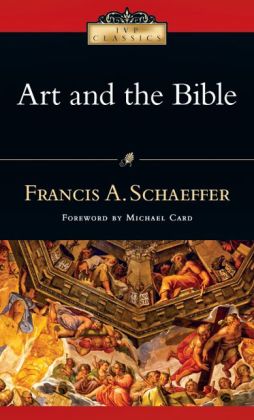
art and the bibleMy dear friend Elyse recently loaned me a book called Art and the Bible, written by Francis Schaeffer.  It was less a book and more an essay, and I read it in one sitting.  Let me tell you, it was refreshing to have someone explore so many ideas related to the Christian worldview and the value of art.

The idea that stood out to me the most was this: the Christian world view has both a major and minor theme.  The minor theme is that the world has revolted and is revolting against God, that Christians will never be perfect this side of heaven.  The major theme is that God is at work redeeming the world.

What does that mean for the Christian artist? It’s okay for your art to show both themes too.

Why does this matter to me? Because, as a Christian artist who has suffered from OCD, I’ve sometimes wondered if my responsibility to my faith meant that I needed to focus only on the positive.  The answer is no.  It should be emphasized over the minor theme, but the minor theme has its place in my writing too.

I wish that all Christian artists realized this. We need more gritty, raw Christian art and fewer poems about rainbows and puppies.  If you have art like this– especially written work– you should submit your work to Crux Literary Journal.  We’d be thrilled to take a look.

Scripts and Therapy Thoughts

My friend Anna is going through ERP therapy right now. Loved these thoughts from her!

Anna's avatarLiving the Story

Imaginal scripts, how do I hate thee? I shall not count the ways.

I just wrote another script, and thought I would bring my emotional fallout over here.

This week, I’m supposed to write as many as I can (I have four more to go). I meant to write one yesterday . . . and then I didn’t. No excuses. Just did not do it. Sat down to write it today, and found myself more fidgety, procrastinating, and just plain reluctant than I’ve been in a long time. I did not want to write it. I hate delving into the very core of my fears. In case you’re unfamiliar with the concept, an imaginal script is basically where I write out my worst fears (obsessions) coming true. In loads of detail. There is no gratuitous detail in imaginal scripts. The more detail, the better.

I hate writing these scripts. And…

View original post 298 more words

Surprises on the Journey to Publication

First, some truths as the groundwork:

* I love being a writer.  Sometimes I feel that I have no choice– I simply must write– but even if I did have the choice, I’d want to be a writer.

* I have an amazing agent and the sweetest, loveliest, most brilliant editor ever, and I feel like I won the jackpot.

* My contract is with HarperCollins, the publishing house of my dreams, the publishing home of C.S. Lewis and Melina Marchetta.  I am utterly humbled and full of deep gratitude.

writerAnd now, some things that are surprising me on my journey toward publication:

* It’s still really hard.  I think I’ve been laboring under the idea that the hard part was getting the book deal, and after that, smooth sailing.  Nope.  My edits come fast and furious, and I don’t think I’ve ever been stretched as much as a writer as I have been since I got my book deal.

* My skin is not as thick as I thought it was.  I’ve prided myself on being a writer with a pretty thick skin– I welcome criticism and can (usually) take it in stride.  I’m learning that maybe I’m more tender than I imagined.

* I have a lot of self-doubt. I once thought that getting a book deal would be like an eternal validation stamp: OFFICIAL WRITER.  I would be someone who Knows What I Am Doing.  Nope.  If anything, I feel even more doubt than ever.

* It’s a true partnership.  I was ready to take orders from my editor– aye, aye, captain, that sort of thing– but she asks more questions than she gives answers.  She raises the questions and then lets me answer them in my own way in what I write.  There’s more freedom than I imagined, and she is a great listener.

* One last thing: it took a long time to finalize the deal. It was offered in November, and I signed my contract in February.

I know that some of you blog readers are on your own writing journeys and are interested to hear how mine goes, so I thought I’d share these things with you.  Now I want to hear from you: what expectations do you have for after you get that first book contract?  Were any of my surprises also surprises to you?


Image credit: Laura Makabresku

The Invisible Fight

There’s a scene in C.S. Lewis’s Voyage of the Dawn Treader where Lucy, Edmund, Eustace, and Caspian land on an island inhabited by invisible people who seem to be enemies.  The group talked over their best options for escape and realized they would likely need to fight:

“Surely,” said Lucy, “if Rhince and the others on the Dawn Treader see us fighting on the shore they’ll be able to do something.”

“But they won’t see us fighting if they can’t see any enemy,” said Eustace miserably. “They’ll think we’re just swinging our swords in the air for fun.”

Couldn't find the owner of this awesome pic, but I love how many stories it tells.

Couldn’t find the owner of this awesome pic, but I love how many stories it tells.

It makes me think of OCD. Not only of OCD but other mental illnesses too.

People often cannot see the evidence of a mental illness, and so they think we’re just “swinging our swords in the air for fun.”  It’s difficult– because the enemy is so very, very real, and the stakes are high (sometimes it’s literally life-or-death), but since mental illness is invisible, the fight doesn’t always warrant the respect it’s due.

For some of us, we look perfectly “normal.” We go to work, we smile often, laugh at our friends or co-workers.  And for some of us, the battle against intrusive thoughts is almost entirely internal (especially for those of us with Pure-O, whose compulsions are usually also invisible).

I am not at all trying to pit visible illnesses against invisible ones; every individual struggle matters.  My point is just to say this: you don’t know what the person next to you is fighting. Be kind to all people.


For (lots!) more about OCD and ERP, go to jackieleasommers.com/OCD.

The Small Mountain I Call the TBR List

I have a problem.

I cannot stop buying books.

TBR SHELFRight now, nearly all new books get relegated to the TBR shelves, and when I finish one, it moves off of these shelves and onto one of four other bookcases.  How do I decide what to read?  To be honest, I’ve been using a random number generator. It’s come to that point.

Of course, sometimes a sequel comes out that I simply MUST READ RIGHT NOW. Or there’s a book by a favorite author that gets bumped to the top of the list.  But most of the new books make their way first to this purgatorial shelf for months (sometimes years) before they are read.

I probably order a new book or two every week. I buy them faster than I can read them.

Why not wait till I get caught up?

I’m not sure I’ll ever get caught up.

I’m smart about my purchases (usually). I use coupon codes a lot, and my credit card rewards program is centered around Barnes & Noble gift cards (got one in the mail just today actually … I will probably spend it today too). I get books for gifts from people. I enter contests to win books (I was so excited to recently win Grasshopper Jungle by Andrew Smith).

I’ve tried to use the library.  I do love the library.  But I love owning books even more.

Last year I spent about $1000 on books (well, through B&N; I also bought a much lesser amount on Amazon), and I feel like that is reasonable for someone who is building a career as a writer.  I feel like, so long as I am also giving money to my church, supporting my compassion kids, giving money to missions and ministries, then I can justify buying lots of books.

Thoughts?  Do you buy books or rely on your library?  How do you choose what your next read will be?

My Hunger Mountain Story

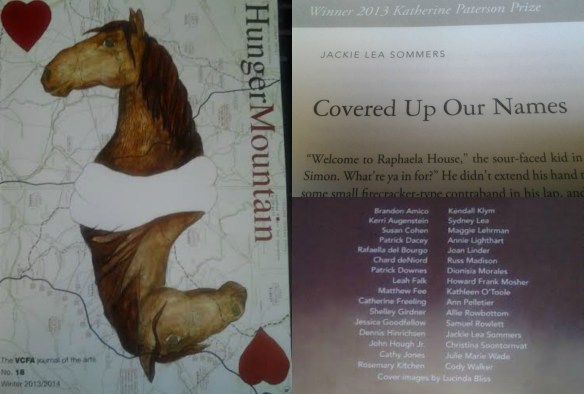
Hunger Mountain 18 is finally out, and it includes my short story “Covered Up Our Names.”

HMcollage


(You may recall that I had this crazy idea about teenaged wards of the state living in hospice care, wrote the story and submitted it to Hunger Mountain with no expectations, and then won the 2013 Katherine Paterson Prize for it!)

Now that it’s been published, the rights have reverted back to me, so I have posted it over at Crux Literary Journal, the online arts project I curate.  I hope you’ll take ten minutes or so to read it and tell me what you think!