
my writing process

Having recently plowed through all three of Kristin Cashore’s books, I ventured over to her blog and found this fascinating post on her writing process.  I thought maybe I’d share the details of my own with whoever might be interested (all three of you, haha).

In general, I need the following things in order to write: time, a distraction-free zone, and my laptop.

Time: I am not one of those writers who is able to write for five minutes at the drop of a hat.  I need to have at least an hour of open time yawning in front of me … better yet, five or six hours.

No distractions: I can listen to music but sometimes only without lyrics.  I can write with friends, but only if they have their own projects.  I cannot write while there is a movie on.  It just isn’t going to happen.  This does not, somehow, apply to the internet.

Laptop: I can’t write freehand anymore.  My thoughts are too fast, and I edit so furiously that I would shred the paper with my pen.  Plus, the idea of having to transcribe it into the computer seems like a terrible waste of my limited time.  I like to keep everything in its place.  (I don’t even like to edit a copy on my work laptop during my lunch break because then I have to make sure to copy and paste it into the right document on my personal laptop.)  Such a hassle.  I just need to have my laptop.  If I am without it, I will journal thoughts here and there on pieces of scratch paper, but I won’t tackle actual novel work.

I have to have access to the internet.  I go absolutely insane without it.  I can have Facebook and Gmail and Words with Friends all open, and it just blends into my whole writing program.  I do a lot of in-the-moment research, so I need to have access to the web (for example, I will just NEED TO KNOW in that EXACT moment what that heavy bib is that you wear during an X-ray … lead apron.  Okay, lead apron.  Moving on.).

I start with characters.  In fact, I like to start with names.  And then I find a picture of that person.  (Sure, it’s some random picture from Google images, but I find a picture that matches the name and the image in my head.)  And then I write down a few thoughts about that person.  I keep this document with me the whole duration of the writing and refer to it often (mostly since I am terrible at descriptions and need to use the photos for inspiration).

With this last novel, I gave myself six months to write a first draft– and didn’t allow myself to rag on myself while I did so.  The first draft is just the bones (and probably weak ones) of the story– I still don’t know my characters super well until the first draft is done.  Only then can I go back and know them well enough to see how they really would react to the situations that took place.  (I know that seems backward … but it’s not.)

I trust my writing group and other creative friends to catch the glaring imperfections for me.  You’d be shocked at what things seem clearly obvious to the plot that would have never been included if a friend hadn’t said, Um, this needs to happen here.

I can write from my couch, but it’s better if I am at a coffeeshop or Barnes & Noble.  There’s no laundry waiting to be done there.  If I am particularly inspired, though, I can sit at my kitchen table for 10-15 hours.  I am not joking.

I am terrified of losing any edits I make, so I email myself my draft after every writing session, and if I am not at home, I email it to myself before I leave the coffeeshop, etc., just in case I get into a car accident or my laptop (or car my laptop is in) is stolen by bandits or the laptop has a total meltdown.  My latest draft is always safe and labelled in the right folder in my Gmail account.  I have been working on my current story for a year, and there are 176 emails in that folder.

When I decide to cut something that I kinda liked, I save it in a separate document called “extries.”  Over the months, this file grows ridiculously large itself.  Also, if I am completely re-doing a scene, I have to edit the scene in the extries file and then copy/paste it into the actual document file.  This seems to go against what I said earlier about keeping things in one place, but it doesn’t: same laptop counts.

I am always thinking about my story, particular scenes that are giving me trouble, my characters I don’t know how to help.  I pray when I get stuck.  I cry.  I ask close friends to discuss problems with me so that they can help me muddle my way through.  Whenever I get an idea and I’m not around my laptop, it goes into my phone.  Later, I dump all of those ideas into the extries file and work through them.  The ones I write down at 3 am sometimes make no sense.

I also keep a fake calendar of the time the story takes place and list out events on the calendar to make sure I’m keeping track of time right.  (There can’t be 6 weeks in June.)

And the whole time I am riding the world’s longest rollercoaster … I love what I wrote tonight! … I am a terrible writer who will never be published … people like this story … it’s not good enough.  The lows are hard, but the highs are fantastic.  And I love the process.  I love the act of creation.  LOVE IT.  My characters and I feel each other out, and they make some of the decisions, but I usually get the final say.  Usually.

Writing a book is kind of like volunteering to be crazy.  Not just to spent time in the loonybin … but to legitimately be crazy.  But then again, maybe that’s already a given if you’re a writer and writing a book is just your way of acknowledging it.
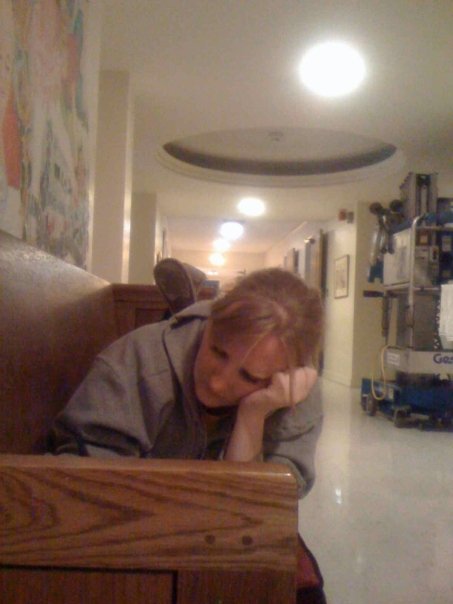
Gah, no laptop!!

Gah, no laptop!!


Reading is sexy.

So true, in my opinion.  Learning is sexy, and one of the best ways I can judge that is by whether a person reads.

I don’t care if he reads business journals, science fiction novels, textbooks, or biographies– or even if he listens to audiobooks to stick it to his dyslexia.  If he likes to read, he enjoys learning, and both are sexy.

It is honestly one of my number one questions when getting to a guy.  1) Does he love Jesus? 2) Does he love reading?

This has definitely influenced the creation of the characters in the YA novel I’m writing.

“My turn to ask the questions,” said Silas, unwrapping a sandwich.  “Tell me what books you like to read.”  He had a nice voice, I decided.  It was low and velvety … but with this sweetness to it, an animation that came from confidence.  And something else: delight?

“Oh, everything,” I said, my feet dragging lazily in the sand beneath them as I bit into my apple—Gala, sweet.  “Peter Beagle.  John Green.  C.S. Lewis.  Dr. Seuss.”

Silas grinned.  “C.S. Lewis.  Have you read his space trilogy?”

“Only a million times,” I said.

His eyes grew wide with a childlike excitement that made me want to laugh.  “I’m making Laurel read it this summer!  That Hideous Strength!” he said, then quoted: “‘It was all mixed up with Jane and fried eggs and soap and sunlight and the rooks cawing at Cure Hardy.’”  Silas sighed in delight.  “Rooks cawing at Cure Hardy … all those k sounds.”

I smiled at him, a little skeptically.

“Don’t you like the k sounds?” he asked, eyes wide and beatific, and I burst out laughing.

“I’ve just never heard a teenager talk affectionately about plosives.”

Am I short-sighted in this?

If anyone knows where I could buy this mug, I would die of delight.

If anyone knows where I could buy this mug, I would die of delight.


dream argument

I could have guessed the tiny Green Lake Library in City Hall wouldn’t have any Billy Collins books.  I asked Janice Boggs, the librarian, to request a few from another branch, then headed out to Legacy House, since Gordon Leimbach had a book collection to rival the library.

“Billy Collins, you say?” he asked.  “I know I have a few of his collections, over there on the middle shelf of the barrister—just go ahead and lift the knob.  The whole glass front panel swings out and tucks right back into the shelf.  See anything there?”

Through the glass fronts of the antique bookcase, I could see the whole thing was dedicated to poetry. Langston Hughes and John Keats.  Calvin Miller.  Robert Frost.  Dickinson and Whitman and Donne.  I saw a few books by Collins, took one off the shelf, then closed the barrister behind me and sat down on Gordon’s couch.  He sat in his rocker and started to pack his pipe.

“Gordon, why do you keep so many books around if you can’t see the pages anymore?”

“They’re just good company,” he said simply.  “Read something aloud, would you?”

I chose a poem called “The First Dream,” which ended with a woman puzzling over her original experience of the phenomenon.  I could hear my voice listing with her as I read:

except that the curve of her young shoulders
and the tilt of her downcast head
would make her appear to be terribly alone,
and if you were there to notice this,

you might have gone down as the first person
to ever fall in love with the sadness of another.

“Brilliant,” said Gordon, pipe now between his teeth, dark glasses on, looking for all the world like some jazz hepcat.  “Mmm.  Brilliant.  Yes?”

“Yes,” I agreed.

“Makes me think of the week on August Arms all about dreams.  Back in, oh, maybe January or February, remember?”

“I do.”  It had been a fascinating week in which I had learned that the faces we see in dreams are all ones we have seen in real life and that those who have gone blind after birth can still dream in images.  Gordon had told me then that his late wife Mavis was the one face that had never faded from his memory after he’d lost his sight.

But Gordon was thinking of a different episode.  “René Descartes’s dream argument,” he said.  “I can’t remember if we discussed it.”

“Briefly,” I said.  “I’m not much of a philosopher.”

Gordon smiled.  “I just find think it’s fascinating, the way people can sort these massive existential topics into numbered statements.  One, if I have experiences in waking life similar to the ones I have in dream life, and two, there is nothing to help me distinguish between the two, then three, it is possible I am dreaming now.”

“Oh, that,” I said, his words prompting a distant recollection.  “I sort of remember that episode.  I guess I never understood why he thought it was so important to go there—you know, to take it that far.”

“Well,” said Gordon, now in his professorial element, “he was trying to establish doubt.  Universal doubt.  You know his famous statement, ‘I think; therefore, I am’?”

“Yes.”

“It was all en route to arriving at that point, which we call the Cogito.  If you strip things down and start with the Cogito, then your philosophy—however you re-build it—is not connected to tradition.”

“But is that a good thing?” I asked, doubtfully.  “I’m not so sure.”

Gordon grinned with pride.  “And you say you’re not a philosopher.”

more thoughts on solipsism syndrome

Solipsism syndrome is a psychological state wherein a person feels that the world is not “real.”  It is only marginally related to the philosophical idea of solipsism (only knowing that you yourself exist and having no way to know with certainty that anyone else does).

All of this intrigues me because I myself went through a period of time where I was very detached from real life.  In fact, for a time, I honestly wondered if people were really demons who wanted to somehow trick me into hell.  There was a part of me that knew it was completely ludicrous.  But I couldn’t let go of the idea that I was somehow stuck in my own personal Truman Show hell.  I was withdrawn from everyone, living in fear and distrust, sadness and loneliness.

In my completely unprofessional and completely personal opinion, solipsism syndrome has a large connection to Pure O OCD.  I am writing a story about a young lady with solipsism syndrome, and to me, it just SCREAMS, “Pure O!” over and over.

To me, the key to putting both OCD and solipsism syndrome under one’s foot is learning to embrace uncertainty. 

It sounds so simple, but it’s incredibly hard to do.  Cognitive-behavioral therapy was the tool in my life that helped me to do this.

audience, revisited

I know that I’ve blogged recently about whom I write for, but I was thinking about that more this past weekend, as I was reading Alan Jacobs’s book The Narnian, a biography of C.S. Lewis’s creative life, and I had additional thoughts … or maybe questions.

If they won’t write the kind of books we want to read, we shall have to write them ourselves; but it is very laborious.  C.S. Lewis to J.R.R. Tolkien

Now, I am certainly not saying that there are no books being written that I want to read (hello, I am practically panting for Marchetta’s new book to arrive in the mail!), but this does bring up the question for me of whether it is okay to write for oneself or if it is more noble to write for others.

What I am trying to do right now with Truest is to write the kind of story that I would like to read.  Is that a selfish way to write?  Is that even a smart way to write?  It’s not that I am not taking any criticism … I just keep my list of whom to please in my mind (#1 God, #2 me, #3 John Green).  (Man, it makes me laugh every time I post that list … John Green.  Oh gosh.  I wonder if he will ever know how influencial he has been on the writing of Truest.)

“Better to write for yourself and have no public, than to write for the public and have no self.” —Cyril Connolly

Anyway, blog world, I’d love to hear your thoughts on this.


Damned if I do; damned if I don’t.

What happens if you write a book that is too Christian for a secular publisher and too secular for a Christian publisher?

God, I want to write a book that honors You, boldly declares Your Name, is NOT preachy, but is CLEAR on the gospel.  And also is realistic and full of grotesque life.  I feel burdened tonight, but I KNOW that YOU will find a place for it if YOU want to.  I just want to write the book that You want me to write.  Point me to YOUR edits above all others’.  I just want to please everyone, and I need to QUIT THAT.  I need to return to my list.  #1 You, #2 me, #3 JG.  Remind me of this list.  This is the list I should have in the back of my mind as I make edits, as I rewrite.
God, I feel emotionally drained by West and Silas and Laurel.  But it feels GOOD, in a way.  Good, if I can point to You in dark times.  Why would I want to write a story that didn’t point to You?  Please help me, Jesus.  Will You please make the road rise up before me?
I love You.  I need Your help in EVERYTHING.  Amen.
And so I am just trying to write the very best book I can and to trust God to divinely intervene all he wants. 

whom I write for

Who is your audience? is a question every writer faces in the midst of creative work.  For me, the question has kind of morphed into For whom am I writing this?  In other words (for me), Whom do I most want to please with this work?

It’s different answers for different things.  For example, with Lights All Around, my first novel, the answer was

1) God.
2) Other obsessive-compulsives.
3) My writing community.
4) Myself.

With my second novel, Truest, I have found the answer to be

1) God.
2) Myself.
3) John Green.

I hadn’t really thought through this much until the other day at work when I was talking to some coworkers about how desperately I wanted John Green to like the story I was writing.  Am I crazy?  Maybe.

How about you, writing friends?  What does your list look like?  Does it change from project to project?

why I love Silas Hart

Silas Hart is the 17-year-old character in the YA novel I am writing.  Here are a couple scenes to show why I love him so much.

1) He is ridiculous.

“So this is why you need a summer job,” I said to Silas as I surveyed his garage sale finds, which were laid out across his bed one afternoon like cheap museum displays: a dollar sign ice cube tray, a box of old eight-tracks, and a “D-Bag Poet”-themed Magnetic Poetry set.  I held up the magnet collection.  “Really?” I asked.

“It’s missing fo sho and dayam,” he said, trying not to crack a smile, “so I won’t be able to write a poem about you, sorry.”

I burst out laughing.  I loved Silas like this—strange and quirky and hilarious.  “What are you going to do with a box of eight-tracks, kid?”

He shrugged.  “Dunno, but aren’t they great?”

“You … are so …”

“Enchanting?  Delectable?  Ambrosial?”

“Weird.”  We grinned at each other.

I marveled at the fact that Silas lived in this pristine palace and yet loved to scrounge around other people’s junk, amassing a variety of worthless treasures to add to the collection in his bedroom.  Well, they weren’t worthless to him—in fact, he’d found a ridiculous t-shirt featuring a unicorn rearing before an American flag, and you’d have thought he’d discovered the pearl of greatest price.

“I saved the best for last,” he insisted, and I realized that he was hiding something

behind his back.

“Don’t tell me,” I said.  “Macaroni art of Steve Buscemi?”

“I wish!” he teased.  “But no.”  Silas pulled from behind him a carrot-colored plastic transistor radio.  It was a little larger than his hand—an awkward size, like an old Walkman on steroids.

“What do you want that for?” I asked, raising both dubious eyebrows.

“Because it’s awesome.  Durr,” he said.  “And because we’re going to use it to listen to that radio show of yours.  Yes?”

I grinned.  “Yes.”

2) He is crazy.

Silas and I spent the rest of that week together, and I quickly determined that he was absolutely crazy—but the very best kind.  One morning he showed up at my house wearing an honest-to-goodness windbreaker suit straight out of the 90’s, purple, mint green, and what is best described as neon salmon.  I could feel the goofy grin on my face while Silas gathered our supplies from my garage.  “What?” he deadpanned.  “What are you staring at?”

I played along.  “Your windbreaker is just so …”

“Fetching?” he interjected.  “Voguish?  Swanky?”

“Hot,” I said.  “Just all out sexy.  Screw trends.  The 90’s neon just exudes sex appeal.”

“Well, I thought so myself.”

And after the sun was high in the sky and the pavement was heating up, he took off the windsuit, revealing shorts and a New Moon t-shirt beneath, Edward Cullen’s pale face dramatically screenprinted on the front.  “Vader’s competition,” he said, shrugged, and started vacuuming the floors of the Corolla left in our care.

Silas talked about the strangest things.  “Can you ever really prove anything?  How?” or “I read about this composer who said his abstract music went ‘to the brink’—that beyond it lay complete chaos.  What would that look like?  Complete chaos?” or “A group of moles is called a labor; a group of toads is called a knot.  Who comes up with this stuff?  It’s a bouquet of pheasants, a murder of crows, a storytelling of ravens, a lamentation of swans.  A lamentation of swans, West!”

We sat in the backseat of a dusty Saturn one afternoon, trading off the handheld vacuum as we talked—or rather, shouted—over its noise.  I ran the hand-vac over the back of the driver’s seat, while Silas said, “I used to think I was the only one with a crush on Emily Dickinson until a couple years ago.”

“You have a crush on Emily Dickinson?”

Durr.

“Did you just ‘durr’ me?  Is that like a ‘duh’?”

He nodded as I handed him the Dirt Devil.  “But then I read this Don Miller book that says it’s a rite of passage for any thinking American man.  I still wasn’t a hundred percent sure, but then I read a Collins poem called ‘Taking Off Emily Dickinson’s Clothes.’”

Just the title made me blush.

Silas, unruffled, continued, “The end of it talks about how he could hear her inhale and sigh when he undid the top fastener of her corset, ‘the way some readers sigh when they realize/that Hope has feathers,/that reason is a plank,/that life is a loaded gun/that looks right at you with a yellow eye.’”

Silas sighed unhappily.

“What’s wrong?” I asked, frowning.

“I finally made it into the backseat with a girl,” Silas cracked, looking hard at the Dirt Devil.  “This is not all I was hoping it would be.”

I slugged him in the arm while his wry smile gave way to laughter.

3) He’s brilliant.

It was a new experience to visit the library with Silas along.  Every section of the library was like its own island—one Silas had explored in the past and was now showing to me.  He started in fantasy, pointing out titles and introducing me to authors—and then we moved into young adult fiction … through the classics … memoir.  Silas indicated story after story that he had read, telling me what he loved about each one, his favorite parts, favorite lines, favorite characters.  It felt like going around a family reunion, meeting all his relatives, and sometimes discovering that we were friends with the same people.  In the poetry section, he showed me pages of Kit Kaiser and Jolie Brightman.

“Here,” he said, pulling a “Best of e.e. cummings” book off the shelf, “I’ll show you something.”  He checked the table of contents, flipped open to the right page, marked a place with his finger, and handed it to me.

I read the line aloud: “nobody, not even the rain, has such small hands.”  I looked up at Silas, and his eyes were shining.

“I still think I’ve never read anything better than that.  The morning I first read it, I went into some kind of shock,” he said.  “I hadn’t known anything could be so incredible.  It’s the line that made me want to write.”