A Metaphor for Obsessive-Compulsives

A new friend came over to my apartment the other week, and we got to talking about Exposure and Response Prevention (ERP) therapy, and I shared a metaphor with her that I’d like to share with you now.

We put out fires, but what we need to do is shoot the arsonist.

arson

The problem with attempting to “solve” an OC’s obsession is that, as soon as it’s solved, a new obsession will take its place.  In that way, you’re only putting out fires, not dealing with the root issue, which is an inability to handle uncertainty.  For years and years, I watched my obsessions hop from one thing to the next.  My compulsions– and even my talk therapy sometimes– were shortsightedly stamping out the flames in one corner of my mind while OCD set a new fire in another corner.

How can you possibly manage to keep up that way?  It’s not sustainable.

That’s why I agree with so many of the OCD experts in this country that the best way to fight OCD is with Exposure and Response Prevention therapy.  ERP is so very different from most standard therapies.  In it, obsessive-compulsives are exposed to a trigger that prompts in them deep anxiety; then they are not allowed to respond with an anxiety-easing compulsion.  Instead, they are forced to sit in that discomfort.  Doing this repeatedly actually re-wires the obsessive-compulsive’s brain in a way that they learn to live with uncertainty and their quality of life improves dramatically.

It’s been four years since I turned my attention from the bonfires to the disorder that was setting them.

It’s been a good four years.

A Closer Look at HOCD

Since I first blogged about HOCD, more and more people have been coming out of the woodwork in my life to say, “That’s me.”  I’m realizing every week just what a common OCD theme it is to struggle with and question one’s sexuality, even when there is really very little reason to do so.  When I talk to obsessive-compulsives with HOCD, it’s very clear to me that they are straight (they want to be straight, they are not generally attracted to the opposite sex, etc.), but OCD– that old bastard– won’t give them any rest.

I decided to conduct a small, not-scientific-at-all study on my own so that I could compare responses and see what trends I could see.  I asked the same 8 questions to 4 of my friends– one male and one female, each with HOCD, and one male and one female, both who are homosexual.  I’m so grateful to them for their thorough and honest responses, which I have edited down without changing any of the meanings obvious in the larger context.

I’d like to share them with you.

1. When did you first start to wonder if you were gay? How old were you? Was there a particular experience that “triggered” your questioning?

finalHOCD1

2. When you first suspected you were gay, how did you feel? What emotions went through you, both as you considered what it would mean for yourself internally and for your relationships externally?

finalHOCD2

3. How long did the debating (am I gay/am I not?) last? Was this something you knew or something you were/are trying to figure out?

finalHOCD3

4. When you pictured yourself interacting romantically with someone of your same sex, what emotions did you experience? Also, how sure of those emotions were you? (Did you waffle back and forth between your reactions, or were you certain and set on a particular reaction?)

finalHOCD4

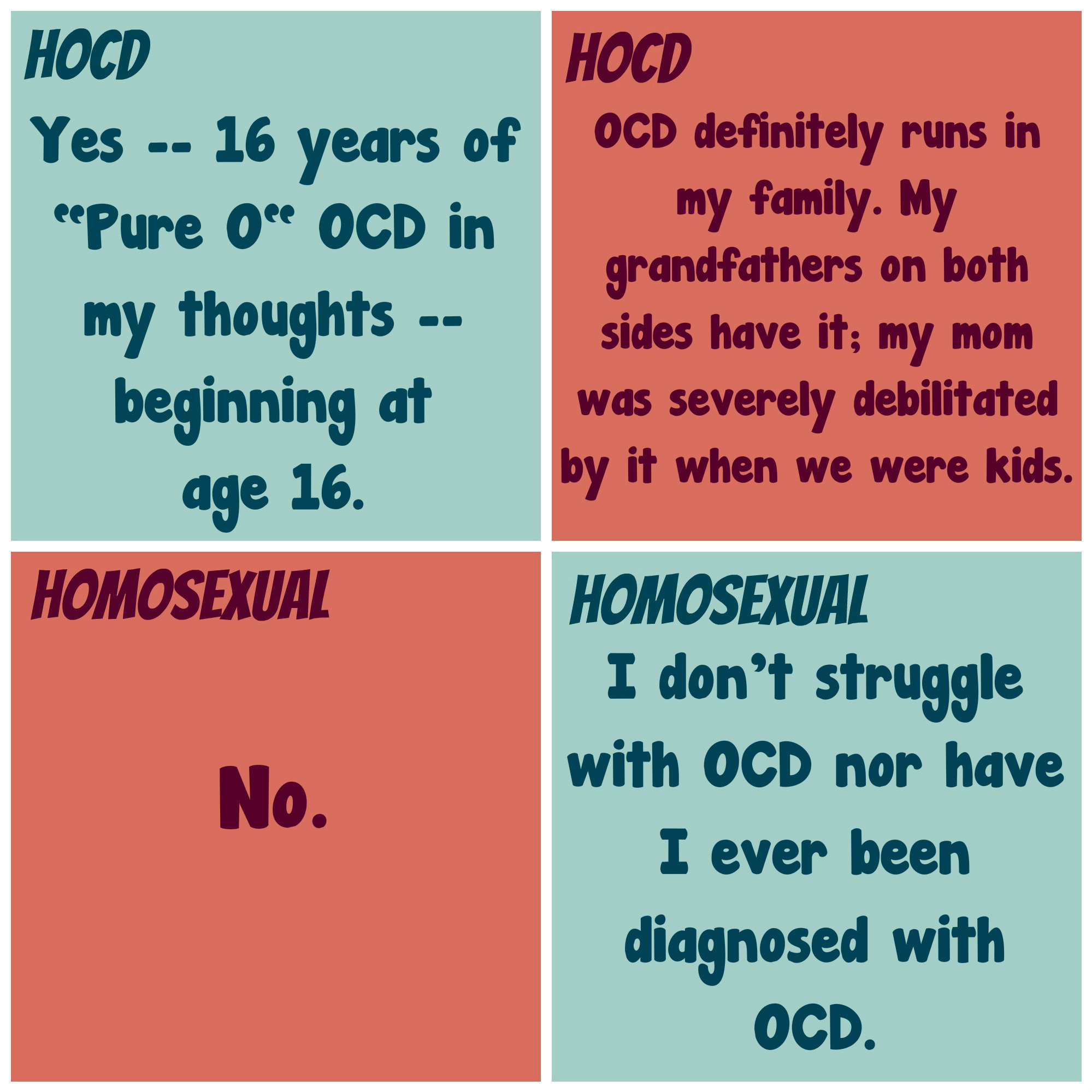
5. Did you/do you want to be gay?

finalHOCD5

6. Do you struggle/have you struggled with any OCD-related obsessions (HOCD or otherwise)? Have you been diagnosed with OCD?

finalHOCD6

7. In general, do you find yourself primarily attracted to the opposite sex or your same sex?

finalHOCD7

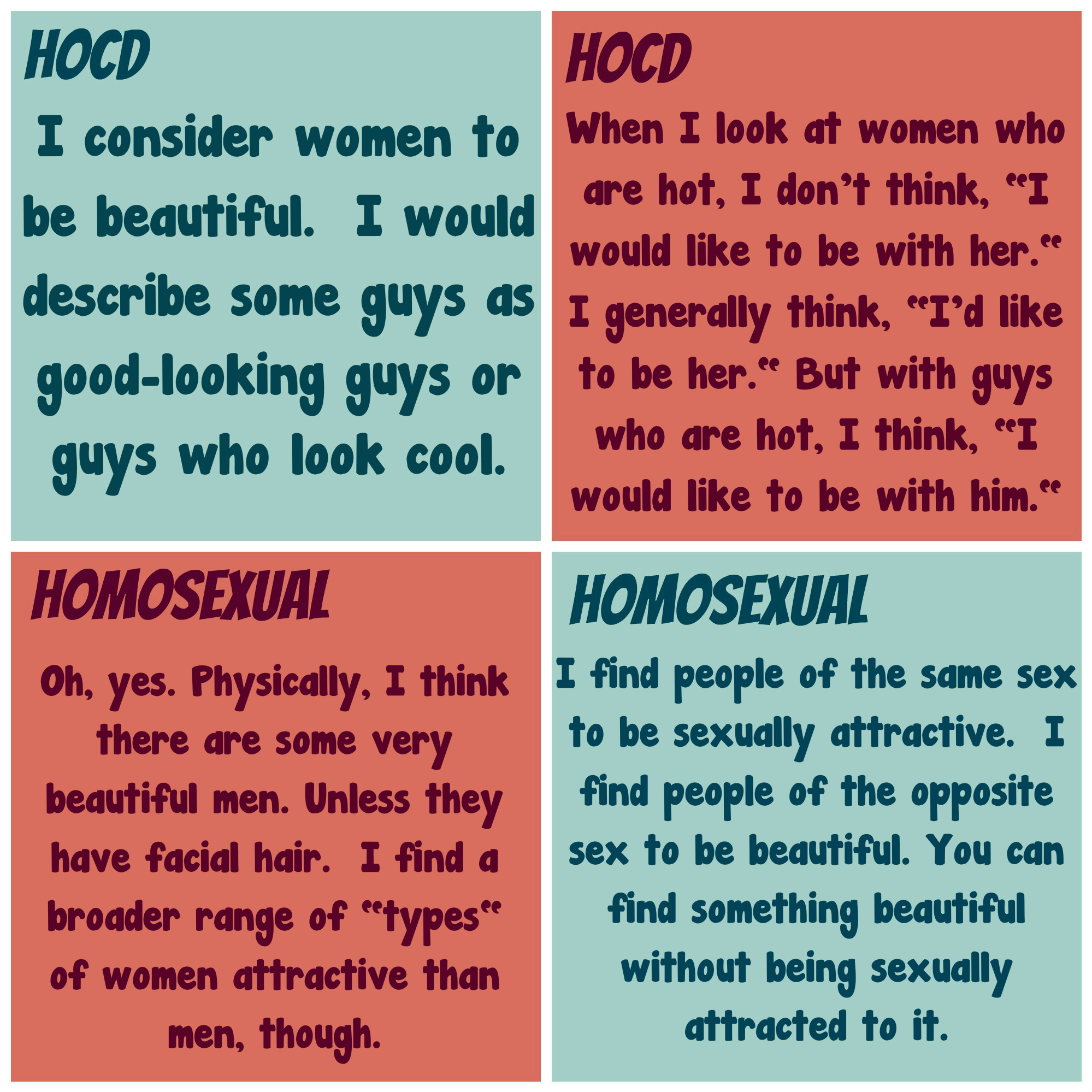
8. Do you find people of both genders attractive? 

finalHOCD8

I’d be so fascinated to hear reactions to these answers from my blog readers.  What did you notice?  What surprised you?  Are there any trends you are seeing or sensing?

A couple things I noticed:

* In both the male and female HOCD answers, their sexual questioning was triggered by a relatively minor event.  In contrast, the homosexual response from both genders was more of a large-scale “I knew I was different.”

* My gay friends seemed to fear people’s responses and reactions more than they actually feared being homosexual.

* Both HOCD responses toward imagining romantic interactions with the same sex were primarily negative– disinterest, nausea– even though there may have been physical reactions that seemed to say otherwise.

* Those with HOCD thoughts were already deeply struggling with other areas of OCD.

Everyone agreed that both genders can be attractive– but note that doesn’t equate being attracted to them.

I’d love to hear from my readers.  What are your thoughts?

Disclaimer that I should probably have put at the top: I think it is obvious that this blog post is not at all about discussing the morality of homosexuality.  This blog post is about discovering what we can about HOCD in comparison to homosexuality.  All four of the people who so graciously agreed to be interviewed are my friends, if you think I will so much as let you breathe an insult in their direction, just get ready to feel my wrath.  There are avenues for you to debate homosexuality and/or homophobia; this blog is NOT one.  >calms down, flashes big smile<

Related posts:
Interview with a Former HOCD Sufferer
Another Interview with a Former HOCD Sufferer
No One Wants to Talk about HOCD
A Big Ol’ HOCD Post
A Third Interview with a Former HOCD Sufferer

If it doesn’t hurt, it’s not OCD.

Let’s be real here.  Almost everyone has a quirk or two.

quirks

Some people have to organize their shirts by color.  Some need to dot their i’s a certain way.  Some have to clean their kitchen in just a certain way.  Some always double-check the front door before they go to sleep.

Quirks.  Quirks, I tell you!

Unless …

You feel that a disorganized closet is going to ruin your day, your week, or even your life (and you will panic and feel sick over it until you fix it).  You think that if you don’t dot your i’s just so it might mean that something bad will happen to your family.  You think that if you don’t follow a particular routine in cleaning, you (or people you love) are going to get really sick and probably die.  You think that if you don’t check the front door, a murderer will certainly get inside, kill your entire family, and it will actually be all your fault.

Those are just some examples off the top of my head, but my point is this: if it doesn’t hurt, it’s not OCD.  

In fact, it’s built into the very definition: OCD is an anxiety disorder characterized by intrusive thoughts that produce uneasiness, apprehension, fear, or worry; by repetitive behaviors aimed at reducing the associated anxiety; or by a combination of such obsessions and compulsions.

I was recently on a web forum that was asking “What minor OCD quirks do you have?” and the answers amounted primarily to superstitions and quirks:

* I feel naked without a pocketknife handy.
* I just have to snip or pull loose threads on clothes or buttons.
* I tap my pockets to make sure my keys are there.
* I fold my dollar bills face-in.
* I hate it when someone else uses my pillow.

Now, don’t get me wrong.  These may all very well be true for these people– but I didn’t get the impression from these forum users that if they didn’t do these things, they would spiral into tumultuous anxiety that makes you believe things will never be okay again.  That is OCD.

It’s fine to have quirks; they can even be funny!  But please call them quirks.

OCD is an anxiety disorder.  It ruins people’s lives.  It steals joy from them.  It gives them a sickening feeling of terror.

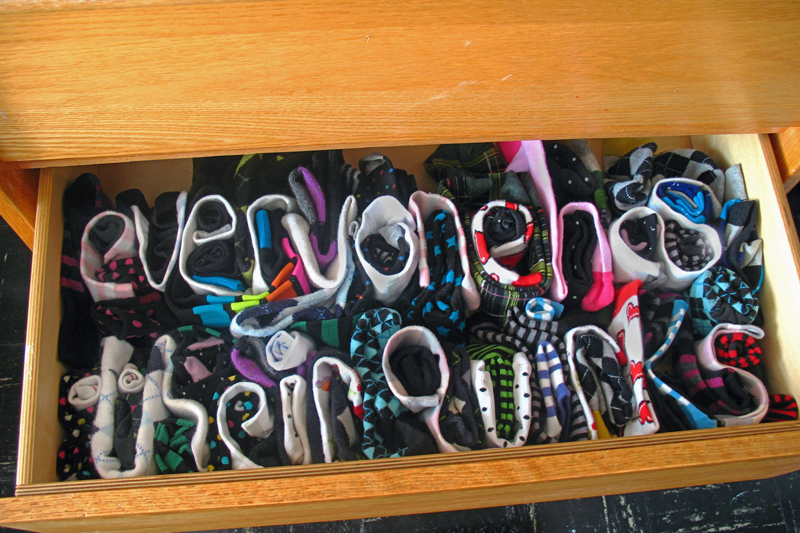
Please don’t feed into the misrepresentation.  You are not “so OCD” just because you organize your sock drawer.  If, on the other hand, you believe that something terrible will happen if you don’t organize it just right, and if the organization and reorganization of your drawer seems to be adding to your distress, well, that’s another story.

Be informed.  And compassionate.

Don’t label something cutesy and funny as “OCD” — OCD is anything but.

no one really wants to talk about HOCD

HOCD stands for “homosexual obsessive-compulsive disorder,” and I think it’s about time I wrote about it on my blog.

HOCD is essentially when someone has intrusive thoughts and worries that he or she might be gay, even though they have been straight for years with no doubts … and even though they are attracted to the opposite sex and want to be with the opposite sex.

A better term would actually be “sexual orientation obsessive-compulsive disorder” because these worries sometimes torment gay people who suddenly wonder if they might be straight.

Just to be clear … this post is not about homosexuality and is not meant to spark debate about homosexuality.  This post is about questioning whether you’re gay when you’re not (or vice versa), and that is a common thread amongst obsessive-compulsives, one I feel that most people would rather not discuss.  People can argue till they are blue in the face about what to think about homosexuality, but there is only one way to look at a disorder that makes you question something that never needed to be questioned: that disorder is a liar.

Why don’t people want to talk about it more?  I confess, I myself don’t, especially not in a platform like this blog.  Because no one understands an obsessive-compulsive like another obsessive-compulsive, and it’s so hard to explain the internal riot occurring while going through any obsession.  Many OCs are upfront about their obsessions with those they are closest to … then they (we) use those friends to solicit reassurance from.  Do you think that was bad?  Do you think I cleaned the dishes well enough and the kids won’t get sick?  Do you think it was stealing when I took a paperclip home from work today?  The friends tell us, No, it wasn’t bad; yes, you cleaned well; no, you’re not a thief.

But when an OC is struggling with HOCD, it’s very hard to ask friends, Do you think I really might be gay?  We are less worried about their answer than about their secret judgments toward us after the question is asked.

I remember in 8th grade thinking that my friend looked pretty one day, and it set me off on a trail of questions and doubts: did that mean I was gay?  Did that mean I liked her?  Was attracted to her?  I was the most boy-crazy girl that I knew, and inside my head, I was asking these questions.

Now that I am on the other side of cognitive-behavioral therapy, it is so unbelievably clear to me: If I liked only men and wanted to date only men, then I was not gay.  But I can remember the questions: But do you only want to date men?  It’s crafty, OCD is.  It plays dirty.  It makes us second- and triple- and quadrupal-guess ourselves.  It’s all so exhausting.

I just wanted to write a post on it to explain what it is and to say that it is such a common obsession.  I think the more we can see how it’s just the same old story with OCD, the more we can see clearly that we are not alone and that OCD is just that old liar who only has a small bag of tricks.

Related posts:
Interview with a Former HOCD Sufferer
Another Interview with a Former HOCD Sufferer
A Closer Look at HOCD
A Big Ol’ HOCD Post
A Third Interview with a Former HOCD Sufferer

where the music comes from

Early that next week, with my head still spinning, I sat with the Conner family for Ellen’s first jazz concert of the year—her three younger brothers sandwiched between their parents and me next to Mrs. Conner, feeling guilty that I’d been avoiding her daughter.  It was pretty obvious that, between the six of us, only Mrs. Conner and I actually wanted to be there, but Mr. Conner dutifully tried to keep the boys quiet and entertained.

“Ellen looks gorgeous,” I whispered to Mrs. Conner when the jazz band made its way onto the stage.  Ellen wore a knee-length black dress with long sleeves and a scooped neckline.  Her mom had forced her to take off the leather choker for the evening.

“She’s miserable,” Mrs. Conner whispered back.  “We go through concert dress woes every year.”  She rolled her eyes.  I smiled and looked back to the band members, who were tuning their instruments to Ellen, the lead saxophone.  They began with a few big band arrangements, followed by a swing tune, then a ballad.  “Ellen has a solo in this one,” whispered Mrs. Conner.

When the band fell into the background, Ellen stood up and a giant spotlight shone on her.  She played effortlessly, a beautiful, full tone, with perfect rhythm.  The concert band director had begged Ellen to join their group as well, but she just wasn’t interested.  “In jazz,” she’d told me, “you can actually lean into a wrong note and make it sound right.  It’s not like concert band, where you have to be perfect.”

“She’s got this down,” I commented to Mrs. Conner.

“It’s actually improv,” she offered back.

My eyes widened.  I could hardly believe that this picture-perfect sound being pushed along the ceiling by an alto sax was being invented on the fly.  I imagined myself standing in front of tonight’s crowd, looking not at a sheet of music but letting it flow out of me like rays of sunlight.  I shivered in the audience—not from any chill but from the fear conjured up by the brief imagination.

Dr. Foster is right, I thought.  I am definitely uncomfortable with uncertainty.  It upset me a little to see how far-reaching it went.

“Jazz and fantasy both push the limits,” Ellen had said to me once.  I’d had to think about it for awhile before it sat right with me.  Tonight I could see that Ellen was just a teenager who wanted no boundaries.  She needed improvisation, needed those grace notes.

A dark stage, a young girl in a black dress.  The spotlight’s mouth circling her in a perfect O as she gazed straight ahead.  It reminded me of the stormy night that Matt played his keyboard for me, the way his eyes too had found that particular secret spot where the music comes from.

saxophone

looking back … and ahead

2012 was a good year.

In January, I had just aside my OCD manuscript and was 50 pages into writing adult fiction about a woman who was a late discovery adoptee when I read The Fault in Our Stars by John Green.  The book walloped me in the best way possible, inspiring me to drop the LDA story and try my hand at young adult literature.  12 months later, I am head-over-heels in love with writing for this demographic– not to mention deeply in love with the characters in my book.

In February, I posted one of my most frequented links, about how medication is scary.

In March, my friend Ashley encouraged me to get serious about my blogging, and the rest is history.  I started blogging with a lot more frequency after that, trying to refine and define what exactly Lights All Around was about.  In the end, it boils down to three things: faith, creativity, and OCD.

I believe it was in April that I wrote and submitted a post for the Rage Against the Minivan blog, never guessing that it would actually be chosen and posted months and months later.

In May, I left my job in management, moving into my old role as an admission counselor only.  At the time, it was devastating to me, but in the months since, I have come to realize it was a true blessing in disguise.  I had wondered if it might, but it was hard to see past the sadness.

In June, I spent a week tucked away in an apartment above a Wisconsin garage, writing like a maniac and finishing the first draft of Truest.  It was a bad draft, but that’s what first drafts are supposed to be.  At least it was in the computer.

July, I nursed my crush on the Olympian Michael Phelps and posted a mildly scandalous short story about Adam and Eve, one of my most-commented-on posts.

In August, I read The Night Circus by Erin Morgenstern, which, alongside The Fault in Our Stars, was one of the best books I read all year.  (I love that I can measure my months by the words I encountered.)

September marked the end of an era as I ventured to the University of Minnesota Medical Center to meet with my beloved psychiatrist for the final time before he retired.

In October, the International OCD Foundation flew me out to an event of theirs in Boston to read an excerpt from my OCD novel that had won an international creative expression contest.  There, I fell in love with the IOCDF.

November I decided to speak out even louder than usual about cognitive-behavioral therapy, explaining to blog readers what my life was like before and after CBT and also details of what my CBT experience was like.  I got emails from people after this, asking for even more details, even some fellow Minnesotans wondering specifically about my own therapist.

In December, I finished yet another draft of Truest while on an artist retreat I had been selected for.  I am committed to this story.  My writing group has helped and continues to help me SO MUCH with revisions, and I decided to purchase a short mentorship with a Minneapolis editor.

Which brings us to now.  And what’s ahead for me?

I have gotten into the habit of blogging, and I love it.  I will keep speaking loudly about OCD and CBT and ERP.  God has been so good and so faithful to me, and even today, when I was feeling very low, I was still able to be grateful that I have a permanent love in my savior.  I will keep reading as much as I possibly can and review the books here on my blog.  I will keep writing– because I love it, and because I crave it, and because I have to.  I will continue to meet with my brilliant writing group and start my online mentorship next month.

2012 was good.  Here’s to an amazing 2013.

20122013

OCD and suicidal thoughts

Recently Janet at the OCDtalk blog posted about her friend whose obsessive-compulsive son had just committed suicide.  The post broke my heart.  It reminded me of earlier this fall in Boston where I met Denis Asselin, the winner of the International OCD Foundation Hero Award.  Denis’s son Nathaniel, who suffered from intense body dysmorphic disorder (on the OCD spectrum), took his own life in 2011.  It was beautiful but devastating to listen to him talk about his beloved son.  My heart is heavy as I think about these families, now missing an important member, and about the horrific pain that these young men were experiencing that made them see no other way out.

It’s a dark, heavy topic, but tragically important to discuss.

OCD is so often thought of as simply being neat or orderly– or sometimes even anal retentive about certain things.  Media portrays obsessive-compulsive disorder as a quirky, nitpicky, and sometimes comical disorder, but let me level with you: OCD is debilitating, devastating, and torturous.

Can you imagine feeling nothing but sheer, unadulterated terror for days, sometimes weeks, on end?

I remember some of my darkest, hardest, most terrifying days.  I lived in the Brighton Village Apartments with Becky and Tricia.  During the day, I was given the small grace of suspending my obsessions– at least enough to make it through work (most days– not all), for which I am grateful.  In the evenings, I would return to our apartment, where I would drown in an ocean of terror.  My soul felt untethered, lost, condemned; I felt the hot, ugly breath of hell on my neck all evening.  I felt unforgiven and completely cut off from the God I wanted so desperately.  (It is making me cry right now as I write about those dark days.)  And the torture of not knowing— heaven or hell?  saved or condemned?  found or eternally lost?  heard or ignored?– was the worst kind of mental anguish.

Those apartment buildings were built like an X, with the pool and laundry facilities at the center where all four wings came together.  I remember– and this is not an isolated event but something that happened every time I was in that third-floor laundry room– I would look over the balcony down to the first-floor pool area, usually empty, and I would thinkIf I threw myself off this ledge head-first, I would finally know: heaven or hell.  I would have my answer, instead of the torture of not knowing.

But what if the answer was hell?  I couldn’t hurry that on.  What I wanted even more was annihilation— to cease to exist.  I craved oblivion.  That is true pain for you.

I realized that I was already in hell– just of a different stripe.  I was living like a condemned person, in TERROR and heartache and loneliness, and in constant combat with the blasphemous thoughts that plagued my mind.

Most people wouldn’t have guessed it.  I smiled a lot at work.  I even managed to fool those closest to me who knew the anguish I was experiencing.  But I would look over that balcony at the hard floor, and I would think about it.  OCD is that devastating.  I believe obsessive-compulsives (even those who take their own lives) are some of the strongest people you will ever meet.  They fight a constant war.  It is no wonder to me that many want to lay down their weapons and surrender.

And yet, here I am, eight years later, happy and healthy and secure in my faith, enjoying life and friendships and a growing relationship with Jesus Christ.  I am not tormented by my own thoughts, and uncertainty isn’t anguish any longer.  I want to gently take the faces of the anguished obsessive-compulsives into my hands, stare them directly in the eye, and tell them, There is hope.  There is help.  It doesn’t have to stay this way.  I would hug them and cry with them and personally drive them to my cognitive-behavioral therapist.  I was once where you are.  Follow me to freedom.

If you are struggling today with intrusive thoughts, obsessions that plague you, compulsions that take over your life, THERE IS HOPE.  I promise you.  This is a disorder– just a disorder, albeit a powerful, ugly, life-thieving one.  Follow me to freedom.  There is Truth, and it is not what you are hearing from your OCD.  Rescue is possible.  Follow me to freedom.  Email me.  Joy, happiness, laughter, truth, peace, safety– these may seem like impossibilities, but they can be yours too.


suicide

Mental illness is a medical problem.

One thing that frustrates me to no end is when people treat mental illness like moodiness, as if you can just snap out of it, instead of like the medical issue it is.  This mindset is so pervasive that it has infiltrated even those with mental disorders.  It broke my heart to sit across the table from an obsessive-compulsive who thought she should be able to just “pray away” her OCD.  Now, of course I think that prayer matters.  But I think also that you pray about cancer– and then undergo chemotherapy— and pray some more.

whatifwe