my two cents

Well, wouldn’t you know it– I wrote up a whole blog entry, and it somehow vanished.  I think I might be due for a new laptop soon.

It’s been so interesting to read the comments on the last post– MLP, keep it up and one of these days you’re going to coax me away from my Prozac and onto a Maximized Living chiropractor’s table!

Let me be honest (and brief, since I’m annoyed that my post disappeared): what do I know about anything?  I don’t consider myself an expert at all.  Meds have been terrible to me and wonderful to me.  Luvox stole my energy for a time.  Salagen gave me a spasm in my back that dropped me to the floor of my apartment.  Paxil made my mind throw up on itself.  Going off of Clomipramine sunk me into a depression.  An allergic reaction to Propranolol almost sent me to meet my Maker.

And  yet the lovely little cocktail I’m on now– Prozac, Effexor, and Risperdal– seems to be going great.  I will say that I believe that the successful completion of cognitive-behavioral therapy, along with a year and a half of successes, has probably done more for me than meds ever will.  (Successes accumulate, you know, tearing away at OCD’s ridiculous pride– I love that it isn’t in charge anymore!)

I thought everyone made such good points!

I will say this one quick thing.  My body reabsorbs serotonin so quickly– is it wrong if I “level the playing field” by taking a pill to slow that down?  I don’t think it’s wrong.  I feel like it is bringing me back to “zero.”  I believe that God can and does use medication to lift sick, broken people in a fallen world out of their deficit and back to square one– in some ways, a “redemption.”  It is, afterall, His business, is it not?

Love to hear your thoughts!

Christians and medication

First, I’d love for you to read the following by John Piper:

Should Christians use anti-depressants? (by JOHN PIPER … not Jackie!)

It is a gray area. I don’t preach against anti-depressants, though I have mentioned them before and dealt with a good many people who use them.

In the secular world at large there is a huge reaction these days against the overuse and dangers of anti-depressants. The world itself is recognizing that we may be doping up too quick and too superficially.

But still, if you go to a doctor now, very often you’ll be prescribed a medicine for almost any kind of relational, emotional, or behavioral problem that you’re having. That is happening too quickly I think.

I appreciate the concern people have about the use of anti-depressants among Christians. God had something to teach Job—who didn’t have Prozac—through his pain, and he might have something to teach us too.

Therefore, I encourage slowness to use anti-depressants. God may have a way forward for someone before they start altering their mind with physical substances.

However, on the other side, it seems clear to me that the brain is a physical organ with electrical impulses and chemicals, and that mental illness is therefore not merely spiritual. No man could persuade me that all mental derangement is owing to a spiritual cause that has a purely spiritual solution.

There are physical damages that happen in life or that a person is born with that alter the brain’s functionality. The question then becomes whether we should only pray for it to be healed, or whether we might also use medicine to help it.

Just like you take aspirin to get you through a very serious back-ache, you might, for a season, take some kind of medicine that would enable you to get your bearings mentally so that you can then operate without the medicine.

Near our church there is a place called Andrew home and it houses people who are severely mentally disabled. All of them are on heavy medicines to keep them from killing themselves, killing other people, or being totally unable to work.

A few of them worship with us at Bethlehem, and I believe that through their medication they perceive and know God and that God is in fact using them for good. They are seriously mentally ill. I don’t know all of their circumstances, but I couldn’t rule out the option of medicine for them (or for others struggling with certain forms of serious depression) as a means to try and help them get their bearings.

One way medicine can be helpful is if it gets people to a point where they have enough stability to read the Bible. Then, through being able to read the Scriptures, people are able to be refreshed in the Lord and, in time, come off of the medicine. In that case medicine is a means to an end, and that seems perfectly natural to me.

© Desiring God

Well, hey there.  Jackie again. What are your thoughts on this?  I’d love to generate some discussion in the comments.  I want everyone to weigh in.  I’ll share my thoughts in another post very soon!

CBT prep …

  I looked at the back cover of Freedom for Today’s Obsessive-Compulsive.  Apparently Steve Jewett and James Nash were some big names in the OCD world.  “Open this book,” the back cover read, “and unlock the doors of your mind’s prison.  What lies ahead of you is freedom.”  The goal was appealing, and I liked the confident wording.  Just straight to the point: “What lies ahead of you is freedom.”  Well, okay.

            I opened to a random page and read, If I were to say to you, ‘Don’t think about a red unicorn,’ what would happen next?  Why, immediately, you’d begin to think of a red unicorn!  In fact, I’m sure that’s what’s in your mind’s eye right now as you continue to read this page.  That is what we’re dealing with as we fight OCD.  An obsessive-compulsive experiences an intrusive, unwanted thought, and because it is intrusive, he feels disgusted by it, wants to stop thinking that particular thought.  But just as my telling you, ‘Don’t think about a red unicorn’ results in your immediately doing so, the obsessive-compulsive’s panic and desire to stop thinking the intrusive thought actually drive him to continue thinking about that very thing.”

            Well, that was certainly true enough.  When my worst thoughts arose in my mind and I tried to stamp them out, it was a battle of escalation.  The harder I fought, the harder I needed to fight. 

            “In cognitive-behavioral therapy (CBT),” the book continued, “we encourage the obsessive-compulsive to give in to those intrusive thoughts, to stop fighting them.  Time and time again, CBT experts have found that it is when an obsessive-compulsive stops fighting the intrusive thoughts and actually embraces them that he finds freedom from them.”

            Oh gosh.  I set the book down, my heart beginning to race.  It wasn’t new information to me—Ruth’s brochure had given me the basics of behavior therapy—but the way it was worded gave me a chill.  “Give in to those intrusive thoughts.” 

             “So I’m reading this book for Dr. Foster, right?” I said a couple nights later at Rosie’s Place to Stella before she opened her laptop.  “It’s like reading my own biography.”

            “Yeah?” she asked, taking a sip of something foamy.  “What do you mean?”

            “Well,” I said, “you know how all my ‘issues’ seem so bizarre?  Some of them are not bizarre at all, I mean in the world of OCD.  I’m textbook.  It’s crazy really.” 

            “Like?”  Stella began to sort through the tangled mess of beads she was wearing—black, red, maroon, picasso jasper.  These, in addition to a floral chambray shirt and hiking shorts.

            “Okay,” I said, “so there are all these made-up scenarios, and the book circles back to revisit these same examples.  One of them is a dad who’s sure he’s going to kill his baby girl, so he won’t even hold her.  He gets all these images in his head of suffocating her, stabbing her in her little chest, shaking her, drowning her.”

            “Ew,” she said, still fussing with her beads.

            “Yeah, but these thought make him completely sick,” I explained.  “It’s clear to everyone else, including his wife and therapist, that he would never ever hurt his daughter.  I mean, they’re not freaking out.  He’s the one avoiding alone time with his daughter.

            “And there’s this lady who thinks she might be a lesbian even though she isn’t attracted to women.  Every woman she walks by, she thinks, ‘Am I attracted to her?  Do I want to kiss her?’ then she imagines herself kissing that woman.  She’s just sick over it, but instead of thinking, ‘Oh, I guess not.  That’s not a pleasing image to me,’ she thinks, ‘I must be gay.  Why else would I be thinking so much about kissing women?’  This is called HOCD—homosexual OCD.

“But then get this.  One of the example scenarios is about this girl who has these blasphemous images attack her mind.  She … she pictures herself having sex with Jesus.”  Stella looked bemused, but I continued.  “She doesn’t want to think about that, but there are all these triggers in her normal day—when she sees someone praying, or a cross around someone’s neck, or a kissing scene in a movie or on TV.  And whenever there’s nothing else to think about, that’s where her thoughts go.  She believes that her thoughts are blasphemous, so she believes that she will go to hell.  She thinks about hell all the time.  The book even said that she confessed to her priest, and even he said she was fine, but she couldn’t believe it.  Whenever the image of having sex with Christ came into her head, she said a Hail Mary to alleviate her guilt and drive the image away.  Eventually she had to quit her job because she was too distracted saying her Hail Marys to get work done.”

            Stella’s eyebrows furrowed.  “Gosh, that does sound like you!”  She abandoned the necklaces she’d been working on and clasped her hands together on the table between us, leaning forward as she listened.

            “I know!  I mean, elements are different, for sure, but the basic idea is the same.”

            Stella sighed.  “I used to think that OCD meant that people were super clean.”  She chewed on the inside of her cheek.  I knew what she was thinking, even though she didn’t say it aloud: It’s so much worse than that.

            “Yeah,” I said, agreeing both with what was said and unsaid.  “Even the people who are really clean, or who wash their hands all the time—they’re driven to it.  They think something horrible is going to happen if they don’t do it. It’s so much bigger than just being a neat freak.  It kinda drives me nuts when people with quirks say, ‘I’m a little OCD myself.’”

Stella nodded violently.  “Remember that receptionist job I took at that plastic surgeon’s?  One day this nose-job lady came in, right?  She sat beside a burn survivor, pointed at his dressings, then at her own protective shell covering the bridge of her nose, and said, ‘I know how you feel.  Hang in there.’”

“I don’t believe you,” I said, jaw dropped.  “You’re joking.”

“I’m not,” she said.  “I’ve never been so pissed at a job site before.  I’d take the call center perverts over those rich bastards any day.”  She shook her head in disbelief.  “So … therapy?”

            “Therapy,” I said.  “I guess it’s like a pyramid, and you climb to the top, step by step—if you don’t reach the pinnacle event, CBT probably won’t work.  In the book examples, the dad had to write down all the ways he was going to murder his daughter—graphically!—and then record himself reading it, and he had to listen to it over and over.” 

Stella looked disgusted.

            “The HOCD person had to rate women’s butts and record everything in a notebook, and she had to read a couple LGBT novels.  And the one with religious obsessions had to write a story about having sex with Jesus Christ and then read it over and over again without saying any Hail Mary prayers.”

            Stella made a face but nodded slowly.  “So what will you have to do?”

            I shrugged.  “All I know is that it will be terrible.”

            And for once, I appreciated it when Stella didn’t reassure me.  There was more strength in knowing she agreed.  “I don’t know what to do,” I confessed. 

            “Write about it,” she said.  So I did.


OCD

There he is, that scarlet beast,
black horn like a railway spike.
I check myself against the blood-red giant,
close my eyes, cover my ears,
two-thirds of the famous monkey trio
where I sit cross-legged between cloven hooves.
Do not think of a red unicorn.  Do not do it.
But I can feel his wet, warm breaths like humid whispers

as he lowers his nostrils to my neck, crimson ears at salute
like a maddening accusation.

thought for today

Quote

A writer — and, I believe, generally all persons — must think that whatever happens to him or her is a resource. All things have been given to us for a purpose, and an artist must feel this more intensely. All that happens to us, including our humiliations, our misfortunes, our embarrassments, all is given to us as raw material, as clay, so that we may shape our art. -Jorge Luis Borges, writer (1899-1986)

Thank You, Lord, for my OCD.  Thank You, Potter, for making this vessel exactly as is.

PANDAS

The PANDAS that I’m talking about has nothing to do with these guys …


… and everything to do with childhood strep throat.

PANDAS = Pediatric Autoimmune Neuropsychiatric Disorders Associated with Streptococcal infections

Say what???

PANDAS describes a set of children in whom an ordinary bacterial strep infection can turn into a neuropsychiatric disorder.  The strep seems to cause the body’s immune system to build up antibodies that – who knows why – turn traitor and attack the basal ganglia in the brain.

In other words, a simple case of strep throat gone to hell.

Sometimes a child gets strep throat, and the body gets confused– instead of fighting off the bacteria, it attacks the basal ganglia … which leads to obsessive-compulsive disorder.

The first time I had an intake with a psychiatrist, she asked about my past medical issues.  “Ummm … I broke my elbow twice,” I said, thinking how a broken bone had nothing to do with my head issues.  I reached: “And I’ve had strep throat like a million times.”  I felt a little stupid and way too thorough.  Keep it to related issues, I thought to myself.  Duh.

But my psychiatrist perked up.  “Did you know there’s a strong connection between strep throat and OCD?” the doctor asked me.

Apparently, this is a little controversial, and some doctors aren’t convinced.  But come on– how many cases of strep-followed-by-rapid-onset-of-OCD do you have to see before you raise an eyebrow at the connection?

My doctor– Dr. Suck-Won Kim, the absolutely brilliant OCD expert at the University of Minnesota– believes there is a strong correlation, and I’m in his court.

A scene cut from my book:

“You have heard of PANDAS?” he asked.

            “I have,” I said, although I couldn’t remember at the moment what it stood for.  “It’s when kids get strep throat and then OCD.  Or something like that.”  I realized that I probably sounded stupid, explaining PANDAS to an OCD expert.

            “So many PANDAS studies … it has to be solved because far more OCD cases are strep-linked than people know.”

            “Yes, I had strep a lot as a kid.”

“YOU DID? YOU SEE?!”  Dr. Lee became animated as if a moment ago I’d said no such link between strep and OCD existed but now he was proving me wrong.

“The first time I met with a psychiatrist, she asked about my medical history.  I didn’t have a lot to share, but I happened to throw it out there that I’d had strep throat a lot, and she said it was probably connected.”

“She knew that?” asked Dr. Lee, impressed.  “That is uncommon.  Most doctors have no clue.” 

For more information on PANDAS, feel free to check out

I think I had strep throat nine times as a child.  Can anyone beat that?  Leave a comment!

quote for ya

Quote

“As we discussed in Chapter 1, the more you fight an obsession, the more frequent and intense it becomes.  This is called a paradoxical effect, something we all experience at times.  For instance, if someone commands you, ‘Do not think of a red elephant,’ you will automatically respond by thinking about a red elephant.”
Edna B. Foa, Ph.D., Stop Obsessing!

CBT intake

“This will be different from other kinds of therapy, Neely,” said Dr. Foster, as if he could read my mind and there see my image of Ruth.  “You’ll have homework and be expected to go through various exposures when we meet together.”  He picked up the top coaster off a stack of them on the coffee table between us and set his coffee mug on it.  It had had writing on it.  I looked at what was now the top coaster on the stack.  It read, “Uncertainty and mystery are energies of life. R.I. Fitzhenry.”

For the next hour Dr. Foster tuned in carefully for any mention of rituals, anxiety, and triggers.  I knew that he was combing through my words for his options, already working on his plan of attack for how he would prompt anxiety in me like a gun’s trigger, asking over and over, “If you couldn’t do that, would you have a lot of anxiety?” I blathered, but he was only seeking one thing: what would stress me out to the max.

“When I hear words that start with the f sound, I start praying over and over again in my head,” I revealed.  

“How would you feel if you were prevented from repeating the prayer at those times?”

My heart clenched a little in my chest.  My prayer was the key to counteracting the whole chain of ugliness that lead to blasphemy and hell.  “Um, anxious, nervous, crazy.”

“Mmm hmmm.”  Dr. Foster was jotting notes furiously.

“It’s because of hell,” I shared, explaining how curse words and the sound of the letter f  made me think of cursing the Holy Spirit, which I believed to be unforgivable.  “I’m always scared of hell—only sometimes it’s in the background, like elevator music.”

 He continued to write and encouraged me to keep talking.  “When you’re nervous about going to hell, how do you calm yourself down?”

 “I can’t calm myself down,” I admitted.  “But I ask my friends and family what they think.  Even though it doesn’t convince me, I still like to hear them say I’m okay.”

 “Hmm,” said Dr. Foster in recognition.  “Seeking reassurance is another of your compulsions, another thing you do to ease your anxiety.  Pay attention this week—I bet sometimes you do this passively, like mentioning that you’re a bad person.  Watch for it.”

 We continued on this way, Dr. Foster asking the questions and me providing the answers, feeling ridiculous and unhelpful and as if I were maybe wasting Dr. Foster’s time. 

 “Do you have any questions?” he asked as we were wrapping things up.

 “My faith plays a huge role in my OCD,” I said.  “Do you … ”                                  

 “I believe in God, yes,” he interrupted.  The way he spoke made me certain that he did not feel about God the way that I did.  I gulped.

 “Ninety-nine-point-nine percent of people are skeptical going into this,” he told me, his face like a stone.  I wondered if he ever smiled, even at home.

 “Okay, because I am,” I said.  It felt appropriate to tell him this, even though I was intimidated by his seriousness.  “I think I understand how this works,” I said, “but I’m a little confused.  Like, for example, a washer would be prevented from washing, and then they’d realize that nothing bad happened when they didn’t wash—they still lived.  So how will that work for me?”

 “You’re misunderstanding a fundamental part of cognitive-behavioral therapy,” said Dr. Foster, folding his hands across his stomach.  “The point is not to take away the person’s uncertainty.  The point is to make him or her okay with uncertainty.”

Well.  That didn’t sound so good.

He continued, “Just because a washer doesn’t get contaminated after being prevented from washing one time doesn’t mean that the person won’t still fear a deadly disease the next time.  Each time is a new adventure.”  He raised his eyebrows.  “And with you, well, we can’t fast-forward to the end of your life and see whether you’re going to heaven or hell.  CBT will teach you how to live with uncertainty.”  He tapped on the top coaster in the pile.  “Energies of life.”

exhausted

I remember feeling SO tired … but not in a I-didn’t-get-enough-sleep way.  Just in a deep, heavy-hearted, there-are-too-many-things-to-manage kind of way … including all your thoughts, which are vomitting all over your mind.

There is rest available.  I wish I could get you to believe that.

“Yes, keep it up,” repeated Dr. Lee, “and you will beat this still.  There is rest for you ahead.”  He narrowed his eyes at me as if he were imagining my successful future.  “But not yet. For now, more work.”

More on CBT this week.

OCD101

Hopefully this scene from my novel will give you a better understanding of how OCD works; in it, Neely is attempting to explain OCD to her new friend Gabe.  (By the way, Gabe is just finishing up his chemotherapy– hence the lack of hair.)  Ask your questions in the comments!!  (I would seriously love it if every person who reads this blog asked one question!)

“So, how is Tatum’s Pizza Arcade the best place to tell me about OCD?” he asked while grease from the pizza collected at the corner of his mouth.  He wiped it away.  “I’m … rather curious.”

I’d been planning this for the last week.  “Okay,” I said, “so you get to learn about OCD in three parts tonight.  First, I’m going to tell you about it.  The second and third parts are more experiential.”

“I’m ready to learn.”

“Obsessive-compulsive disorder is basically where you have these intrusive thoughts—they come out of nowhere and assault you—and then to combat them, you perform some kind of compulsion.  Compulsions are more obvious than obsessions—washing your hands til they bleed, checking the oven or the lock on the door over and over and over, being a pack-rat to the furthest extremes, doing weird little rituals.”

“You don’t do any of those things.”

“No.  Well, kind of.  I have my own rituals.  Mine are hard to see because I’m a pure obsessional.”

“So you don’t have compulsions?”  I loved the thoughtful way he chewed his food, the earnest look in those pale blue eyes. 

“No, I do, I do.  They’re just, well, trickier to catch.  They’re mostly in my head or to myself.  Or well masked.”

“I don’t get it,” he said.  “We’re not off to a good start.  And this pizza sucks worse than I remember.”

“Let me start over.  Okay, so an obsessive-compulsive has an intrusive thought—could be anything—maybe ‘I am going to get sick and die.’  So they hate that this thought keeps hounding them, making them feel sick—so they do something about it.”

“Wash their hands,” he supplied.

“Right,” I said.  “You’re getting it.”

“So what about someone who touches the doorknob forty times or something?”

“Same thing.  There’s some intrusive thought—and they’ll perform the ritual to temporarily alleviate the sick feelings from the bad thought.”

“Okay, so how about you?”

“My intrusive thoughts are blasphemous.”

Gabe raised an eyebrow—or what was left of one.  “Liar.”

“They are,” I insisted.  “I think bad thoughts toward the Holy Spirit, and since I’m scared that doing that is unforgivable and that I’m going to hell if I think those things, my head automatically wants to combat those intrusive thoughts.  So I say a prayer, the same one over and over to bat down those thoughts.”

He frowned.  “And there’s no way to just stop them?”

“Gabe,” I said, borrowing from my old friends Jewett and Nash, “do me a favor and don’t think about a red unicorn.  What are you thinking about?”

The corners of his mouth turned up, just slightly.  “A red unicorn,” he admitted.

“Well, stop it,” I said.  “Quit thinking of the red unicorn.  Stop now.  Do not think about that red unicorn.  Stop—”

“Okay, I get it.”

“So … yeah,” I summed up.

“It’s like warfare up there?” he asked.  I nodded. 

After dinner, I said, “I want to show you something.  Come with me.  Bring the tokens.”

We walked to the kiddie arcade.  I looked around.  “What are we looking for?” asked Gabe.

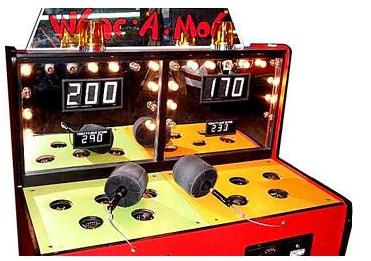
“There it is!”  I pointed to an arcade machine that came up to my hips, with five small holes in the top.  I took Gabe’s hand and pulled him along behind me toward the machine then maneuvered Gabe into place in front of the game.

“Whac-a-Mole?” he asked, doubtful.

“Whac-a-Mole,” I said, inserting a token into the machine.  “Let’s see you go, Reed.”  I slapped him on the back for luck.

He made a big show of it, shaking out his shoulders, squaring his jaw, performing minor stretches.  I laughed when the plastic moles covered in weathered paint began to pop up randomly from the five holes.  Gabe jumped into action, reached for the foam-covered mallet and began to attack the moles, forcing them back into their respective holes as they showed their faces.

Gabe was pretty good—at least, at first.  The game began slowly, with moles creeping leisurely out of their holes.  But in a short time, several moles began to pop up at each time, and Gabe struggled to keep up.  Before long, the moles were out of control, popping up for only a split-second.  Gabe let out a choked, surprised laugh as the game sped up even faster.  He was wielding the mallet like a boy swiping at the air with a toy sword. 

As the machine lit up and the moles retreated, I laughed at Gabe, who looked legitimately surprised to be getting his butt kicked by five plastic mammals.  Three red tickets popped out of the dispenser attached to the arcade machine.  “What’re those for?” he asked, mallet still in his hand, limp at his side.

“The better you are, the more tickets you get.  Then you trade them in for prizes.”

His jaw dropped.  I threw my head back and laughed.  “Three measly tickets?” he said.  “Put in another token.”  He wound up with the mallet as if it were a baseball bat.

Gabe played a few more games, getting better and better, the red tickets spewing out of the machine like an overgrown tongue.  Still the machine overwhelmed him by the end of every round.

He was no idiot.  “So, this is some sort of metaphor for OCD?” he deduced.  “The experiential part of tonight?”

I smiled.  “You got it.  Blasphemous thought—mole rising.  Say my prayer—bash it down.  Blasphemous thought—mole rising.  Say my prayer—bash it down.  Now, Mr. Reed,” I said, lowering my voice, “this time, pretend it’s salvation on the line.  If you mess this game up—misstep somewhere—you go to hell.  Hell being where you are forever separated from the person you love the most.”  I dropped another token into the machine; in the middle of the cries of kids and beeps and clangs of arcade games, I could swear that I heard that token hit its fellows in the collection bin beneath the token slot.

Gabe frowned but played his hardest.  In the end, when the game had once again gone out of control, it ended.  Another string of tickets whirred out of the dispenser, but Gabe only looked at me, and even when I smiled at him, his blue eyes were sad.  “I’m sorry,” he said. 

my OCD heroes


Jesus Christ*                    Dr. SW Kim           Dr. C. Donahue

*not to be confused with Jim Caviezel 🙂

I was diagnosed with OCD at age 22, approximately 15 years into the struggle.  It took another 4-5 to go through about 11 failed prescription meds, 2 psychiatrists, 1 physician’s assistant, 2 talk therapists (one amazing, one horrendous), and myriad debilitating obsessions before I was connected to Dr. Suck Won Kim, a nationally recognized genius in the realm of OCD medication– and working right at the University of Minnesota!

Dr. Kim speedily got me onto the right medicine (the perfect combination of Prozac, Effexor, and Risperdol) and encouraged me to call Dr. Christopher Donahue, a cognitive-behavioral therapist whose practice was located in Edina.

Cognitive-behavioral therapy is somewhat a paradox.  To me, it was hell and rescue, both at the same time.  CBT is one of the hardest things I’ve ever done but also one of the best.  The premise behind CBT, and more specifically ERP (exposure and response prevention), is to face your obsessions head on and be restricted from performing a compulsion to alleviate the stress.  Can you imagine it?  (To be honest, unless you struggle with OCD, you probably can’t.  But trust me, it’s horrible– in a later post, I’ll detail what my therapy looked like.)

Twelve weeks.  In twelve weeks, CBT works or it doesn’t.

And mine worked.

Think about it.  Fifteen years of torment (including a three-year period where a junior higher cried herself to sleep every night) till it was named.  Five years of running in place.  And then … twelve weeks of hell and freedom.

I am a recruiter for Northwestern College, but sometimes I wish that I could be a fulltime recruiter for cognitive-behavioral therapy, the tool Christ used to set me free.

For those of you out there who are living the impossible life right now, saddled down burdens you cannot bear, terror trilling in your heart from morning till evening, there are steps that you can take.  CBT is the number one way to treat OCD, and while it seems impossible, the alternative is living the impossible every day.

As I wrote this post, I realized that some readers will not even understand the basics of how OCD works– how obsessions and compulsions “complement” one another.  In tomorrow’s post, I’ll try my best to give an OCD101 session!