diagnosis

Eve Ensler writes, “I believe in the power and mystery of naming things. Language has the capacity to transform our cells, rearrange our learned patterns of behavior and redirect our thinking. I believe in naming what’s right in front of us because that is often what is most invisible. I believe freedom begins with naming things. Humanity is preserved by it.”

And I agree.

To me, naming an enemy steals away some of that enemy’s power, and that is why I believe diagnosis is so important.

For years, I didn’t know what was wrong with me– only that I thought and worried more than anyone I knew– enough to think myself into panicked circles from which escape was nearly impossible. I couldn’t see this behavior in any of my friends, this dizzying chasing-of-my-own-tail beginning the moment I woke up. I was the odd man out, always stressed to the max, always teetering on the edge of something HUGE– heresy, atheism, a change in direction or pursuit, a redefining of my entire worldview.

But how can you fight against an invisible enemy? Since you can’t see the enemy standing between you and the mirror, instead you see yourself and the fight becomes personal. All the while, the real culprit is standing right there … only it is unnamed.

And then, the diagnosis arrives. OCD is named. There is a transfer of power, even if only minute. And the real war begins.

Anonymous, you feasted on me like a silent maggot,
until I was weary of the ugly business of waking up.
You fed on my tears, licking the salt off of
your fingertips in a greedy appetite for sorrow that
backed me into a boxy corner of paranoia
where I first learned your name.
My move.

I couldn’t have guessed

Tonight I had dinner with some lovely young writing majors at the college where I work, and of course, talking about their senior projects made me think back to my own.  “It’s interesting,” I told them.  “I wrote about having OCD, although at the time I didn’t know that’s what it was.  In my senior project, I called myself ‘a skeptic’ and someone who ‘didn’t understand grace’ when really– a couple years later– I’d be diagnosed, and all of this would be so clear.”

And here, for your viewing pleasure, is a piece of work from my senior project.  (I can’t believe it’s been 8 and a half years since I read this at my Capstone presentation!)  (Oh, and P.S. Don’t judge my writing too critically– I’ve grown a lot!)

If You, Lord, should mark iniquities,
O Lord, who could stand?
But there is forgiveness with You,
That You may be feared.

Psalm 130:3-4

Grace Beneath the Line

There are people who live the scripture verse that instructs, Work out your salvation with fear and trembling, harassed by the pressure to perform. I am one of them. A rotting offering in my hands, I seek God, knowing my gift is sour but too insecure to approach with empty palms.
We who are this way step lightly and with caution through days of deliberation. We twist beneath blankets from fear carried over into sleep, hoping all the while that God is not like us, hard and without mercy. Often we’d rather stay stagnant than move at all, rather close our eyes to the search than squint at a Savior we don’t know—fearing unseen wrath. And we wonder: What if He sees us and turns away His holy face? So we continue inching our way, working out our salvation. With fear. With trembling.
With much trembling.

Last summer at camp, I was the volunteer counselor whose voice cracked and split at the faculty meeting, disturbed by the nature of the game Kierstin explained to us all. A mock heavenly judgment at Pine Haven Christian Assembly in Park Rapids, Minnesota—an activity called “Heaven and Hell”—was intended not only to make the campers think but also to unsettle them with fear.
I knew that Kenny was rolling his eyes behind me, the 20-year-old Target operator, as he said, “It’s just a game”—to me—but while looking ahead at Kierstin, who had planned this controversial activity without a thought of its controversy, now looking helpless and unsure behind the lodge’s wooden lectern.
“Well, maybe we could …” she started.
“No,” said Kenny firmly. “The game is simple. It’s good.”
The game would last 24 hours, during which 20 counselors would defend 10 assigned worldviews—2 counselors for each—while the campers searched for a view they agreed with. When the campers asked us for the Truth, we’d spell out the worldview we were assigned as best we could, try to persuade them, as someone would in real life. Once the kids found the worldview they agreed with, they were to sign up on that counselor’s list.
Troubled with lying to the kids even in the context of a game, I muttered, “It just kills me to think that they’ll ask for the Truth and I’ll give them a lie.” My title of counselor afforded no comfort in temporary deception.
They gave me a real saved-by-grace-through-faith-in-Christ worldview to endorse to keep me pacified and participating.
The following day, only the names collected on my created page—along with another counselor’s twin list—would be welcomed into “heaven”—the right side of the chapel. Those not found in that pretend Book of Life—folded into squares in the back pockets of jeans—would depart to “hell”—on the left.

I’d known Phil for nearly a year; he was a skinny, artistic kid who played bass guitar and drums and who sent me e-mails clever enough to be published. He wore glasses with thick black rims and grew his dark blonde curls long “to look like a rock star.” Still, this witty, intelligent boy was far less than confident when he asked me to write his name on my worldview’s list. After some private calculating, some dialoguing with counselors, and a lot of camper “evangelism,” he added his name to my paper—the action that would “save” him—but even the next day as we all stood in line for pseudo-judgment, Phil looked worried.
Since the campers were to enter the chapel to “approach the throne” one at a time, the procession of casual teenagers curved itself down the rock path from the chapel toward the mess hall. Phil and I were at the line’s end, discussing thoughts on acne, baptism, and poetry.
Phil pushed his glasses up his nose and put his hand through his hair as he carelessly handed over a piece of paper to amuse me. I laughed at his comically malicious thoughts about loud boys in his cabin, but my compliments dropped to the ground in the warm, wet air.
“You okay?” I asked.
“Yeah. No. I don’t know. Jackie … we’re going to heaven, aren’t we?” His
gathered eyebrows told of sincere concern even though he smiled. It was an honest question although he referred only to the action inside the chapel, swallowing campers whole as we spoke.
And because I knew the answer, I smiled softly at his worry and asked, “Well, did you find the Truth?”
“I think so,” Phil said, frowning at the path, “but I’m not sure. You know. Tell me. What’s going to happen in there?” And he looked up and nodded at the white building collecting bodies the way the afterlife would someday collect souls. Phil pressed his mouth shut firmly, and my heart hurt with a huge love for this boy whose fear was so real.

Why did Phil doubt? Why did he fear even a game’s rendition of hell? Christians accept Jesus; we are saved; then, so often, we doubt that the God we love really loves us back. A pastor I know once asked my Bible study, “Do you think your name is written in God’s book in pencil?” and I rutted my brows in my forehead because I lived as if I believed in a God who stands ready with eraser poised over my name if His flitting eyes came to rest on the dark places in my mind. Even David the God-chaser spoke, “Take not your Holy Spirit from me.”
But scripture tells also of grace, of mercy, of a Jesus who’s gentle and of a Spirit
who stays. If we are faithless, He remains faithful, for He cannot deny Himself.
What parts of life pervert pictures of the Christ who promises never to leave nor forsake into One whose mind changes every moment I sin or sing? I may be born guilty, but I am looked on in love; yet some malicious, hot voice asserts it’s a love that keeps strict record of wrongs.
Sunday Schools, churches, parents, camps—when they teach that Jesus doesn’t like sin, do they inadvertently emphasize sinner?

Simon, Simon, behold, Satan has demanded permission to sift you like wheat.
At age seven, I thought of dirty words in my head, running to my mother while hitting my forehead, confessing, “Bad thoughts! I’m thinking bad thoughts!” I was terrified that these tiny seeds would overgrow my entire mind until I was so engulfed in sin that the Lord of my Sunday School would shake a divine finger at me and bar the gates to His heaven.
But even worse was the fear of lying. I knew that lying was sinning and that God hates sinning, and so to protect my heavenly innocence, I wouldn’t answer questions. “Jackie, what do you think?” “I don’t know.” “Jackie, what’s your favorite color?” “I don’t know.” All this in an attempt to ward off what would amount to lies if I were to change my young mind. And in doing so, I lied. My favorite color was purple.
This is the life of a neurotic Christian skeptic who has yet to understand grace.
At eleven, I wondered if I loved God—and even how to love God. But I knew, too, that this was wrong and assumed that hell would drink my soul greedily if I died in that state. I sang the inserted words want to in “I Love You, Lord” quickly, and I still have that pillow with its circular tear stains, evidence of pain that stayed quiet so I wouldn’t wake my sleeping sister. I cried nearly every night from fifth grade to eighth.
Then, at age sixteen, I labored with a heart hostile to the atheism that desired to hold it, fighting doubt alternately wildly and weakly, drinking communion juice that tasted like acid, hearing hypocrite! hissed in my ears that craved the voice of the God I questioned. Fear. Its claws ripped into my brain, and to drive five miles into town was terrifying. I distrusted thoughts of heaven but felt hellfire like a razor to my throat, escalating the intense horror of death. To pass a car, I’d hold my breath.
And then, at twenty, I died. I went blank. I read Matthew 12’s passage about the unpardonable sin, feared I had committed it. Unalterable guilt prescribed in red. Whoever speaks a word against the Son of Man, it shall be forgiven him; but whoever speaks against the Holy Spirit, it shall not be forgiven him, either in this age or in the age to come. And how is one to live without the hope of heaven? What of quiet mutterings questioning the Holy Spirit’s work? What of the testing of the spirits? What of bad thoughts? Are they the equivalent of bad words? Certain condemnation. Sadness to sickness to bitterness. And the hostility hardened my heart to a rock. Now I loved God and believed He was real, and that made it all worse.
Then a pastor sat me down at Caribou, my own personal purgatory, where Dave promised me that there were no black holes in Christianity. I wasn’t expecting his condemnation, but I supposed that he wouldn’t be able to take me far enough in the opposite direction and that his failure to explain the road to heaven to me would leave me scratching at my eyes in the burning blank room I was locked into, severely calloused at this milestone so far down the path of destruction.
But is this really life? Maybe this is the continual death. The hell on earth—but still with a vague, far-off hope.
Until now—it shall not be forgiven him, either in this age or in the age to come. Ah! Even a quick glance at holiness broke me into an Isaiah much too ashamed to cry out, “Woe is me!” In His dazzling, overwhelming beam, all of my sins were laid bare before those eyes and mine. To see—even for a second—God’s holiness is awesome and horrible because it shows that I am ugly with guilt for everything and anything.
But has He not blood-colored vision? Dave reminded me of all the other scriptures of promises undeniable. Therefore there is now no condemnation for those who are in Christ Jesus. We will know by this that we are of the truth, and will assure our heart before Him in whatever our heart condemns us; for God is greater than our heart and knows all things. And the testimony is this, that God has given us eternal life, and this life is in His Son. He who has the Son has the life. There is weight on my side. Many scriptures tip the scale.
Or maybe there is no scale. I am a neurotic Christian skeptic who has yet to understand grace.
It’s still hard to believe Dave sometimes. We get so scared about what happens “after.” But I’m learning how to trust the Lord’s promises in other places, how to read Matthew 12, sleep in peace, and then—the next morning—exhale a deep and quiet breath and read Matthew 13. In faith.

“Jackie … we’re going to heaven, aren’t we?” Phil asked. And now I wonder if his thoughts were only of the chapel’s game. At the age of 17, my own mind had already a vertical focus.
The Judgment Day game was meant to shake the kids, to make them realize the importance of what comes next, to realize how awesomely narrow the road to eternal life really is, but maybe they already know. Maybe they’re already crushed beneath the weight of the stone at the Savior’s tomb, which their sins helped prod into position. Maybe they’ve forgotten that omnipotence rolled it away, and that love, mercy, and grace in bodily form walked barefoot from that grave to find them where they wander—in the corners of locked houses, on their beds that fill with tears, on the road to Emmaus, or at the tables of Caribou Coffee.
Maybe we all need a reminder of saving grace—or a friend to point us to that reminder: He who has the Son has the life. I want to collect Phil and all the others in my arms and weep with them—tremble—for the uncertainty that burdens some of us even daily. I want to hold them while they struggle against the Stealer of Hope. My arms are available, but I know the Lord’s are stronger, and His hands cup themselves beneath the taut thread we creep to heaven; then that slight path lies sagging on His wide, wide palms, and the curve of them keeps us protected from the fall.
Work out your salvation with fear and trembling … if we dare to read further, we find our assurance. Work out your salvation with fear and trembling; for it is God who is at work in you, both to will and to work for His good pleasure.
Yes, Phil, we are going to heaven. We have to trust that.

journal entry from 2008

i don’t think that people can really understand what it’s like to be tortured by your own mind for so long that the continuous agony of thinking becomes the new norm.  something kind of like i wonder if God is real then will i go to heaven but i don’t know what i believe and do i like that boy still is he even a good guy who are my real friends and are
people really people or are they really demons can i trust anybody if i don’t trust then what and if i think bad thoughts about the Savior then am i unsaved and what if those horrid things were right because it was something i felt inside but i need to not go with what i feel but with what i know what do i know do i really know anything is it even possible to really know anything will i be held accountable for the things i teach as fact when i don’t even know if i can even know and what if someone dies from doing something i knew was going on and i never said anything will i suffer with guilt my whole life will i suffer condemnation in the afterlife?

and to achieve respite only in the sweet hours of sleep each evening, waking to a morning that will begin it all again, as i lie in my bed, wondering where i left off the night before and where i should pick up again this morning. 

tricho

In Matthew 10:30, Jesus says, “And even the very hairs of your head are all numbered.”

That is lovely to know as someone with trichotillomania.

Trichotillo-whatta?

Trichotillomania.  The compulsive urge to pull out one’s hair.  NBD. 😉

I’ve suffered from this for years, can’t remember how long– I think maybe I started compulsively pulling my hair out in college.  I am blessed though– some people have it waaaay worse than I do– to where I’ve googled some images and have deemed them too disturbing to post.

Here’s one that’s pretty mild:


My own pulling is from a very specific spot on the back of my head.  Over the years, there have been many times when the back of my head actually is sore because of how much pulling I’ve done.  For a long time, I’ve had a “tuft” there– a small “sprig” of shorter hair, since I let it grow to be a couple inches and then pull it again, so there is a patch of continually short hairs.  But now I have short hair, so you can’t see it, suckas. 🙂

It’s not as big a problem for me now as it used to be, although when I get stressed, I will just sit on the couch and pull and pull– just ask my roommate.  I am gaining mastery over it now, but it used to be this COMPULSION– if I didn’t pull I’d miss this tiny release.  I learned that if I squeeze my hand into a very tight fist, I could sometimes get the same release as a pull.

I know, I know.  One more weird tale from the obsessive-compulsive.

At least I didn’t eat my hair then, as many tricho sufferers do.  If you’re ready for nightmares, google it.


set up for failure? what’s your theology?

Once upon a time, I read a book called Perelandra, written by the amazing C.S. Lewis.

I happened to read it during a week when I was travelling in South Dakota, in a year before I discovered the joys of audiobooks.  It was engrossing– so much so that I may have been reading the paperback while driving down I-29.  This is not a confession. 🙂

Perelandra is Venus, and the protagonist of the book (Dr. Elwin Ransom) travels there, where he finds Venus’ version of pre-fallen Eden, including an Eve character.  There is also an evil character there (Dr. Weston/the Unman), and he and Ransom function as the good and bad angels on the shoulders of “Eve,” each trying to influence her either to commit that first sin or not to.

As you can well imagine, this “conversation” (especially in light of Earth/Eden/the fall of man) would be stimulating to the normal person– to an obsessive-compulsive, it was like sheer panic.  OCs want things to be solved/clear/understood NOW– and instead we are met with the panicked feeling that things will NEVER be that way.

I drove seven hours one day while I was still in the midst of reading that book.  By the time I got home, I screamed in my car.  No joke.

Here’s my question, as we consider Eden:

Did God set us up to fail?

For those in the free will/arminianist camp:
*Wasn’t giving humans free will setting them up to fail?  That is, if you give a created being an option to choose the wrong thing, aren’t you setting them up?

For those in the calvinist camp:
*Did God predestine humanity for failure?

There is also the thought that being set up for failure was perhaps exactly what He intended.

I’d like to generate some discussion on this, especially now that I can consider things without letting my brain blow up!  (Spattered gray matter all over just from obsessions was messy work! 😉 )

So, what do you think?
1) Did God set humanity up to fail?
2) Was His goal really that we would continue in perfection?
3) If He knew the cross would be necessary one day, then doesn’t that show that we were only pawns there in the Garden?

OCD and relationships

Not just relationships.  Boy-girl relationships.  Romance.  How does it work?

I’m thinking about this because I just had coffee with my dear friend Caitlin and we were talking about when we were first discovering that we had hormones.

Two memories for me:

1) Reading YM Magazine beneath a desk with a girl named Lindsay in 4th grade.  We paged through the magazine, and Lindsay would say of a celebrity, “Oh, look at him.  He’s hot.”  I had to think about it.  Was this okay to say?  It seemed kinda risque (ha!), but I figured it was all right.  Page turn.  My turn: “Oh wow.  Hot.  He’s totally hot, isn’t he?”  Repeat.

2) Watching Little Giants with my friend Jacki in 6th grade.  Devon Sawa made us giddy.   Like, lie-on-our-backs-while-screaming-and-kicking-our-feet-in-the-air giddy.  Hormones, I decided, were wonderful things.

As I got older and my struggle with OCD magnified, things got more muddied in this arena.  (Relationships got trickier than a tween crush on Devon Sawa and JTT?  SHOCKER!)

A couple thoughts on love/romance and OCD, the doubting disease.

In tenth grade, I liked Zac Hanson.  Yes, of MMMBop fame.

(Are you loving these pics? Because I am!)

It was 10th grade.  It was a stupid celebrity crush.  And it would drive me crazy– way too crazy for a 10th-grade celebrity crush.  I would overthink my love for him– and sometimes I would think that maybe I liked Taylor instead, which felt absolutely TREACHEROUS to me.  Then I would feel guilty.  Then I would think in circles until I could boil whatever “issue” I had down into one statement, which I would write in a notebook with a Crayola bold marker.

I mention this because I would carry this action with me for quite some time– thinking in circles until I could come up with a “summary statement.”  I can see now that this was my way of trying to get a handle on things that were too overwhelming for me.

I also mention this because, um, hello– this was too overwhelming for me.  And that’s ridiculous.  And that’s OCD.

Next story.

(Is this post getting way too long?  Just wait.  I have several more stories.)

One day in 7th grade, I thought my friend Lisa looked pretty.  Just a simple thought: “Lisa looks pretty today.”  Then I tore myself to shreds wondering if I was gay.  Years later I would discover that this is SO common of an obsession that there’s a name for it– HOCD, homosexual OCD.  Wow.  I was a textbook case.  I didn’t even want to be gay– and I definitely liked men– and yet, somehow (cough, OCD) I still worked myself into a tizzy.

Along came college.

Freshman year I liked a boy who liked me back.  We got along great, had awesome chemistry, enjoyed each other’s company, the whole shebang.  My OCD chewed the relationship up like a junkyard dog eats garbage.  I remember the night that he told me that he liked me.  We sat in his car till late that night, holding hands, talking over everything.  I was on Cloud Nine.  This gorgeous boy somehow liked little old ME– actually thought I was incredible!– and I remember going back to the Northwestern dorms, waking up Tracy to tell her about the DTR.  Then I went back to my bedroom and cried myself to sleep, completely sick over it.

Doubt creeps in that fast.

I spent the next day convinced that I had to end whatever had just begun.  I can’t tell you how sick I felt over it.  It’s that same feeling when you’ve betrayed your dear friend and she doesn’t know it yet.

He was crazy about me, but I couldn’t handle the sick feeling I had (OCD-induced, although I didn’t know it at the time), and soon after, I had to call it quits.  I remember spending many days down by Lake Johanna, doing another of my little rituals– making list after list, still trying to do the old trick of finding a summary statement I could live with.  I convinced myself that I liked his roommate (whom I did not like) even, which is another whole stupid story.  I just felt like a murderess all the time– and so sinful!  It was doomed.

(Don’t feel too sad– in the end, it wouldn’t have worked anyway!  I don’t regret it.)

One last story.  I hope you’re hanging in there with me on this post.

Post-college.  I had a massive crush on the sweetest boy in the world.  He was adorable, nerdy, wonderful, and we were good friends on our way to becoming even better friends.  I convinced myself that I was not “allowed” to like him and that God would not approve of my crush on him.  Let me be clear on something: this was OCD-induced, not Spirit-induced, which is clear to me now.  It was agonizing.

I felt torn between this boy, whom I loved and who could have helped me to grow in my relationship with Christ, and Christ Himself, who I half-convinced myself was against the relationship.  Notice: half-convinced.  Some days I was certain that it was sinful for me to like this boy; some days I thought I’d be throwing away God’s gift to me if I were to let him go.  OCD, the doubting disease.  I shredded my heart.

It’s interesting to look back through the years now and see OCD’s clear but ugly hand pulling the strings in my life.  What a thief.  Thanks be to God who has rescued me from such an ugly enemy (who sometimes masquerades as a friend!!  LIES!).  When the time comes, and the right boy comes along, this time I’ll be ready for him.  All glory to Jesus for that!!

bullying my bully, part two

Such an interesting post on this same topic on ocdtalk’s blog!

In my story, Neely discovers this concept through a brochure in her psychiatrist’s office, but in my own life, it came out of NOWHERE.  (God??)  All I’d ever heard of it before was from a friend with an eating disorder who called it “Ed” and talked about it as something separate from herself.  So I randomly started to do something similar, imaginging my OCD as a black dot. 

In real life, people stumble into things, but most of the time in fiction, characters have to be forced.  That’s why I altered my story a little bit as I told Neely’s story.  I mean, how crazy is it to just one day start imagining a little black dot riding in the car’s passenger seat?!

Here’s another scene:

“My OCD wants me to think that thought,” I’d spell out in my head as I continued through the neighborhood, realizing that autumn’s chill had definitely hit Minnesota at full force.  “It’s not actually my thought.  I’m just the messenger.” 

It was an awkward dance, one where I sidled up to the thought and tried to hold its hand.  One foot in front of the other, a stealthy warrior on a tiptoed journey toward freedom. 

“Oh, you’re along?” I said to the black dot that was jogging to keep up with my longer strides.  “Well, keep up, won’t ya?”  I “dressed” it in a child’s train conductor costume and laughed under my breath as it seethed in humiliation.  “Chugga-chugga-choo-chooooo!” I said, pulling a fake train whistle above my head.  “Aren’t you a cute little conductor?”  It glared at me.

Another day, another walk, this time my little black dot in a Scottish kilt and a tiny tam beret.  The day after, a doll-sized sailor suit and white sailor hat.  It had toddled behind me, trying to keep a low profile, which was just fine by me.  By the end of the week I’d landed on an outfit for keeps—a pink tutu with tights and ballet slippers, which my OCD hated worse than all the rest.  I was bullying my bully, and it felt powerful.  Whenever my mind started to race, I said to my OCD in its ballerina getup, “You there!  Start twirling!”  And so it would, even as it boiled with rage.  “Keep on twirling!” I said with a smile.  “I’ll tell you when you can stop … little one.”

I felt an odd sense of control that I’d never had before, not completely free of OCD, but like someone separate from it.  I didn’t need to get my toes wet; I could stand on the dry bank, command my orders, and get back to work.

Isn’t it interesting that something that seems so crazy is actually what’s keeping an obsessive-compulsive from craziness?  I’d love to hear your thoughts on this concept.  Leave a comment!

bullying my bully

This post from Pure O Canuck inspired me to post this excerpt from my novel.

There were new magazines on the table beside me but the same display of brochures.  I skipped the
pamphlet about CBT, feeling I knew more about it than I wanted, and chose one labeled “Narrative Therapy.”  I had intended just to skim it, to amuse myself as I waited, but the heading on the inside flap caught my attention.  “The person is not the problem,” it boldly claimed.  “The problem is the problem.”

The brochure shared how narrative therapy assumes that stories shape a person’s identity and has an emphasis on externalizing the problem.  “Name the problem—allow it to have its own identity—so that you can assess and evaluate its presence and ultimately choose your relationship to it.”  I thought briefly about Ellen’s story and the scene she’d written the other night about tricking the wizard into revealing his name.  Name something and steal its power.

On the back of the pamphlet was a photo of a young lady with thin white-blonde hair, and beneath her photograph, there was a quotation: “When I started thinking of my anorexia as separate from myself, the real healing began.  I named my problem Ed (for ‘eating disorder’), and I continually reminded myself that Ed was a liar and started to take back control.”

It all resonated with me.  In fact, it was exactly what I had been doing this last week—employing
Dr. Foster’s strategy, making observations: I am the messenger.  OCD has the message.  We are
not the same. 
“The person is not the
problem; the problem is the problem.”

“Neely,” said that familiar accent, and I looked up to see Dr. Lee, nodding at me before tearing down the hall like a shot.  I tucked the pamphlet in my purse and made my way, alone, down the hallway to his office.  I knew the next words before he spoke them, and I mouthed them along with him: “Come in.  Close door please.”

            This time he decided to reduce the Prozac, dropping me from thirty milligrams to twenty. 
He typed it into his computer and murmured, “Looking good … looking good …” as he did so.  Dr. Lee swiveled his chair to look at me.  “As we lower your dosages, you’ll have to double your behavioral therapy efforts.  You will do okay though.  This is good.  We reduce medicine side of things.  We are almost there with meds, agreed?”

“Agreed.”

“Almost there,” he said again, looking at me as if my potential were dancing atop my head like a little flame.


I noticed the brochure when I searched through my purse for my keys.  I sat in the driver’s seat of
my car, looking at it, re-reading it, thinking about it.  “Name the problem—allow it to have its own
identity—so that you can assess and evaluate its presence and ultimately choose your relationship to it.”  I didn’t know if Dr. Foster would approve, but as I turned the key in the ignition, I imagined my OCD as a little black dot sitting on the passenger’s seat beside me. 

It was the size of a large fist, perfectly round, and it had attitude.  Even sitting in the passenger’s seat, I could feel the way it tried to masquerade as my smarter, oppressive friend.  Its condescending
grin showed it didn’t think much of me, especially in this moment as I left the hospital, the gathering place of the weak.

As I drove, I felt the dot exuding confidence.  It actually annoyed me to the point where I said aloud, “You know what?  You think you’re sooo cool, but you’re a dot.”  Then I realized that I was talking outloud in my car and laughed a little bit.  This couldn’t possibly be what the brochure was talking about, could it? I thought.  Then with only the slightest glance at the passenger’s seat out of the
corner of my eye, I visualized a change in the black dot as I dressed it in baby clothes—a tight little blue onesie and a binky in its mouth.  It was enraged by this turning of the tables.  “Now who looks dumb?” I muttered with a smile on my lips.

what it feels like

I just had an OCD dream.  Is that even possible?

In it, my mom was talking about Halloween and beseeching me to guard myself against dark powers on that day (my mom is not generally a nut about these kinds of things, but she was very passionate in my dream), and I was telling her that I was protected because I have Christ … when I began to doubt my salvation.  In my dream. 

Weird.  Never have done that before.

And I woke up to those same old feelings of terror that dominated me for so long.

I was reading OCDTalk blog and read a post about what OCD felt like (the link will take you there).  She wrote:

* You have that feeling you get after swerving to avoid a potentially fatal car accident.

* You have that feeling you get when you take your eyes off of your child in a store for one minute, and then he/she is gone.

With the above examples, your physical and mental distress dissipates once the blackboard scratching stops, you avoid the accident, or you’ve located your child. But try to imagine having those feelings of intense anxiety repeatedly, perhaps hundreds of times a day. That is what some sufferers say life with severe OCD feels like.

Those were the two examples that resonated most with me– I wrote a couple things over the past three years trying to describe what OCD felt like.  Here’s a poem that reminds me of how I just woke up from my dream– the feeling that I’m trying to let drain out of me right now as I blog:

TERROR

 I remember in junior high when for Christmas I received
an old-fashioned alarm clock, two bells like golden mushrooms
and the tiny hammer that trilled between them. 
The alarm was like crashing through four levels of reality
in mere seconds, like being doused with water from the Atlantic,
like defibrillator plates on my chest, shocking me into the morning,
like frozen hands slapping my brain.  These days,
it is as though the golden clock of my childhood has taken up residence
inside my chest, where it is continuously ringing, jolting me back to the
Issue at Hand whenever I forget, for a moment, to be scared.

Here’s another line from my book:

I worked myself into hysterics by that evening, an amusement park ride spinning out of control.  Terror licked at my heart and felt permanent: I just knew that nothing would ever be right again. 

And here’s one last one.  I hope it helps you to understand.

It reminded me of my later years of high school, when Charlotte’s and my friend Terri started to go to parties in our classmates’ cornfields, where she would steal cigarettes from boys’ mouths to take her own drag.  Jeremy Mason’s back forty was the preferred party spot for our small class, although from time to time, the melee would move over to Madison Prewett’s pasture pond.  And sometimes, as if they were begging to be stereotyped, the group would convene for indiscretion at the railroad trestle just outside of the Collins Falls city limits.

At the time, I was stuck in my own paradoxical world—worrying that God wasn’t real, and that because I thought so, He would send me to hell—and so had no time for petty crimes like underaged drinking, which would only muddy my already-soiled “record.” 

            The one time I made it out to the trestle was on a Sunday afternoon, the day after a party where half of my class had gotten minors.  Terri had shirked the police but dropped her cell phone while fleeing the scene, so the next day, she asked me and Charlotte to help her look.  Charlotte, who had just gotten both her license and the Voyager, drove us to the scene in a reckless fashion she’d never outgrow.

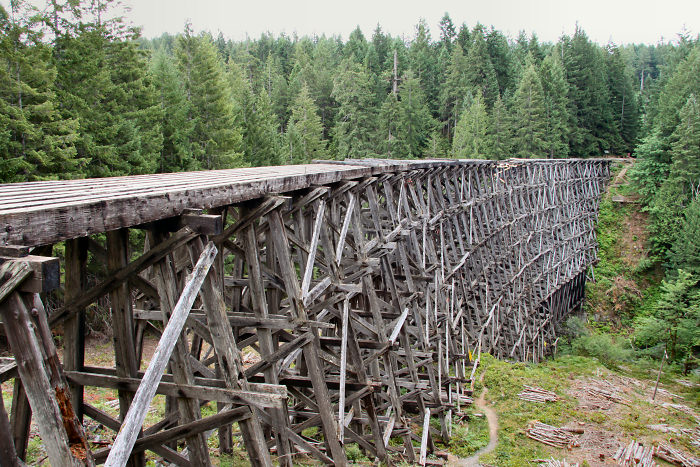
            The site had an abandoned, makeshift fire pit and empty cans of Coors Light scattered all around like eggs at an Easter hunt.  The fire pit had a few hay bales around it that someone or another had brought out in his pickup truck, and all this was at the base of the western hill.  From the top of that hill, the trestle bridge ran out straight to the eastern bank, at least 120 feet high in the center of
the bridge and about a quarter of a mile from one end to the other.  It looked rickety and ominous, like the oldest rollercoaster at the amusement park.

            “Call my number,” demanded Terri, as we started to climb the western hill.  “I ran this way, trying to get into the trees.” 

            We were nearly at the top when we heard the old Nokia ring.  Terri located it and wiped it off on her jeans.  “Good as new,” she pronounced.

            The three of us turned around and looked down the hill, then across the long stretch of tracks with the support frames branching out beneath them like Tim Burton’s grotesque version of gothic
giraffe legs or the Imperial walkers on planet Hoth.  “Let’s go across it,” said Terri, her eyes shining.

            “Oh gosh,” said Charlotte.  “Really?”

            “I’ve done it before,” said Terri.  “It’s really not that big of a deal.”

            “What if a train comes?” I asked.

            “That’s the point,” said Terri.  “It’s scary because you don’t know if a train could be coming just around the corner.  I mean, it probably won’t, but you don’t know that.  If a train comes, then you
have to run for it.”

            “Okay,” I said, and the words shocked me as they left my mouth.  I felt as if someone had bumped into me and I’d accidentally burped them out. 

            “Really?” asked Terri.

            “Yeah, really?” asked Charlotte.

            Now my stomach was reeling as I looked down the side of the hill we’d come up.  It was a long way down.  I moved over to the tracks and stood in the middle of them, facing the bridge.  It was so far across, and so terribly narrow.  I wondered briefly if we could somehow climb down the support beams if the worst came to the worst.  “Let’s just do it,” I said.  “Let’s get going.  It’s going to be fine.”

            And so we walked across the trestle then, a quarter mile from safety to safety, and the whole time we marched across those wooden slats, none of us spoke but Terri, who said, “Whoa,” in the
middle of the bridge, when she looked over the edge.  She said, “It’s actually worse in daylight,” and then we continued on, a silent march, ears tuned for any shrieking whistle just around the bend.  I felt bent over with tension, as if my shoulders were knotting up the way water boils in a pot.  My stomach felt hollow and greasy. 

            It’s nothing, I told myself.  Nothing is coming.   But it didn’t calm me. My heart beat like a steady roll on a snare.  It was one of the most terrible and memorable experiences of my young life, and my mind was ravaged with images of three bodies lying still in the rushes below.  Every step felt like sheer panic flowing up from my toes to my chest, rattling my heart then moving like a laser beam to my head, where I manufactured nightmares.

            And now, all these years later, this memory was like putting a finger on the pulse of that evening: absolute terror, only this time, there was no safety in sight.  Just the feel of walking on an endless, narrow railroad trestle, listening, straining for the sound of destruction on its way to meet me.