More Thoughts on Profanity [& how ERP therapy changed my writing]

profanityAs you may have read before, I have a strange and evolving relationship with profanity.  Having grown up in a home that outlawed even pseudo-swearing (we couldn’t say gosh or shut up, among other things) paired with growing up with a mental illness elicited in me a dreadful fear of curse words– more than was ever healthy, even for a child.  For many years, my intrusive thoughts centered around illicit words, which developed in me a deep sense of guilt.

In my ERP therapy, I had to learn to think those words, even say them.  In doing so, I was stealing back power from my OCD, putting it more and more under my heel.  It was during ERP and in the year that followed that I realized a couple things:

1) Words are just words.  That said, “just words” still pack as much power as a nuke.

2) You can harm with words that are not profanity– worse than with profanity, in some cases.  A hard-hitting insult or an insincere comment can sting far worse than the word shit.

3) Shit does not equal poop.  Ass does not equal butt.  Damn does not equal darn.  They just really, really don’t.  They are completely different words.  As a writer, it’s my job to choose the best word in every line I write.  Just the same way that valor and courage both mean bravery, but those two words are not the same word.  I have to select each word with extreme care.

4) The fearsome qualities one assigns to the dreaded f-bomb are terribly reduced when you’re forced to listen to it for 80 minutes a day (again, ERP).

5) In ERP, I learned to separate myself from my OCD.  I learned to assign my intrusive thoughts to my disorder, instead of to myself.  To say, “OCD wants me to think X.”  This view, I see, has carried over into my view of my characters.  Even though I am the author, if my character John or Paul or Suzie wants to say a curse word, I don’t feel guilty.  Characters have their own histories, their own choice of words.  (Maybe you think this is strange … passing off my responsibility to characters that I’ve created.  If you do, then you’re probably not a writer.  As a writer, I have far less control over my characters than you might ever imagine.)

6) I write realistic contemporaries.  A teenager who has grown up lawlessly is going to swear.  You know that’s true.

7) In my personal life, I refuse to let OCD enslave me again.  One way it did so was by a huge and unwarranted fear of profanity.  I damn well won’t let it take control of me in that way again.

8) Personally– again, this is just for me– profanity is a small way for me to ward off the legalism that used to bind me.

9) “Let nothing unwholesome come out your mouth”: I guess I have to admit that I don’t really find curse words terribly unwholesome anymore.  I’m finding a lot of it to be based on social constructs that I don’t value enough to hold to.  I find it far more unwholesome for me to open my mouth and speak lies or to tear my fellows down.

10) This quote from Maggie Stiefvater:

Occasionally a reader will tell me that I don’t need to use swearing. They will follow this up with this well-worn phrase “you have a good enough vocabulary that you don’t need to use THOSE words.” Yes, I do. I do indeed. Since I don’t need to use them, that means I’m choosing to use them. If you trust me to be using non-swear words in a skillful way, please assume that I’m wielding my fucks and damns with the same contemplation.

As should all of you other writers out there. They’re just words. Handle them with care.

So, those are my thoughts.  I’m not terribly interested in getting into a debate, but do feel free to share your thoughts in the comments!

See more of my thoughts on profanity here:
Profanity in Literature
Profanity

Image credit: found this all over the internet, couldn’t find original.
Reading from Truest

For my blog readers who are local to the Twin Cities, I’d love to invite you to an event next week where I’ll be reading excerpts from my forthcoming YA novel Truest.  Two talented Northwestern students will also be reading that night– Marie Pearson and Brienna Rossiter (who, coincidentally, was one of the Truest‘s beta-readers!).

The reading will be at 7 pm at the University of Northwestern on Tuesday, February 11th.

University of Northwestern
Nazareth Hall
Blue Room
3003 Snelling Ave N
St. Paul, MN 55113

It is just north of the Rosedale Mall, and there will be plenty of free parking!

Campus map can be found here.

Grieving the Reader’s Experience

Let me be clear on one thing: I love literature.  I really, really do.  That’s why I’m a writer!

But being a writer has also drastically changed my reading experience.

In the words of Billy Collins, “Readers read great work and feel appreciative.  Writers read great work and feel a burning jealousy.”

I know I’ve talked about this before, but I just wanted to share that– in some ways– I grieve the true reader’s experience.  It’s becoming more and more rare that I can just fully take in a great book with an open, generous heart.  There is this little flame of envy that licks all over my body, and while I think it’s a bit uncharitable, it also both reminds me that I’m a writer and fuels my writing.

Though I am terribly grateful that I’m a writer down to my bones, sometimes I do long for those golden moments of childhood when I could just embrace a book with nothing but love.  Don’t get me wrong, I still love books– with a deep, passionate, fiery love– but there is usually envy in that matchhead too.  Envy and analysis: how did the author do that?  Can I do that?  What if I were to …

Sometimes I miss it.  That’s all I wanted to say.

Había una vez... (Once upon a time) by Carolina Pratto

Había una vez… (Once upon a time) by Carolina Pratto

I Confess

confessI don’t want to admit this to you.  I really don’t.

But I’ve made such efforts to be honest with my blogging community, and the wonderful, encouraging reception I’ve always gotten from you, my beloved readers, has continually encouraged me to continue with that honesty and integrity.

So today I’m going to tell you something that might make you made at me.  Here it is:

Sometimes I get really frustrated with people with OCD. 

Five years of freedom and already I am so quick to frustration.  Shame on me, right?  Then again, the last five years of my life (post-ERP) have been so absolutely incredible that they make me even more frustrated with those who avoid treatment.

The truth of the matter is this: exposure and response prevention is the best and most appropriate treatment for OCD.  Quite simply, if you’re looking for a “solution” to your OCD, then I have it for you: ERP.  I hear from a lot of people who seem to want a different answer, and yet my bottom line remains the same: ERP, ERP, ERP.

I know it’s scary.  (Trust me, I know it’s scary!)  But it’s the right answer, and I’m not going to send you on a wild goose chase when I know the right answer.  That would be like me telling you to go get chemotherapy for your gunshot wound or that you need insulin for your broken arm.  It’s obvious that those aren’t the correct treatment for the issue, and I won’t do that to you.

Research shows that ERP is the best treatment for OCD.  My life shows that a person with obsessive-compulsive disorder can redeem the years he or she lost to being enslaved by OCD.  No matter how many times you ask me, I’m going to give the same answer.

There.  Got it off my chest.  Don’t worry, folks; I’m still here for ya!  I aim to be a voice advocating for our quiet and oppressed community.  But just how I refuse to aid someone in compulsions, I will also refuse to send you down the wrong corridor for help.  I’m doing this with the best interest of our community in mind, I promise.

My heart and energies and motivations rest in leading those in slavery toward freedom.  Know that.

Life after OCD Treatment

Someone on Quora asked:

How does your personality compare from before and after the treatment ? Do you feel you are not curious anymore ?  Do you feel you are now asking less questions than before ? Is there any reduction or improvement in cognitive performance ? What were the negative symptoms ?
You can read my answer here.
For more information about ERP, the #1 treatment for OCD, go to jackieleasommers.com/OCD.

Dear Diary (January 2014)

january ddToday is my spiritual birthday!  I made my commitment to Jesus Christ eighteen years ago!  (Does this make me an “adult” Christian now?  Can I vote?  I vote for grace.)

I rang in the new year with my best friend Erica and the cast of Downton Abbey.  As you may recall, one of the keys to my productivity is that I’ve effectively cut TV out of my life.  However, Eir decided to sabotage my life by forcing a Downton addiction on me, lol!

Photo credit: Ashley Thorman Top: Eir, Ash, Amanda Bottom: Jackie, Dora

Photo credit: Ashley Thorman
Top: Eir, Ash, Amanda
Bottom: Jackie, Dora

Early in the month, we in the Cities were blessed by a visit from Dora, one of our favorite out-of-town friends, so a crew of my favorite people all hung out together.  So lovely, although we missed Des!

Speaking of Des, I was able to get lunch with her on one occasion and coffee on another, and I can’t tell you how grateful I am that my former roomie and her husband live only two buildings down from me …

… especially because I had not one but two flat tires this month!  Yeah, seriously.  The one went out, and then one week later, another followed suit.  The first time around, I handled it well.  I’m fairly independent.  I called AAA, and I took it to Tires Plus, and I shelled out the three bills it took to get two new tires and an alignment.  But when it happened again a week later, I have to admit, I cried.  I so desperately wanted to not be a grown-up in that moment.  My delightful parents came to Minneapolis that weekend and rescued my car, dealt with it all for me.  I felt a little like a baby, and it. felt. great.  Des’s husband Matt drove me to and from work for a couple days.  (Thanks, Matt!)

Then my heater quit working the following week.  Did I mention that it’s been dangerously cold in Minnesota?  We’re talking 60 below wind chill.  So … I am really thinking that my book advance might need to go toward a new car.

My book showed up on Goodreads!

Photo credit: Ashley Thorman
Me, Eir, Des

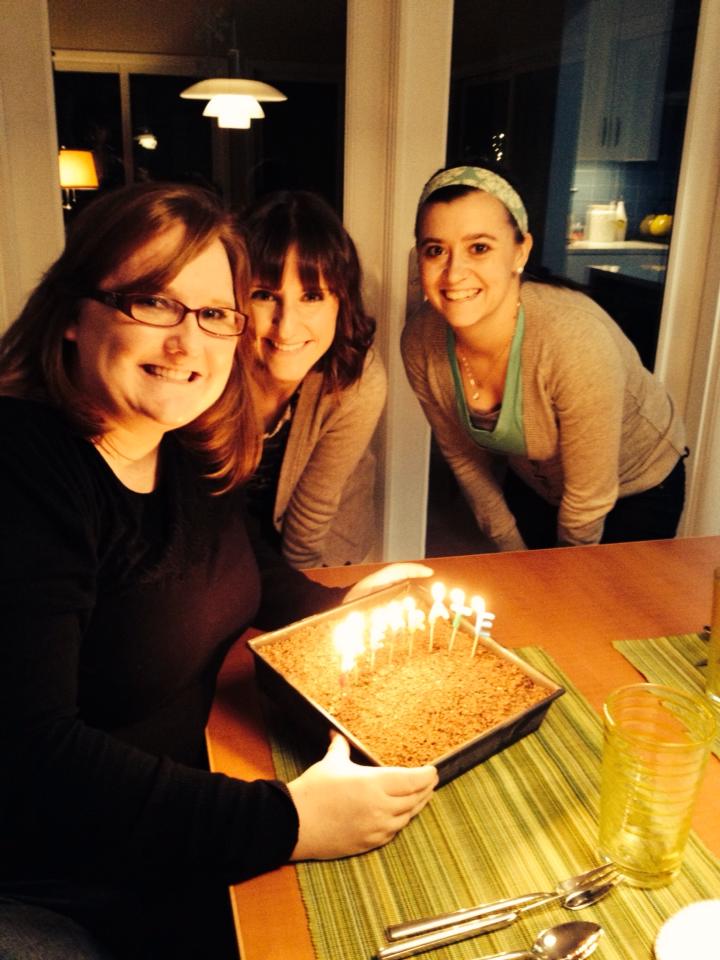
I celebrated my birthday with some of my favorite girls!  Eir made dinner for me, Des, and Ashley.

As for the next novel, it’s coming along quite well!  (I know I was just complaining about anxiety, but the writing is [mostly] faring well.)  I’ve met some friends on Twitter who use the hashtag #wewrotetoday to help encourage one another and keep each other accountable.  I’m loving it!

Writing a novel means that you have to do a BOATLOAD of research (and sometimes it’s all for just a small detail that most readers aren’t even going to notice).  Lately I’ve had to research woodworking, crown moulding, various sounds, and incomplete spinal cord injuries.  Unlike a non-fiction writer, the novelist can (sometimes) get away with not becoming an actual expert in the various areas.  We do this through skillful (and maybe manipulative) omission of facts, by insinuations, and by using vagueness to our benefits.  I’ll be honest though: sometimes it doesn’t work.  I do my very, very best.

One more exciting thing: I finally saw my contract.  I’m thrilled.  I’ll be signing any day now (once my agent irons out a couple wording issues!).

So that’s my January!  I’m really excited for February, because I’m participating in a reading on Tuesday, February 11th, at the University of Northwestern — St. Paul.  I’ll be reading excerpts from Truest and (I think) doing a Q & A afterward.  If you’re in the Twin Cities, you should come!  (More details soon!)

Writing a Novel in Layers

For me, layer one is dialogue/characters.  My first draft is almost entirely just a series of conversations.  This helps me get to know my characters, what they want, what they believe, how they feel about each other and the world.

After that, I’ll need to go through and make sure that the plot works, that all events naturally flow into one another and are connected the right way.  I’ll have some beta-readers take a look and they’ll point out big plot holes, inconsistencies, gaps in action, times when what my characters do seems highly unlikely.  I’ll re-write again and get the series of events in order.

Next, I need to work on the setting.  I am very negligent in the description department, so I have to take a pass at the novel focusing entirely on this area.  With my last book, I wrote “SEE TASTE HEAR TOUCH SMELL” at the top of a page and went through the story scene by scene, writing down what I would “SEE TASTE HEAR TOUCH SMELL” in each one.  Then I went back through the novel and grafted those descriptions in– seamlessly, I hope!

Finally, language.  I take a fine-tooth comb and crawl through the manuscript looking for opportunities to use better words (note: better— that doesn’t mean longer, stranger, fancier) and images.

layers math

Other writers do it differently– and that’s perfectly fine.  In order to not overwhelm myself, I essentially need to focus on one specific item at each “pass.”  That said, if I do find other things to change, I change them as I go.  So, really, more is happening than just the one concentration, but that one thing is at the forefront of my mind.

I’d love to hear from other writers!  What’s your crafting process look like?  Do you focus on one area at a time or do you revise in another way?  

Reviews: 4 Books of Poetry

I have been trying to incorporate more poetry into my life, so as to let it infiltrate my writing.  (Did you know I focused on poetry– and not fiction– in college?)  Here’s what I’ve been reading:

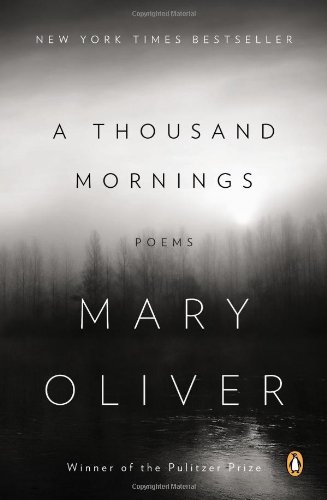
poetry1A Thousand Mornings by Mary Oliver

A lovely collection of very Oliver-esque poems, focusing often on nature and setting.  Easy to access; beautiful, spare language.  Smacks of loneliness in a achingly pleasant way.  My favorite collection of hers still remains Thirst.

poetry2Tickets for a Prayer Wheel by Annie Dillard

So fascinating to dive into this book right after the clear, accessible poetry of Mary Oliver.  Dillard’s poems are deep, complicated, long, confusing, unavailable– and lovely.  I often feel this way when I’m reading her prose too: as if it is a fire; that is, I’m not certain of what is going on, but I want to move in closer anyway.  The breadth of her vocabulary is astonishing, and these poems stretched my mind in the best way possible.

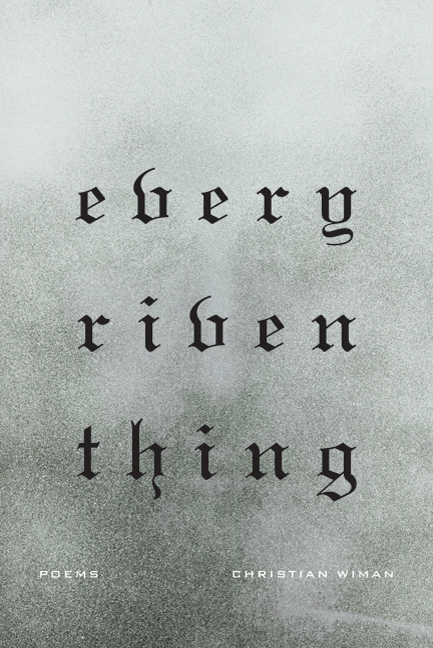
poetry3Every Riven Thing by Christian Wiman

There is an urgency to these poems, and no wonder: Wiman has a rare, incurable form of cancer.  With a toe over the cusp of eternity, Wiman dives into deep and fascinating concepts.  He talks about spirituality without ever declining into sentimentality.  Incredible collection.

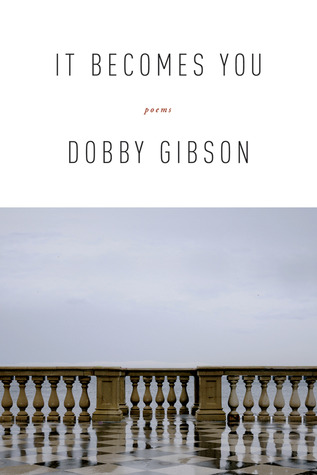
dobbyIt Becomes You by Dobby Gibson

I was blown away by Gibson’s thought-provoking poetry.  He has a very contemporary, Billy Collins-esque feel to his work, though perhaps grittier.  I felt like every poem stirred questions in my heart.  Loved this collection so much that I immediately purchased his other two– Polar and Skirmish.

P.S. It appears that I am prejudiced against books that do not have gray covers, but it’s not true.  I have room in my heart (and collection) for covers of all colors.  Except maybe hot pink.