25 Steps to Revisions for Writers with Anxiety Disorders

revisions with anxiety.png

  1. Get critique letter or email. DO NOT OPEN. DO NOT READ.
  2. Wait until you are in your safe place.
  3. Apply essential oils.
  4. Pray, if you pray.
  5. Decide to take a nap instead, just in case this is the last time you are able to find peace.
  6. Oversleep.
  7. Read editorial letter.
  8. Go back to sleep. DO NOT THINK ABOUT THE LETTER. DO NOT EMAIL EDITOR IMMEDIATELY.
  9. The next day, email editor to say thank you and acknowledge receipt of editorial letter. Ask for a few days to process things.
  10. Do not actually process things. Probably best to continue avoidance tactics at this point.
  11. When avoidance time runs out, go back to safe place.
  12. Apply essential oils.
  13. Pray, if you pray.
  14. Re-read editorial letter.
  15. Boil letter down into themes.
  16. Journal about each theme. Make a list of questions.
  17. Finally reply to editor.
  18. Repeat steps 1-8 with editor’s reply.
  19. Ask for time to process again.
  20. Do not actually process.
  21. Stay busy. Let the revision requests exist in the back of your mind while you let the sting and fear subside.
  22. Optional: take Ativan or similar prescription drug. Not optional: take nap.
  23. Depending on deadline, keep revision requests at the back of your mind until they begin to tiptoe toward the front.
  24. When they have stealthily made their way to the front of your brain AND you feel excited, return to safe place to make a plan.
  25. Revise.

If you have a question …

and would like to ask me … you can do that now.

If you’re on my actual website (www.jackieleasommers.com), just click the blue doors in the sidebar that subtly read ASK ME ANYTHING.

Otherwise you can always click here too.

It’s anonymous or not, up to you.

Why did I add this?

  1. NOT because I’m some sort of guru.
  2. But people do have lots of questions about OCD and writing and faith and stuff, and they often email me. Especially about OCD.
  3. That can be a little overwhelming, and I’d prefer a more public platform to respond.
  4. This.
  5. Also, this way we all learn together. (P.S. I can totally do the dance below.) (No joke.)

Thanks, Wildcats! I hope you’ll use this! It will really help me know what readers want to hear about! 🙂

A Better Question

Did I ever share this article with you guys? It’s important.

Instead of asking, “What do I want?” ask, “What is worth struggling for?”

I hope you’ll read this and share your thoughts.

It begins:

Everybody wants what feels good. Everyone wants to live a carefree, happy and easy life, to fall in love and have amazing sex and relationships, to look perfect and make money and be popular and well-respected and admired and a total baller to the point that people part like the Red Sea when you walk into the room.

Everyone would like that—it’s easy to like that.

If I ask you, “What do you want out of life?” and you say something like, “I want to be happy and have a great family and a job I like,” it’s so ubiquitous that it doesn’t even mean anything.

A more interesting question, a question that perhaps you’ve never considered before, is what pain do you want in your life? What are you willing to struggle for? Because that seems to be a greater determinant of how our lives turn out.

Click here to read the rest.

Processed with VSCOcam with x4 preset

Perfectionism & Writing [& OCD Too]

messyYou’d think being a perfectionist would be beneficial for an artist, but I really don’t think that’s true.

(Neither, apparently, does Google: search “artists are perfectionists” and you’ll get the following:


For me, being a perfectionist means that writing a book can be a slow form of torture. You see, it takes a long time for a book to even begin to resemble perfection. You have to spend months, even years, sitting uncomfortably in the middle of a mess, working through sloppy drafts and chasing rabbit trails into very disorganized forests.

Or maybe that’s just me.

In any case, it’s a continual lesson in learning to enjoy the process and not just the product. If I only enjoy the product, I will get to be happy about 24 hours out of every three years. This is a journey of embracing uncertainty, letting myself wait in the cold water till I begin to adjust.

And that’s the story of my life with OCD too. Heck, the story of my life, period.

I– a perfectionist, an OCD survivor– want pretty things in pretty boxes with pretty bows on top. I– an artist, an OCD survivor– know that’s not what life looks like. Life is full of doubt and wrong directions, wasted time and imperfect choices. Life is full of discomfort and years and years and years of tolerating discomfort … with the hope there is a pretty thing in a pretty box with a pretty bow at the end. But it is not guaranteed.

So, is art in general– or writing specifically– a difficult career choice for a perfectionist? Heck yes. But it’s fulfilling, worthwhile, hard, dirty, beautiful work– and it is helping me appreciate this fulfilling, worthwhile, hard, dirty, beautiful world.


Love Your Work and … It’s Still Work

“Love what you do, and you’ll never work a day in your life.”

Lovely sentiment. But it’s a lie.

If you love what you do for work, it sure makes it more meaningful and enjoyable … but it doesn’t change that it is still work.

This is as true in art as it is in any field.

I am so overwhelmed with gratitude that I get to write, and that I even get paid to do it. And I know some people will negate what I say next by claiming writing is privileged work. Maybe it is. I don’t know. Maybe it is just for some people and not for others. I certainly don’t mean to whine or complain.

I merely want to say that art is hard work. So hard. Harder than any job I’ve ever had, scarier than any job I’ve ever had, emotionally draining unlike any other relationship in my life. Sometimes it feels impossible. Sometimes it feels like it might kill me. Art has sent me into therapy, required medication. Nothing in my world has thrown more resistance at me than art, my own art.

I’ve just needed to toss these thoughts out into the universe for a little while, and so now, tonight, I am. Thanks for listening. Thanks for trying to understand, even if it sounds silly to you. Now, tell me about you. What part of your life throws the most resistance at you, friend?

unsplash66


So, you want to be a writer?

I got these great questions from a reader/Twitter pal/friend for her school project, and I thought people might have some interest in reading the responses. Just in case, I’m pasting them below!

1. What do you like most about your job and why?

Hearing from readers who were impacted by what I’ve written is always a highlight. It’s one of the main reasons why I write– in the hope that my stories will resonate with readers and make them think. It’s also fun when you get into a great writing groove and hours fly by like seconds. It’s so satisfying to enjoy what you’ve written.

2. What do you like least about your job and why? (Maybe revising? 😛 It’s not very fun!)

The middle part of writing a novel is probably the hardest part. The beginning is fun because you’re charging toward an idea, and the final touches are great too because you’re perfecting everything. But when you’re in the middle, it’s too early to see the finish line– plus, you’re too far past the starting line to easily change course. I can get a little crazy and sad during the middle of writing a novel– for me this is usually drafts two and three.

3. How did you decide to get into the writing field and how did you enter the field? What alternative ways could someone enter the writing field?

I’ve been a storyteller since I could speak and a writer since I learned my letters. I wrote all through junior high and high school, then studied writing in college.

There is no specific requirement to being a writer except to write well. Some people can do that without extensive training. For me, I studied creative writing as an undergraduate student, where I focused mostly on poetry. After college, I took a little break from writing before diving in to writing my first (unpublished) novel. The vast majority of stories about how people got published are the same: write a great book, write a great query letter, secure an agent, and let the agent secure a book deal. I have writer friends who never finished high school, and I have writer friends who have an MFA in writing, so there’s a wide range. It’s critical to spend lots of time reading incredible literature; this is an education in itself!

4. What training would you recommend for someone who wanted to enter this field now? What skills and background are needed to get into this field now?

As I mentioned above, there is no specific education necessary, although many find a college degree in writing very helpful (at least I did!). It helps to be an avid reader and someone with a great imagination. The writers I know are fascinating people who are usually fascinated by the world.

5. What is the salary range for a person in this field? Entry level to top salary? (I know that’s kind of a funky question, particularly for authors!)

When an author gets published traditionally, he or she is given an advance, which is a sum of money paid to the writer from the publisher upfront. The author then tries to “earn out the advance” in royalty sales; after earning out, all the royalties (minus the literary agent’s cut) go to the writer. Advances have an incredible range. One author might get a $5000 advance. One might get $2 million.

6. What personal qualities do you feel are most important in your work and why?

Since I identified as a poet before identifying as a young adult author, it’s really important to me to have great imagery and strong diction in my stories. Characters are of the utmost importance to me, as they are for many or most writers. I find that writers who write contemporary stories sometimes especially rely on characters, since our books have to build their own “magic,” as opposed to, say, a fantasy novel which might have “real” magic in it. Not to discount characterization for ANY writer. It is, in my opinion, the most important part of any great story.

The other things that I like in books (and try to include in mine) are opportunities to learn and encouragement to think.

7. What are the tasks you do in a typical workday? Would you describe them?

I work a day job (as most young writers do) from 8 to 4:30; then I go home, eat dinner and relax a little bit before I retreat into my home office to write. Some days this looks like generating material; some days this looks like revision; some days this is research; some days this is plotting. There are so many parts of writing a book that are not actually writing. Research takes up a lot of my time. My current work in progress takes place on an island; I spent a whole evening researching boats in the Pacific Northwest just so that I could write one convincing paragraph! But it’s worth it. Details matter! I will usually write from about 7-9 pm, although if things are going well, I will keep working till 10, 11, or midnight. I try to get 7-8 hours of sleep or else I screw everything else up. I also keep a process journal while I write too, in which I brainstorm, sketch ideas, plot, and the like.

8. What types of stress do you experience on the job?

EVERY KIND OF STRESS. Will my agent like this? Will my editor like this? Do I like this? Will it sell? Will I make money? Will I earn out my advance? How do I make sure this character changes enough by the end of the book? Will this story matter to people? AM I A FRAUD??

Plus, there’s a fair amount of public speaking, but I don’t mind that. I know a lot of people do though!!

9. What types of people survive and do well in the writing field?

People who persist. I’m not even joking. Many of the writers you know and love and whose books are on your shelves often wrote another book or two that didn’t get published before one finally did. It’s hard to pour yourself into a project for four or five years, only to have it not get an agent … then to turn around and just start a new project. Writers hear a lot of NOs before that one YES changes things.

This also applies to the writing itself. I use the phrase “show up,” and by that, I mean the actual hours of work put into a project. It’s so easy to get overwhelmed by a project the size of a novel, and sometimes that fear is crippling. But showing up every day– putting in an hour or two or five of real work– keeps you moving toward your goal. You have to show up and persist in order to succeed at writing.

10. Are resumes important in getting a job? (or I guess query letters? :P)

The query letter is the key to getting a literary agent, and the literary agent is the key to getting a book deal. Query letters are, for novelists, a whole different type of writing. You spend years with a creative hat on, then need to put on a business/marketing hat to write the letter. A good query will only go so far though– the manuscript has to also be solid!

11. What are the opportunities for promotion? (another weird question for a writer, but it was in the book)

This looks different for different writers. “Moving up” might mean selling more books– or getting a higher advance– or going on a book tour– or having your book be optioned for a movie. Every writer has their own idea of personal success. Making the New York Times bestseller list. Getting starred reviews. Being a keynote speaker at a conference. It all depends.

12. Is the field of writing expanding or taking new directions?

I see writers taking tremendous creative risks lately, and I love it. Plus, there is the whole avenue of self-publishing, which is open to anyone now with things like Kindle Direct Publishing. Trends are constantly changing in the world of novels– best not to hop on trends: they will be long over before your book makes it to print.

13. What related occupations could I research?

Being a literary agent or an editor (for a publishing house or freelance. Copyediting. Public relations. Creative writing instructor. On the other side of the spectrum, technical writing. As I mentioned, most new writers work a “day job” in addition to their writing. If you have a degree in English, you have a lot of options you can go; such a degree teaches you to communicate well and think critically, and every employer wants that!

14. Is there anything else about being a writer that would be helpful for me to know?

It is a roller coaster of emotions. It can be a tough field for perfectionists or people who have anxiety. (But not impossible— I have both!) It’s tremendously rewarding. You spend a lot of time alone, more than you might guess. You have to be okay with things being icky and uncertain for long periods of time– but draft after draft after draft, it all comes together.

Dear Diary: Thoughts from the Couch

A photo by Amaan Hai. unsplash.com/photos/nqz4WOGDo4AHi folks! I’m typing on my laptop keyboard, something I haven’t done in a while, since I use an ergo keyboard at home and at work. Unfortunately, my home office desk chair is broken, and while I thought I could make due with another chair, it’s murder on my back. So instead I’m sitting on my couch with my laptop, how and where I wrote Truest.

I can’t believe my baby has been in the world for over a year now. It’s also crazy to think that I’ve written two other manuscripts since finishing Truest! My broken chair and my work schedule have put a kink in my writing rhythm as of late, but these things happen. Life goes on.

I’m feeling especially share-y tonight, so maybe I’ll just address a few things below. Skip anything you’re not interested in.


Wrist Issues

I’m reading a book called Pain Free at Your PC by Pete Egoscue, and he addresses how hand/wrist pain can’t be blamed only on the hands and wrists. The exercises I’m doing are actually more related to the hips and have made me think I need to ask my chiropractor to measure my legs and see if they are still different lengths like they were in elementary and high school. At first my left leg was just 1/4″ shorter than my right, but they assumed it would correct itself. However, when I was next tested for scoliosis, my left leg was now 1/2″ shorter than my right. To be honest, I’d forgotten about this, since the only time it was ever really noticeable was after a full day of intense walking (like a day at an amusement park, for example). But reading this book has made me wonder if this might be the root of some of my injuries.

Salt Novel

My gosh, I’m so close to finishing this draft, you guys. But I think that is sort of freaking me out and I’m self-sabotaging a little bit, scared to show it to my agent and editor, knowing that it is still very flawed. I need to find the time and drive to just hammer through it and turn it in. The sooner I get feedback on it, the sooner I can correct those issues. I went through a brief time in my life (post-undergrad) where critique didn’t faze me. I realize now that that was because the critique was all from peers at that time, whereas before that it was from professors and after that from publishing industry professionals. There is for sure a power imbalance (perceived or real) that affects that. Also, I’ve realized that I need to take into account the culture differences too. The difference between Minneapolis and New York City is far more than just 1,200 miles.

Sleep

I sleep with no sleep aid now. I’m so, so, so grateful to not have to rely on anything but good ol’ Circadian rhythm to sleep.

Reading

Halfway through Leigh Bardugo’s Crooked Kingdom right now. Next up will likely be David Arnold’s Kids of Appetite, although Jennifer Nivens’s Holding Up the Universe just came in the mail this weekend! I also have a book by Cheryl Klein that I really want to start, The Magic Words. It’s about writing for children and young adults.

Election

I can’t wait for it to be over. Seriously, what a mess. I consider myself an advocate for the marginalized and will vote with that in mind.

Adulting

I paid to have my home deep-cleaned this weekend. I recognize that is a privileged statement, and I’m grateful to have the means to do so. Honestly, it felt like something that needed to happen in order for me to move forward with so many of my other goals. Next weekend, I have a handy man coming to the house to fix up odds and ends and my desk chair, and then I’ll truly be poised for success.

Northwestern

I honestly feel so grateful to be part of such a beautiful community. Right now I am especially loving the current writing majors and recent writing grads. It’s such an honor to be part of their lives. They are so talented, thoughtful, generous. They care so much about words and story and beauty, and they make me better person.

Your turn: a) What have you read recently? b) What are you looking forward to this week? c) What thing or person has added value to your life lately?

Resistance: The War of Art

war-of-art4I had in the past attempted to read Steven Pressfield’s The War of Art: Break Through the Blocks and Win Your Inner Creative Battles, but I’d been waylaid, I think due to the way he talks about mental illness in the book.
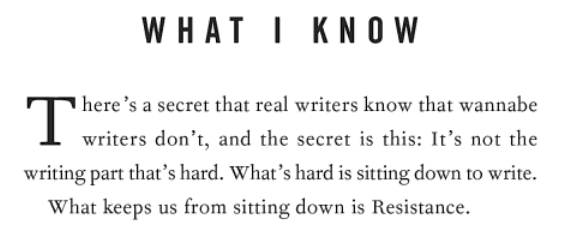
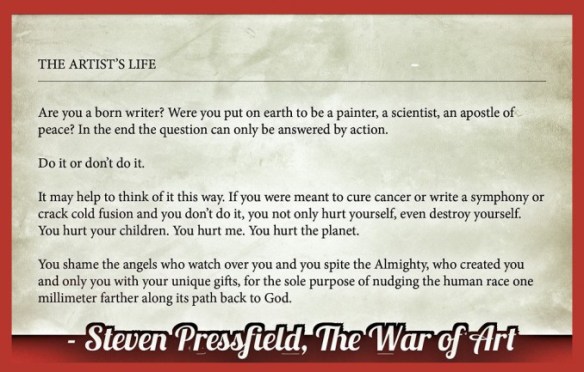
But this time I pressed through, and I really enjoyed it! I listened to the audio book on a long trip for work, and it only took about three hours from beginning to end. I probably could have read it even faster with the book in my hand.

The War of Art is about Resistance. It’s about anything that stops us from getting our creative work done– and about how to overcome it. Pressfield makes an extensive list of things that play into resistance: procrastination, of course, but also sex, trouble, drama, victimhood, self-doubt, fear, criticism, love, stardom. He’s not afraid to add things to the list that you and I would rather keep off it. This was pretty eye-opening for me.

war-of-art

In the second part of the book, he talks about “becoming a pro”– how to overcome Resistance. To be a professional, we need to show up, be prepared, be patient, ask for help, accept no excuses, among other things.

A quick excerpt:

In my younger days dodging the draft, I somehow wound up in the Marine Corps. There’s a myth that Marine training turns baby-faced recruits into bloodthirsty killers. Trust me, the Marine Crops is not that efficient. What it does teach, however, is a lot more useful.

The Marine Corps teaches you how to be miserable.

This is invaluable for an artist.

Wow. Pressfield goes on to say:

The artist committing himself to his calling has volunteered for hell, whether he knows it or not. He will be dining for the duration on a diet of isolation, rejection, self-doubt, despair, ridicule, contempt, and humiliation.

Tell us how you really feel, Steven. 😉

But, honestly, this resonated with me. Writing is a mix of joy and misery; publication too. But what am I supposed to do? Ignore my calling? No. I need to become a pro.

war-of-art3

In the last part of his book, Pressfield talks about muses and angels– he takes the book to a whole other plane, reflecting on how the artist isn’t really in charge anyway. I’m sure he loses a lot of readers here, but not this girl. As a person of faith, I already believe something similar.

All told, this was a fast read and well worth it. In the days since finishing it, I’ve been able to recognize areas of Resistance in my life and to deal with them accordingly. Great, thoughtful book.

Beyond Writer’s Cramp: Any Ideas?

In most regards, it’s been an incredible weekend: I got to see my dear friend Cindy (to whom Truest is dedicated) and meet her adorable baby boy; I’ve gotten lots of rest; I’ve written a lot, chapters I feel really, really good about.

But there’s one area that’s been brutal. I am still battling overuse of my hands, wrists, arms, and elbows. It was perhaps the worst it’s ever been this weekend, and that’s saying a lot. I was sincerely considering going to the ER.wrist InjuryA brief history:

It’s hard to remember when it started, but I’ve had bad wrists for something like a decade now. At one point, I couldn’t open a car door or hold a book with one hand. I can’t do certain things anymore, even just for a short time, like bowling with coworkers or helping a friend paint her house. I can’t carry a lunch tray without both hands. I stare in awe at restaurant servers. I might go a month with little to no pain, only to have one or both wrists completely flare up.

Measures I’ve already taken:

  1. I see a chiropractor and a massage therapist.
  2. I was diagnosed with overuse– not arthritis, carpal tunnel, tendonitis, etc. Just overuse.
  3. I was formerly in occupational therapy with a hand specialist until she broke up with me because I couldn’t afford to go weekly.
  4. I do stretches.
  5. I ice.
  6. I take Ibuprofen/Advil/Aleve.
  7. I use Biofreeze.
  8. I have an entirely ergonomic set-up, both at home and at work.
  9. I don’t write for (what I consider) unreasonable amounts of time, maybe 2-3 hours a night, although I am at a computer for my day job too.

The one measure I can’t take:

  1. Using dictation software to write. Please believe me when I say that I have thoroughly investigated Dragon, read reviews from other authors who have used it, and I also know my own methods well enough to understand that this is not a viable option for me.

That said, does anyone have any other ideas? I’m a little desperate here. After all my efforts, sometimes it just feels like it’s getting worse and worse. I was in so much pain this weekend that I was making noises like a wounded animal. This writer needs some solutions.

Six Parts of Writing a Book that Aren’t Actually Writing

There is so much more to writing a book than just writing a book. I’ve been thinking about that a lot lately and thought I’d write up a few thoughts about it. Note that this is my experience; every writer has his or her own methods!

writing3Research. 

When I was younger, I thought, “I’ll never write historical novels; that way, I won’t have to do research.” HA. I think any well-thought-out piece of writing requires so much research, and not always the kind you might imagine. I’ve spent countless hours researching things that my characters are interested in, just so that I can have my characters talk about them with convincing acuity. When those things are above my head (i.e. the quantum mechanics in Yes Novel), I have to still find a way to write just enough to convince the audience I know more. (Then I had to have my physics Ph.D friend read those scenes to make sure I didn’t say anything absolutely wrong.)

Speaking of bringing in friends, I do this all the time. My Facebook friends usually assume that any random question that comes from left field is usually book research. Sometimes I will spend hours just finding the name of a color or how to build a table or how to translate one sentence of Portuguese. I remember taking so long just to find the name for the “blanket” used during X-rays: a lead apron. That sentence wasn’t about X-rays either; it was about how depression presses weighs on a person. I spent all night researching boats for a paragraph in Salt Novel. And if I get the details right, the reader probably won’t notice– it will flow smoothly instead of tripping someone up!

Brainstorming.

For me, this usually looks like conversations, either prayer or otherwise. I get out either my prayer journal or my process journal and start asking questions, thinking, waiting for answers. Sometimes I tell my friends, “I have a problem to solve. I need this square peg to fit into a round hole,” and we go back and forth until we make it work. Sometimes this takes a long time and means headaches and tears. But I don’t do it alone.

Listening.

I’m not sure if that’s entirely the right word. But with the exception of when I’m sleeping (although not always– sometimes I think about my novel while I dream!), I am always on alert for ideas, solutions, objections. My co-worker said, “Can I still rent a vehicle if I’m not 25 yet?” and my first thought wasn’t how to help her but, “Oh crap, I have a 19-year-old renting a car in my manuscript. FIX.” Anything funny or beautiful or interesting– all my experiences, in fact– pass through the novel-sieve: is this something I can use for the story?

Timeline.

I spent the entire evening earlier this week nailing down the timeline of my story. For me, I find it easiest to use an actual calendar and to fill in the days with the names of scenes. Timeline matters especially if there is a “time bomb” in the novel or if there is some process (pregnancy, an academic year, etc.) that has to follow certain general guidelines. It also keeps me from bypassing important holidays. And the weather has to be right for that time of year (see above: research). And if there is a love story, I want to make sure that it’s reasonable. I don’t want my characters falling in love in just three days.

Strategy.

This is something I am learning. With my first novel (Lights All Around, unpublished), I had no strategy. I barely even considered the most basic constructs of a novel: action, climax, resolution, and the like, let alone thought strategically about how the characters were changing from beginning to end. I did that so much more with Truest, and now it’s becoming a built-in part of my writing life. I find myself thinking things like, “If I want M to relax and C to become more assertive, then I should have a scene where C takes control and M follows suit.” That probably seems like a no-brainer, but for this writer, it took about three decades to get there. Now I think, “If I want X to be especially impactful, then I need to set it up by making Y more extreme. How can I do that?” (See above: brainstorming.)

Reading. 

When I am writing, I like to stay deep in the waters of great fiction. I have re-read a handful of books that inspire Salt Novel over and over again. I enjoy the story, but I also examine it. Why did that work? How did the author make me feel that way? Why did I change my mind about that character? If I am trying to create a river, it helps to stand in one. 

There are other things too, like outlining, marketing (eventually), and finding connections between themes (my favorite!). It’s a lot of work, but soooo rewarding! How blessed am I to get to do this with my life?

Off to write now– actually write!