Win-Win-Win?

My big question as of late was this:

How do I honor God, myself, and my agent when we seem to want different things?

A little backstory: my novel has significant religious themes, ones that are important to me.  (Like, the-core-of-who-I-am important.)  My agent thought it all needed to be toned down in order to sell.  At first, I thought I was going to refuse.  I really did.  I didn’t even look at my manuscript for over a week.

Then, one night, I had an epiphany.  I had thought epiphanies were accompanied by a choir of angels or a visible light bulb illuminated over one’s head, but it turns out that they can be just as quiet as a word crawling into your mind while you try to sleep and making a nest for itself there.

The word was parables.

In scripture, Christ told stories all the time.  Parables.  Lots of people believe that parables were intended to make things easier for people to understand, but that’s not actually what the Bible says.  Essentially, scripture says that parables were meant for some to see … and some to not.

I wondered, Can I bury these truths so deep in my story that those who want to see them will see them– and those who don’t want to won’t?

It seemed like the one and only way to satisfy my agent while also honoring the story I wanted to tell.  It also seemed terrifically difficult.  Shooting for such a minuscule target.  I knew I wasn’t good enough writer to do these edits without help.

So I prayed.  A lot.  And spent time in scripture.  A lot.  And wrote an okay new first draft, a better second draft, third …, showed it to my writing group, wrote another draft or so, and after two weeks of attempting to create a parable, I sent my revisions off to my agent.

Heard from him today.  Thumbs up.

He’s going to send the manuscript out to editors on Monday.

win win

 P.S. If you’re a person who prays, would you pray for my manuscript to find favor with an editor?  I’m sooooooo nervous!

Over at The Redeeming Things

Today, I am blogging over at The Redeeming Things, the blog of Trinity City Church, where I am blessed to worship and fellowship here in the Twin Cities.  I’m blogging about the intersection of my faith and my mental illness.

Here’s the beginning:

RedeemingThingsJLSLast week, while listening to an audiobook by Anne Lamott, she mentioned a line she tries to live by: “And may the free make others free.”

I had to rewind a few seconds and listen to it over again. And again, amazed at the stark and beautiful way these few words summarize the last four years of my life.

I have obsessive-compulsive disorder, an anxiety disorder that preyed on all I most value: faith, friendships, vocation. Forget all media has ever taught you about OCD—it is not a funny, quirky, bothersome nuisance. Instead, it is a hellish, tormenting thief and tyrant. It caused me to question whether God was real, if he loved me, if I loved him, if I was going to hell, if writing fiction was sinful, if people were demons, if real life was real life– but not in the normal way that all or most people question such things. With “normal” minds, thoughts come and go freely, but with OCD, the gate is broken, and the thoughts get trapped inside the head, never making progress or finding resolution. Without the resolution, an obsessive-compulsive becomes lodged in a perpetual state of panic and terror. OCD is slavery, and I was in bondage to it for over twenty years. I was a tormented pot that complained to the Potter, “Why-why-why did you make me this way?”

To read the rest, jump on over here.
photo credit: izarbeltza via photopin cc

Writing is HARD … but worth it. (I think.)

nobody saidNo, no, I don’t think it– I know it.  I’m just coming off of a long weekend chock full of revisions.  The hardest revisions of my life.

I mean, I’ll be honest, I got down on my face before God about these revisions.

Here’s the thing.  One of my #1 goals in writing is to make people think.  I’m not setting out to write a little beach read about which boy is the cutest one on the island.  (No offense to anyone writing a book with that premise.)  I want to write about ideas and history, about philosophy and religion and paradigms for understanding the world.  For teens.

The thing with that kind of book is that it’s hard to write.  Your brain churns like a waterwheel, and you have to process these ideas that you’re setting forth.  My goodness, I’m writing for young adults, so I feel this responsibility to present them with valid questions (and sometimes answers, although the questions are often more interesting).  When I write a pivotal scene and send it off to beta-readers, the response isn’t just, “I like it” or “Use more imagery” or “Better word choices please.”  Sometimes the feedback launches me into a re-evaluation of my worldview and the framework through which I see the world.

Makes revisions go a lot slower.

The thing is, I love productivity, so I want to revise quickly and efficiently, but sometimes that’s just not possible.

I am so grateful for amazing friends who are also fascinated by ideas and willing to process them with me.  Right now I’m thinking especially of Kristin Luehr and Cindy Hunt.  Thanks, ladies, for loving the questions and, each in your own way, embracing the incredible gray areas while believing that black and white also exist.

I and my book are indebted to you.

My Favorite Verses

Random 5 Friday is a weekly meme over at A Rural Journal.

Today I’d like to share with you my favorite Scripture verses!

1. “And this is eternal life, that they know you the only true God, and Jesus Christ whom you have sent.” (John 17:3, ESV)
I love how well this defines eternal life: knowing Christ is the ultimate reward!

2.”For freedom Christ has set us free; stand firm therefore, and do not submit again to a yoke of slavery.” (Galatians 5:1, ESV)
This verse reminds me of just how much freedom and joy Christ has won for me.

3. “When my anxious thoughts multiply within me, Your consolations delight my soul.” (Psalm 94:19, NASB)
Love this verse as someone who suffers from an anxiety disorder!

4. “And this is the testimony: God has given us eternal life, and this life is in his Son. 12 Whoever has the Son has life; whoever does not have the Son of God does not have life.” (1 John 5:11-12, NIV)
Spelling it out.

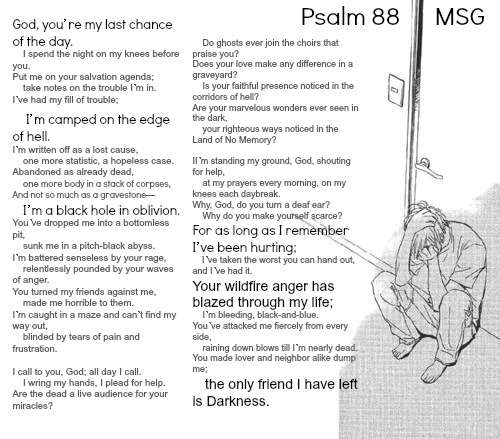
5. Psalm 88, MSG
These verses put my deepest heart sorrows into words.  Even though the psalm is a devastating one, it was good to find myself in the pages of the Word.  I’m glad I don’t feel this same pain anymore!
psalm88


Christian Culture’s (Sad) Response to Mental Illness

It’s in the Title: Mental Illness is an Illness

Salads and sandwiches and a shared mental illness, all of it on the tiny table between us.

“There is help for OCD,” I told her.  “The most effective treatment is cognitive-behavioral therapy.  Between that and my medication, I got my life back.  I know you can too.”  (The evangelical zeal I have for this particular therapy reminds me of the way I love Jesus: both took me from darkness into light, both make me want to throw parades in their honor.)

“Oh, I don’t know,” said my friend, poking at her salad with a fork, sounding hesitant.  “I think before I take any extreme methods, I want to just pray about it more.  I know that God can bring me through this.”

I wanted to say, But you have been praying about this for years!  I also believe God can bring you through this—and I am telling you how.

There is a pervasive and unhealthy attitude in the Christian culture toward mental illness.  Many believe that one should be able to “pray away” a disorder.  Some think that mental illness is, quite simply, spiritual warfare; some think it’s the result of unresolved sin issues.  One of my friends has said before that a real Christian can’t be clinically depressed.  I saw a Facebook status once that read, “Depression is a choice.”

These sentiments light a fire in me, especially for the way that they marginalize a group of people that are often already more susceptible to guilt.  I know that in my OCD hey-day, I felt continual guilt and severe shame; for someone to intimate to me that these feelings were the appropriate ones would only mean that my Christian brothers and sisters were siding with my disorder—and against me.

Mental illnesses are just that: illnesses. 

friendsGod and Satan can work through them just the same way as they could through, say, cancer or diabetes.  All issues are spiritual issues, simply because we are spiritual beings, but it is not helpful to label a chemical issue with a giant term like spiritual warfare.  To say that a Christian cannot be depressed is like saying a real Christian can’t get the flu.  To say that depression is a choice is like saying strep throat is a choice.

If you break a bone, do you get it set in a cast?  If you learn you’re diabetic, do you take insulin?  If cancer steps into your body, do you pursue chemotherapy?

The answer is usually yes.  Yes—and pray.  (Don’t get me wrong: I’m all for prayer!  And for medical innovation!)

That is why I am unashamed of my OCD, my depression.  Instead, I am proud of my God for seeing me through a therapy as difficult as CBT and for being my strength through five years of side effects in the search for the right medication.

Unfortunately, my friend left the sandwich shop that evening feeling obligated to “pray away” a spiritual flaw instead of feeling empowered to fight illness, in spite of my best efforts.  My voice is being drowned out by the multitude of louder voices of the Christian culture, a culture that should be supporting this demographic, not alienating it.

OCD, ERP, and Christianity

ocd and christianityI often hear from obsessive-compulsive Christians asking, “If my OCD is centered around my faith, will ERP still work even if my therapist is not a Christian?”

I’ve written elsewhere about how OCD is an arsonist, setting fires (obsessions) in our minds and how our compulsions are like shortsidedly trying to put out the fires instead of going for the arsonist directly.  You don’t need a Christian cognitive-behavioral therapist.  You just need someone who knows ERP and knows it well.  In other words, you need an OCD assassin.

If you are obsessing about the unforgivable sin or something else faith-related, you don’t need a great theologian to dialogue with you about it.  (In fact, chances are that you’ve already discussed this with all your Christian friends and maybe even a respected pastor.)  After that conversation with the theologian, you’re probably just going to start obsessing again, either about the same thing or something else.  You need someone who can take out the OCD, and yes, I mean “take out” in a sniper kind of way.

“But I’m worried that ERP is just going to cover up my real issues.  I don’t want to just forget about these things.  I want to solve them.”

First of all, you’re misunderstanding ERP.  It doesn’t sweep issues under a rug.  It’s not like you’re brainwashed into believing that life is now perfect.  Not at all!  It rewires your brain so that you can think the way “normal” people do– less circularly.

Secondly, you’re misunderstanding life and faith.  These things aren’t “solvable”– at least, not generally.  Sure, you might be the one person in a million who has God audibly speak to you one day– but probably not.  Life is full of uncertainty.  It’s a FACT.  And faith is about TRUSTING God even in uncertainty.

You need to get it out of your head that you will ever be rid of uncertainty in this life.

Back to the original question …

Your ERP therapist is not going to talk you through theological issues.  That’s not his/her job, and actually, it would be counterproductive to what ERP is all about.

If you can find an incredible cognitive-behavioral therapist who is also a follower of Christ, then yes, by all means, go to that person!  But if healing and health are your goals, then your first order of business is finding someone who knows how to do Exposure and Response Prevention.  You are looking for an OCD assassin, not someone to have tea and Bible study with.

Thoughts?  Further questions?


The Truth About Rule-Keeping: It Doesn’t Bring Life.

Freedom2


I was an obsessive-compulsive in bondage to rule-keeping– but freedom came through Christ.  People get this wrong all the time.  Christianity is not about what you do or don’t do– it’s about what Christ did.

Also from Galatians 3, emphasis mine:

And that means that anyone who tries to live by his own effort, independent of God, is doomed to failure. Scripture backs this up: “Utterly cursed is every person who fails to carry out every detail written in the Book of the law.”

The obvious impossibility of carrying out such a moral program should make it plain that no one can sustain a relationship with God that way. The person who lives in right relationship with God does it by embracing what God arranges for him. Doing things for God is the opposite of entering into what God does for you. Habakkuk had it right: “The person who believes God, is set right by God—and that’s the real life.” Rule-keeping does not naturally evolve into living by faith, but only perpetuates itself in more and more rule-keeping, a fact observed in Scripture: “The one who does these things [rule-keeping] continues to live by them.”

And from Galatians 5:

Christ has set us free to live a free life. So take your stand! Never again let anyone put a harness of slavery on you.

I am emphatic about this. The moment any one of you submits to circumcision* or any other rule-keeping system, at that same moment Christ’s hard-won gift of freedom is squandered. I repeat my warning: The person who accepts the ways of circumcision trades all the advantages of the free life in Christ for the obligations of the slave life of the law.

I suspect you would never intend this, but this is what happens. When you attempt to live by your own religious plans and projects, you are cut off from Christ, you fall out of grace. Meanwhile we expectantly wait for a satisfying relationship with the Spirit. For in Christ, neither our most conscientious religion nor disregard of religion amounts to anything. What matters is something far more interior: faith expressed in love.

Rule-keeping is impossible, and so many obsessive-compulsives know that– but can’t seem to quit trying.  Grace is the name of the game now, not laws.

*For those of you unfamiliar with the way the author is using this, he is referring to it as a rule-keeping, religious obligation.

Redeemer

I am being mentored at my workplace, and Monica, my brilliant mentor, said to me the other week, “If we are being conformed into the likeness of our Redeemer, then we should be little redeemers.”

I like that idea.  I think.

Remember John Coffey in The Green Mile?  How he could siphon illness and even death from people with his touch– and then would expel it from his mouth like ashes?

Sometimes I wish I could do that for the readers of this blog.  Just steal your suffering away.

Reminds me of the verse from Galatians 3: “Christ redeemed us from the curse of the law by becoming a curse for us” (emphasis mine).

I love that RESCUE is God’s work, and I will count it an honor if he grants that I be used as a tool in that work.

cross2

Hope Begins in the Dark

hopeinthedark


I love when my worlds collide.  This quote from Anne Lamott’s brilliant book Bird by Bird can be seen through every lens of this blog: faith, OCD, creativity.  Here’s the full quote:

“I heard a preacher say recently that hope is a revolutionary patience; let me add that so is being a writer. Hope begins in the dark, the stubborn hope that if you just show up and try to do the right thing, the dawn will come. You wait and watch and work: you don’t give up.”