
I want to facilitate that interaction. If that’s even possible.
Related posts:
Quality Christian Fiction
Introducing Crux Literary Journal
Crux Literary Journal Site

I want to facilitate that interaction. If that’s even possible.
Related posts:
Quality Christian Fiction
Introducing Crux Literary Journal
Crux Literary Journal Site
Random 5 Friday is a weekly meme over at A Rural Journal.
Today I’d like to share with you my favorite Scripture verses!
1. “And this is eternal life, that they know you the only true God, and Jesus Christ whom you have sent.” (John 17:3, ESV)
I love how well this defines eternal life: knowing Christ is the ultimate reward!
2.”For freedom Christ has set us free; stand firm therefore, and do not submit again to a yoke of slavery.” (Galatians 5:1, ESV)
This verse reminds me of just how much freedom and joy Christ has won for me.
3. “When my anxious thoughts multiply within me, Your consolations delight my soul.” (Psalm 94:19, NASB)
Love this verse as someone who suffers from an anxiety disorder!
4. “And this is the testimony: God has given us eternal life, and this life is in his Son. 12 Whoever has the Son has life; whoever does not have the Son of God does not have life.” (1 John 5:11-12, NIV)
Spelling it out.
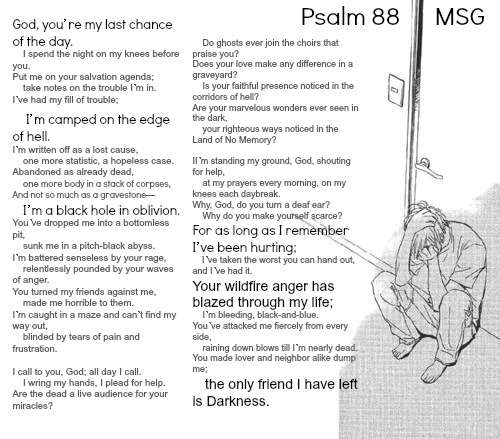
5. Psalm 88, MSG
These verses put my deepest heart sorrows into words. Even though the psalm is a devastating one, it was good to find myself in the pages of the Word. I’m glad I don’t feel this same pain anymore!
 I often hear from obsessive-compulsive Christians asking, “If my OCD is centered around my faith, will ERP still work even if my therapist is not a Christian?”
I’ve written elsewhere about how OCD is an arsonist, setting fires (obsessions) in our minds and how our compulsions are like shortsidedly trying to put out the fires instead of going for the arsonist directly. You don’t need a Christian cognitive-behavioral therapist. You just need someone who knows ERP and knows it well. In other words, you need an OCD assassin.
If you are obsessing about the unforgivable sin or something else faith-related, you don’t need a great theologian to dialogue with you about it. (In fact, chances are that you’ve already discussed this with all your Christian friends and maybe even a respected pastor.) After that conversation with the theologian, you’re probably just going to start obsessing again, either about the same thing or something else. You need someone who can take out the OCD, and yes, I mean “take out” in a sniper kind of way.
“But I’m worried that ERP is just going to cover up my real issues. I don’t want to just forget about these things. I want to solve them.”
First of all, you’re misunderstanding ERP. It doesn’t sweep issues under a rug. It’s not like you’re brainwashed into believing that life is now perfect. Not at all! It rewires your brain so that you can think the way “normal” people do– less circularly.
Secondly, you’re misunderstanding life and faith. These things aren’t “solvable”– at least, not generally. Sure, you might be the one person in a million who has God audibly speak to you one day– but probably not. Life is full of uncertainty. It’s a FACT. And faith is about TRUSTING God even in uncertainty.
You need to get it out of your head that you will ever be rid of uncertainty in this life.
Back to the original question …
Your ERP therapist is not going to talk you through theological issues. That’s not his/her job, and actually, it would be counterproductive to what ERP is all about.
If you can find an incredible cognitive-behavioral therapist who is also a follower of Christ, then yes, by all means, go to that person! But if healing and health are your goals, then your first order of business is finding someone who knows how to do Exposure and Response Prevention. You are looking for an OCD assassin, not someone to have tea and Bible study with.
Thoughts? Further questions?

I love when my worlds collide. This quote from Anne Lamott’s brilliant book Bird by Bird can be seen through every lens of this blog: faith, OCD, creativity. Here’s the full quote:
“I heard a preacher say recently that hope is a revolutionary patience; let me add that so is being a writer. Hope begins in the dark, the stubborn hope that if you just show up and try to do the right thing, the dawn will come. You wait and watch and work: you don’t give up.”
Recently, one of my blog readers asked me how I could tell when a thought came from OCD or from God, especially because one of my formerly intrusive thoughts was of a Bible verse that seemed to condemn me. She wrote, “I keep reading that Bible verses spontaneously popping into one’s head is a prime way God speaks to people.”
What a great question. One I’m not entirely sure I’m qualified to tackle, although I do know that the more I learn about and understand my OCD, the easier and easier it is for me to spot it. I can recognize its tell-tale voice from a mile away now. And while I don’t think that OCD = Satan (at all), they are both my enemies and they are both accusers.
Here is the (in flux) conclusion (is that an oxymoron?) I’ve come to:
I guess the big thing is this: when OCD would bring up that Bible verse, it worked like an intrusive thought and brought deep anxiety to me, but with God … his kindness leads us to repentance, not to shame. The voice of God showers me with kindness, grace, conviction that leads to change … but I don’t think God’s voice is one of shame and accusation. In fact, scripture even tells us that SATAN is the accuser and CHRIST is the one who defends us.
Remember, Satan used and twisted scripture when Christ was going through his temptations, so we know that it’s part of the devil’s arsenal.
 My friend Erica told me something fascinating she’d once heard: “The Holy Spirit does not motivate with guilt.” Likewise, my incredibly wise writing professor Judy said, “I know the voice of God because that voice invites me to move closer without shame while the voice of Satan fills me with an electric dread that makes me want to hide.”
As always, I encouraged this blog reader to explore Exposure and Response Prevention therapy. In the four years since my ERP, the voice of OCD has become so easy to recognize. I finally know my enemy’s voice.
And better yet, I know my savior’s.
Just wanted to sort out some thoughts and spark conversation on my blog today.
A little while ago, I asked the question on my blog Did God give me OCD? and came to conclusion that yes, he did, to draw me to himself and so that I could use it to glorify him and help others. A blog reader challenged me on that conclusion, and I thought her questions were valid. She wrote:
Let me challenge this: Is God good or bad? Does God do bad things? I do not believe that God gives people sickness, disorders, etc. It is contrary to God’s character to do those things. I DO believe that God will use bad circumstances/disease/etc in order to bring Him glory and all the things you said. BUT the whole reason that Jesus died for us is to enter into relationship with the Father. There had to be a sacrifice to tear the veil and stand in the gap between the God of the Old Testament and the New Covenant. When we look at the OT, we have to look at it through the lens of the Cross…would the Cross change how a situation would look? Judgement in the New Testament is always correctional because final judgement doesn’t happen on this earth anymore (it did in the OT). When we look at sickness, we see that Jesus performed miracles to show God’s love. He never caused anyone sickness. I do not believe that God gave you OCD, but I 100% agree that God is good and uses your OCD to drive you to Him, so that you could glorify Him with it, and to help others who are suffering.
This comment has got me thinking deeply about this. Right now, it’s still a pretty jarbled (that’s a mix of jumbled and garbled) blend of the doctrine of suffering (suffering in itself is not virtuous, but it does seem purposeful [Romans 8:28-29]), God’s sovereignty (is God in control of everything? Even disease/disorder? Sin and evil aren’t of his making, but if he gave humans the choice to opt for them, doesn’t that mean he is still master over it all?), and hindsight (now that OCD is not master of me, it’s easier to see the larger picture of OCD as a tool God used in my life).
I think that my position (for now) still stands with the belief that God did give me OCD for his glory and purposes.
 To answer the commenter’s questions, I respond with my own questions: from one perspective, the CROSS was a “bad thing.” In the moment, who would have guessed it would come to be known as GOOD Friday? And we know it was planned. Redemption through the cross was the plan for forever. “Yet it was the will of the LORD to crush him; he has put him to grief; when his soul makes an offering for guilt, he shall see his offspring; he shall prolong his days; the will of the LORD shall prosper in his hand” (Isaiah 53:10). Think of this from a human perspective. If we watched a father allow his son to be tortured, we would probably say that dad was doing a “bad thing.”
But, of course, we don’t see the cross from that angle anymore. We know what happened on Sunday morning after Christ’s death. And we now know that the cross is the most beautiful thing, the event that allows us freedom and life. We look on the “bad thing” as a glorious thing.
So, could it be that way with OCD? (I don’t think I’m ready to call it a “glorious thing” yet!) But if suffering is predetermined (“Therefore let those who suffer according to God’s will entrust their souls to a faithful Creator while doing good” [1 Peter 4:19]), who predetermined it? It’s hard for me to separate God from control over all things (I’m still sorting through some of this, including the fall of man).
What do you think? Let’s dialogue.
 The Wednesday before Easter, my dear friend Ashley and I went to a performance of “Kingdom Undone,” which was showing at the Southern Theater in Minneapolis. This was a story of days leading up to Christ’s death, but the emphasis … was on Judas Iscariot.
The betrayer. The traitor. But in this play, a lover of Christ who misunderstood just what the coming of Christ’s kingdom would truly look like. A zealous believer who thought he was doing what was right, even what was needed of him.
It was fascinating. Afterward, Ashley and I could not quit talking about Judas and his role in Christ’s death, both of us eager to return to Scripture to measure our thoughts against Truth.
I want Judas to be redeemed. So badly. Mostly because I think that would make for the best story.
That alarmed me for a little bit, made me really uncomfortable. Was I imagining that I could make an “improvement” on the gospel story (if Judas was not under grace)? The gospel is my FAVORITE story. It’s like how I’d feel if someone wanted to change the ending to The Last Battle or something. (Potentially– I still have not totally landed on what I think was Judas’ fate. Although scripture does say, “Satan entered into him.” But we also do know that he regretted his choices– deeply.)
Anyway, it’s good for this obsessive-compulsive to sit with troublesome uncertainty. Once upon a time, these kinds of questions would have collapsed me, but now I’ve learned to sit with them.
…
Another of my friends emailed me this week with an unrelated faith crisis as she struggles to reconcile the (vengeful, confusing, sometimes bloodthirsty) God of the Old Testament with the (merciful, loving, gracious) Christ of the New Testament. They are, after all, one and the same. But she loves Jesus, she told me, and is pissed at the OT God and trying to struggle her way through the dissonance.
I wonder the same thing sometimes too. The Old Testament and New seem so vastly different. But I know that the Law was a tutor to lead us to Christ, and I know that the God of the Old Testament orchestrated the whole beautiful gospel from before time began, so they do flow together. I know that God welcomed Gentiles like me in order to make Israel jealous, and I am forever grateful to be a wild shoot grafted into the natural tree.
This post doesn’t have a lot of answers, and I think that’s okay. I’m learning to ask the tough questions and to sit without an answer, wait in that uncomfortable silence because God is still holy there.
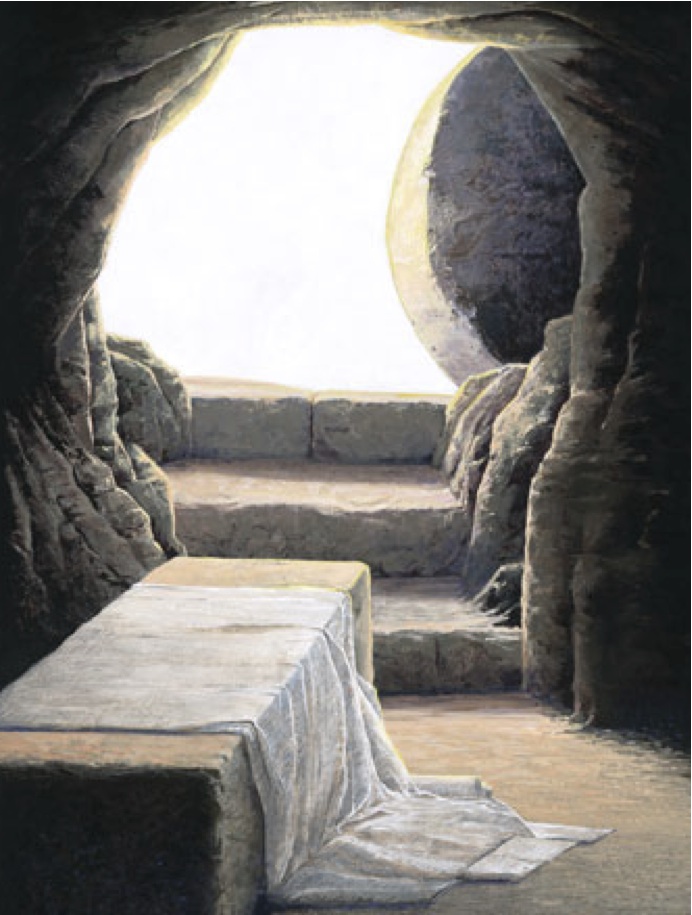 I. LOVE. EASTER.
Today I celebrate the event that makes everything– everything!— different for me! Jesus Christ, who died, is ALIVE!
My purpose comes from the resurrection. The resurrection puts weights in my shoes, tethers me from drifting into nothingness. The resurrection injects meaning into my daily life like a holy syringe.
On Easter morning, I wake with this feeling of power and pride– pride in my Savior and joy in knowing that the Spirit that raised Christ from the dead is living in me! Makes me want to start throwing air punches along to the Rocky theme song!
Or how about this song instead? This is one of my favorite songs about Easter, especially for the line, “The mouth of the tomb shouted, ‘Glory! The groom is alive!'” So. Good.
Enjoy, and may you truly REVEL in the delight of the resurrection today and every day.
 I’m one of those people who can’t tackle giant rollercoasters because of the long, slow, clicking rise to the top. Not the way down! I could probably handle the drop, but I cannot deal with that painful rise, that horrible anticipation.
Tonight I’m thinking about Gethsemane, about the weight of anticipation on Christ’s shoulders as he looks forward and sees the cat o’ nine tails, the cross, the nails, and so much blood. To know fully what is only hours away … anguish.
But he knew he was destined for the cross long before the garden that night … his whole life … and even before his earthly birth … for all of eternity.
That, my friends, is a long time to ride the rollercoaster up.
I am so proud of my savior.
Earlier this week, A Deeper Story shared an incredible post called “A Lesson in Words: They Mean Things,” and while I generally like to produce my own work on my blog, this post was too good not to share.
Here’s the beginning of it:
My voice came out braver than I felt, startling me.
“I need you to explain what you mean by God-centered shame.”
The entire class turned and looked in my direction. A guy sitting at our table cleared his throat and shifted in his seat. I didn’t realize the tension in the room until I spoke up. But it was clear: they are the leaders; we are the students. They know more than we do. They speak; we inhale.
I couldn’t ignore my gut any longer – the small voice telling me to speak! – and so I did. I raised my hand, and when my hand was ignored, I interrupted the greeting to ask my question.
The response to my question was mediocre and confusing at best, and so I pushed a little more. “But, I still don’t understand. How can shame exist within His kingdom if Christ went to the cross despising the shame? Shame cannot coexist with grace. It can’t.”
And they told me that it came down to the Greek roots of words, and in 2 Corinthians 7:10, the godly sorrow leading to repentance is really an offshoot of godly shame. We’re faced with our sin, and so ashamed, we’re moved to repent.
People joined in the discussion. I still wasn’t willing to let it go, but my words were starting to trip over themselves because of the almost robotic-like responses of those around me. Phrases like “Well, I think what he means is this…” and “we can definitely feel shame over our sin and it lead to repentance” and “I can totally see how shame, in this context, would be beneficial to our salvation” were said.
And friends, I swear I saw red.
“I still don’t see how they relate.” I said. “Grief is not shame. Sorrow is not shame. When I feel shame, I believe lies. Grief and sorrow are healthy emotions. Shame is not. Shame is negative. Shame speaks lies.”
To read the rest of the post, click here.
Then hop back over to my blog and let’s discuss!

 JACKIE LEA SOMMERS