I’ve posted several times on this blog about HOCD (homosexual OCD– when OCD causes someone to question his or her sexual identity), and the statistics don’t lie: it is one of the biggest reasons that people end up on my blog.
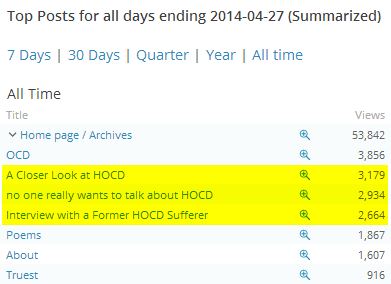
Anecdotally, most of the emails I receive from my fellow OCD sufferers are from those who are battling HOCD. I had an inkling that HOCD was far more common than most people would imagine, but ever since I started talking openly about it on my blog, I’m more convinced than ever.
Many of the people I talk with have a very similar story: they have never questioned their sexual orientation before X happened, now it is all they can think about, they are constantly “testing” themselves to see if their sexual attraction has now changed. Many already have a history of OCD, though perhaps it’s never broached their sexuality before now. Some– though never having had this problem before– cannot seem to generate any attraction to the gender they have always been drawn to, while they are suddenly feeling attraction (and even bodily responses) to the gender they have never entertained liking before. They are scared, confused, exhausted. Their minds are going wild. Some are single and feeling grief that their futures “must” now look different than they’d always dreamed. Some are dating or married and terrified to tell their partner about the fears and obsessing they’ve been experiencing. Some of them say they would rather die or be alone forever than to be gay (if they are really straight) or straight (if they are really gay). That’s intense, folks.
(Please note that I am avoiding using specific terms because HOCD affects both straight and gay people. I’m trying to keep my post very generic so that I don’t write just to the straight crowd.)
But I get it. Our sexuality and sexual preferences are so core to our identities, and when OCD causes us to question them, it is an intense experience. It’s torture. Hellish. Exhausting.
I’m sorry.
The good news is that you’re not alone. Not even close. There are so many others who are struggling with this– and there are sufferers who have come out on the other side.
Here’s the truth:
* You have an illness. It’s OCD and it will attack whatever is most important to you.
* You need to treat your illness. The best treatment is exposure and response prevention (ERP) therapy.
* ERP therapy treats OCD, not just HOCD– this is important because, if you were to somehow get rid of your HOCD obsessions and compulsions, it is incredibly likely that OCD would just move on to a new theme– often a bigger, harder, scarier one.
* For some people with HOCD, the most intense anxiety is caused over not knowing their sexual orientation. My friends who are gay tell me that their anxiety was not around not knowing, but more around logistics of coming out and how they’d be received. **I’d love to hear people’s thoughts on this, gay, straight, bisexual, or HOCD sufferer.***
* Many do anything to avoid ERP because they are scared of what ERP will reveal about themselves. Bad idea. OCD is your cancer; don’t put off ERP, your chemo. ERP is recognized worldwide as the best treatment for OCD. In other words, I’m not just advocating some hokey, weird techniques.
* Are there other ways to treat HOCD? You can try medication (probably an SSRI) or hope for a miracle. Your (much) better option is to proactively commit yourself to ERP therapy.
* I highly recommend finding an ERP specialist to guide you through your therapy. If you meet with a therapist who does not mention “exposures” as a part of your therapy, find a new therapist.
* You can do ERP therapy on your own, if needed, but you should get a book to guide you through it, such as Stop Obsessing by Edna Foa or Freedom from Obsessive-Compulsive Disorder by Jonathan Grayson.
* I am not an ERP therapist. I cannot be your therapist. I can be your cheerleader.
I’m sure you’re so ready to have your life back– to be in control of your own thoughts again. Your path is clear! I’m so excited for you!
For more about HOCD, OCD, and ERP, go to jackieleasommers.com/OCD.
 4. Rose Weasley from Harry Potter & the Deathly Hallows (epilogue) by J.K. Rowling

 JACKIE LEA SOMMERS