Pimp the Guilt, a poem & why I wrote it

My former co-worker Micah once instigated a challenge with me, saying that he would give the title for a poem, and we would each interpret it as we chose, each write a poem with that title, and see which one was better.  I actually wrote one.  I don’t think he ever did.  (He owes me!)

The title he chose was “Pimp the Guilt,” which we thought was kinda funny sounding– but OCD was in its hey-day in my life, and the title actually reminded me of the way my disorder made me feel guilty all the time.

This is what I wrote:

PIMP THE GUILT

The smallest thing, a trigger,
a rooster.  Casual words
look like pointed fingers,
wagging in accusation,
and me, unable to process
advice for what it is,
feeling  shame rip my heart
the way you’d tear a valentine.

deviantART by ~ginny1441

deviantART by ~ginny1441

OCD and writing

Recently, my friend Tina at the Bringing Along OCD blog wrote about “reading OCD” — which she had in an earlier post described this way:

Imagine opening up a book to begin reading it. Chapter one. You read a paragraph. Then you reread it. Then you move to the second paragraph, but you realize that you may not have read the first paragraph well enough. So you go back and read paragraph one again. Then you read and reread paragraph two several times. You finally make it to the end of the page, and in turning the page, you think, “I’ve read page one adequately.”

  But you can’t be sure. Did you understand everything you read? Will you remember it?
  So you reread page one, reading and rereading the paragraphs again. After an hour of being on page one, you get tired and decide to put down the book. You’ll get through the book someday. It’s only the third time you’ve tried to read chapter one.
Tina said, “This makes reading laborious and sometimes unbearable. I find myself avoiding reading.”
I really, really hate OCD.  I hate the way it tries to steal whatever is most important to us.
For me, it tried to steal (and for a time DID steal) my writing.
At the time, I was working on my first novel, which was all about OCD, and my OCD kept reminding me of the Bible verse that says, “Finally, brothers, whatever is true, whatever is honorable, whatever is just, whatever is pure, whatever is lovely, whatever is commendable, if there is any excellence, if there is anything worthy of praise, think about these things.”
My head snagged on the verse.  I was writing about OCD … and OCD was not lovely; that I knew for sure.  OCD was not pure or commendable.  It was ugly, tyrannical … not worth of praise.  And yet, I was spending all this time writing about it, all this time thinking about it.
I started to obsess that my writing was sinful.
Writing, which had always been a lovely release for me, a respite … even that was being stolen from me by OCD.  This is the scene I ended up writing about it (eventually):

“Stella,” I said, reaching out and touching her hand.

She looked at me.  “What’s up?”

“I think it’s wrong to write my poems.”

She frowned.  “What.”  It was an accusation, not a question.

I tried to explain my logic.  “So I write about feeling scared about hell, for example, okay?  And then other people read about it, and I’m causing them to sin.”

“Neely, the Bible talks about hell.”  The brown eyes of Stella Bay-Blake were flashing—and looking dangerously similar to Trapper’s.

“There is that,” I said, pausing to think it through.  Maybe Christ’s brief mentions of hell didn’t warrant people’s actual dwelling on it, whereas a poem would.  In that case, I’d still be out of line.  “I don’t know.”

“Neely, there is rape in the Bible.  And adultery.  And murder.”

“But maybe not really in a way so that the reader dwells on those things, you know?”

“No,” she said.  She sounded angry, and with her curls falling forward into her face, she looked violent, like a lion.  “This is the one way that you can healthily process your stupid OCD.”

“Maybe I could try to dwell on lovely things.  Write about lovely things.”

“Yeah,” she said sarcastically.  “You can write ‘Walking on a Rainbow to the King: Reprise.’  Because what I want to read are a hundred pages about sunshine and puppies.”

“Not sunshine and puppies, not necessarily,” I said.  “But things like … like faith and confidence.”  Father God, I love You.

“You have OCD,” she reminded me, “and you are going to write convincing poems about confidence?”  She had a point.  “My gosh, I will really blow a nut if you quit writing.  I’m the writer who doesn’t write!”

But we sat in silence at the tiny table, my closed journal a symbol of all my failure.


OCD. Is. A. Thief.  It will steal whatever you love best.  It will warp your mind into believing things that are so far from the truth.  It is a liar.  I hate the bondage it keeps so many people in.  I am so glad to no longer listen to and believe all those lies.

31

bday


Too often I use my birthday as a way to think of all I didn’t accomplish in the past year.  But not today.  Today I am trying to think of all that I did accomplish in my thirtieth year.  In honor of my 31st birthday, here are 31 blessings I’ve experienced in the past year (in no particular order):

I read The Fault in Our Stars and The Night Circus for the first time.  I started my novel and completed a first draft, met Mary Roach, got serious about blogging, won an international contest, flew to Boston, went on three writing retreats.  My job became less stressful, and I traveled less for work.  

Lunch dates with Elyse became standard.  Elsie Marie was born, and I fell in love with her and continued falling in love with Ava Elisabeth and Emeline Grace.  I moderated kind and compassionate debates on my Facebook wall during the election season.

I enjoyed an absolutely incredible snow day with Desiree.  My writing group grew even stronger by adding a new, talented member.  I hired an editor.  I shouted the praises of CBT from the rooftops.  I recruited an awesome fall 2012 class.

Ashley and Erica were my rocks.  My family and I laughed like crazies.  I advocated for OCD awareness and spoke for chapel and was a guest blogger at Rage Against the Minivan.

I encouraged many people and was loved.

brave

When I think of words to describe myself, brave is not one that comes quickly to mind.  In fact, I think I’m actually kind of a wimp.  A chicken.  I read books about crazy adventures because quite often I’m too scared to tackle them myself.

If I’d have gotten my letter for Hogwarts, I’d so desperately have wanted the Sorting Hat to put me into Gryffindor House.  But, let’s be honest, I’d have probably been in Ravenclaw.  Or Hufflepuff (gasp!).

hufflepuff

Movies scare me … sometimes even when they’re not supposed to be scary.  Change scares me.  Public speaking scares me (although not as much as it used to!).  I’m scared of needles, writing criticism, driving in the snow, and going to parties alone.

But last week I was emailing my friend Kyle about various opportunities in my life, and he wrote to me: “It will be a brave decision to stay, or a brave one to go, and for different reasons. You’re a brave person.”

Really?

But I thought about it more.  I am scared of change … but I am willing to take risks I feel called to take.  I am scared of public speaking … but I force myself to accept opportunities to share with crowds (and have really honed my skills!).  I’m scared of needles, but I get shots.  Of writing criticism, but I invite it, ask for feedback all the time.  Of going places alone, but I suck it up, paste on a smile, and meet new people.

Driving in the snow … yeah, okay, I avoid that and just stay in. 🙂

But even more than all of this, I lived for over fifteen years under the tyranny of obsessive-compulsive disorder, and I stood up to it.  I tackled cognitive-behavioral therapy, which was the hardest thing I have ever had to do, and came out with OCD under my foot instead of the other way around.

Know how I feel?

Brave.

brave

a whole new way to look at things (and myself)

I can’t tell you how blessed I am to know Judy Hougen.

I had coffee on Friday night with my former writing instructor, who is so full of wisdom that she can’t help but share life-giving insight.  We were discussing my recent blog post in which I fretted over mediocrity.

“I don’t think in terms of success and failure anymore,” she told me.  “I’ve trained myself out of thinking that way.  It’s better to think in terms of faithfulness and unfaithfulness.  You are being faithful with the gifts that God has given you, and that is not a mediocre thing.”

Judy reminded me that that success/failure framework is all about us, but faithfulness/unfaithfulness frames things in our relationship to Godand those are the questions believers need to be asking.

I felt a little like a kaleidoscope that had just been given a good shake: a new way to look at things.

I’d been so zoomed in on my own life, the camera screen was full of me.  But talking with her reminded me to take a step back, to zoom out, to remind me that I am a servant of God, that I am tethered to the King, that my actions gain meaning when seen in relation to him.

And anytime I include Jesus Christ in the picture, the pressure on me relaxes.

Kaleidoscope


where the music comes from

Early that next week, with my head still spinning, I sat with the Conner family for Ellen’s first jazz concert of the year—her three younger brothers sandwiched between their parents and me next to Mrs. Conner, feeling guilty that I’d been avoiding her daughter.  It was pretty obvious that, between the six of us, only Mrs. Conner and I actually wanted to be there, but Mr. Conner dutifully tried to keep the boys quiet and entertained.

“Ellen looks gorgeous,” I whispered to Mrs. Conner when the jazz band made its way onto the stage.  Ellen wore a knee-length black dress with long sleeves and a scooped neckline.  Her mom had forced her to take off the leather choker for the evening.

“She’s miserable,” Mrs. Conner whispered back.  “We go through concert dress woes every year.”  She rolled her eyes.  I smiled and looked back to the band members, who were tuning their instruments to Ellen, the lead saxophone.  They began with a few big band arrangements, followed by a swing tune, then a ballad.  “Ellen has a solo in this one,” whispered Mrs. Conner.

When the band fell into the background, Ellen stood up and a giant spotlight shone on her.  She played effortlessly, a beautiful, full tone, with perfect rhythm.  The concert band director had begged Ellen to join their group as well, but she just wasn’t interested.  “In jazz,” she’d told me, “you can actually lean into a wrong note and make it sound right.  It’s not like concert band, where you have to be perfect.”

“She’s got this down,” I commented to Mrs. Conner.

“It’s actually improv,” she offered back.

My eyes widened.  I could hardly believe that this picture-perfect sound being pushed along the ceiling by an alto sax was being invented on the fly.  I imagined myself standing in front of tonight’s crowd, looking not at a sheet of music but letting it flow out of me like rays of sunlight.  I shivered in the audience—not from any chill but from the fear conjured up by the brief imagination.

Dr. Foster is right, I thought.  I am definitely uncomfortable with uncertainty.  It upset me a little to see how far-reaching it went.

“Jazz and fantasy both push the limits,” Ellen had said to me once.  I’d had to think about it for awhile before it sat right with me.  Tonight I could see that Ellen was just a teenager who wanted no boundaries.  She needed improvisation, needed those grace notes.

A dark stage, a young girl in a black dress.  The spotlight’s mouth circling her in a perfect O as she gazed straight ahead.  It reminded me of the stormy night that Matt played his keyboard for me, the way his eyes too had found that particular secret spot where the music comes from.

saxophone

YA reading list

It was time for me to re-evaluate my top 10 young adult books.  So, without your seeing my raging internal debate*, I very cleanly present to you the following:

1) The Chronicles of Narnia by C.S. Lewis
2) Harry Potter series by J.K. Rowling
3) The Book Thief by Markus Zusak
4) Jellicoe Road by Melina Marchetta
5) The Fault in Our Stars by John Green
6) Stargirl by Jerry Spinelli
7) Saving Francesca by Melina Marchetta
8) Fire by Kristin Cashore
9) Unwind by Neil Shusterman
10) Every Day by David Levithan

*Ugh, I hate making top 10 lists of books– it’s so hard for me.  Even now, I see that I’ve favored books I’ve read more recently over some of the “classics.”  Tuck Everlasting.  Bridge to Terabithia.  The Secret Garden.  It seems like a crime to leave these off the list.  The Pigman.  When You Reach Me.  A Monster Calls.  

Oh gosh.  Anne of Green Gables.  How could I leave Anne off this list– especially when I’ve included other books much more controversial?  Or The Sky is Everywhere, which is better written than several books on the list?

Next time I do this, I need to be more specific with the name of my list.  Top 10 YA Books I’d Never Want to Live Without … if that were the list title, it would be different than the list above.  Top 10 YA Books That Made Me Think.  There!  That more accurately fits the list above.

Okay, it is time to quit obsessing over this list, which only 100 people are even going to see anyway.

What I’d rather do is give you a must-read book list personalized to your reading tastes.  I LOVE doing this, so let me know if you’re interested.

reading0


my writing process

Having recently plowed through all three of Kristin Cashore’s books, I ventured over to her blog and found this fascinating post on her writing process.  I thought maybe I’d share the details of my own with whoever might be interested (all three of you, haha).

In general, I need the following things in order to write: time, a distraction-free zone, and my laptop.

Time: I am not one of those writers who is able to write for five minutes at the drop of a hat.  I need to have at least an hour of open time yawning in front of me … better yet, five or six hours.

No distractions: I can listen to music but sometimes only without lyrics.  I can write with friends, but only if they have their own projects.  I cannot write while there is a movie on.  It just isn’t going to happen.  This does not, somehow, apply to the internet.

Laptop: I can’t write freehand anymore.  My thoughts are too fast, and I edit so furiously that I would shred the paper with my pen.  Plus, the idea of having to transcribe it into the computer seems like a terrible waste of my limited time.  I like to keep everything in its place.  (I don’t even like to edit a copy on my work laptop during my lunch break because then I have to make sure to copy and paste it into the right document on my personal laptop.)  Such a hassle.  I just need to have my laptop.  If I am without it, I will journal thoughts here and there on pieces of scratch paper, but I won’t tackle actual novel work.

I have to have access to the internet.  I go absolutely insane without it.  I can have Facebook and Gmail and Words with Friends all open, and it just blends into my whole writing program.  I do a lot of in-the-moment research, so I need to have access to the web (for example, I will just NEED TO KNOW in that EXACT moment what that heavy bib is that you wear during an X-ray … lead apron.  Okay, lead apron.  Moving on.).

I start with characters.  In fact, I like to start with names.  And then I find a picture of that person.  (Sure, it’s some random picture from Google images, but I find a picture that matches the name and the image in my head.)  And then I write down a few thoughts about that person.  I keep this document with me the whole duration of the writing and refer to it often (mostly since I am terrible at descriptions and need to use the photos for inspiration).

With this last novel, I gave myself six months to write a first draft– and didn’t allow myself to rag on myself while I did so.  The first draft is just the bones (and probably weak ones) of the story– I still don’t know my characters super well until the first draft is done.  Only then can I go back and know them well enough to see how they really would react to the situations that took place.  (I know that seems backward … but it’s not.)

I trust my writing group and other creative friends to catch the glaring imperfections for me.  You’d be shocked at what things seem clearly obvious to the plot that would have never been included if a friend hadn’t said, Um, this needs to happen here.

I can write from my couch, but it’s better if I am at a coffeeshop or Barnes & Noble.  There’s no laundry waiting to be done there.  If I am particularly inspired, though, I can sit at my kitchen table for 10-15 hours.  I am not joking.

I am terrified of losing any edits I make, so I email myself my draft after every writing session, and if I am not at home, I email it to myself before I leave the coffeeshop, etc., just in case I get into a car accident or my laptop (or car my laptop is in) is stolen by bandits or the laptop has a total meltdown.  My latest draft is always safe and labelled in the right folder in my Gmail account.  I have been working on my current story for a year, and there are 176 emails in that folder.

When I decide to cut something that I kinda liked, I save it in a separate document called “extries.”  Over the months, this file grows ridiculously large itself.  Also, if I am completely re-doing a scene, I have to edit the scene in the extries file and then copy/paste it into the actual document file.  This seems to go against what I said earlier about keeping things in one place, but it doesn’t: same laptop counts.

I am always thinking about my story, particular scenes that are giving me trouble, my characters I don’t know how to help.  I pray when I get stuck.  I cry.  I ask close friends to discuss problems with me so that they can help me muddle my way through.  Whenever I get an idea and I’m not around my laptop, it goes into my phone.  Later, I dump all of those ideas into the extries file and work through them.  The ones I write down at 3 am sometimes make no sense.

I also keep a fake calendar of the time the story takes place and list out events on the calendar to make sure I’m keeping track of time right.  (There can’t be 6 weeks in June.)

And the whole time I am riding the world’s longest rollercoaster … I love what I wrote tonight! … I am a terrible writer who will never be published … people like this story … it’s not good enough.  The lows are hard, but the highs are fantastic.  And I love the process.  I love the act of creation.  LOVE IT.  My characters and I feel each other out, and they make some of the decisions, but I usually get the final say.  Usually.

Writing a book is kind of like volunteering to be crazy.  Not just to spent time in the loonybin … but to legitimately be crazy.  But then again, maybe that’s already a given if you’re a writer and writing a book is just your way of acknowledging it.

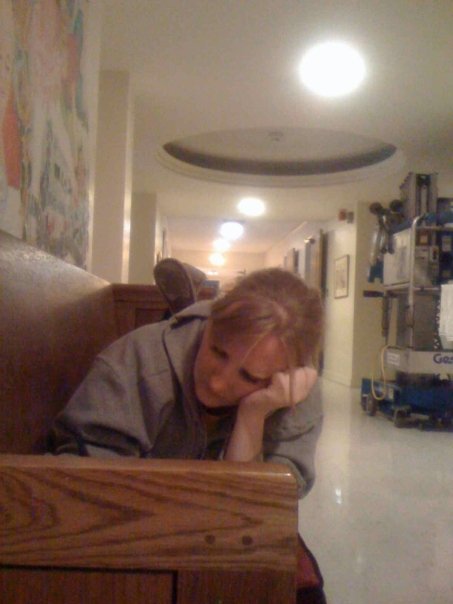
Gah, no laptop!!
Gah, no laptop!!


Tips for Interviewing a Therapist for Your OCD

Janet from the ocdtalk blog pointed me to the International OCD Foundation’s website for this list.  I hope it will be helpful for you as you seek appropriate treatment for your OCD.  I can’t stress this enough: OBSESSIVE-COMPULSIVES SHOULD NOT WASTE THEIR TIME ON TALK THERAPY.  YOU NEED COGNITIVE-BEHAVIORAL THERAPY, SPECIFICALLY EXPOSURE AND RESPONSE PREVENTION THERAPY.

“What techniques do you use to treat OCD?”
If the therapist is vague, or does not mention cognitive behavior therapy (CBT) or Exposure and Response Prevention (ERP), use caution.

“Do you use Exposure and Response Prevention to treat OCD?”
Be cautious of therapists who say they use CBT, but won’t be more specific.

“What is your training and background in treating OCD?”
If they say they went to a CBT psychology graduate program or did a post-doctoral fellowship in CBT, it is a good sign. Another positive is if a therapist says they are a member of the International OCD Foundation (IOCDF) or the Association of Behavioral and Cognitive Therapists (ABCT). Also, look for therapists who say they have attended specialized workshops or trainings offered by the IOCDF, like our Behavior Therapy Training Institute (BTTI) or Annual Conference.

“How much of your practice currently involves anxiety disorders?”

“Do you feel that you have been effective in your treatment of OCD?”

“What is your attitude towards medicine in the treatment of OCD?”
If they are negative about medicine, this is a bad sign. Medicine is an effective treatment for OCD.

“Are you willing to leave your office if needed to do behavior therapy?”
It is sometimes necessary to go out of the office to do effective ERP.