CBT

“Tell me, Neely.  OCD—do you know about it?”

            Oh wow.  I hadn’t realized that I was going to be quizzed.  “Some,” I said.  “I’ve read a few books, some articles.”

            He nodded his head vigorously.  The sharply combed strands of black hair on his head did not budge.  “Yes,” he said.  “Yes.  Education is critical.  You know how you fight OCD?”

            I wasn’t sure if this was a rhetorical question or not.  I nodded a little, but when I saw that he was waiting for an answer, I said, “With education?”

“With knowledge.  Knowledge is the weapon,” he said, continuing to speak in italics and suddenly launching into war metaphor, “You fight disease—disease fight back.  You have to negotiate carefully.  This is a game of tricking OCD.  Invade without alerting your enemy.  Side-step into enemy territory—your own mind—and take captive a small plot of land, just what you know you can win.  You have to condition your mind to the idea of winning.  Right now, it is used to losing.  What works best is cognitive-behavioral therapy.  You have heard of it?”

The vague sickness I’d been feeling all morning suddenly gathered into a physical reality in the pit of my stomach.  It took only those three seconds to realize that this is what I’d been afraid of.  “Yes,” I said quietly.

“It is the best treatment for OCD that we know of.  Medicine is good, but CBT is better.  There is a man—Jon Foster—you will call him.  He will help you.”  He scrawled the name onto a piece of scrap paper in the messy handwriting of a doctor.  “He is young, but he is good.  You meet with him—I bet he can kill it.”

Dr. Lee met my eye just then, and I could tell he meant what he’d said.  “Kill it?” I managed to squeak out.

“Cognitive-behavioral therapy, very effective,” he said.  “OCD is never cured, but CBT brings it under control.  You will call Jon.”  It was not a question.

“Okay,” I said, taking the piece of paper with Jon Foster scrawled on it. 

I needed to leave.  I needed to process all this.  My indistinct fears now had a name, and I needed to be alone, let my head spin through this like a rolodex.  I started to collect my purse.

            “Listen,” he said, “it will be hell.”  I winced inside and hoped it hadn’t shown on my face.  “Hell,” he repeated.  “CBT is very, very difficult.  You will be asked to do things you cannot imagine doing.  But it is the best treatment.  You have to think like a mother.  A mother would do anything for her child.  You have to do anything asked of you.  But you can do it.  You are Christian.  That is good.  You will need will power and faith to get you through this.”

My heart went into a freefall, and I never felt it land anywhere inside of me.  I swallowed—or tried to.  My throat was suddenly very dry.  “Oh,” I said.  What else was there to say?

OCD101

Hopefully this scene from my novel will give you a better understanding of how OCD works; in it, Neely is attempting to explain OCD to her new friend Gabe.  (By the way, Gabe is just finishing up his chemotherapy– hence the lack of hair.)  Ask your questions in the comments!!  (I would seriously love it if every person who reads this blog asked one question!)

“So, how is Tatum’s Pizza Arcade the best place to tell me about OCD?” he asked while grease from the pizza collected at the corner of his mouth.  He wiped it away.  “I’m … rather curious.”

I’d been planning this for the last week.  “Okay,” I said, “so you get to learn about OCD in three parts tonight.  First, I’m going to tell you about it.  The second and third parts are more experiential.”

“I’m ready to learn.”

“Obsessive-compulsive disorder is basically where you have these intrusive thoughts—they come out of nowhere and assault you—and then to combat them, you perform some kind of compulsion.  Compulsions are more obvious than obsessions—washing your hands til they bleed, checking the oven or the lock on the door over and over and over, being a pack-rat to the furthest extremes, doing weird little rituals.”

“You don’t do any of those things.”

“No.  Well, kind of.  I have my own rituals.  Mine are hard to see because I’m a pure obsessional.”

“So you don’t have compulsions?”  I loved the thoughtful way he chewed his food, the earnest look in those pale blue eyes. 

“No, I do, I do.  They’re just, well, trickier to catch.  They’re mostly in my head or to myself.  Or well masked.”

“I don’t get it,” he said.  “We’re not off to a good start.  And this pizza sucks worse than I remember.”

“Let me start over.  Okay, so an obsessive-compulsive has an intrusive thought—could be anything—maybe ‘I am going to get sick and die.’  So they hate that this thought keeps hounding them, making them feel sick—so they do something about it.”

“Wash their hands,” he supplied.

“Right,” I said.  “You’re getting it.”

“So what about someone who touches the doorknob forty times or something?”

“Same thing.  There’s some intrusive thought—and they’ll perform the ritual to temporarily alleviate the sick feelings from the bad thought.”

“Okay, so how about you?”

“My intrusive thoughts are blasphemous.”

Gabe raised an eyebrow—or what was left of one.  “Liar.”

“They are,” I insisted.  “I think bad thoughts toward the Holy Spirit, and since I’m scared that doing that is unforgivable and that I’m going to hell if I think those things, my head automatically wants to combat those intrusive thoughts.  So I say a prayer, the same one over and over to bat down those thoughts.”

He frowned.  “And there’s no way to just stop them?”

“Gabe,” I said, borrowing from my old friends Jewett and Nash, “do me a favor and don’t think about a red unicorn.  What are you thinking about?”

The corners of his mouth turned up, just slightly.  “A red unicorn,” he admitted.

“Well, stop it,” I said.  “Quit thinking of the red unicorn.  Stop now.  Do not think about that red unicorn.  Stop—”

“Okay, I get it.”

“So … yeah,” I summed up.

“It’s like warfare up there?” he asked.  I nodded. 

After dinner, I said, “I want to show you something.  Come with me.  Bring the tokens.”

We walked to the kiddie arcade.  I looked around.  “What are we looking for?” asked Gabe.

“There it is!”  I pointed to an arcade machine that came up to my hips, with five small holes in the top.  I took Gabe’s hand and pulled him along behind me toward the machine then maneuvered Gabe into place in front of the game.

“Whac-a-Mole?” he asked, doubtful.
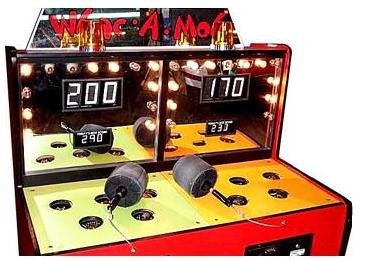
“Whac-a-Mole,” I said, inserting a token into the machine.  “Let’s see you go, Reed.”  I slapped him on the back for luck.

He made a big show of it, shaking out his shoulders, squaring his jaw, performing minor stretches.  I laughed when the plastic moles covered in weathered paint began to pop up randomly from the five holes.  Gabe jumped into action, reached for the foam-covered mallet and began to attack the moles, forcing them back into their respective holes as they showed their faces.

Gabe was pretty good—at least, at first.  The game began slowly, with moles creeping leisurely out of their holes.  But in a short time, several moles began to pop up at each time, and Gabe struggled to keep up.  Before long, the moles were out of control, popping up for only a split-second.  Gabe let out a choked, surprised laugh as the game sped up even faster.  He was wielding the mallet like a boy swiping at the air with a toy sword. 

As the machine lit up and the moles retreated, I laughed at Gabe, who looked legitimately surprised to be getting his butt kicked by five plastic mammals.  Three red tickets popped out of the dispenser attached to the arcade machine.  “What’re those for?” he asked, mallet still in his hand, limp at his side.

“The better you are, the more tickets you get.  Then you trade them in for prizes.”

His jaw dropped.  I threw my head back and laughed.  “Three measly tickets?” he said.  “Put in another token.”  He wound up with the mallet as if it were a baseball bat.

Gabe played a few more games, getting better and better, the red tickets spewing out of the machine like an overgrown tongue.  Still the machine overwhelmed him by the end of every round.

He was no idiot.  “So, this is some sort of metaphor for OCD?” he deduced.  “The experiential part of tonight?”

I smiled.  “You got it.  Blasphemous thought—mole rising.  Say my prayer—bash it down.  Blasphemous thought—mole rising.  Say my prayer—bash it down.  Now, Mr. Reed,” I said, lowering my voice, “this time, pretend it’s salvation on the line.  If you mess this game up—misstep somewhere—you go to hell.  Hell being where you are forever separated from the person you love the most.”  I dropped another token into the machine; in the middle of the cries of kids and beeps and clangs of arcade games, I could swear that I heard that token hit its fellows in the collection bin beneath the token slot.

Gabe frowned but played his hardest.  In the end, when the game had once again gone out of control, it ended.  Another string of tickets whirred out of the dispenser, but Gabe only looked at me, and even when I smiled at him, his blue eyes were sad.  “I’m sorry,” he said. 

paranoia

The following scene is from my novel, a conversation between Neely and her therapist as Neely explains the time after college she finally CRACKED.  My story is fiction, but this re-telling is VERY true to life for me.  It was a terrifying time of life.  I remember enjoying only food and fiction at the time, the two things I thought I could trust.  I was even scared of my poor roommates.

It started simple enough: I’d modeled my new shorts in the hall of our post-college apartment.  “What do you think?” I asked Trapper.

“I like them,” she said—but a little off-handedly—as she moved past me and into her own bedroom.

In my room, I examined myself in the full-length mirror, wondering over her tone.  “Do you honestly like them?” I called to her.

“Yes,” she answered from her room.

She’s lying, I thought.  She doesn’t like them.  I frowned into the mirror.  If Trapper was lying about something small like this, what else could she have lied about?  Maybe she didn’t like any of my clothes.  Maybe she didn’t even like me!  I felt suddenly dizzy.

“You ready to go get supper?” she said, appearing in my doorway.

“Oh!  Oh, yeah.  Okay.” 

“You okay?” she asked.

“Yeah.”  Why did she live with me, hang out with me, go to dinner with me if she didn’t like me?  Maybe it was all an act—the whole friendship—and eventually, the truth would come out.  It would hurt worse because I’d believed we were such good friends.  It was a calculated plot to ruin me.

Trapper chattered in the driver’s seat on the way to dinner, but I wasn’t listening.  I was thinking in fast-forward mode, possibilities inciting nausea.  Like a pinprick of light, I wrestled my way to a new “realization”: Trapper McKay was a demon.  Our “friendship” was a ploy that allowed her to deceive me and lead my soul into hell.  I felt sure I was going to vomit. 

She turned the volume up, steering with her right hand while her left raked the air.  “My milkshake brings all the boys to the yard,” Trapper sang, looking over at me and grinning while the breeze from the window whipped strands of red hair across her face.  Meanwhile, I staggered in the knowledge that one of my closest friends was methodically planning my annihilation. 

During dinner, my reeling thoughts crossed another line as I realized that if Trapper was faking, then anyone could beI glanced around the restaurant, realizing a horrendous new truth.  Everyone was a demon.  I was living in a real-life Truman Show, only with more destructive actors, and they with far uglier ambitions.

“Neels,” Trapper said.  “You’re acting really weird.  Whatcha thinkin’ about?”

I couldn’t let her know what I’d uncovered, that I was catching on.  “Not much.  I’m fine,” I peeped.

“You?  Fine?  We should throw a party.”  When I smiled weakly, she said, “Neels, it’s a joke.”

“Yeah,” I said, forcing out laughter.  “Yeah, I know.”  But I spent the next month faking my way through life, shocked at my discovery and desperate to keep it under wraps.


“Did it feel silly and serious at the same time?” Ruth asked me.

“Yes!” I said, nodding violently.  “I was ultra-aware that I was being ridiculous, but it just didn’t matter.  My head had gotten stuck in its regular loop, and when that happens, it’s pretty hopeless until it wears me out.  During the workday, I talked with prospective students, joked with my co-workers—but really, I was wondering if they could tell I knew the ‘truth.’”  I made quotation marks with my fingers.  “Sometimes I’d forget—find myself feeling all right—but then I’d remember: these people were demons and trying to trick me into hell.  I retreated from people—even my friends.” 

“This was after college, you said?” asked Ruth.

“Yeah, three or four years ago.”  I was glad Ruth didn’t see me shudder: I didn’t want her to think I was a drama queen.  “My best friend Charlotte—the same girl who was with that first day on the playground?—at the time she was finishing up undergrad in Chicago and applying for med school back here in Minnesota.  She’d call and while she gabbed, I’d think, ‘She’s acting friendly now so that the betrayal will be even more painful.’  Paranoia made me a real loner.”

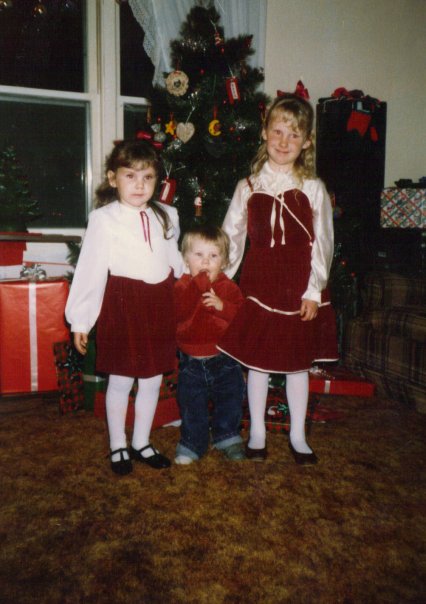
seven years old

My little sister Kristin (4), baby brother Kevin (1), and me (7) — at least, this is my best guess of our ages at this time.  (Mom?)

My OCD struck at age seven.  I had curse words running through my head as if I were some foul-mouthed sailor, when the truth of the matter was that I was a shy (Yes, really!  Hard to believe now!) girl from a conservative home, who would have never DARED to utter those phrases outloud.

I drew on real life as I detailed this scene about my protagonist Neely in my book:

“On summer vacation, I’d lie on my back outside and picture the sky littered with profanity.  Then I’d erase it with my mind until it was clear again.  This would maybe take ten minutes.  Then I’d pick up my book—all I ever did was read—and immediately, all those words would swarm back.  Seven years old,” I said again, making a face.  “I felt stained.”  I glanced again at her notes, wondering if she’d written down the word stained, if she’d underlined it. 

“I’m sorry, Neely,” said Ruth, narrowing her eyes at me slightly.  They were outlined in dark eyeliner and, although apologetic, they were also at peace, as if nothing in the world could truly surprise her. 

“My brother Joseph was two years old at the time, just a baby.  I’d watch Joseph playing—usually the sandbox—and be so jealous: his mind was so uncluttered!  I mean, he was thinking things like ‘digging is fun’ or ‘I have to go potty’—my head was a garbage dump. 

“At the time, my mom and I thought I was going crazy.  She said she barely got a minute of peace that summer—I was always looking for her and confessing, ‘Bad thoughts!  I’m thinking bad thoughts!’”  I felt sorry for myself, a seven-year-old wracked with guilt. 

I have this image in my head of running to find my mom under the clothesline, smacking my fist against my forehead, and confessing.  My poor mom.

I wish we’d known then.  It would be another fifteen years before my OCD would be named, but I’ve wondered what life would have been like had we caught it back in the summer of 1989.  Drat you, internet, for coming along too late!  Out of curiosity, I googled “my daughter is attacked by bad thoughts”– just to see what would have popped up had Mom had access to the world wide web back then.  Four or five of the links were about OCD.

My heart breaks for the obsessive-compulsive children out there, wild minds racing, hearts terrified, robbed of childhood.