List-Making as a Compulsion

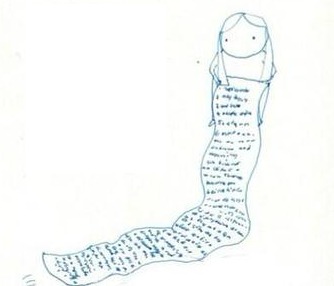
lists2A compulsion I haven’t talked about very often on this blog was list-making.  Since it was never something I worked on in CBT/ERP, sometimes I forget about all the lists.

Mine would be numbered (though the numbers didn’t mean much), and they were an attempt to bring some sort of order back into my messy thoughts.  They were an attempt to nail down a position or a stance or anything I could stand on.

This was mostly in high school and in college, before I was even diagnosed with OCD.  All I knew was that my doubts were eating away at me.

For example, in college, I didn’t know if I liked one boy (who liked me back) or his roommate (whom I fought with).  I was in turmoil over this (since OCD can’t just play it by ear– let alone see that I didn’t like the roommate, who annoyed me), so I’d go down by the lake with a notebook and start making a list:

1) I think I like James, not Toby.
2) I don’t want to like Toby.
3) I can decide that, right?
4) Maybe I can’t.
5) But I should be able to– right?  That’s my decision, isn’t it?
6) James is so kind.  And cute.
7) Toby pisses me off.
8) I would break James’s heart if I liked Toby.
9) I don’t want to like Toby.
10) Then why do I think I do?
11) I don’t want to hurt James.
12) If I don’t want to hurt James, then I must really care for him.
13) Do I care about hurting Toby?
14) Not as much.
15) I must like James then.

Satisfied that I was now certain I liked James, I’d stash my notebook back into my backpack and head to class with a smile.

Except that the next time I saw Toby and James, I’d be confused again.  Time for another list.

List-making was a mix of confession and seeking reassurance, to and from myself.

Did/does anyone make lists as a compulsion?

Landing on a Dime

Recently, I was over at my friend Kristin’s Minnesota house (she spends most of the year at her Kenya house), discussing writing and Christian art.

Kristin is lovely and brilliant and so terribly wise– and she gets me, gets my heart.  She knows how the desperate cry of my heart is to honor God in my writing through creating a book that is excellent and thought-provoking while avoiding mawkish sentimentality and all cliches, Christian or otherwise.

It’s so hard.

dime“I feel like I’m parachuting,” I told her, “and trying to land on a spot the size of dime.”

That is how precise my goal seems.  I want my stories to be just offensive enough to disturb someone’s thoughts– but not so offensive that they’ll put down the book.  I want them to be full of mystery– but with enough clues to find the answer.  I want them to reflect the trials, confusions, and joys of my deepest heart– but in a way that no one will find cheesy or trite.

Again: the size of a dime.

I’m not sure that I am a good enough writer to hit such a bullseye (in fact I feel quite confident that I am not).  So, what then?  Do I stop writing?

Of course not.  Not when that’s the goal of my life and the best worship I can offer.

I tell myself, You’re 31.  Keep writing and you’ll be better at 32 … 33 … 34.  But I am a perfectionist, an achiever, a go-getter, and terribly impatient.  I get frustrated with myself (see here, here, here, here, here, and here) and get so down and low, or else frantic and scared.  But the best I can do is to keep writing, continue praying, practice grace, revel in creation, and gauge my faithfulness.

And my faithfulness looks like persistence, like fidelity to Christ, to his gifts, and to showing up.

Review: The Lover’s Dictionary by David Levithan

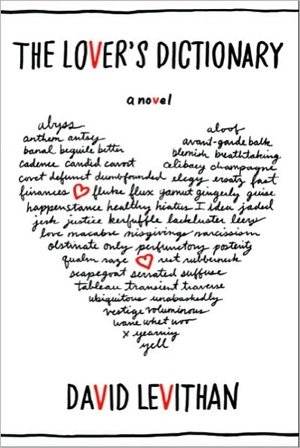
lover's dictionaryHaving enjoyed David Levithan’s recent YA book (Every Day) as well as his co-authored book with John Green (Will Grayson, Will Grayson), I was excited to see he had another novel out, The Lover’s Dictionary.

I read it in about an hour.

It’s a delightful little novel/poem/dictionary with short entries and unnamed main characters, just “you” and “I.”  I didn’t know how much I’d get to know the characters through the tiny little vignettes, but the answer was a lot.  And it was a story too– a novel, though a non-traditional one.  The ending is a bit of a cliffhanger, but it seemed quite satisfying for it to end that way.

I hope you’ll enjoy it.  It includes delicious little lines like these:

“Knit me a sweater out of your best stories.”

“It was after sex, when there was still heat and mostly breathing, when there was still touch and mostly thought …”

“Cranes, the birds with the rubber necks, don’t always find carnage.  Sometimes it’s just rain.”

Christian Culture’s (Sad) Response to Mental Illness

It’s in the Title: Mental Illness is an Illness

Salads and sandwiches and a shared mental illness, all of it on the tiny table between us.

“There is help for OCD,” I told her.  “The most effective treatment is cognitive-behavioral therapy.  Between that and my medication, I got my life back.  I know you can too.”  (The evangelical zeal I have for this particular therapy reminds me of the way I love Jesus: both took me from darkness into light, both make me want to throw parades in their honor.)

“Oh, I don’t know,” said my friend, poking at her salad with a fork, sounding hesitant.  “I think before I take any extreme methods, I want to just pray about it more.  I know that God can bring me through this.”

I wanted to say, But you have been praying about this for years!  I also believe God can bring you through this—and I am telling you how.

There is a pervasive and unhealthy attitude in the Christian culture toward mental illness.  Many believe that one should be able to “pray away” a disorder.  Some think that mental illness is, quite simply, spiritual warfare; some think it’s the result of unresolved sin issues.  One of my friends has said before that a real Christian can’t be clinically depressed.  I saw a Facebook status once that read, “Depression is a choice.”

These sentiments light a fire in me, especially for the way that they marginalize a group of people that are often already more susceptible to guilt.  I know that in my OCD hey-day, I felt continual guilt and severe shame; for someone to intimate to me that these feelings were the appropriate ones would only mean that my Christian brothers and sisters were siding with my disorder—and against me.

Mental illnesses are just that: illnesses. 

friendsGod and Satan can work through them just the same way as they could through, say, cancer or diabetes.  All issues are spiritual issues, simply because we are spiritual beings, but it is not helpful to label a chemical issue with a giant term like spiritual warfare.  To say that a Christian cannot be depressed is like saying a real Christian can’t get the flu.  To say that depression is a choice is like saying strep throat is a choice.

If you break a bone, do you get it set in a cast?  If you learn you’re diabetic, do you take insulin?  If cancer steps into your body, do you pursue chemotherapy?

The answer is usually yes.  Yes—and pray.  (Don’t get me wrong: I’m all for prayer!  And for medical innovation!)

That is why I am unashamed of my OCD, my depression.  Instead, I am proud of my God for seeing me through a therapy as difficult as CBT and for being my strength through five years of side effects in the search for the right medication.

Unfortunately, my friend left the sandwich shop that evening feeling obligated to “pray away” a spiritual flaw instead of feeling empowered to fight illness, in spite of my best efforts.  My voice is being drowned out by the multitude of louder voices of the Christian culture, a culture that should be supporting this demographic, not alienating it.