enabling OCD and telling the truth

I have not written about this in the past because this is not an area that I have a good grasp on.  To me, there is a fine line between enabling an obsessive-compulsive and just being a helpful supporter of that person.  When I was going through cognitive-behavioral therapy, my therapist had me tell my roommate and friends that they were no longer able to reassure me about anything silly.  I was instructed to tell them that if they did this, it would interfere with my therapy and decrease its opportunity for success.

So, all those times when I would ask, “Do you think that is okay?  Is this sinful?  Do you think I’m going to hell?” … they were supposed to answer it with something like, “I’m not allowed to answer that question.”  Or “I don’t answer silly questions.”  Or “I’m not going to answer and enable your OCD.”

It’s a hard position for them to be in.  For the OC too!

As a Christian who believes the Bible when it says, “The truth will set you free,” I had (and still have) a hard time thinking that it is not helpful for a friend to tell someone the truth– shouldn’t that help set them free?

But then I think how I asked those questions for years and years, and all that stated truth piled up like a mountain but never moved me.  Why was it that listening to a LIE– an audio recording telling me repeatedly that I was going to hell– is what ultimately unlocked the doors of my prison?

A student at the university where I worked asked me that earlier this fall– how listening to a lie could rescue me.  I didn’t have an answer for her then.  The more I thought about it afterward though, I realized that what had happened was that listening repeatedly to a lie started to make the lie SOUND like a lie– and that was the truth!  CBT helped me recognize truth, and so in that way, it was still truth that set me free.

Does that make sense?

I’m still processing all of this and would love insight on this!

~4

creative growth

body of work

I am still learning this, but oh, how I am learning this!  

I spent four years writing my first novel, finally putting my stamp of approval on it in January of 2012.  Next month will be one year since I put the manuscript away, and already it is so very clear to me how much I have grown as a writer.  History should have taught me that this would happen.  I remember loving my creative work in junior high, high school, and college– all of which I can now summarize as weak.  I didn’t know what I was doing!  I hadn’t read widely enough, experimented enough, or even lived life enough to create a truly brilliant body of work.

Sure, there were moments– beautiful lines here or there that spoke of depth– but I was and still am a learner.

I was so proud of my first novel.  I poured my entire self into the writing of it.  And already one year later, I’m a little ashamed of it.

But not too ashamed.

had to write it.  It was my next step.  It was what needed to happen.  It was my playground.  School was in session.

At least now I am more aware of the process, aware of the way I grow.  I was always in school, but now I’m aware of it.  I read as much as I can, and I re-read books that I love.  I marvel at imagery.  I work at my craft.  I write draft after draft after draft, knowing that it will take a mountain of them before I am truly happy with the finished product.  (Writing that word– finished— makes me smile a little bit.  I wonder if artists ever really feel as if something is completed?  I hope so– but I am going to wait and see.)

I know that twenty-some years of writing has been to build a solid foundation for me to stand on– and maybe leap from.  I needed to invent that Pononia family in elementary school and come up with stories about their lives, needed to write about Mariah and Kayy, the best-friends-turned-track-rivals, in seventh grade.  I needed to write that horror story where the best friend turned out to be a killer– her name was Chloe, and I definitely thought it was pronounced Sh-low.  And that soap opera– the one about Sunnyside High and teen pregnancy, AIDS, romance, running away, and finding a long-lost twin– needed to be written and circulated amongst friends in high school.

And college.  I had to vomit out those awful poems in college, had to learn how to take criticism, how to re-write, how to love a writing community.  I had to attempt  to not be jealous of great writers and then learn that it is pretty much impossible and that you can love those great writers even though you seethe with envy.

I turn 31 next month, but as a writer, I’m practically an infant still– maybe a toddler.  It’s hard to assess.  I still have a lot to learn, and I’m thrilled about that.  I am committed to the writing life for the long haul, even if I still have years ahead of stilted, awkward, gangly stories ahead of myself.

Someday they will shine so bright they will blind you.

How/why does a good and all-powerful God allow bad things to happen?

In light of the recent shooting at the Connecticut elementary school, many people are asking this question.  Years ago at a youth workers’ conference in Atlanta, I heard one of the most stirring messages of my life, delivered by Louie Giglio, and I have never forgotten what he had to say there.  In fact, his message has taken up residence inside my heart so permanently that it made its way into the novel I’m writing.  Here’s an excerpt:

He moved so that he was sitting beside me, both our backs against the tower wall.  “You know, West, I believe that God is in control of everything.”

“Even over the bad things?”

“Yes.”

“Death?  Disease?”

“Yes.”

“Catastrophe?”

“Yes.”

“Solipsism syndrome?”

The pause was brief.  “Yes.”

Why?” I asked.

“The cross,” he said simply, and when I didn’t answer, he took my hand in both of his and explained, “When Christ died, his followers looked at his bloody body on the cross and said, ‘That is the worst thing in the universe.’  The ugliest.  The most horrific.”

I nodded, prompting him to go on.

“After the resurrection, Christians say that same image was the most incredible, amazing thing in the universe,” he said.  “How is that possible?  How is it that one weekend separated the worst thing from being the best thing?”  He leaned his head back against the wall, looking up toward the tower roof.  “That is how I believe that God is in control of everything.”

One thought wrestled its way to the front of my mind, and I blurted out, “But why was it necessary?”

Silas frowned.  “Eden.  The fall of man,” he said.

I shook my head.  “Even that,” I said.  “If God is in control of everything—like you say—then why did humanity fall at all?  Why wouldn’t God just have life go on perfectly, like in the garden at the beginning?  He could have stopped Adam and Eve from ever screwing things up.”

“I think,” said Silas with a sincerity that almost frightened me, “that God favors redemption over perfection.”

“You mean … you mean, he prefers a rescue operation over having no need for one?” I asked.

“That,” said Silas, “is exactly what I mean.”

You can watch the sermon that so impacted my life below, and I hope that you will.  Forty-five minutes of your time is a small price to pay for such a life-changing message.  If you choose to watch, will you post your thoughts in the comments section below?  I’d love to start a healthy and friendly discussion.

OCD and suicidal thoughts

Recently Janet at the OCDtalk blog posted about her friend whose obsessive-compulsive son had just committed suicide.  The post broke my heart.  It reminded me of earlier this fall in Boston where I met Denis Asselin, the winner of the International OCD Foundation Hero Award.  Denis’s son Nathaniel, who suffered from intense body dysmorphic disorder (on the OCD spectrum), took his own life in 2011.  It was beautiful but devastating to listen to him talk about his beloved son.  My heart is heavy as I think about these families, now missing an important member, and about the horrific pain that these young men were experiencing that made them see no other way out.

It’s a dark, heavy topic, but tragically important to discuss.

OCD is so often thought of as simply being neat or orderly– or sometimes even anal retentive about certain things.  Media portrays obsessive-compulsive disorder as a quirky, nitpicky, and sometimes comical disorder, but let me level with you: OCD is debilitating, devastating, and torturous.

Can you imagine feeling nothing but sheer, unadulterated terror for days, sometimes weeks, on end?

I remember some of my darkest, hardest, most terrifying days.  I lived in the Brighton Village Apartments with Becky and Tricia.  During the day, I was given the small grace of suspending my obsessions– at least enough to make it through work (most days– not all), for which I am grateful.  In the evenings, I would return to our apartment, where I would drown in an ocean of terror.  My soul felt untethered, lost, condemned; I felt the hot, ugly breath of hell on my neck all evening.  I felt unforgiven and completely cut off from the God I wanted so desperately.  (It is making me cry right now as I write about those dark days.)  And the torture of not knowing— heaven or hell?  saved or condemned?  found or eternally lost?  heard or ignored?– was the worst kind of mental anguish.

Those apartment buildings were built like an X, with the pool and laundry facilities at the center where all four wings came together.  I remember– and this is not an isolated event but something that happened every time I was in that third-floor laundry room– I would look over the balcony down to the first-floor pool area, usually empty, and I would thinkIf I threw myself off this ledge head-first, I would finally know: heaven or hell.  I would have my answer, instead of the torture of not knowing.

But what if the answer was hell?  I couldn’t hurry that on.  What I wanted even more was annihilation— to cease to exist.  I craved oblivion.  That is true pain for you.

I realized that I was already in hell– just of a different stripe.  I was living like a condemned person, in TERROR and heartache and loneliness, and in constant combat with the blasphemous thoughts that plagued my mind.

Most people wouldn’t have guessed it.  I smiled a lot at work.  I even managed to fool those closest to me who knew the anguish I was experiencing.  But I would look over that balcony at the hard floor, and I would think about it.  OCD is that devastating.  I believe obsessive-compulsives (even those who take their own lives) are some of the strongest people you will ever meet.  They fight a constant war.  It is no wonder to me that many want to lay down their weapons and surrender.

And yet, here I am, eight years later, happy and healthy and secure in my faith, enjoying life and friendships and a growing relationship with Jesus Christ.  I am not tormented by my own thoughts, and uncertainty isn’t anguish any longer.  I want to gently take the faces of the anguished obsessive-compulsives into my hands, stare them directly in the eye, and tell them, There is hope.  There is help.  It doesn’t have to stay this way.  I would hug them and cry with them and personally drive them to my cognitive-behavioral therapist.  I was once where you are.  Follow me to freedom.

If you are struggling today with intrusive thoughts, obsessions that plague you, compulsions that take over your life, THERE IS HOPE.  I promise you.  This is a disorder– just a disorder, albeit a powerful, ugly, life-thieving one.  Follow me to freedom.  There is Truth, and it is not what you are hearing from your OCD.  Rescue is possible.  Follow me to freedom.  Email me.  Joy, happiness, laughter, truth, peace, safety– these may seem like impossibilities, but they can be yours too.

suicide

Why Write?

When it’s just you and your manuscript in a tiny house for a week, both truth and lies are going to ricochet like crazy off those old walls and you know some barbs are going to get stuck in you.  You’ll go from imagining your impending wild success to realizing that you’re a complete fraud.  The only reassurances you can find are electronic—Facebook, texts.  You drink them like water, but even then, you think what do these people know anyway?

This has been happening a lot lately, you think. This up and down, this rollercoaster.  You’ve tried to tell yourself it’s just the writing life, the way things are.  And to some extent, this really has to be true.  But you’ve got to find some solid footing or you’re going to go insane.

So stand on this: you don’t write because you want to be published.  You write because you love writing.

You love sounds and rhythms and the way words work.  You love that challenge of finding that exact right word—the one you’ll know when you see it—and so you dive through the thesaurus and spin in circles until you finally find capacious or sentinel or intrepid and think yes, yes, that is the one.  You love the characters and the way they take on their own personalities and force you to share the decision-making with them.  You love the modicum of control you retain over the rest of it—the smells, the sounds, the setting.  (Even if you can’t manage what your characters will do or say, you can still toss them onto a roof together or in a car wash or a parking ramp.)  You love story.  You love the way that truth sometimes is clearest in fiction.  You love alliteration and imagery and all those uncontrollable verbs.  You love the way one perfect line can steal your breath.  You love that you get to be a little creator.

And you love the writing community—how it’s full of quirky, broken people who beat back the darkness by stringing words together.  You love how you can understand one another, and how at one point or another, they all need to be reminded of the same thing you did this week.

Life of a WriterdeviantART by seetheduck

Life of a Writer
deviantART by seetheduck

Barnabus

I am so glad that my spiritual gift is encouragement.  It is such a fun gift!

I love targeting a friend and sending an email full of the things I like about him or her.  I systematically go through my phone to send encouraging texts– just a little 140-word pop! of joy or gratitude, or something to make a friend laugh.  I do this on Facebook too sometimes– click on “Friends” and write on the first dozen or so people’s walls with just a little something.

I try to do this for strangers too– you never know when it might make their day.  I compliment strangers in the hallway and send “WOW” messages to Etsy artists I will never, ever meet.  If I am on a website that I like, I’ll take the extra couple seconds to email the site owner.

The reason for this post is not to praise myself– but to share how much joy this gives me.  I am so grateful to God for giving me such a fun and delightful and life-giving challenge to make people understand how loved they are– how beautiful– how talented.  I never have to lie or invent a reason to encourage someone– there is so much to love in each person.

I also love to buy gifts for people– some fun little present, a scarf they’ve admired or a book I know they will love– but my main gift is words.  They matter so much, and anytime I toss a line of Truth into the darkness, I am reminded just how much words shine.

sparkler

Mental illness is a medical problem.

One thing that frustrates me to no end is when people treat mental illness like moodiness, as if you can just snap out of it, instead of like the medical issue it is.  This mindset is so pervasive that it has infiltrated even those with mental disorders.  It broke my heart to sit across the table from an obsessive-compulsive who thought she should be able to just “pray away” her OCD.  Now, of course I think that prayer matters.  But I think also that you pray about cancer– and then undergo chemotherapy— and pray some more.

whatifwe

books books books

Just finished …

The Casual Vacancy by J.K. Rowling |We’re not in Hogwarts anymore, Toto.  This is Rowling’s first book after the Harry Potter series, and it is absolutely nothing like them, which I’m sure was her point.  I mean, how do you compete with one of the most popular children’s series ever?  You avoid the competition and write an adult novel instead, I guess.  The Casual Vacancy was hard for me to get into at first– I felt that Rowling was trying to shock me just because she could.  Also, I couldn’t tell what the story was about for quite a while.  It is a book about smalltown politics– both literal politics and also the inner workings of a town that is all interconnected and where people often say and do things that are different from what they think or believe.  The book is very well-written, but very raw, real, gritty, and sad.  Very, very sad.  While I will re-read the Potter series for the rest of my life, I think one time through of this book will be enough for me, period.

Map of Time by Felix J. Palma | I had heard this book likened to The Night Circus by Erin Morgenstern, one of my favorite books I read this whole year.  But it just wasn’t true, and I’m not sure at all where the comparison came from.  Map of Time started off fascinating– telling the story of a man in love with one of the Whitechapel prostitutes in the time of Jack the Ripper.  (I have researched Jack the Ripper in both high school and college, so this was particularly interesting to me to hear about the incidents from the other angle!)  The premise seemed interesting, and I was starting to care about the characters … and then suddenly, I felt duped and we were onto the second story of three in the book, and the person I thought had been the protagonist had to climb down off the stage.  It was just such a strange format, and it didn’t work for me.  In the end, the book was too shallow for me, and I never felt like I really got to know the characters.  Palma tries to trick his readers multiple times throughout the book, and I’m not sure how I feel about that.  In most books, I am thrilled when I discover a twist, but Palma’s just disappointed me.

Gorgon in the Gully by Melina Marchetta | As I just posted recently, I think everyone should read Marchetta’s books.  Unlike her usual writing for teens, this book is for younger readers.  It still appealed to me because 1) Everything she writes is marvelous and 2) It is about Danny, the younger brother of Jonah Griggs (of Jellicoe Road).  It is a delightful little story about pulling together a group of friends from various groups.  I think it would be the perfect read for a middle schooler!  It inspired me to re-read

Jellicoe Road by Melina Marchetta | Masterful.  Just masterful.  And so absolutely original.  A book centered around the territory wars between the boarding school kids, the town kids, and the cadets in the visiting military school– but really, that’s just the venue for the story.  The real story is one of love and friendship and generations.  This is such an incredible book, and I can’t recommend it highly enough.  If you read it, you will fall in love.

The Five Dysfunctions of a Team by Patrick Lencioni | So, this is obviously not the usual type of book I review on my blog, but it was quite fascinating.  It is a “leadership fable” about a team that needs to work together better and how the CEO makes it happen.  I read it in two days!  The majority of the book is a story about this fictional company/team, but then the last part of the book goes into non-fiction details of how to put this into effect at your workplace.

The Chronicles of Narnia by C.S. Lewis | Yes, the whole series.  Yes, again.  Yes, just as incredible as the last time through.

The Sky is Everywhere by Jandy Nelson | This was only my second time reading this story, and somehow I forgot how magnificent it was.  The writing is absolutely stunning, which is not surprising, since the author has two MFAs– one in poetry and one in writing for children and young adults.  It is the story of Lenny Walker, whose older sister/best friend Bailey died suddenly about a month before the book starts.  She is trying to navigate her grief all while falling in love for the first time, and it is just so good and sad and good.  If you have a sister, you’ll probably shed a couple tears.  This book will break your heart.

Currently reading …

Reached by Ally Condie | The third book of the Matched series, and again … my opinion is still out.  I liked Matched but was not very into Crossed.  We’ll see if Reached can win me back!

I did just get Finnikin of the Rock by Melina Marchetta on audiobook, and I am so pumped to listen/re-read that one!!  I have so many books that I want to read, and I just keep amassing books (I just bought a new bookcase that is back in my apartment waiting to be assembled after my writing retreat) and am not able to get through them as fast as I’d like (especially since I spend a lot of time re-reading favorites, which I know some people can’t understand).  I guess that’s the problem when you love reading but you LOVE writing.

Questions for today: what are you reading right now?  Do you like to re-read?  If you’re a writer, do you, like me, find a hard time balancing reading and writing?

reading16

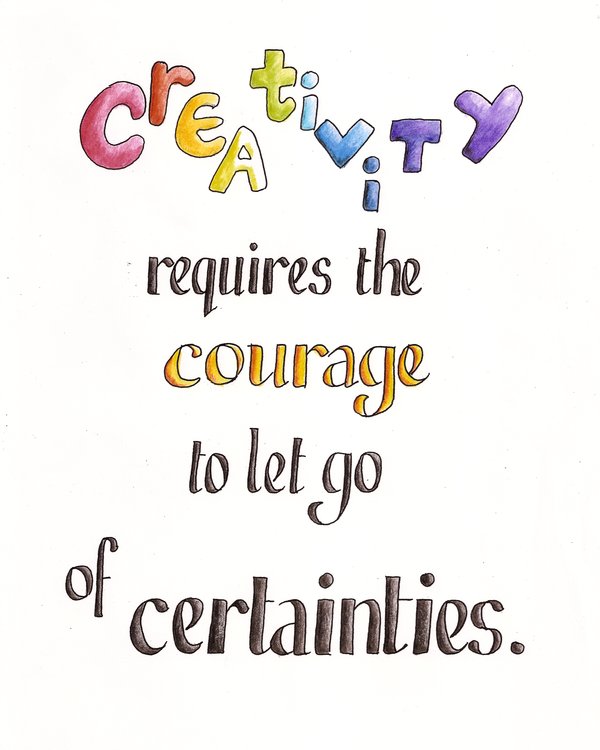
letting go of certainties


I thought this picture was particularly fascinating because you can replace “creativity” with “cognitive-behavioral therapy.”    And those are two of the most important things in my life.

I always thought that certainty was the goal and that doubt was the adversary, but it was just another lie.

What do you think of this quote?

holidays are hard for some of us

Last year, I posted that Christmas isn’t fun for everyone, and today I am thinking again how that is true.  And not only Christmas, but other holidays too.

Thanksgiving is just behind us, and to be honest, I am glad.  Mine was fine, very lowkey– I spent it with my sister and brother, eating pizza and banana cream pie, watching the Dallas game and hushing my voice when the Cowboys fell behind the Redskins and my brother raged at the TV screen.  It was fun, very chill, lazy, and we all met up at Mom and Dad’s house, even though the parents were in Missouri to see Grandma and the rest of Mom’s family.

But it’s these winter holidays that do me in.  While everyone else is giddy with anticipation, I am anxious mostly for them to be OVER.  Somehow there is an expectancy surrounding the actual holiday, something that stresses me out and makes me just want to return to normalcy.

I think, for me, it’s a combination of the cold weather (it snowed all afternoon in Minnesota on Thanksgiving), the claustrophobia of bundling up in jackets and scarves, real or imagined seasonal depression, and memories of high school, when the holidays were the hardest.

1997.  Thanksgiving.  It was the first real breakdown of my life.  I can remember it like it was yesterday and not fifteen years ago.  Was God real?  How could anyone ever really know?  And if I didn’t know, then wasn’t I hellbound?  (Such a paradox, I know– if there was no God or heaven, then there would also be no hell.)  I was in 10th grade, and OCD was swallowing me whole, and it would still be another seven years before it would even have a name.

I was in Missouri with the rest of the family, breaking away from the games and conversation and cooking upstairs to retreat to Grandma’s basement, lock myself in the bathroom, and sob.  The ground had been taken from underneath my feet, and all I could do was weep– all while hiding it from the rest of the family, all those happy Christians upstairs, secure in their beliefs.

I can picture myself now, doubled over on the bathroom floor, lost and sad and scared and not understanding that God Himself could supercede my disbelief and make Himself known to me.  It was a dark year that followed.  I was scared of everything, especially of dying without knowing that God was real.  I held my breath when I’d pass a car on the highway, knowing I was inches from my death– and maybe eternal death.

OCD, you thief.  I hate you with such intensity.

For years after that, I could not return to Missouri without being triggered into a complete relapse which would take weeks to recover from.  Once I went to college, I refused to return.  I wonder what my mom’s side of the family thought– if they wondered if I was stuck-up or selfish for not making that 11-hour drive to see them.  It was only once a year, for goodness sakes.  They didn’t know any of the background, didn’t know the way that just crossing that state border into Missouri had become the instant switch for me to question my faith.

Christmas stumbled along after Thanksgiving, and it was just as hard.  And so, these holidays over the years cemented themselves into difficult seasons that I would have to survive.  And even though November and December are nothing like they were even ten years ago, those memories are strong.

I know there are a lot of people out there who will have such a hard time this season, those of you who have Christmas hang over you like a stormcloud, who will breath a sigh of relief when you return to “life as usual” on the day after New Years.  I’m so sorry, and I totally understand.  I hope that this year will be different for you– that God will supernaturally supercede your painful memories and depression and general feelings of wrongness, and that He will give you joy in your hearts instead of these.

As Christmas approaches, my prayer for you is this: Jesus Christ, You are the Word that became flesh, a holy incarnation that blows my mind every time I stop to consider it.  Please overwhelm us with the sacred mystery of it all in ways that memories, depression, OCD, anxiety, and other mental illnesses can’t defeat.  Jesus, be the mighty redeemer that You have been and continue to be and REDEEM this holiday season for those of us who need a rescue.  Hold us in real ways that we can feel.  Amen.