Bread of Angels

Tonight I was thinking of the creative process, how when I go big picture, my brain collapses beneath the weight of writing a book. But when I take it day by day, short assignments, bird by bird, the work gets done.

It made me think of manna.

So I reread Exodus 16 in scripture, where God provides bread for the people of Israel every morning. Manna was said to be flake-like, fine as frost, like coriander seed, and tasted like wafers made with honey.

They were to gather each morning just what they needed for the day. All leftovers (except on the Sabbath) stank and had worms. The people had to learn to trust that their needs for that day would be taken care of that day . . . And the next day, there would be new bread and new mercies.

I need to remember this as I write. Today I had the creativity and courage for today. Tomorrow I will get a new batch for my next pages. Man does not live by bread alone after all.

#OCDWeek

It’s OCD Awareness Week 2016!

Check out the IOCDF page for ways to join in this week, including pre-written things to share on social media.

If you live in the Twin Cities, please join us for our OCD Mini-Conference on Monday night. Details are here. We will have local OCD experts leading sessions, plus the OCD Twin Cities staff (including yours truly) will be leading a roundtable discussion.

Every week I hear from sufferers who still don’t know there is a treatment for OCD. Every week I see the stigma of mental illness still so strong in our culture. OCD Awareness Week moves us one step closer to fixing both of those problems.


Dear Diary: Thoughts from the Couch

A photo by Amaan Hai. unsplash.com/photos/nqz4WOGDo4AHi folks! I’m typing on my laptop keyboard, something I haven’t done in a while, since I use an ergo keyboard at home and at work. Unfortunately, my home office desk chair is broken, and while I thought I could make due with another chair, it’s murder on my back. So instead I’m sitting on my couch with my laptop, how and where I wrote Truest.

I can’t believe my baby has been in the world for over a year now. It’s also crazy to think that I’ve written two other manuscripts since finishing Truest! My broken chair and my work schedule have put a kink in my writing rhythm as of late, but these things happen. Life goes on.

I’m feeling especially share-y tonight, so maybe I’ll just address a few things below. Skip anything you’re not interested in.


Wrist Issues

I’m reading a book called Pain Free at Your PC by Pete Egoscue, and he addresses how hand/wrist pain can’t be blamed only on the hands and wrists. The exercises I’m doing are actually more related to the hips and have made me think I need to ask my chiropractor to measure my legs and see if they are still different lengths like they were in elementary and high school. At first my left leg was just 1/4″ shorter than my right, but they assumed it would correct itself. However, when I was next tested for scoliosis, my left leg was now 1/2″ shorter than my right. To be honest, I’d forgotten about this, since the only time it was ever really noticeable was after a full day of intense walking (like a day at an amusement park, for example). But reading this book has made me wonder if this might be the root of some of my injuries.

Salt Novel

My gosh, I’m so close to finishing this draft, you guys. But I think that is sort of freaking me out and I’m self-sabotaging a little bit, scared to show it to my agent and editor, knowing that it is still very flawed. I need to find the time and drive to just hammer through it and turn it in. The sooner I get feedback on it, the sooner I can correct those issues. I went through a brief time in my life (post-undergrad) where critique didn’t faze me. I realize now that that was because the critique was all from peers at that time, whereas before that it was from professors and after that from publishing industry professionals. There is for sure a power imbalance (perceived or real) that affects that. Also, I’ve realized that I need to take into account the culture differences too. The difference between Minneapolis and New York City is far more than just 1,200 miles.

Sleep

I sleep with no sleep aid now. I’m so, so, so grateful to not have to rely on anything but good ol’ Circadian rhythm to sleep.

Reading

Halfway through Leigh Bardugo’s Crooked Kingdom right now. Next up will likely be David Arnold’s Kids of Appetite, although Jennifer Nivens’s Holding Up the Universe just came in the mail this weekend! I also have a book by Cheryl Klein that I really want to start, The Magic Words. It’s about writing for children and young adults.

Election

I can’t wait for it to be over. Seriously, what a mess. I consider myself an advocate for the marginalized and will vote with that in mind.

Adulting

I paid to have my home deep-cleaned this weekend. I recognize that is a privileged statement, and I’m grateful to have the means to do so. Honestly, it felt like something that needed to happen in order for me to move forward with so many of my other goals. Next weekend, I have a handy man coming to the house to fix up odds and ends and my desk chair, and then I’ll truly be poised for success.

Northwestern

I honestly feel so grateful to be part of such a beautiful community. Right now I am especially loving the current writing majors and recent writing grads. It’s such an honor to be part of their lives. They are so talented, thoughtful, generous. They care so much about words and story and beauty, and they make me better person.

Your turn: a) What have you read recently? b) What are you looking forward to this week? c) What thing or person has added value to your life lately?

Days like This

Slept about 3.5 hours last night and woke up with my FOOT in pain. Goodness gracious, what did I do now? I’ve been the queen of biofreeze and ice for a week now. I’m stressed about work, stressed about the new software at work, stressed about writing, stressed about my overdue library book, stressed about my messy bedroom, the stack of mail I’ve been ignoring, the chair I bought that is defective, all the bills I need to pay, and the tax forms I need to fill out for Germany’s translation of Truest. 

But I made a list. I iced my foot (and wrists). I returned my library book and paid my fines. I took a nap. I paid my bills, emailed with OCD sufferers, cleaned out my inbox, started the tax form process, cleaned my living room, dealt with the mail, took out the garbage, did laundry, got quotes from cleaning services, and treated myself to ice cream. 

Tomorrow and next week, I will attack work-related issues. Tomorrow night, I will go to the MOA with my favorite nine year old and try to forget everything but making her smile.

I also read an article about depression and remembered where I was at in 2003-2008. That certainly gave me some perspective.

Life is messy and stressful and busy, too busy, but I am capable, creative, and (doing my best to be) faithful. One day–one moment–at a time.

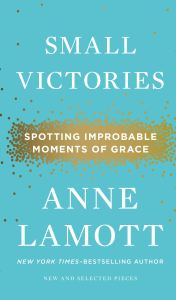
Small Victories by Anne Lamott

smallvictories1221-2A few things I know:

  1. I love Anne Lamott.
  2. She is an incredible writer and person.
  3. She loves God in her own irreverent way.
  4. I learn from her in everything of hers I read.


What this book is about:

“I have gotten lost all of my life, maybe more than most, and been found every time.”


My recommendation:

Read it. And then read everything else she’s ever written. Enjoy.

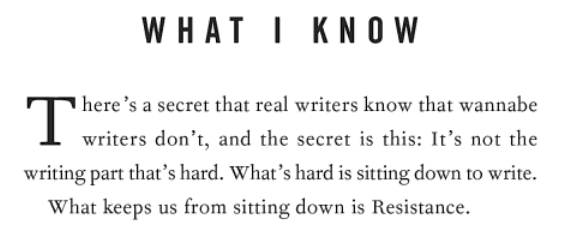
Resistance: The War of Art

war-of-art4I had in the past attempted to read Steven Pressfield’s The War of Art: Break Through the Blocks and Win Your Inner Creative Battles, but I’d been waylaid, I think due to the way he talks about mental illness in the book.

But this time I pressed through, and I really enjoyed it! I listened to the audio book on a long trip for work, and it only took about three hours from beginning to end. I probably could have read it even faster with the book in my hand.

The War of Art is about Resistance. It’s about anything that stops us from getting our creative work done– and about how to overcome it. Pressfield makes an extensive list of things that play into resistance: procrastination, of course, but also sex, trouble, drama, victimhood, self-doubt, fear, criticism, love, stardom. He’s not afraid to add things to the list that you and I would rather keep off it. This was pretty eye-opening for me.

war-of-art

In the second part of the book, he talks about “becoming a pro”– how to overcome Resistance. To be a professional, we need to show up, be prepared, be patient, ask for help, accept no excuses, among other things.

A quick excerpt:

In my younger days dodging the draft, I somehow wound up in the Marine Corps. There’s a myth that Marine training turns baby-faced recruits into bloodthirsty killers. Trust me, the Marine Crops is not that efficient. What it does teach, however, is a lot more useful.

The Marine Corps teaches you how to be miserable.

This is invaluable for an artist.

Wow. Pressfield goes on to say:

The artist committing himself to his calling has volunteered for hell, whether he knows it or not. He will be dining for the duration on a diet of isolation, rejection, self-doubt, despair, ridicule, contempt, and humiliation.

Tell us how you really feel, Steven. 😉

But, honestly, this resonated with me. Writing is a mix of joy and misery; publication too. But what am I supposed to do? Ignore my calling? No. I need to become a pro.

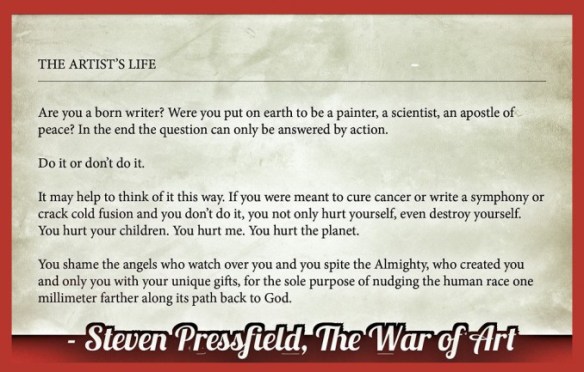
war-of-art3

In the last part of his book, Pressfield talks about muses and angels– he takes the book to a whole other plane, reflecting on how the artist isn’t really in charge anyway. I’m sure he loses a lot of readers here, but not this girl. As a person of faith, I already believe something similar.

All told, this was a fast read and well worth it. In the days since finishing it, I’ve been able to recognize areas of Resistance in my life and to deal with them accordingly. Great, thoughtful book.

Beyond Writer’s Cramp: Any Ideas?

In most regards, it’s been an incredible weekend: I got to see my dear friend Cindy (to whom Truest is dedicated) and meet her adorable baby boy; I’ve gotten lots of rest; I’ve written a lot, chapters I feel really, really good about.

But there’s one area that’s been brutal. I am still battling overuse of my hands, wrists, arms, and elbows. It was perhaps the worst it’s ever been this weekend, and that’s saying a lot. I was sincerely considering going to the ER.wrist InjuryA brief history:

It’s hard to remember when it started, but I’ve had bad wrists for something like a decade now. At one point, I couldn’t open a car door or hold a book with one hand. I can’t do certain things anymore, even just for a short time, like bowling with coworkers or helping a friend paint her house. I can’t carry a lunch tray without both hands. I stare in awe at restaurant servers. I might go a month with little to no pain, only to have one or both wrists completely flare up.

Measures I’ve already taken:

  1. I see a chiropractor and a massage therapist.
  2. I was diagnosed with overuse– not arthritis, carpal tunnel, tendonitis, etc. Just overuse.
  3. I was formerly in occupational therapy with a hand specialist until she broke up with me because I couldn’t afford to go weekly.
  4. I do stretches.
  5. I ice.
  6. I take Ibuprofen/Advil/Aleve.
  7. I use Biofreeze.
  8. I have an entirely ergonomic set-up, both at home and at work.
  9. I don’t write for (what I consider) unreasonable amounts of time, maybe 2-3 hours a night, although I am at a computer for my day job too.

The one measure I can’t take:

  1. Using dictation software to write. Please believe me when I say that I have thoroughly investigated Dragon, read reviews from other authors who have used it, and I also know my own methods well enough to understand that this is not a viable option for me.

That said, does anyone have any other ideas? I’m a little desperate here. After all my efforts, sometimes it just feels like it’s getting worse and worse. I was in so much pain this weekend that I was making noises like a wounded animal. This writer needs some solutions.

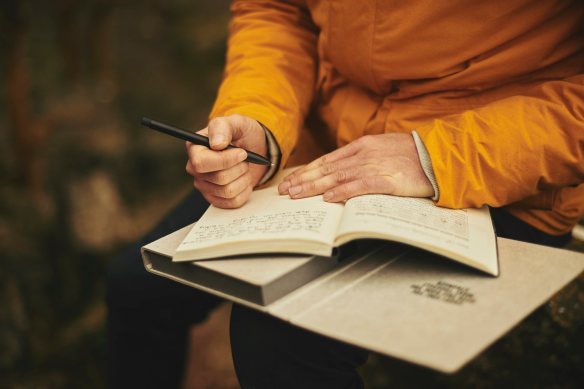
Six Parts of Writing a Book that Aren’t Actually Writing

There is so much more to writing a book than just writing a book. I’ve been thinking about that a lot lately and thought I’d write up a few thoughts about it. Note that this is my experience; every writer has his or her own methods!
writing3Research. 

When I was younger, I thought, “I’ll never write historical novels; that way, I won’t have to do research.” HA. I think any well-thought-out piece of writing requires so much research, and not always the kind you might imagine. I’ve spent countless hours researching things that my characters are interested in, just so that I can have my characters talk about them with convincing acuity. When those things are above my head (i.e. the quantum mechanics in Yes Novel), I have to still find a way to write just enough to convince the audience I know more. (Then I had to have my physics Ph.D friend read those scenes to make sure I didn’t say anything absolutely wrong.)

Speaking of bringing in friends, I do this all the time. My Facebook friends usually assume that any random question that comes from left field is usually book research. Sometimes I will spend hours just finding the name of a color or how to build a table or how to translate one sentence of Portuguese. I remember taking so long just to find the name for the “blanket” used during X-rays: a lead apron. That sentence wasn’t about X-rays either; it was about how depression presses weighs on a person. I spent all night researching boats for a paragraph in Salt Novel. And if I get the details right, the reader probably won’t notice– it will flow smoothly instead of tripping someone up!

Brainstorming.

For me, this usually looks like conversations, either prayer or otherwise. I get out either my prayer journal or my process journal and start asking questions, thinking, waiting for answers. Sometimes I tell my friends, “I have a problem to solve. I need this square peg to fit into a round hole,” and we go back and forth until we make it work. Sometimes this takes a long time and means headaches and tears. But I don’t do it alone.

Listening.

I’m not sure if that’s entirely the right word. But with the exception of when I’m sleeping (although not always– sometimes I think about my novel while I dream!), I am always on alert for ideas, solutions, objections. My co-worker said, “Can I still rent a vehicle if I’m not 25 yet?” and my first thought wasn’t how to help her but, “Oh crap, I have a 19-year-old renting a car in my manuscript. FIX.” Anything funny or beautiful or interesting– all my experiences, in fact– pass through the novel-sieve: is this something I can use for the story?

Timeline.

I spent the entire evening earlier this week nailing down the timeline of my story. For me, I find it easiest to use an actual calendar and to fill in the days with the names of scenes. Timeline matters especially if there is a “time bomb” in the novel or if there is some process (pregnancy, an academic year, etc.) that has to follow certain general guidelines. It also keeps me from bypassing important holidays. And the weather has to be right for that time of year (see above: research). And if there is a love story, I want to make sure that it’s reasonable. I don’t want my characters falling in love in just three days.

Strategy.

This is something I am learning. With my first novel (Lights All Around, unpublished), I had no strategy. I barely even considered the most basic constructs of a novel: action, climax, resolution, and the like, let alone thought strategically about how the characters were changing from beginning to end. I did that so much more with Truest, and now it’s becoming a built-in part of my writing life. I find myself thinking things like, “If I want M to relax and C to become more assertive, then I should have a scene where C takes control and M follows suit.” That probably seems like a no-brainer, but for this writer, it took about three decades to get there. Now I think, “If I want X to be especially impactful, then I need to set it up by making Y more extreme. How can I do that?” (See above: brainstorming.)

Reading. 

When I am writing, I like to stay deep in the waters of great fiction. I have re-read a handful of books that inspire Salt Novel over and over again. I enjoy the story, but I also examine it. Why did that work? How did the author make me feel that way? Why did I change my mind about that character? If I am trying to create a river, it helps to stand in one. 

There are other things too, like outlining, marketing (eventually), and finding connections between themes (my favorite!). It’s a lot of work, but soooo rewarding! How blessed am I to get to do this with my life?

Off to write now– actually write!

11 years ago … my memories of 9/11

Four years ago, I wrote down my memories of 9/11. Today, 15 years after that unbelievable day in our nation’s history, I have not forgotten.

Jackie Lea Sommers's avatarJACKIE LEA SOMMERS

My second year of college, I lived in a suite with seven other girls whom I laughed with and fought with and loved.  That Tuesday morning, one of my quadmates Tracy and I had a class together, and I was getting annoyed because she was dawdling because she didn’t feel well and was probably going to make me late.

Another quadmate Megan, pre-med, had an early lab that morning and returned to our place, breathless as she reached for the remote.  She clicked on the news, saying, “A plane crashed into the World Trade Center!”

My first image was of some podunk, rogue new pilot who had accidentally somehow managed to bump into the building.

But the people on the news seemed serious, and Tracy sat down on the couch next to Megs to watch.  “We need to go,” I told her.

She waved me off, still watching the…

View original post 492 more words