3 Tips for Being Intentional with Setting & Description

3d interior render of empty white room with big windowAs I’ve said before, I’m not naturally good at description in my writing. It’s an area of weakness of mine, but since I’ve identified it as such, I can make intentional efforts to supercede that weakness.

1. I try to choose a location– or a location within a location– that lends itself to sensory detail. Instead of setting the scene in a regular old room, why not on the roof? Or in a church belltower? An abandoned greenhouse? A former-insane-asylum-turned-boarding-school? (My friends were creeped out by that one and steered me away from it. Ha!)

Figure one. I really believe this place is going to find its way into one of my stories one day.

greenhouse

2. I use photos, lots of photos, for reference. The internet is my friend: Pinterest, Tumblr, Google Images, We Heart It. I actually think people would be shocked to learn how much time I spend looking for images– but the pictures help me find the words.

Figure two. I’d have a hard time describing such a scene as below without the image.

bed

3. I write the senses at the top of a document and go scene by scene, asking what the characters could see, hear, taste, smell, or touch in that particular scene. This sensory document for Truest ended up to be fourteen pages. Then, back through the manuscript to graft the details in so that readers don’t see the seams.

Figure three. The red means that I ended up using the detail.

details

Your turn, writers: what are your best tools for setting and description? Does it come naturally to you, or do you have to “fight for it” the way I do?

Author/Editor Disagreements

disagreementWhat happens when an author and her editor disagree?

I’ll admit that not knowing the answer to this question is what started my intense bouts of panic, which started almost immediately after I was offered my book deal.

Now, nearly one year later (the first panic “attack”– I’m not sure it was a full-blown panic attack, but that is the best way that I can think to describe it– occurred on November 22, 2013), I have an answer to that question, though, of course, I can only answer from the perspective of my own partnership with my brilliant and beloved editor at Katherine Tegen Books.

She let me win.

Granted, I took nearly every suggestion she gave. She really is a genius when it comes to YA literature, and though feedback often stings, in almost every case, I could see why she made the suggestions, and when I took them, I loved the results.

There was only one thing– and it’s a big SPOILER, so I can’t share yet!– where she and I were on opposite sides of the fence, and I stressed and stressed and stressed.  Panic rolled off me in waves. I was sick over it, and cried my heart out to my team, prayed for a solution from God. Finally, I just explained my reasoning for my decision, detailing how important it was to me, and my editor said, Then let’s do it your way. I get it now. But we’ll work on it.

And we did.

And Truest is better for it.

She also let me win several smaller victories too, once I explained my reasoning. She has been so, so respectful of the fact that this is my story– my baby— and she wants me to be happy with it.

I am.

You guys, I cannot wait for you to read my story.

[Rambling Thoughts on] Self-Publishing vs. Traditional Publishing

self pub vs trad pubI often see people falling into the camp of “If I Can’t Publish Traditionally, I’ll Self Publish,” and I think that’s a dangerous place to vacation, since there are pros and cons to both sides. In my (amateur) opinion, it’s better to examine both sides thoroughly and choose which avenue suits you best and then go after it.

Obviously, in traditional publishing, there’s the benefit of having a publishing house to help edit your book, format it, market it, etc., but then again, your royalties are significantly less than if you self-publish (we’re talking maybe less than 15% for traditional and about 70% for self). In self-publishing, you have total control of everything (your book’s content and cover, your marketing plan, etc.), and in traditional publishing, you lose a lot of that control. On the flip side, you’re working with experts who can often push your writing past the brink of your own talent and into a whole new level.

Sometimes I talk to people who say, “Well, if I can’t get a traditional book deal, then I’ll just self-publish this story, write another book, and hope to publish that one traditionally.”  My concern with this is that if your self-pubbed book doesn’t sell well, you’re going to have one more hill to climb to get an agent for the next book. In other words, if an agent sees that your self-published title didn’t sell well, it’s going to be an even bigger gamble for them to take you on.

That’s why I say to just stick to your guns.  Make an informed decision of what you want and go after it.

That might mean abandoning your first story (or second or third) to the bottom drawer while you work on crafting a new story.

And that, my friends, is hard.

I poured four years of my life– blood, sweat, tears, joy, sorrow– into writing Lights All Around, and for it to not get an agent was tough.

But I will tell you right now: it wasn’t ready. It really wasn’t.  Oh, how I thought it was!  But, now, three years later, I can’t tell you how glad I am that it’s in the bottom drawer and that Truest will be my debut novel.

Consider the alternative: what if I had self-published Lights All Around?  Well, I know now that I would not have had the resources to promote and market it, so I would have had piddly sales. Then, when I tried to sell Truest, I’d have had to explain my lack of sales. And even if I’d still gotten the book deal for Truest, I’d probably be ashamed that I had this sub-par first novel floating around out there.

I repeat: I did not think it was sub-par when I was querying it. It was the best I had to offer at the time. But really, I was just cutting my teeth on writing fiction. I had so much to learn. My gosh, I STILL have so much to learn.

Anyway, I know this post is all over the place, but I hope that it sheds some light on things to consider as you determine which route is best for you! Would love to hear your thoughts in the comments below!

Advice for Aspiring Young Writers [from an Aspiring Young Writer]

????????????????????????????

Show up.

I’m convinced that’s about 80% of writing a book right there. Show up to write, day after day, and put in the work. Don’t wait for inspiration to strike. Inspiration will be abundantly there when you show up. Inspiration will learn your routine and meet you there.

Don’t let yourself be paralyzed by fear of failure; I am telling you right now: you will fail.  But keep showing up. Write a bad first draft, the worst one in the world. But then show up and write a better second draft. Show up again and write a better third draft. Repeat until you’re satisfied with your work. Meanwhile, the people who never showed up might not have a first draft at all. They’re still on the starting line, scared to put down a wrong word.

Think about Story more than grammar. Read great books and then take the time to think about what you liked about them, what made them “work” for you. Copy that technique. Put your own spin on it.

Winston Churchill said, “If you’re going through hell, keep going.”

In other words: show up, show up, show up.

Malcolm Gladwell says it takes 10,000 hours of practice to achieve mastery in a field.

In other words: show up.

Stephen King wrote, “Amateurs sit and wait for inspiration, the rest of us just get up and go to work.

He’s right: you’ve got to show up.

Writing is hard. So hard. One of the hardest things I’ve ever committed to in my life. But also one of the most rewarding things. And when my first novel comes out, if you enjoy it, please remember that it took 33 months of showing up– almost daily– to get to where it is. And those 33 months came after 48 months of showing up to another novel that never even saw the light of day. And before that? Three years of college writing courses. Along with a whole childhood packed full of stories from the moment I could first write.

My book is less the result of talent than it is of  hours and months and years of showing up to do hard work.

Ready?


Second Draft Manifesto

second draft manifestoJackie, be kind to yourself. Writing is a long, arduous, difficult, but rewarding process, and almost nothing comes to you easily. You have to fight for it all, and you do that by showing up, day after day, sitting down, and doing hard work. You eat an elephant one bite at a time, and to be honest, it’s probably irrelevant where you start: toes, ears, tail. Bring salt.

But really, salt is prayer, friends, and courage that looks an awful lot like fear. It’s easy to confuse the two, but courage is fear that keeps showing up to work.

You can do that. It will look different on different days, and that is perfectly fine.

Please remember that you love this. The writing life is a mysterious amalgam of your choosing it and its choosing you. That feels almost holy.

This process necessitates many steps backward. It’s an inherent part of the journey, and that means that even steps backward are steps forward. And that fits with your worldview too, you know: all things working for good.

Keep your hands and heart and mind open to grace, which is more abundant than you ever seem to realize.

And find the joy in this journey. Please. There is so much there, and sometimes you let fears and doubts scream so loudly that you can’t hear the laughter. Listen for it.

Be gentle with yourself. You’re not alone. Not ever.

Image credit: I think the image of the giant elephant in the sea is from the cover of an Explosions in the Sky album. It was so perfect that I had to use it.

Things I Need to Hear

Sooooooooo … I had a bit of a breakdown last night. I’m not quite sure how to classify it: Mental breakdown? Nervous breakdown? Emotional breakdown? Manic episode?  Whatever it was, it was wild and rollicking and high-pitched and ugly.

It was not, however, connected to OCD. So, there’s a victory.

It was connected to my next novel. I have a first draft but it’s terrifically first-drafty, with so much work needed that it feels insurmountable. When you see my post about “showing up” later this week, you’ll think I’m a hypocrite, but yesterday, it really felt like staring at an elephant that was so big it filled my viewfinder. And there I was, holding a fork, with the instructions to start eating.  Where do you start?

In addition, there are some very dear people in my life who are dealing with health concerns right now, so worrying about a revision felt like complaining about a stubbed toe in contrast with their much larger concerns. I felt wildly overwhelmed and terribly selfish and utterly alone in the world.

I sent out a call for help to my team, and received many texts and phone calls, proving how not alone I am. Des even invited me over to her place (two buildings over), so I spent a couple hours with her, calming down from the fever-pitch wildness of my night.

So, what do I need to tell myself?

I have my First Draft Manifesto. I think I need a Second Draft one too.

It would say this: Jackie, be kind to yourself. Writing is a long, arduous, difficult, but rewarding process, and almost nothing comes to you easily. You have to fight for it all, and you do that by showing up, day after day, sitting down, and doing hard work. You eat an elephant one bite at a time, and to be honest, it’s probably irrelevant where you start: toes, ears, tail. Bring salt.

But really, salt is prayer, friends, and courage that looks an awful lot like fear. It’s easy to confuse the two, but courage is fear that keeps showing up to work.

You can do that. It will look different on different days, and that is perfectly fine.

Please remember that you love this. The writing life is a mysterious amalgam of your choosing it and its choosing you. That feels almost holy.

This process necessitates many steps backward. It’s an inherent part of the journey, and that means that even steps backward are steps forward. And that fits with your worldview too, you know: all things working for good.

Keep your hands and heart and mind open to grace, which is more abundant than you ever seem to realize.

And find the joy in this journey. Please. There is so much there, and sometimes you let fears and doubts scream so loudly that you can’t hear the laughter. Listen for it.

Be gentle with yourself. You’re not alone. Not ever.

So there’s that. Thank you for letting me sit down and process this with you, dear blog readers.  Any encouragement you’d like to leave in the comments section will be gobbled up like it’s a Thanksgiving feast.  By the way, I made the decision last night to spend Thanksgiving alone, back up in Duluth, attending to my story. I feel good about it.

Love!

All About the Benjamins: Author Advances & Royalties

advances and royaltiesI’ll be the first to admit: I’m not an expert on the business side of being an author. I’m not even an expert on the author side of being an author. But a lot of you have asked questions about how the money side of things works. I’m gonna do my best to explain it!

The first money that an author makes when getting a book deal is called an advance. The advance can range wildly, and while it’s uncommon that an author will go around sharing what their advance was, there is an insider publisher code used to put advances into certain categories:

  • a “nice deal” ranges from $1 to $49,000
  • a “very nice deal” ranges from $50,000 to $99,000
  • a “good deal” ranges from $100,000 to $250,000*
  • a “significant deal” ranges from $251,000 to $499,000
  • a “major deal” ranges from $500,000 and up

Usually (I think– at least for mine!), the advance is given out in chunks. Mine was a two-book deal, and I got 50% of the advance after signing, 25% will come now that I’ve turned in book #1, and the last 25% comes after I turn in book #2.

My agent gets 15% of this, 20% of any foreign sales.

So then what?

I have to “earn out” my advance– that is, earn it back.

Here are my royalties terms, directly from my contract:

royalties

So, first I “earn out”/earn back what they paid me in my advance, and then after that, I would get a royalty check twice a year (if people are still buying the book). That’s the goal: that the book would be so popular that people keep buying it long after it’s released. They call this the long tail.

So, here’s a hypothetical scenario using small, easy numbers.

Say an author gets an advance of $10,000.
Their agent gets $1500.
Let’s say their book costs $10.
At a rate of 10% per book, the author would make $1 back toward their advance this way.
So they’d need to sell 10,000 books before they’d “earn out” their advance and start collecting royalty checks.

Simple, right? 🙂

*mine.

Writing Ergonomics: Investing in Myself, My Career, & My Wrists

I’ve had problems with my wrists for years. At their worst, I couldn’t carry a book with just one hand or open a car door. Mercifully, the pain wasn’t constant but would come and go.

This year, I asked the chiropractor for help– and it turned out not to be an issue with my spine, so she sent me to my regular doctor, who said my problems were from overuse. Overuse? Me? I’m just a writer and blogger and … oh. You mean typing directly on a laptop at work all day and then directly on a laptop (on the couch, at that) all night might be rough on my hands and wrists?

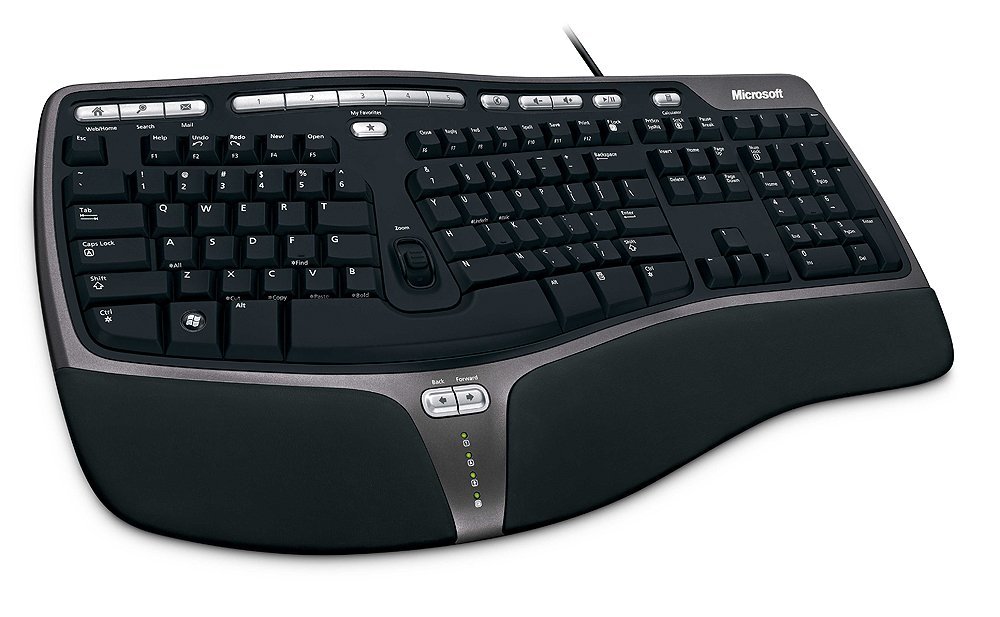
I talked to my supervisor about getting an ergonomic set-up at my office desk. We elevated my laptop, located a better chair, and purchased an ergonomic keyboard.

This beast of a thing:

work keyboard


At home was a little trickier. I didn’t think I had room in my small apartment for a desk, so at first, I purchased some wrist pads for my laptop, but it was pretty clear that they weren’t doing much– plus, they got in the way and slowed me down.

So, I did some rearranging in my head, hopped on Craigslist, and found an amazing old desk that I immediately fell in love with.

Here it is, in my apartment. Isn’t it gorgeous?

new desk


After that, I did a ton of research about keyboards. I knew I didn’t want such a huge keyboard as the one I used at work, but I wanted a good one that was still affordable. I kicked out a little more than I’d have liked for the Kinesis Freestyle, but I love it:

kinesis freestyle


I thought it would take me longer to get used to it, but I just did a ton of my line edits on it, and I’m adjusting quickly. It’s amazing so far.

I also bought:

Goldtouch gel-filled palm supports

goldtouch


an Innovera mouse pad with gel wrist pad

innovera


and this TeckNet wireless mouse.

tecknet


I love the whole set-up. It feels so good.

In addition, my mom reupholstered my desk chair to add a LOT of padding.

Didn’t she do a great job??

mom chair


Also, I’ve taken to icing my wrists after long bouts of writing.

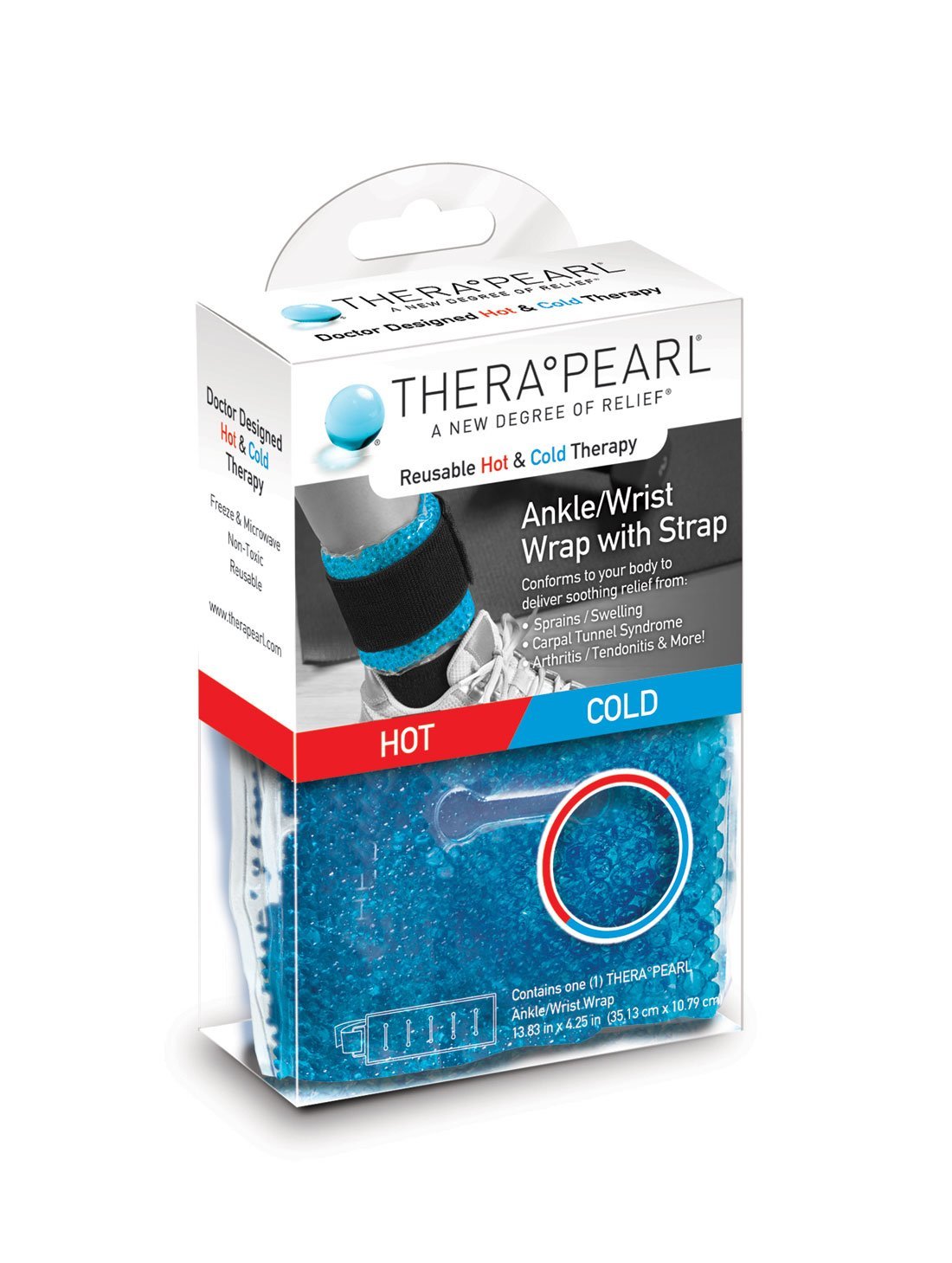
I use these TheraPearl wraps. I just toss them in the freezer, then wrap them around my wrists. They stay cold for about 20 minutes or so, feel good, and keep my hands and fingers free to keep working.

thera pearl


Did this cost me a lot? Yes, but not as much as you might expect. All told, it was about $300, including the desk, which is either an antique or at least looks like one!

I’m a 32-year-old writer. I plan to be writing for many, many years to come. It was time for me to invest myself and my career, and I’m so glad I did!

Recent Reads

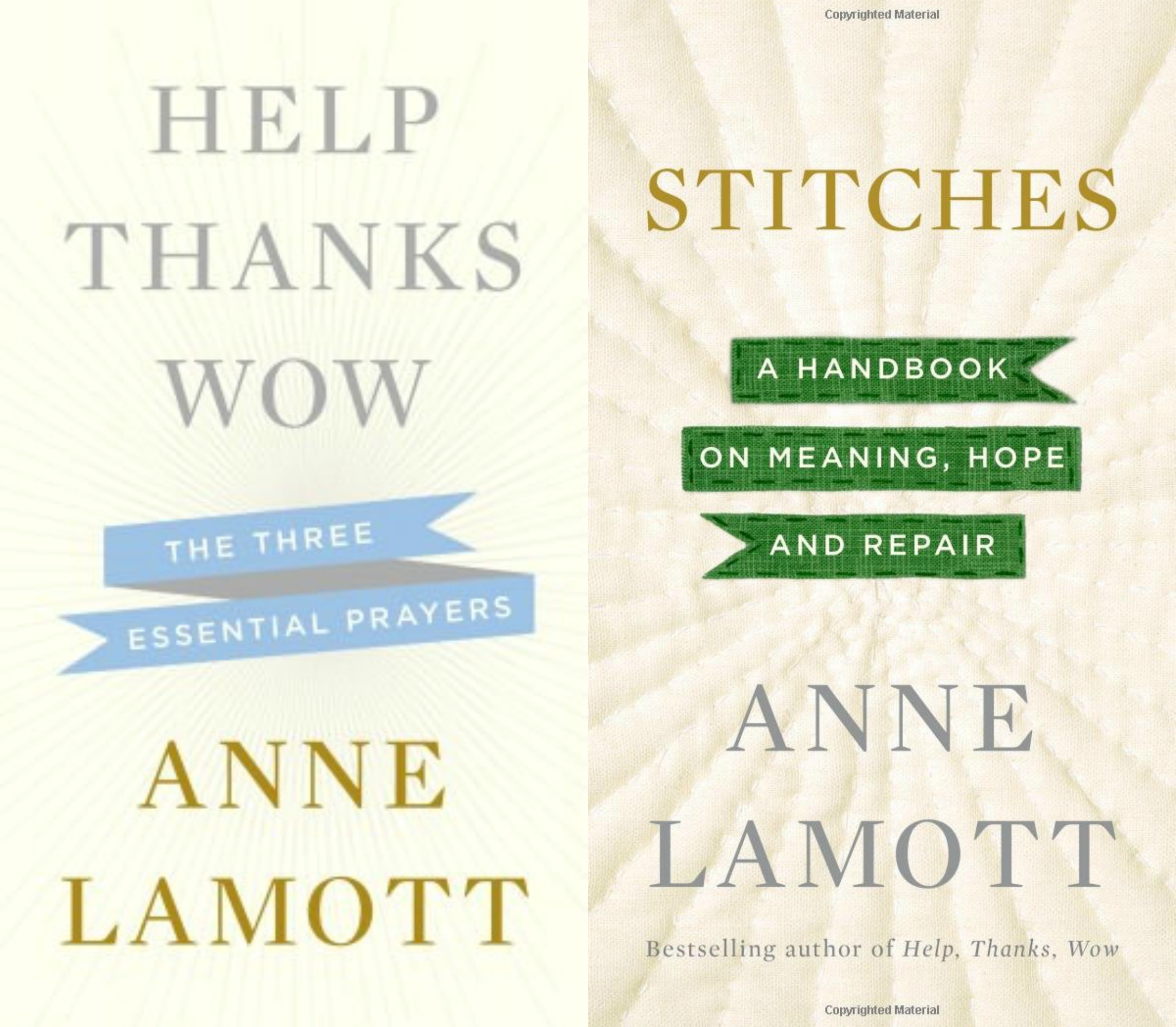
anne lamott 3Help Thanks Wow Stitches by Anne Lamott | It’ll be no surprised that I adored these books. Anne Lamott’s words– whether I’m reading one of her books, listening to her speak, or gulping down her Facebook posts– feel sacred, true, and deep. I absolutely adore her as a writer– and as a person. I would read her grocery lists. Help Thanks Wow is about the three essential prayers of the title. Stitches is about “meaning, hope, and repair.” I listened to both of these books on audio, at night, in the dark, and each one was like applying balm to my broken heart.

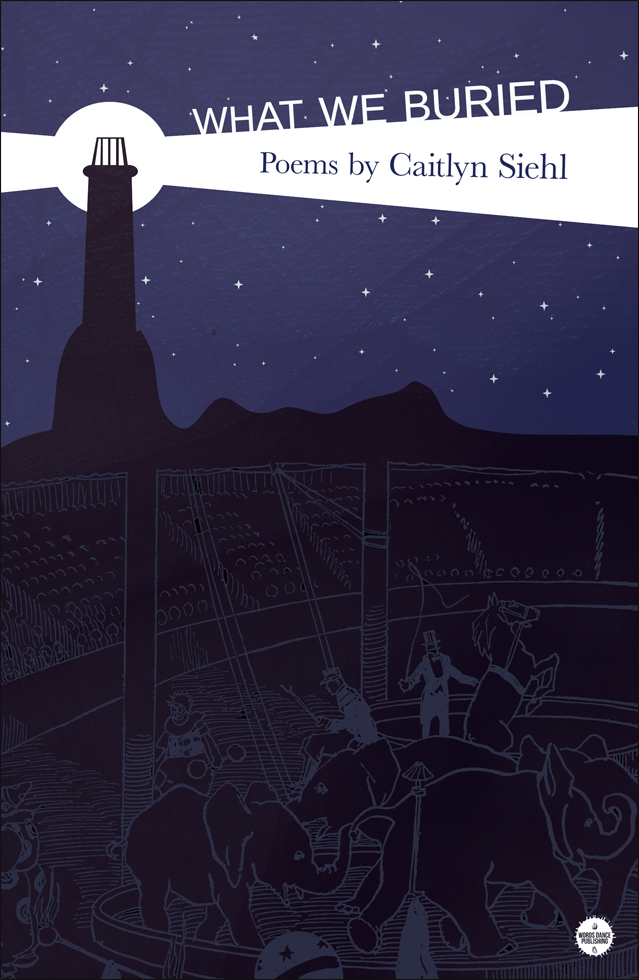
what we buriedWhat We Buried by Caitlyn Siehl | I purchased this book of poetry after bumping into some of Caitlyn’s free verse online. There were some gems in this collection, though I think her youth showed in the book (she is in her twenties). Not one I’ll revisit often, but it was still worth the read!

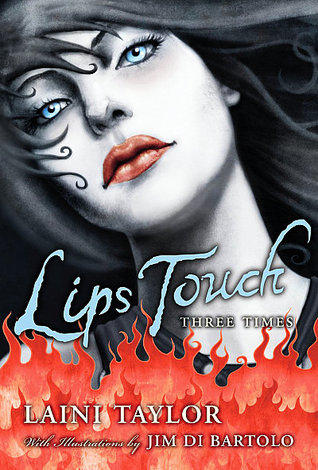
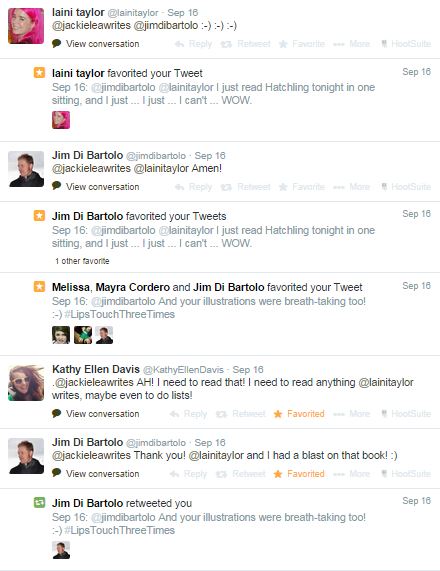
lips touchLips Touch: Three Times Laini Taylor | I would not have ever picked up such a book except that it was written by the indomitable Laini Taylor. It’s a collection of three short stories, and they were a treat.  Short stories are not my forte, and I’m bowled over when a short story can capture me in such a small space. These ones were fantastic, full of the powerful, literary prose you’d expect from Laini Taylor. When I finished the book, I was flummoxed and got into a little tweet-happy mini-convo with Laini and her husband Jim.

lips touch tweets

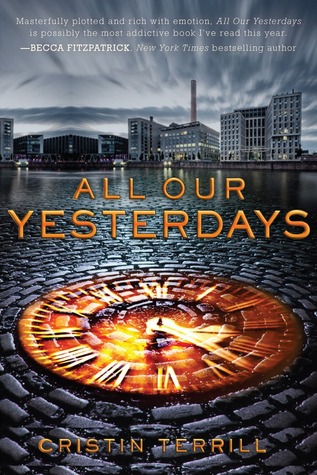
all our yesterdaysAll Our Yesterdays by Cristin Terrill | I love time travel in books. I love when two stories are really one story. This book had both, plus a shocking twist ending. Picture this: in the future, your best friend becomes evil, so you need to go back in time to kill him. Only your childhood self is in the past, working hard to protect him from you. Yup: mind-bending. An engrossing read, though not a new favorite (I’m pretty darn picky).

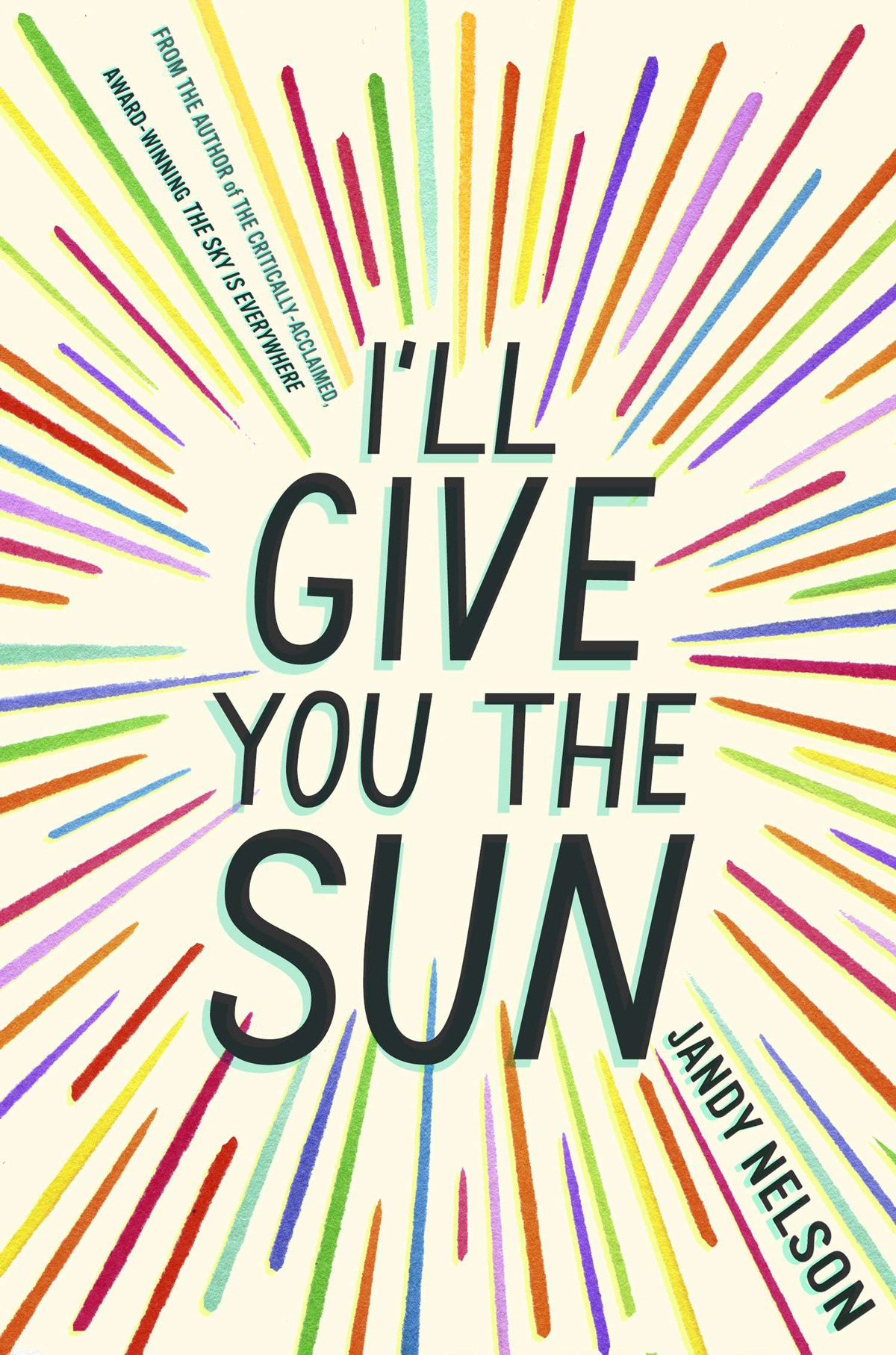
jandyI’ll Give You the Sun by Jandy Nelson | Oh yes. I pre-ordered this book at my first sniff that it existed. I’ve been so, so looking forward to this book, and it did not disappoint. This is the story of twins Noah and Jude, told in dual POV: from 13-year-old Noah before the tragedy and from 16-year-old Jude after it. So clever!  I loved it, loved the characters, loved all the art, loved Jandy Nelson’s mastery of language (she’s studied poetry, and it shows), loved the complicated emotions it evoked from me. It was a sad, heavy book. It occurs to me now that The Sky is Everywhere is sad too … but I felt that it had more light than this one (probably thanks to Joe Fontaine). Regardless, this book is incredible, a must-read.

What have you read recently? What’s up next for you?

Wizards and Princesses and Unicorns, Oh My!: That Time I Met Peter Beagle

The Last Unicorn is one of my all-time favorite books, so when I found that its author Peter S. Beagle would be in Minneapolis for a special screening of the movie, I knew I had to go. My roommate Chelsea agreed to come along.

It’s safe to say we had no idea what we were getting into.

Peter Beagle 4The Riverview in Minneapolis is a 1950s-style theater, and it was packed to the gills with an eclectic bunch that night: bronies, high fantasy enthusiasts, Lady Amalthea cosplayers, and even someone in a unicorn “suit.”
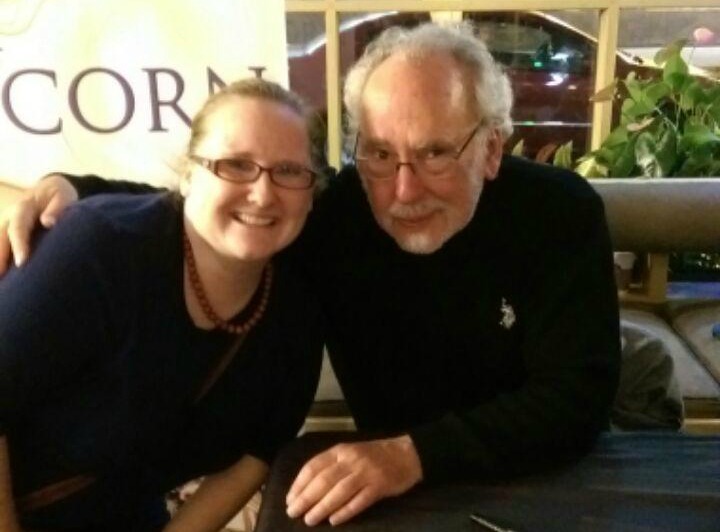
There was Q&A with Peter Beagle (in which he said of one of his favorite lines, “It was either dumb luck or some kind of blessing”– my thoughts here), and the movie was fun (it’s been a while since I’ve seen it). Afterward, Chelsea and I waited in line for nearly two hours in order to meet Peter himself.

I had so many things I wanted to tell him– how much his novel mattered to me, my favorite line from it (“He thought, or said, or sang, I did not know that I was so empty, to be so full.“), what a huge fan I am … but what (lamely) ended tumbling out of my mouth was that I am a writer too and that my first book is being released next year. Peter was so sweet; he signed my book and smiled and said softly, “I remember that feeling.” Then he told me, “Don’t believe your best or your worst reviews.”

Peter Beagle crop

All in all, it was a fun, strange, lovely evening.