
So much amazingness.
Bonus: I wouldn’t mind having written Harry Potter either. 🙂
So much amazingness.
Bonus: I wouldn’t mind having written Harry Potter either. 🙂
Okay, today’s Top Ten Tuesday theme was “Scariest-Looking Book Covers,” and since I generally don’t purchase (or read) those, I thought I’d do my own thing today!
Therefore, I present to you some of my favorite books on writing:
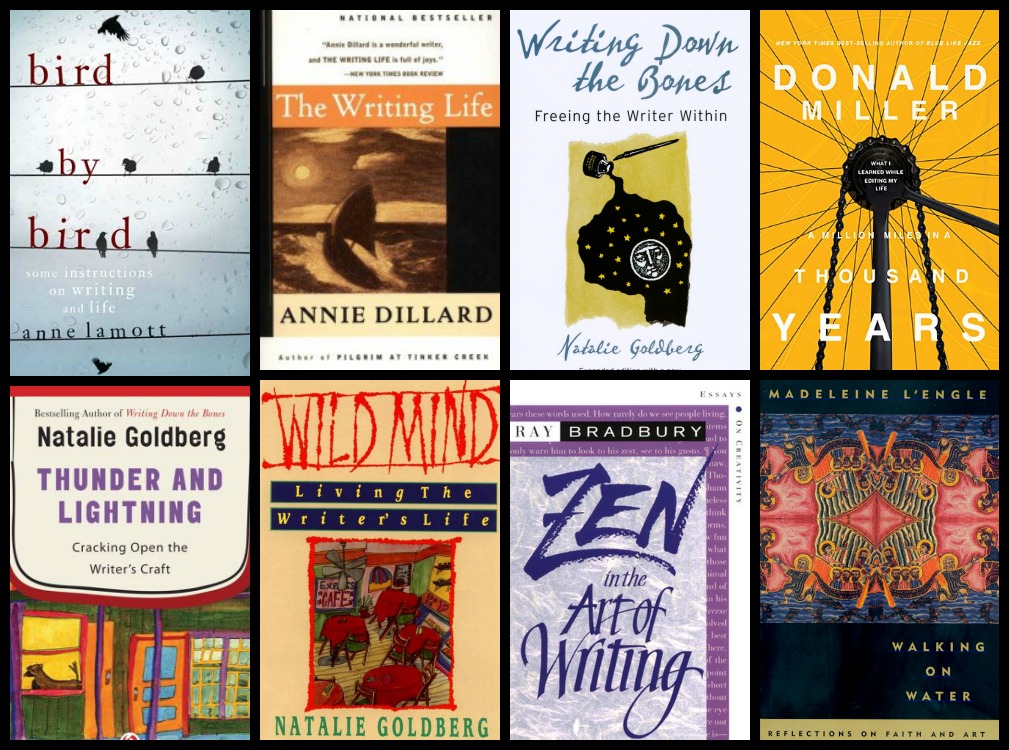
Bird by Bird by Anne Lamott | The ultimate book about the writing life!
The Writing Life by Annie Dillard | So much yes.
Writing Down the Bones by Natalie Goldberg | Even if you don’t agree with her Zen teachings, you have much to learn from her methods: “Ten minutes. Go.” It’s gotten me through many writing slumps!
A Million Miles in a Thousand Years by Donald Miller | How to not just write but live a great story.
Wild Mind & Thunder and Lightning (and really anything writing-related) by Natalie Goldberg | More deliciousness.
Zen in the Art of Writing by Ray Bradbury
Walking on Water by Madeleine L’Engel | Reflections on faith and art
Dear Jackie,
By the time you start writing your next novel, you will have forgotten a few things, and in those moments, I hope you’ll come back to this post and be reminded.
* Writing a novel is hard. The beginning stages kind of suck. You barely know your characters until you’ve written the whole first draft, and so for a couple months, you’re essentially writing blind. You forget that. In those difficult days of editing, you think longingly of the “carefree” days of freewriting, having forgotten that you felt completely lost and simultaneously terrified that you were wasting your time.
* This is just what it is like at the start of a new novel. You feel lost and lonely, and every scene feels stilted and confused. You haven’t yet figured out your character’s deep-seated desires, let alone their surface ones, and you certainly aren’t aware of their secrets and many of their motivations. You will. You just need to spend time with them. That’s how you get to know any new friend.
* It all seems so touch-and-go at the start. You feel sort of committed to your idea, kind of committed to the characters. Everything seems masterful in your head, and then the moment you start to type it out, it feels thin and aimless. That’s because it is thin and aimless– for now— but that is just what it’s like at the start of a new novel. At least for you.
* One thousand words each day will get you one thousand words a day closer to a completed first draft. And when you force yourself to show up and sit down, your characters will show up too, and that’s essentially the only way you’re going to get them to spill their guts to you. So keep showing up.
* First drafts are meant to be terrible.
* You don’t see most writers’ first drafts, just like most people won’t see yours. So calm down.
* Remember that E.L. Doctorow quote? “Writing a novel is like driving a car at night. You can only see as far as your headlights, but you can make the whole trip that way.” Those are someone else’s words explaining your experience, because, really, it’s quite universal. Remember that.
* Sometimes you’ll go down rabbit holes that lead nowhere. Even if there aren’t novels down there, there are still lessons.
* Pumps need to be primed.
* Quit complaining to everyone and go write one thousand more words.
Love,
Jackie Lea, who is fumbling in the darkness of the beginnings of a first draft and wanted to remind future Jackie Lea of what it is like

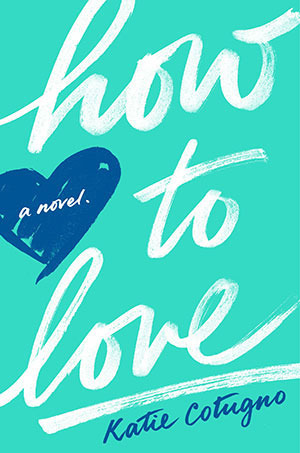 Oh my gosh, loved this. I tore through Katie Cotugno’s debut novel in only a couple days!
This is a young adult contemporary novel, and it’s told in alternating chapters of “before” and “after”– that is, before Reena’s boyfriend/baby daddy vanished for two years and after he came back in her and their daughter’s life. Interestingly, my novel Truest also does this back-and-forth thing, but it felt different than mine. How to Love was equal parts before and after, whereas the bulk of my novel is the before– the after is just tiny glimpses. Anyway, it was fascinating to watch how another novelist made this work for her so well. The hard thing about it though was switching back and forth. Just when I’d really get into either the before or after, we’d switch. Still, it drove the novel forward.
How to Love is really the story of Reena and Sawyer– but also a story about family and about failed friendships and secrets and drugs and ohmygosh really enjoyed this. If you like contemporary, go! Read! Enjoy!
P.S. If you do read this one, let me know. I have a couple things I want to discuss with someone!
I know I just recently blogged about this, but I just wanted to emphasize it again. Not to toot my own horn (ummm, I don’t even have a book deal yet!), but to wave some sort of banner over those who are DOING IT.
Writing a book means this: days that turn into months that turn into years of writing and revising, hours upon hours invested into researching minute details, the sacrifice (and also joy) of building a platform from the ground up, giving up evenings with friends to stay home and research literary agents, headaches, crafting the perfect query or proposal, taking a permanent seat on an emotional rollercoaster.
Kristin Cashore is a YA author I admire. She wrote Graceling, Fire, and Bitterblue. Click here to read about the journey it was to get Bitterblue to where it needed to be (hint: after three years on a first draft, her editor suggested she start over from scratch). There are even pictures. Read this, and you’ll better understand the agony of writing.

 When a writer reads, a lot is happening.
If the book is good, there is one level of enjoyment, a second of envy, and a third of collecting style and ideas for future mimicry. If the book is amazing, sometimes the envy hits like a punch in the gut. If the book is flabbergasting, sometimes the enjoyment wins out and puts the envy on the backburner until the book is over. Sometimes.
If I’m re-reading a book I love, my brain is whirring like a machine: pictures … could I introduce characters with pictures? The author started with a flood of memories … interesting way to get it all on the table. Dual POV … is it working? Structure, repetition, imagery, setting …
Whirr …
Whirr …
Whirr …
I never regret being a writer, since it’s one of my truest joys, although it makes my life exponentially more difficult. The closest I get to that regret though is probably when I’m reading. It’s been a while since I’ve been able to just. simply. read.
It’s easier to read outside of my genre, which makes sense, since the envy lessens. I don’t have aspirations to be an incredible fantasy writer, so it’s easier to give fantasy writers their due accolades and move on. But then again, my favorite genre is contemporary, the genre in which I write, so of course I want to read those books. And they’re often going to be the ones that will propel my writing the most.
What a strange tightrope writers walk! There is almost nothing I love more than a good book– and yet, I’m doomed to have my enjoyment tainted simply because I’ve chosen that writing life for myself (or that life has chosen me).
I read a lot of book blogs, and I marvel at how differently a reader reads from the way a writer reads.
This sounds like a lament, and I suppose it is a little. But then again, I get to be a writer, and for that it’s all worth it.
This article made me happy.
To summarize, contemporary realism on its way up, dystopia on its way out. More standalones please, and fewer trilogies. And no more vampires needed, thankyouverymuch.
Good news for this writer (I hope!).
 What do you think about profanity in literature? Some people can’t stand it, think it reveals sloppy writing, insist that writers can still get their point across without using curse words.
Wendy Lawton, an agent at Books & Such Literary, recently blogged:
But for me the biggest reason to avoid questionable language in a book is that it is usually lazy writing. It’s like telling instead of showing. Rather than just put a cuss word in a character’s mouth, there are so many more powerful ways to get the attitude and language across.
(You can read her entire post here.)
My friend and fellow writer Addie Zierman, whose memoir was released this week, likewise blogged about why her Christian memoir has R-rated words, saying:
And yet maybe there’s that person who needs to hear it. The bad word, the foul word, the one that cuts into the hard reality of her life. Maybe she needs to know that God is big enough to go even there. That his grace makes beauty from what is hard and ugly and foul. That he loves her more than all that.
Grace Biskie, a Christian blogger, used some profanity in one of her posts and then later defended her swearing, saying this:
Jesus is my life. Jesus is my everything. Jesus is my all in all. ALL MY EGGS are in the Jesus basket. I have no other eggs, no other baskets. Everything about me lives and breathes and moves and longs for Jesus. I long to live life in the presence of God, faithful to the work that He’s given me. What I want you to know about why I swear, in light of allegiance to my faith is this: I’m trying to fucking survive. That’s all I can say. That’s all I can tell you. … If you are worried about me, don’t. I have an inner circle. I have a therapist. I have Jesus. And thankfully, antidepressants.
I’d like to hear your thoughts, readers– Christian and otherwise. My young adult novel (on submission right now) has more than a handful of curse words, including a couple of the dreaded F-bombs. When I was writing those scenes, though, it truly felt that no other word would capture the complete devastation of those moments. They are sad, scary, heartbreaking scenes where the characters are broken, and no other word felt powerful enough to reach out and slap the reader’s heart in a way that they could realize the ruins my characters lay in.
I will lose some readers because of this, I imagine. My own mother and sister don’t understand my “need” to use such harsh words in my writing. I know that if my brother reads my story, he will be disappointed with my word choices. But I don’t feel guilty, and I know that part of that is due to the spiritual freedom I’ve experienced since God and ERP broke my shackles four years ago.
Let’s start a discussion in the comments below, friends! All opinions welcome! Play nice.
Picture this.
You’ve been working on your novel for almost two years. The first draft was so long ago that you laugh over your silly non-ending and lack of conflict with friends who have read the completed story. For a year and a half, you’ve been refining, editing, polishing the story to a high gloss. You’ve had the luxury of being picky and choosy over individual words and phrases. You can decide to drop in an extra image here or there as if you’re scattering flower petals. You know your characters so well that their reaction to things comes automatically, without reaching.
And then
you start all over with a new story, new first draft. It’s rough and ugly and the characters are stereotypes. You barely know how to start, and every paragraph you write, you want to go back and fix, make perfect. But that’s not what a first draft is like, and you know it. You can remember that years ago, the novel that you’ve just perfected also came out stilted and wrong, but it’s so far away and you’ve become so accustomed to polishing instead of drafting that it’s
quite
jarring.

 Absolutely no word on the novel yet. I know that publishing is a “hurry up and wait” game, but it is so hard. I desperately want an editor to love my story and give me a chance, and it sometimes feels so close and sometimes so far away.
To occupy my waiting time, I have started to work on a new novel— and not the one I’ve thought for the last two years that I was going to write. I have an idea now that I love and am excited about, but I am not joking: this first draft feels lethal. It’s like I’ve forgotten how to write a novel. I keep wondering, “Maybe those first two stories were all you had in you.” I don’t really believe that, but sometimes it feels that way.
I’ve been traveling for work. Just around Minnesota and South Dakota, and I’m meeting some wonderful students!
Alison Dotson and I are putting on an event for OCD Awareness Week! If you live in the Twin Cities, you should come on out to the Loft/Open Book in Minneapolis. I’ll be reading some fiction I wrote about ERP, and she’ll be reading from her non-fiction book (soon to be released!). Check out the details here.
I just shared about OCD with two separate biblical counseling undergraduate classes at the University of Northwestern. It was a great experience, and the students listened well and asked wonderful questions.
My short story will be published soon through Hunger Mountain! The rights will revert back to me after that, and I’ll share the story with you then– I can’t wait to hear what you guys think of it! (I’d be lying if I said my eyes weren’t glued to my mailbox, waiting for the check to arrive too.)
Blessings, all! Thanks for caring about the details!
 JACKIE LEA SOMMERS